Why Upgrade Gas Station Canopy Lighting?
The fuel island canopy is the most visible lighting feature at any service station. Customers rely on it for safe fueling, clear visibility, and an overall sense of security.
Older metal halide, fluorescent, and first-generation LED canopy fixtures often suffer from:
- Uneven illumination
- Frequent maintenance
- High electrical consumption
- Color inconsistency
- Long warm-up times
- Reduced light output as fixtures age
A modern LED retrofit improves lighting quality while lowering operating expenses and reducing maintenance interruptions.
A canopy retrofit is just one part of a complete fueling station lighting system. Explore our LED Gas Station Lights page to compare canopy fixtures, parking lot lights, area lighting, and complete lighting solutions for fuel stations.
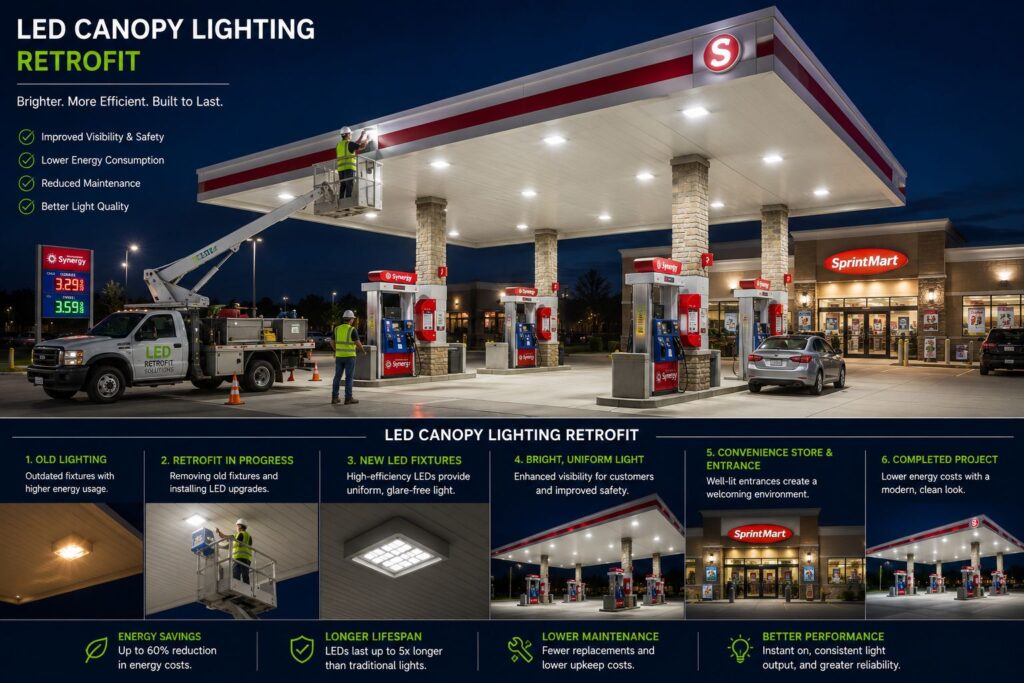
Modern LED canopy lighting improves customer safety, enhances visibility around fuel dispensers, reduces operating costs, and creates a cleaner, brighter fueling environment.
Planning to modernize your fuel station lighting?
Our lighting specialists can recommend the proper LED canopy fixtures, mounting configuration, wattage, optics, and lighting layout to maximize visibility while reducing operating costs.
Request a Gas Station Lighting Consultation – – https://industriallightingfixtures.org/
What Is a Gas Station Canopy LED Retrofit?
A canopy retrofit upgrades existing lighting with modern LED technology while utilizing as much of the existing canopy structure as practical.
Depending on the project, the retrofit may include:
- Complete fixture replacement
- Driver upgrades
- Electrical improvements
- New controls
- Updated mounting hardware
- Improved optics
- Lighting layout optimization
The goal is to improve visibility beneath the canopy while minimizing installation costs and downtime.
Signs Your Fuel Station Is Ready for an Upgrade
Many fueling stations continue operating lighting systems long after their performance has declined.
Typical warning signs include:
- Dark areas beneath the canopy
- Uneven lighting around fuel dispensers
- Frequent ballast failures
- Burned-out lamps
- Rising maintenance costs
- Increasing electrical bills
- Poor security camera images
- Customer complaints
- Difficulty sourcing replacement lamps
If these conditions exist, an LED retrofit often provides immediate operational benefits.
Retrofit Existing Fixtures or Replace Everything?
One of the first decisions involves determining whether the existing canopy fixtures should be retrofitted or replaced.
Retrofit Existing Fixtures
Appropriate when:
- Existing housings remain structurally sound
- Mounting systems are reusable
- Budget limitations exist
- Existing canopy appearance is acceptable
Complete Fixture Replacement
Recommended when:
- Fixtures are outdated
- Corrosion exists
- Better optics are desired
- Higher efficiency is needed
- Smart controls will be added
- Field-selectable technology is preferred
Modern LED canopy fixtures generally provide better light distribution, higher efficacy, and lower long-term maintenance than retrofit kits.
Planning additional building upgrades? Our Commercial LED Lighting Retrofit Guide explains how modern LED technology improves energy efficiency, maintenance, and long-term operating costs across all commercial facilities.
Selecting the Right Canopy Fixture Mounting Option
One of the most important decisions during a canopy retrofit is selecting the proper mounting style.
Most commercial LED canopy fixtures are available in three mounting configurations.
Recessed Mount
Recessed fixtures install flush within the canopy ceiling, providing a clean architectural appearance while protecting the fixture from accidental impact.
Advantages
- Flush architectural appearance
- Excellent glare control
- Protected fixture housing
- Modern aesthetic
- Preferred by major fuel brands
Typical Applications
- New construction
- Complete canopy renovations
- Premium convenience stores
- Corporate fueling stations
Surface Mount
Surface-mounted fixtures attach directly to the underside of the canopy and represent one of the most popular retrofit options.
Advantages
- Fast installation
- Lower labor costs
- Minimal canopy modifications
- Easy maintenance
- Excellent retrofit solution
Typical Applications
- Existing gas stations
- Convenience stores
- Fleet fueling
- Budget-conscious upgrades
Pendant Mount
Pendant-mounted fixtures suspend below the canopy using rigid stems or conduit.
They are commonly used where taller canopies or exposed conduit make recessed installation impractical.
Advantages
- Flexible installation
- Better performance under tall canopies
- Accommodates existing conduit
- Excellent for specialty applications
Typical Applications
- Truck fueling islands
- Fleet fueling facilities
- Bus terminals
- High-clearance fueling canopies
Mounting Comparison
| Mounting Style | Best Applications | Primary Advantages |
|---|---|---|
| Recessed | Premium stations | Flush appearance, reduced glare |
| Surface | Retrofit projects | Lowest installation cost |
| Pendant | Tall canopies | Flexible installation, improved light distribution |
Surface-mounted LED canopy fixtures remain the most economical solution for many retrofit projects, while recessed fixtures offer the cleanest architectural appearance and pendant-mounted fixtures provide flexibility for taller fueling canopies.
Want to learn more about commercial canopy fixtures used beyond gas stations? Visit our LED Canopy Lighting page for information on parking garages, loading docks, commercial entrances, and covered walkways.
Uniform Lighting Improves Customer Safety
Gas station lighting should produce consistent illumination throughout the fueling area.
Dark spots between dispensers make fueling less comfortable and reduce visibility for both customers and surveillance cameras.
Professional canopy lighting emphasizes:
- Uniform light levels
- Reduced glare
- Minimal shadows
- Consistent color temperature
- Improved facial recognition
- Better vehicle visibility
Rather than producing isolated bright spots, modern LED canopy fixtures distribute light evenly across the fueling area.
The canopy is only one component of a successful fueling station lighting design. Our Parking Lot Security Lighting Guide explains how parking lot illumination complements canopy lighting to improve customer safety and surveillance.
Why High CRI Matters at Fuel Stations
Color Rendering Index (CRI) measures how accurately lighting reveals colors.
Higher CRI lighting improves:
- Customer visibility
- Fuel pump displays
- Credit card readers
- Safety markings
- Security camera footage
- Product appearance inside the convenience store
Most commercial LED canopy fixtures utilize 80+ CRI, providing excellent visibility while maintaining high energy efficiency.
Field-Selectable Wattage and Color Temperature
Modern gas station canopy fixtures frequently include field-selectable technology.
Installers can adjust:
- Wattage
- Lumen output
- Color temperature
using internal selector switches.
Common color temperatures include:
- 3000K
- 4000K
- 5000K
This flexibility allows one fixture model to accommodate multiple canopy designs while simplifying future lighting adjustments.
Earlier LED Canopies vs Today's Technology
| Earlier LED Fixtures | Modern Commercial Canopy Fixtures |
|---|---|
| 90–120 lumens per watt | Up to nearly 200 lumens per watt |
| Fixed wattage | Field-selectable wattage |
| Fixed CCT | Field-selectable color temperature |
| Basic optics | Precision optical systems |
| Standard drivers | High-efficiency drivers |
| Limited controls | Smart lighting compatibility |
Many stations that upgraded to LED ten years ago can still achieve significant energy and maintenance savings by replacing first-generation LED fixtures with today’s higher-performance luminaires.
Choosing the Proper Canopy Optics
Unlike parking lot fixtures, gas station canopy fixtures are engineered to illuminate a relatively confined area beneath the canopy while maintaining excellent lighting uniformity.
For this reason, canopy fixtures typically utilize wide symmetric optical distributions that spread light evenly in every direction beneath the canopy.
Parking lot fixtures, by comparison, commonly use Type III, Type IV, or Type V distributions designed to project light across large open areas.
Using parking lot optics beneath a canopy often creates:
- Bright areas directly below fixtures
- Dark spaces between fuel dispensers
- Increased glare
- Uneven lighting
- Reduced customer comfort
Selecting optics specifically designed for canopy applications produces more consistent illumination throughout the fueling area.
Uniform Lighting Improves Safety and Customer Confidence
Customers expect fuel stations to feel safe and inviting.
Large differences between bright and dark areas make fueling less comfortable while reducing visibility around dispensers.
Professional canopy lighting focuses on:
- Consistent illumination
- Reduced shadows
- Better facial recognition
- Improved visibility around pump islands
- Clear payment terminals
- Safer pedestrian movement
Uniform lighting also helps reduce eye fatigue as customers move between the parking area and the fueling canopy.
Recommended Foot-Candle Levels
While lighting requirements vary by local jurisdiction, gas station canopies generally require higher illumination than surrounding parking lots because customers perform detailed visual tasks while fueling.
| Area | Typical Illuminance |
|---|---|
| Fuel Dispenser Islands | 20–30 foot-candles |
| Payment Terminals | 20–30 foot-candles |
| Walkways Under Canopy | 15–20 foot-candles |
| Convenience Store Entrance | 15–25 foot-candles |
| Parking Areas | 2–5 foot-candles |
A professional photometric lighting plan helps verify illumination levels while maintaining excellent lighting uniformity.
Lighting for Security Cameras
Security cameras operate continuously at most fuel stations.
Lighting should be designed to improve video quality—not interfere with it.
Recommended practices include:
- Uniform illumination beneath the canopy
- Eliminate deep shadows between pump islands
- Avoid aiming fixtures directly into camera lenses
- Reduce glare
- Provide consistent lighting across fueling lanes
- Illuminate customer faces rather than creating silhouettes
Proper lighting improves:
- License plate recognition
- Facial recognition
- Customer safety
- Incident investigations
Smart Controls for Fueling Stations
Unlike office buildings, fuel station canopies generally remain illuminated whenever the station is open.
However, lighting controls remain valuable in surrounding areas.
Typical control applications include:
- Parking lot dimming
- Building perimeter lighting
- Landscape lighting
- Sign lighting
- Employee parking
- Service areas
Photocells and astronomical time clocks also ensure lighting automatically responds to changing daylight conditions.
Lower Maintenance Means Fewer Service Calls
One of the largest financial benefits of LED canopy lighting is reduced maintenance.
Replacing lamps beneath active fuel canopies often requires:
- Lift equipment
- Traffic control
- Temporary pump closures
- Maintenance personnel
- Safety precautions
Modern LED fixtures significantly reduce these maintenance interruptions through:
- Long-life LED arrays
- High-quality drivers
- Improved thermal management
- Durable aluminum housings
- Weather-resistant construction
Many stations experience years of reliable operation with minimal maintenance.
Total Cost of Ownership
The initial purchase price represents only one portion of the overall investment.
A modern LED canopy retrofit also reduces:
- Electricity consumption
- Lamp replacement
- Ballast replacement
- Lift rentals
- Maintenance labor
- Customer disruption
- Emergency repairs
When evaluated over the life of the system, commercial LED canopy lighting frequently delivers one of the highest returns on investment within a fueling facility.
Common Gas Station Retrofit Mistakes
Avoid these common errors:
- Replacing fixtures based only on wattage
- Ignoring lighting uniformity
- Selecting parking lot fixtures instead of canopy fixtures
- Mixing color temperatures
- Installing inconsistent fixture types
- Ignoring canopy mounting options
- Choosing fixtures without field-selectable wattage
- Failing to perform a photometric layout
- Ignoring surveillance camera placement
- Under-lighting payment terminals
Professional planning helps eliminate these problems before installation begins.
Commercial Buyer Checklist
Before requesting a quotation, gather:
✓ Canopy dimensions
✓ Mounting style (surface, recessed, or pendant)
✓ Existing fixture quantity
✓ Existing fixture wattage
✓ Mounting height
✓ Operating hours
✓ Existing voltage
✓ Fuel island layout
✓ Convenience store entrance location
✓ Security camera locations
✓ Site photographs or drawings
This information allows lighting specialists to recommend the proper fixture output, optics, mounting style, and lighting layout.
Inline Buyer Q&A
Which canopy mounting style is best for retrofit projects?
Surface-mounted fixtures are often the fastest and most economical retrofit solution, while recessed fixtures provide the cleanest architectural appearance. Pendant-mounted fixtures are commonly used beneath taller canopies and truck fueling lanes.
Can older LED canopy fixtures still be upgraded?
Yes. First-generation LED canopy fixtures typically operate at much lower efficacy than today’s premium luminaires. Upgrading can reduce energy consumption while improving lighting quality and maintenance.
Why is lighting uniformity important?
Uniform illumination improves customer comfort, enhances surveillance camera performance, and reduces shadows around fuel dispensers and payment terminals.
Should canopy fixtures use the same optics as parking lot fixtures?
No. Canopy fixtures generally use wide symmetric optics specifically designed to distribute light evenly beneath the canopy, whereas parking lot fixtures typically use directional Type III, IV, or V distributions.
Are field-selectable fixtures beneficial?
Yes. Adjustable wattage and color temperature simplify inventory management while allowing installers to optimize illumination during commissioning.
Modernize Your Fuel Station with a Professional LED Canopy Retrofit
A professionally designed LED canopy retrofit enhances every aspect of a fueling station—from customer safety and payment visibility to surveillance camera performance, maintenance reduction, and energy efficiency. Selecting the proper mounting style, optics, field-selectable wattage, and lighting layout ensures uniform illumination that creates a welcoming environment while lowering long-term operating costs.
Whether you’re upgrading a single convenience store or managing a multi-site fueling network, our lighting specialists can help you choose the ideal LED canopy solution for your application.
Ready to Upgrade Your Gas Station Lighting?
Explore our complete selection of LED Gas Station Lights or browse our full range of Commercial Lighting Fixtures to start planning your next retrofit project.
Frequently Asked Questions
What color temperature is recommended for gas station canopy lighting?
Most fueling stations use 5000K LED fixtures to maximize visibility, color accuracy, and customer comfort. Some branded convenience stores may specify 4000K to create a slightly warmer appearance while maintaining excellent visibility.
Can existing canopy wiring usually be reused?
In many retrofit projects, existing electrical infrastructure can remain in place if it meets current electrical requirements and is in good condition.
How long do commercial LED canopy fixtures last?
Commercial-grade LED canopy fixtures are engineered for many years of continuous operation, dramatically reducing maintenance compared to metal halide and fluorescent systems.
Should every retrofit include a photometric lighting plan?
Yes. A photometric analysis verifies illumination levels, fixture spacing, lighting uniformity, and customer safety before installation begins.
Are LED canopy fixtures weather resistant?
Yes. Commercial canopy fixtures are designed for demanding outdoor environments and are typically rated for wet-location operation with durable, corrosion-resistant housings.