
Emergency LED exit signs are critical safety luminaires designed to provide high-visibility egress marking during power loss, emergencies, and fire alarm activations. Commercial-grade LED exit signs deliver energy efficiency, extended service life, and code compliance for office buildings, schools, hospitals, warehouses, and industrial facilities. Available with self-powered battery backup, dual-face or single-face configurations, and various mounting options, these signs help guide occupants safely to exits under all conditions.
Emergency LED Exit Sign Fixtures
In larger commercial and industrial facilities, emergency LED exit signage is often coordinated with emergency lighting systems and pathway illumination to ensure consistent egress visibility throughout the facility during power outages or alarm conditions.
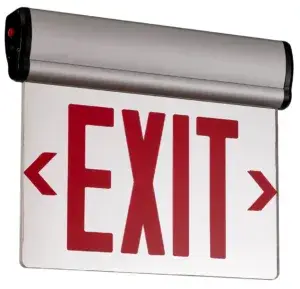
Edge Lite Emergency Exit Sign
Brand: Ledsion
The Ledsion Edge-Lit Red Exit Sign Light blends style and functionality, offering unmatched versatility. Its sleek design and reliable performance make it ideal for diverse settings, providing clear guidance during emergencies; UL; Prices start at $98.

H3
Brand: Beyond
Running Person Symbol
International standard; 3.5W; Green; 120-347V; 3.6V 2000mAh Ni-Cd Battery; Single and Double Face; UL; Prices start at $150.

ES037
Brand: Ledsion
EZ-snap mounting thermoplastic in white finish; Red or Green LED;
EZ snap-out chevron arrows;
Single and double-sided
90-min emergency illumination;
Prices start at $150.
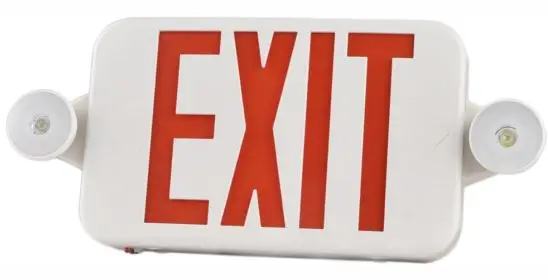
ESC02 Series
Brand: Ledsion
Combo Exit Sign; ultra-bright white LED; lamp heads, 180 lumens
Single or double-face
Prices start at $250.
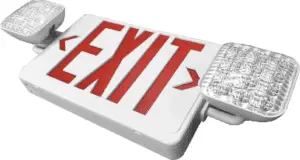
ESC03 Series
Brand: ATG
Combo Exit Sign; 5VA flame retardant;
SALIDA faceplate available; UL listed for damp locations;
Test switch and charge indicator;
Prices start at $250.
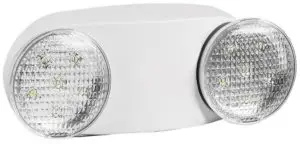
EML01 Series
Brand: Ledsion
Dual Head Emergency Light
adjustable ultra-bright white
LED lamp heads; 2 X 1.2W lamp
205 lumens; Prices start at $100.
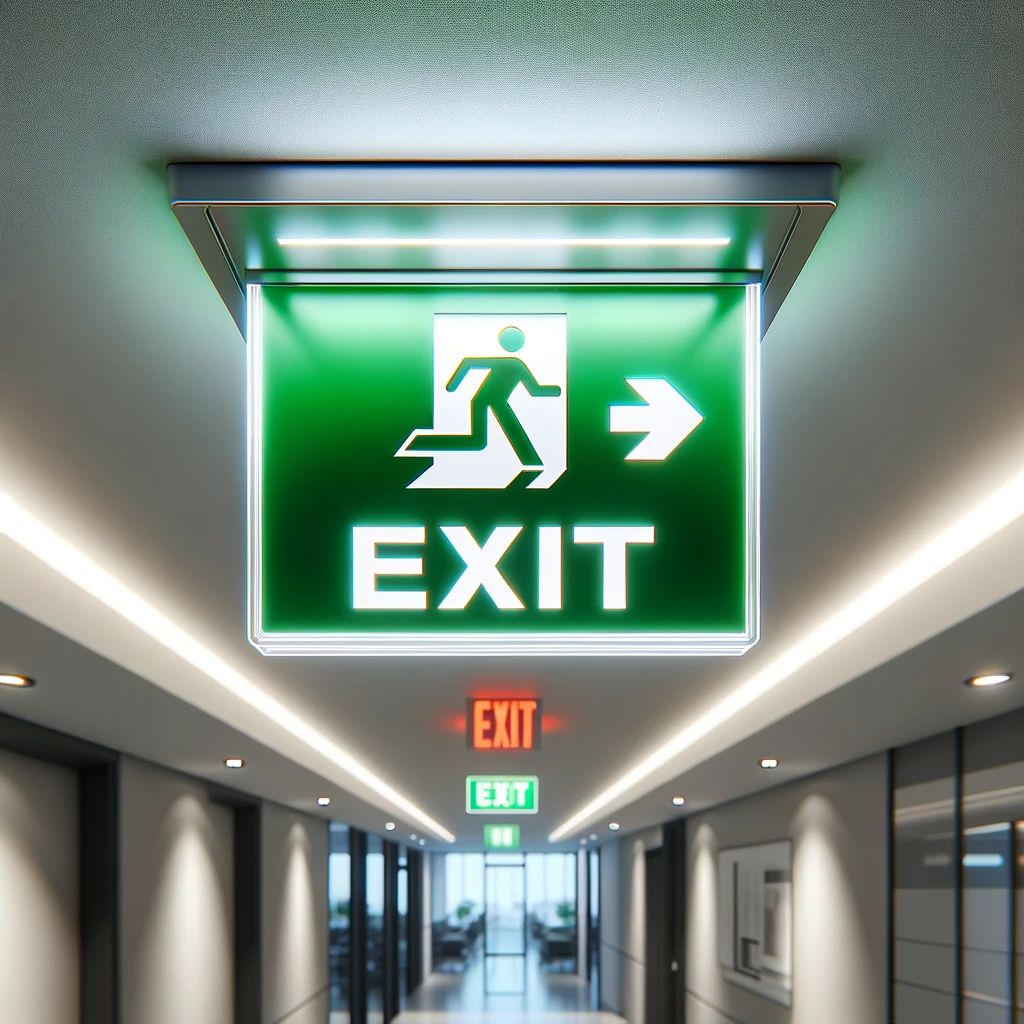
What Are Emergency LED Exit Signs?
Emergency LED exit signs are dedicated luminaires designed to provide clearly visible egress indicators during power failures, fire alarm conditions, or emergency evacuations. Built with efficient LED technology, these signs offer long life, low maintenance, and high visibility under a variety of lighting conditions. Unlike non-emergency signage, certified emergency exit signs incorporate battery backup systems, fail-safe circuitry, and photometric performance that meets life safety codes such as NFPA 101 (Life Safety Code) and IBC (International Building Code).
When Should Emergency LED Exit Signs Be Used?
Emergency LED exit signs are required in virtually all commercial and industrial occupancies where safety codes mandate clearly marked egress paths. Typical environments include:
• Warehouses and distribution centers
• Office buildings and lobbies
• Retail facilities
• Hotels and hospitality spaces
• Educational institutions
• Healthcare facilities
• Manufacturing and light industrial spaces
• Parking garages and multi-level facilities
These signs are indispensable where occupant safety and code compliance during an emergency are non-negotiable. They remain illuminated for a specified minimum runtime (commonly 90 minutes) during power loss to support safe evacuations.
Core Specifications & Performance Considerations
Key specifications for emergency LED exit signs include:
✔ Battery backup runtime: minimum 90 minutes (code standard)
✔ Certification: UL 924 / NFPA compliance
✔ Visibility range: readable at designated distances based on mounting height
✔ Color options: Red or green legends (depending on local code)
✔ Mounting flexibility: wall, ceiling, or end-mount configurations
✔ Self-diagnostics: optional circuitry for automatic testing and reporting
LED exit signs are engineered to maintain consistent luminance over time, consume minimal energy during normal operation, and provide reliable emergency illumination when needed most.
Industrial & Commercial Applications
Emergency LED exit signs are utilized wherever building occupancy and egress routes must be clearly marked for safety and compliance. Typical use cases include:
• Egress corridors and stairwells
• Assembly areas
• Warehousing and racking zones
• Breakrooms and personnel spaces
• Exterior exit discharge paths
• Loading docks and truck bays (code permitting)
Their high visibility and code-approved performance make them essential building infrastructure components in both new construction and retrofit projects.
Looking for a better understanding of emergency egress systems? Read our Emergency Exit Signs Guide to learn how LED exit signs improve occupant safety, simplify maintenance, and support emergency evacuations.
Planning & Selection Considerations
When specifying emergency LED exit signs, consider:
✔ Code compliance: review local and national egress and fire safety codes
✔ Mounting location and visibility: ensure unobstructed sight lines
✔ Battery backup & runtime: meet or exceed minimum safety standards
✔ Test & diagnostics: integrated self-testing reduces maintenance burden
✔ Power feed: coordinate with building electrical plans
Exit signage must be engineered to remain operational during emergencies and routine power interruptions. Proper placement and performance ensure occupant confidence and code adherence.
For vertical surface mounting applications, consider our wall pack light fixtures engineered for perimeter visibility.
Comparison Table — Emergency Exit vs Standard Exit vs Combo Signage
| Attribute / Use | Emergency LED Exit Signs | Standard Non-Emergency Exit Signs | Combo Exit/Light Units |
|---|---|---|---|
| Backup Power | Yes (battery backup) | No | Yes |
| Code Requirement | Life safety mandated | Not compliant | Life safety mandated |
| Runtime | 90 min+ | N/A | 90 min+ |
| Certification | UL 924 / NFPA | None | UL 924 / NFPA |
| Application | Egress routes & stairwells | Decorative egress indication | Egress + area illumination |
| Visibility | High-contrast LED | Moderate | High-contrast LED |
Technical Standards & Compliance Resources
Emergency LED exit signs are governed by life safety and building codes including:
✔ UL 924 Standard for Emergency Lighting and Power Equipment
✔ NFPA 101 Life Safety Code
✔ IBC – International Building Code egress provisions
✔ Local building and fire codes
These standards define minimum visibility distances, battery backup requirements, testing frequencies, and installation practices. Consulting code summaries and authorities having jurisdiction ensures that signage meets safety and compliance expectations without guesswork.
In addition to emergency LED exit signs, many facilities integrate LED wall pack lighting and exterior commercial lighting solutions to ensure visibility around building perimeters and egress routes. Covered areas may also utilize LED canopy lighting, while parking decks rely on LED parking garage fixtures for ceiling-mounted illumination.
Inline Buyer Q&A
How do I choose the correct LED exit sign for a commercial building?
Start with the applicable egress requirements and the location where the sign will be installed.
Important considerations can include:
- Required sign format and legend
- Single-face or double-face configuration
- Directional indicators
- Mounting location
- Viewing direction
- Normal and emergency power requirements
- Battery backup or other emergency-power method
- Voltage
- Indoor or outdoor environment
- Applicable listing and code requirements
- Emergency-lighting combination requirements
The correct configuration depends on the building, occupancy, egress layout, jurisdiction, and project documents.
Does every exit sign need its own battery backup?
Not necessarily.
Required exit-sign illumination during loss of normal power can be provided through different emergency-power arrangements depending on the building and applicable requirements.
Some exit signs use integral rechargeable batteries, while other installations can be supplied from an approved emergency electrical system.
The required emergency-power method should be determined from the project and applicable codes.
Should I use a single-face or double-face exit sign?
It depends on the directions from which occupants must see the sign.
Single-face signs are typically used where the legend needs to be viewed primarily from one direction.
Double-face signs can be appropriate where the exit indication must be visible from opposite directions, such as certain corridors, intersections, or open areas.
The egress layout should determine the configuration.
When should I use an exit sign with emergency lights?
Combination exit-sign/emergency-light units can be useful where both exit identification and emergency illumination are required at or near the same location.
Whether a combination unit is appropriate depends on the egress design, required emergency illumination, mounting location, coverage, and applicable requirements.
The emergency-light heads still need to provide appropriate illumination for their intended area.
What should I verify when replacing an existing exit sign?
Do not select a replacement solely because it physically fits the existing location.
Verify:
- Sign configuration
- Legend and directional indicators
- Viewing requirements
- Mounting
- Voltage
- Normal and emergency power
- Battery requirements where applicable
- Environmental rating
- Applicable listing
- Existing electrical connections
- Project and jurisdictional requirements
For existing facilities, the egress arrangement should also be considered if building use or interior layout has changed.
What information should I provide when requesting commercial exit signs?
Useful information includes:
- Building or facility type
- New construction or replacement
- Required quantity
- Single- or double-face configuration
- Directional indicators
- Mounting method
- Voltage
- Battery-backup requirements
- Combination emergency-light requirements
- Indoor or outdoor installation
- Photographs of existing equipment
- Applicable project specifications
Specify Exit Signs Around the Egress System
Emergency exit signs are part of a building’s life-safety and egress system, so fixture selection should begin with the applicable project and jurisdictional requirements.
Sign configuration, visibility, mounting, directional indication, electrical supply, emergency power, battery backup, environmental conditions, listings, and coordination with the building’s egress design should all be evaluated.
Our lighting specialists can help identify commercial LED exit-sign configurations for new construction, renovations, and replacement projects based on the requirements you provide.
Call 1-844-533-7767 to discuss your commercial emergency exit-sign requirements.
Frequently Asked Questions About LED Emergency Exit Signs
What is the purpose of an emergency LED exit sign?
An illuminated exit sign identifies designated exits or directions of egress so occupants can recognize the path toward an exit.
Where emergency operation is required, the sign must remain appropriately illuminated when normal power is interrupted according to the applicable requirements.
Exit signs support egress, but they should not be described as independently ensuring occupant safety.
What codes apply to commercial exit signs?
Multiple codes and regulations can affect exit signs, and they address different aspects of the installation.
Depending on the project and jurisdiction, applicable requirements can involve building and fire codes, life-safety requirements, electrical codes, accessibility requirements, workplace regulations, and locally adopted provisions.
The authority having jurisdiction and project documents should be used to determine the requirements for a particular installation.
Does the NEC determine where exit signs are required?
Not by itself.
The National Electrical Code primarily addresses electrical installation and power requirements.
Building, fire, life-safety, occupancy, and other applicable requirements can determine where exit signs are required and how the egress system is arranged.
These requirements work together rather than one code addressing every aspect of exit signage.
Does OSHA require exit signs?
OSHA requirements address exit routes and exit marking in applicable workplaces.
However, OSHA requirements should not be treated as the only rules governing a commercial exit-sign installation.
Building, fire, electrical, life-safety, and local requirements can also apply.
Are LED exit signs energy efficient?
LED exit signs can use substantially less power than many older incandescent or fluorescent exit signs.
Actual energy consumption and savings depend on the existing equipment and replacement product.
Because exit signs can operate for long periods, low-wattage LED technology can reduce energy use and relamping requirements.
How long do LED exit signs last?
There is no universal lifespan for an LED exit sign.
LEDs can provide long rated operating life, but the complete unit also contains drivers, power supplies, batteries, charging components, and other electronics that can affect maintenance and service life.
Manufacturer-specific ratings and warranty information should be used when comparing products.
What is battery backup in an LED exit sign?
An integral battery-backup system stores energy so the sign can continue operating when normal electrical power is interrupted.
The battery, charger, transfer circuitry, and sign must provide the emergency operation required for the applicable installation.
Battery condition should be included in inspection and maintenance procedures.
How long must an emergency exit sign operate during a power failure?
Required emergency operating duration depends on the applicable codes and jurisdiction.
A commonly encountered requirement in U.S. life-safety applications is at least 90 minutes of emergency operation, but the project’s actual requirements should be verified rather than assuming one duration applies universally.
Do all exit signs contain batteries?
No.
Some exit signs use integral battery backup, while others can be connected to an approved emergency-power system.
The appropriate configuration depends on how emergency power is provided for the building and the applicable requirements.
What is a self-testing exit sign?
A self-testing or self-diagnostic exit sign can automatically perform certain checks of components such as the battery and emergency operation, depending on the product.
Available functions vary by manufacturer.
Self-testing features can assist maintenance but do not eliminate required inspection, testing, or maintenance procedures.
Do exit-sign batteries need to be tested?
Battery-backed emergency equipment requires appropriate inspection and testing to confirm that emergency operation remains available.
The frequency and procedure should follow the applicable requirements and manufacturer’s instructions.
A battery can deteriorate even when the LED sign itself continues operating normally from utility power.
What is the difference between an exit sign and emergency lighting?
An exit sign identifies an exit or direction of egress.
Emergency lighting provides illumination when normal lighting is interrupted so applicable areas of the egress path remain illuminated.
The two functions are related but different.
Some products combine an illuminated exit sign with emergency-light heads.
What is an exit sign/emergency-light combination unit?
A combination unit incorporates an illuminated exit sign and one or more emergency-light heads into the same assembly.
It can be useful where both functions are needed at the same location.
The emergency-lighting portion still must provide appropriate coverage for its intended application.
Should exit signs be single-face or double-face?
Use the configuration required by the viewing directions at the installation location.
A single-face sign can be appropriate when viewed from one primary direction.
A double-face sign can be useful where the exit indication must be visible from opposing directions.
What do directional arrows on exit signs mean?
Directional indicators help identify the direction occupants should travel when the exit itself is not directly apparent.
The required arrow or chevron configuration should correspond with the actual egress path and applicable sign requirements.
Can exit signs be ceiling mounted?
Many exit-sign models offer ceiling mounting.
Wall, ceiling, end, or other mounting configurations may be available depending on the product.
The selected mounting method must provide the required visibility and be compatible with the structure and sign.
Can exit signs be wall mounted?
Yes.
Wall mounting is common where the sign can be appropriately positioned and viewed along the egress path.
Mounting height and location should follow the applicable project and jurisdictional requirements.
Can LED exit signs be used outdoors?
Some models are designed for outdoor, damp, wet, cold, or other demanding environments.
Environmental suitability is product-specific.
Do not assume that a standard indoor exit sign can be installed outdoors simply because its light source is LED.
Can exit signs be used in warehouses and industrial facilities?
Yes, when the sign and installation meet the requirements applicable to the facility.
Industrial environments can introduce additional considerations such as high mounting locations, dust, moisture, temperature extremes, hazardous classified areas, or physical exposure.
A standard commercial exit sign should not automatically be assumed suitable for those conditions.
Can standard exit signs be installed in hazardous classified locations?
Not unless the equipment and installation are appropriate for the classified environment.
Hazardous-location requirements are separate from the normal life-safety function of the exit sign.
Where exit signage is required within a classified area, properly rated equipment and installation methods must be evaluated.
Can exit signs be connected to a fire alarm system?
Some building systems can incorporate monitoring, controls, or interfaces involving emergency equipment, but this is not a universal feature or requirement of LED exit signs.
Do not assume a standard exit sign should be directly interconnected with a fire alarm panel.
Any system integration should follow the approved building design, equipment instructions, and applicable requirements.
Can existing incandescent or fluorescent exit signs be replaced with LED units?
Often.
Verify mounting, dimensions, voltage, emergency-power arrangement, face configuration, directional indicators, environmental requirements, and applicable listings before selecting the replacement.
The replacement should satisfy the requirements of the existing egress application rather than merely fit the old electrical box.
Do LED exit signs require maintenance?
Yes.
LED technology can reduce lamp-replacement requirements, but exit signs still require appropriate inspection and maintenance.
Batteries, charging circuits, electronics, lenses, mounting, electrical connections, and emergency operation can require attention during the life of the equipment.
Does installing a listed LED exit sign automatically make the egress system code compliant?
No.
Product listing is one part of a compliant installation.
The sign must also be correctly selected, located, mounted, powered, configured, and maintained according to the applicable building, fire, electrical, life-safety, and jurisdictional requirements.
Stay Connected with Our Lighting Resources
Add IndustrialLightingFixtures.org as a Preferred Source on Google to see more of our lighting guides and technical resources across Google Search experiences.
Related Emergency and Commercial Lighting Resources
- Guiding People to Safety During an Emergency with Exit Signs — Learn how illuminated exit signage supports commercial egress planning, emergency operation, visibility, and fixture selection.
- Commercial Lighting Guide — Review broader commercial lighting considerations including fixture selection, controls, electrical conditions, maintenance, and project planning.
- Indoor Lighting — Explore commercial interior lighting categories for offices, retail spaces, common areas, institutional facilities, and other indoor environments.
- Industrial Lighting Guide — Review lighting considerations for warehouses, manufacturing facilities, processing areas, and other demanding industrial environments.
- Commercial Lighting Fixtures — Explore the broader commercial LED lighting category for interior, exterior, parking, architectural, and specialized applications.