LED high mast lighting systems are engineered to deliver powerful, uniform illumination across expansive outdoor environments where conventional pole lighting is insufficient. Designed for mounting heights typically ranging from 60 feet to over 150 feet, these high-output luminaires provide long-throw optical performance, exceptional energy efficiency, and superior durability in harsh outdoor conditions.
High mast LED systems are commonly specified in mission-critical applications such as ports, airports, stadiums, intermodal yards, transportation hubs, and large industrial facilities. In these environments, lighting performance directly impacts operational safety, security visibility, and workflow efficiency.
High Mast LED Lighting Fixtures
Elevate your outdoor lighting with our high mast lighting solutions. Designed to provide powerful, efficient illumination for vast areas, our LED high mast light fixtures are the ideal choice for parking lots, highways, airports, and other large-scale applications
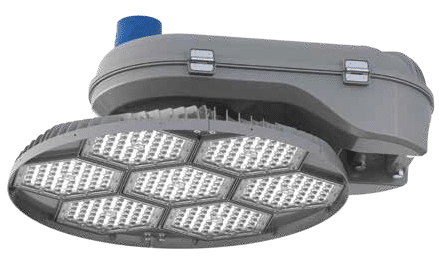
HD-HM04
Brand: MastLed
Ports, Rail Yards, Industrial, and Correctional facilities; up to 160,000 lumens;
300/400/500/600/700/800W
Prices start at $600.
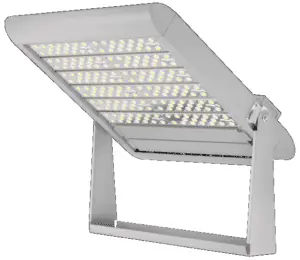
Aurora
Brand: Arrlux
designed for large-scale outdoor illumination; 124,740 lumens 450 to 900W; Prices start at $850.
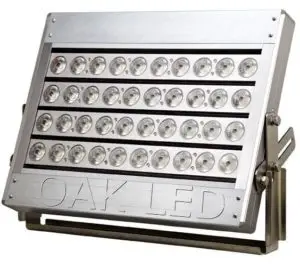
Oak-FL
Brand: Oakled
Lens: Super Clear PC Material with Anti- glare Design; up to 170,000 lumens;
400/500/720/900/1000W.
Prices start at $600.
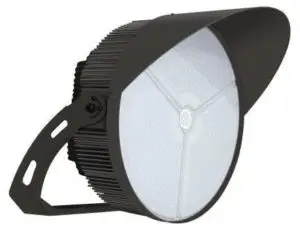
7H
Brand: Green Inova
Industrial, Tunnel, and Stadium uses; High Mast Lighting
400/500/600/750/1000/1200W.
Prices start at $500.
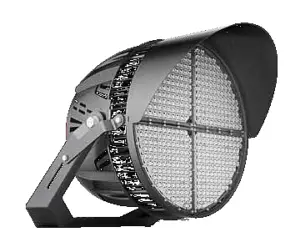
HD-SP
Brand: Huadian
with visor glare shield;
Up to 162,500 lumens; Sports Field Lighting, Sports Arena Lighting; 300/400/500/ 600/
750/1000/1250W;
Prices start at $500.
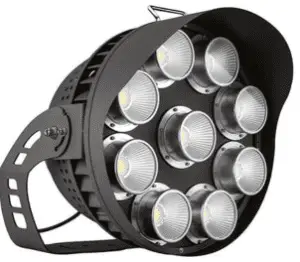
LS-STU
Brand: Ledsion
Citizen COB LED technology
Up to 156,000 lumens; Sports Field Lighting, Sports Arena Lighting; 600/720/960/1200W;
Prices start at $500.
What Is LED High Mast Lighting?
LED high mast lighting is a high-output outdoor lighting system designed to illuminate large areas from mounting heights typically ranging from 60 to over 150 feet. These systems use powerful LED fixtures with precision optics to deliver uniform, long-distance illumination across expansive environments such as ports, highways, airports, and industrial facilities.
Modern container terminals depend on reliable outdoor lighting to support safe cargo movement and heavy equipment operations. The Port & Container Terminal High Mast Lighting Guide provides practical guidance for selecting high mast lighting systems engineered for demanding marine environments.
Unlike standard pole lighting, high mast systems are engineered to provide maximum coverage using fewer, taller poles. This reduces infrastructure costs while improving visibility, safety, and operational efficiency. The elevated mounting height allows light to be distributed evenly across large areas with minimal shadowing and consistent ground-level illumination.
Before designing lighting for a correctional campus or detention facility, review the Correctional Facility High Mast Lighting Guide to compare pole heights, lighting layouts, CPTED principles, and surveillance considerations.
Key Advantages of LED High Mast Lighting
- Wide-area coverage with fewer poles
- High lumen output for long-distance illumination
- Energy savings compared to HID systems
- Reduced maintenance at extreme mounting heights
- Improved safety and operational visibility
Highway interchanges and major transportation corridors require wide-area illumination that supports driver visibility while minimizing the number of poles and maintenance points. See our Highway Interchange High Mast Lighting Guide for pole-height, roadway geometry, glare-control, maintenance, and photometric design considerations.
When to Use LED High Mast Lighting
LED high mast lighting is typically specified when:
-
Wide-area illumination is required across expansive outdoor zones
-
Pole or mounting heights exceed conventional area lighting criteria
-
Uniform distribution and high visual clarity are essential for safety
-
Energy efficiency is important due to long operational hours
-
Maintenance access is limited or costly
These systems are ideal when fewer, taller poles can efficiently cover large footprints compared to multiple lower-mounted fixtures.
Large outdoor facilities require lighting systems capable of delivering consistent illumination across expansive properties. The LED High Mast Lighting Applications Guide explains where these systems are used and how they improve visibility, safety, and maintenance efficiency.
Typical LED High Mast Lighting Specifications
| Mounting Height | Typical Lumen Requirements | Best Optical Focus |
|---|---|---|
| 60–80 ft | 30,000–60,000 lumens | Balanced area coverage |
| 80–100 ft | 60,000–90,000 lumens | Long-throw focus |
| 100–150+ ft | 90,000+ lumens | Highly directional optics |
Before designing lighting for a stadium or athletic complex, review the Sports Stadium & Athletic Complex High Mast Lighting Guide to compare pole heights, lighting layouts, maintenance strategies, and energy-saving opportunities.
Core Technical Considerations
Light Output
High lumen packages engineered for extended projection distances.
Optical Distribution
Advanced reflectors and lens systems designed to maximize uniformity while minimizing glare and spill light.
Color Quality (CCT Options)
Selectable correlated color temperatures (commonly 4000K–5000K) tailored for operational clarity and site visibility.
Control Compatibility
Supports dimming, scheduling, motion sensing, and networked lighting management systems for energy optimization.
Environmental Ratings
Typically IP65 or higher for ingress protection against dust, moisture, and outdoor exposure.
For sites that do not require extreme mounting heights, our LED Area Lighting solutions provide efficient illumination for mid-scale commercial and industrial properties.
High Mast Lighting Planning & Selection
Why Is Optical Control Critical?
At high mounting elevations, poor optical design can result in uneven light distribution, excessive glare, or wasted output. Precision optics ensure that light reaches the intended target areas while maintaining visual comfort and compliance with site-specific lighting standards.
How Do Mounting Height and Spacing Affect Performance?
Mounting height and pole spacing must be engineered together. Higher mounting elevations require:
-
Increased lumen output
-
Narrower beam control for projection
-
Careful spacing to maintain uniformity
Optimizing this relationship reduces energy waste while improving coverage consistency.
When Should Controls Be Integrated?
In large-scale facilities operating around the clock, integrated controls provide measurable advantages:
-
Scheduled dimming during low-activity periods
-
Remote monitoring and fault detection
-
Energy usage optimization
-
Improved operational flexibility
Networked control systems are particularly valuable in distributed outdoor sites such as ports and intermodal yards.
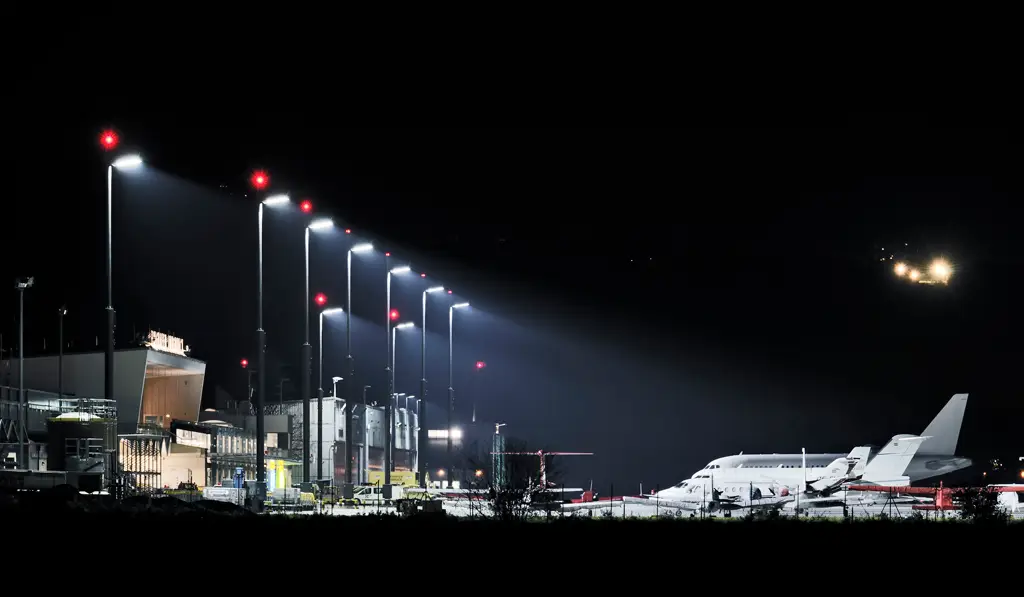
Airport operators seeking to modernize outdoor lighting can use the Airport High Mast Lighting Guide to better understand LED technology, lowering headframe systems, and photometric design considerations.
Common Applications
LED high mast lighting is widely used in:
-
Stadiums and athletic complexes
-
Ports, container yards, and intermodal facilities
-
Airports and airfield perimeters
-
Large parking areas and transportation hubs
-
Industrial yards and material handling facilities
Modern freight terminals operate around the clock and depend on reliable outdoor lighting. The Rail Yard & Intermodal High Mast Lighting Guide explores the applications, benefits, and design considerations for LED high mast lighting.
Inline Buyer Q&A
How do I determine the right LED high mast lighting system for my site?
Start with the size and geometry of the area, existing or proposed pole locations, mounting heights, required light levels, uniformity objectives, surrounding properties, environmental conditions, and applicable project requirements.
High mast lighting should be selected as a complete system involving poles, fixture quantities, lumen output, optical distributions, aiming, controls, and photometric performance rather than by fixture wattage alone.
What information should I provide when requesting high mast lighting?
Helpful project information includes site plans or dimensions, pole locations, mounting heights, required foot-candle or lux levels, uniformity requirements, voltage, existing fixture information for retrofit projects, operating hours, control requirements, and environmental conditions.
For ports, airports, transportation facilities, industrial yards, and other specialized sites, include any project-specific lighting or operational requirements.
Can LED fixtures replace existing metal halide high mast lights?
Often, yes. LED high mast systems are frequently used to replace older metal halide and other HID fixtures while retaining suitable existing poles and lowering structures.
Replacement fixtures should be selected according to the existing mounting height, pole configuration, fixture quantity, optical distribution, required illumination, electrical system, and structural considerations.
A watt-for-watt replacement is generally not the best method for specifying an LED retrofit.
Do I need a photometric layout for high mast lighting?
Yes, photometric analysis is strongly recommended for high mast projects. Because fixtures are mounted at substantial heights and must illuminate very large areas, small changes in output, optics, aiming, pole location, or mounting height can significantly affect ground-level illumination and uniformity.
A photometric layout can evaluate predicted light levels, uniformity, fixture quantities, optical distributions, aiming, and potential spill light before equipment is installed.
Can high mast lighting be designed to reduce glare and light spill?
Yes. Fixture optics, aiming, mounting height, output, pole placement, and shielding where appropriate can all influence glare and spill light.
Photometric modeling is particularly useful near property boundaries, roadways, residential areas, waterways, airport operations, and other locations where uncontrolled light may create problems.
Need a High Mast Lighting Layout for Your Project?
High mast lighting requires more than selecting a high-output fixture. Mounting height, pole locations, optical distribution, aiming, required light levels, uniformity, controls, environmental exposure, and site geometry all influence the performance of the finished system.
Whether you’re lighting a port, container terminal, airport, railyard, industrial yard, transportation interchange, large parking facility, or other expansive outdoor property, our lighting specialists can help evaluate fixture output, optics, controls, and photometric requirements.
👉 Call 1-844-533-7767 to discuss your high mast lighting project and photometric layout requirements.
LED High Mast Lighting – Frequently Asked Questions
What is LED high mast lighting used for?
LED high mast lighting is used to illuminate large outdoor areas from elevated mounting positions. Applications include ports, airports, railyards, container terminals, transportation interchanges, industrial yards, large parking facilities, and other expansive properties requiring broad-area illumination.
Mounting heights vary considerably according to the site, pole system, required coverage, and application rather than following one universal high mast range.
How many lumens are required for high mast lighting?
There is no reliable universal lumen requirement based solely on mounting height.
Required fixture output depends on mounting height, pole spacing, fixture quantity, optical distribution, aiming, site geometry, required ground-level illumination, uniformity, surface characteristics, and surrounding conditions.
A photometric layout should be used to determine appropriate fixture quantities and lumen packages for the specific project.
What mounting height is best for LED high mast lights?
The appropriate mounting height depends on the dimensions of the area, pole locations, required illumination, uniformity objectives, fixture output, optical distribution, maintenance strategy, and site constraints.
Higher mounting positions can provide broad coverage, but they also require careful fixture and optical selection to deliver the required illumination at ground level.
Are LED high mast lights energy efficient?
LED high mast systems can provide substantial energy savings compared with many older metal halide or HID installations.
Actual savings depend on the wattage and quantity of the existing fixtures, replacement LED system, operating hours, controls, and lighting design. Dimming, scheduling, photocells, and other control strategies can provide additional savings where appropriate.
What optical distributions are available?
Commercial high mast fixtures can be available with multiple optical distributions designed for different site geometries and mounting configurations.
Depending on the fixture family, options may include narrow or long-throw distributions, medium patterns, wide distributions, and symmetrical or asymmetrical optics.
The appropriate distribution should be selected through photometric evaluation rather than assuming the widest beam provides the best coverage.
Can LED high mast lighting systems be controlled remotely?
Many systems can support controls such as 0–10V dimming, scheduling, photocells, occupancy-based strategies, and networked lighting-management platforms.
Available capabilities depend on the fixture, driver, control architecture, and project requirements. Networked systems can be particularly useful at large or distributed facilities where centralized monitoring and control can simplify operations.
What IP rating should high mast fixtures have?
High mast fixtures should have an ingress-protection rating appropriate for the environment in which they will operate.
Outdoor installations may require protection from rain, dust, wind-driven moisture, temperature extremes, corrosion, salt exposure, vibration, and other conditions. IP ratings address specific levels of protection against solids and water but do not describe every aspect of outdoor fixture durability.
Always verify the complete environmental specifications for the installation rather than selecting a fixture based on IP rating alone.
How long do LED high mast fixtures last?
Commercial LED high mast fixtures can provide long operating life, often measured in tens of thousands of hours. Published lifetime ratings vary by fixture and manufacturer.
Actual service life depends on driver and component quality, thermal management, operating hours, electrical conditions, surge protection, ambient temperature, environmental exposure, and maintenance.
Long service intervals are particularly valuable in high mast applications because accessing fixtures at elevated mounting heights can require specialized equipment or lowering systems.
Stay Connected with Our Lighting Resources
Add IndustrialLightingFixtures.org as a Preferred Source on Google to see more of our lighting guides and technical resources across Google Search experiences.

Related High Mast & Large-Area Lighting Resources
- High Mast Lighting Design Guide — Learn how mounting height, pole spacing, fixture output, optical distribution, aiming, and photometric analysis work together when designing large-area high mast systems.
- Highway Interchange High Mast Lighting — Review high mast lighting considerations for highway interchanges and large transportation environments where broad coverage and controlled light distribution are critical.
- LED Area Lighting — Explore commercial LED area-lighting solutions for industrial yards, parking facilities, transportation properties, campuses, and other large outdoor sites.
- LED Area Lighting Layout Guide — Learn how pole locations, mounting heights, fixture optics, lumen output, and photometric planning affect large-area outdoor lighting performance.
- Outdoor LED Lighting Guide — Review broader commercial outdoor lighting strategies including fixture selection, controls, mounting, environmental considerations, and lighting-system design.