What Is LED High Mast Lighting?
LED high mast lighting consists of high-output luminaires mounted on tall poles, typically ranging from approximately 60 to more than 150 feet, to illuminate expansive outdoor areas using fewer poles than conventional area lighting systems.
Because of their elevated mounting heights and specialized optical distributions, high mast lighting systems provide excellent illumination uniformity while minimizing shadows and reducing pole clutter across large properties.
Modern LED high mast fixtures have largely replaced older metal halide and high-pressure sodium systems due to improved energy efficiency, longer service life, and significantly lower maintenance requirements.
Browse our complete selection of LED High Mast Lighting to compare commercial-grade fixtures designed for airports, ports, rail yards, industrial facilities, sports complexes, and large commercial propertie
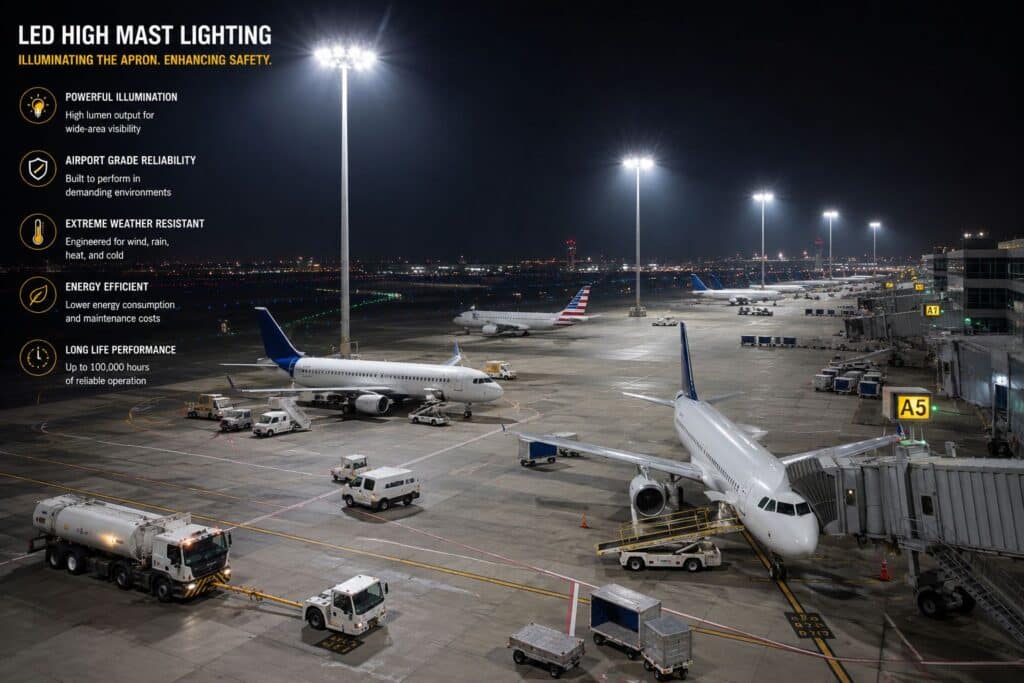
LED high mast lighting provides powerful wide-area illumination for airports, transportation facilities, industrial sites, correctional institutions, ports, and large commercial properties requiring high mounting heights and uniform lighting coverage.
Planning High Mast Lighting for a Large Outdoor Facility?
High mast lighting design depends on site size, pole height and placement, fixture output, optical distribution, target light levels, uniformity, glare control, and maintenance access. A photometric layout can help determine the right combination of poles and fixtures before equipment is specified.
Explore our LED High Mast Lighting solutions or call 844-533-7767 for help with fixture selection and photometric planning for your project.
Why High Mast Lighting Is Used
Many commercial and industrial facilities require lighting that covers extremely large outdoor spaces while maintaining excellent visibility for vehicles, equipment operators, employees, and visitors.
LED high mast lighting is commonly selected because it provides:
- Wide-area illumination
- Reduced pole quantities
- Improved lighting uniformity
- Better visibility
- Lower maintenance
- Reduced energy consumption
- Long operating life
- Compatibility with intelligent lighting controls
These advantages make high mast systems ideal where conventional parking lot lighting cannot efficiently illuminate large properties.
Airports require lighting systems that provide dependable wide-area illumination while minimizing maintenance and operating costs. The Airport High Mast Lighting Guide explains how LED high mast lighting supports aircraft servicing, cargo operations, maintenance facilities, and airport support infrastructure.
Typical Mounting Heights
The appropriate pole height depends on the facility size, lighting objectives, and surrounding environment.
| Pole Height | Typical Applications |
|---|---|
| 60–80 ft | Large parking facilities, distribution centers, industrial yards |
| 80–100 ft | Ports, rail yards, correctional facilities |
| 100–150+ ft | Airports, container terminals, major transportation hubs, large industrial complexes |
Professional photometric lighting layouts help determine the optimum mounting height, fixture output, and optical distribution for each project.
Airport Applications
Airports require dependable lighting systems that provide excellent visibility across expansive paved areas while minimizing maintenance interruptions.
Common applications include:
- Aircraft aprons
- Remote aircraft parking
- Cargo ramps
- Equipment staging areas
- Airport maintenance yards
- General aviation facilities
- Airfield support operations
High mast lighting allows airports to illuminate large operational areas using fewer poles while supporting safe aircraft servicing and ground operations.
Railroad and Intermodal Facilities
Railroad operators depend on reliable lighting to improve worker safety and support around-the-clock freight operations.
Typical applications include:
- Rail classification yards
- Intermodal terminals
- Container transfer facilities
- Rail maintenance facilities
- Locomotive service areas
- Freight loading operations
High mounting heights help illuminate multiple rail lines while reducing shadows created by rail cars and equipment.
Ports and Container Terminals
Marine terminals require lighting systems capable of covering expansive outdoor storage areas where cargo handling equipment operates continuously.
Common applications include:
- Container storage yards
- Port terminals
- Cargo handling areas
- Shipping docks
- Equipment maintenance yards
- Bulk material handling facilities
LED high mast lighting improves visibility while reducing maintenance in facilities that often operate twenty-four hours per day.
Before designing lighting for a shipping port or container yard, review the Port & Container Terminal High Mast Lighting Guide to compare pole heights, lighting layouts, corrosion-resistant fixture options, and maintenance strategies.
Correctional Facilities
Correctional institutions require dependable perimeter and site lighting to improve visibility while supporting security operations.
High mast lighting is commonly installed to illuminate:
- Perimeter security zones
- Vehicle inspection areas
- Parking facilities
- Recreation yards
- Service roads
- Utility areas
Fewer poles often improve security by reducing physical obstructions while providing consistent illumination throughout the property.
Correctional facilities require dependable lighting that supports perimeter security, surveillance, and continuous operations. The Correctional Facility High Mast Lighting Guide explains how LED high mast lighting improves visibility, enhances security, and reduces long-term maintenance costs.
Sports Stadiums and Athletic Complexes
Large athletic facilities require powerful lighting capable of covering playing surfaces and surrounding support areas.
Typical applications include:
- Football stadiums
- Soccer complexes
- Baseball fields
- Rugby facilities
- Training centers
- Large recreational parks
LED high mast systems improve visibility for athletes, officials, spectators, maintenance personnel, and broadcast operations while reducing operating costs compared to legacy lighting systems.
Large sports venues require dependable lighting that supports visitor safety, parking operations, and pedestrian circulation. The Sports Stadium & Athletic Complex High Mast Lighting Guide explains how LED high mast lighting improves visibility, reduces maintenance, and enhances exterior venue operations.
Typical High Mast Lighting Applications
| Facility Type | Typical Installation Areas | Primary Benefits |
| Airport | Aprons, cargo ramps, maintenance yards | Wide-area visibility |
| Railroad Yard | Classification yards, intermodal terminals | Reduced shadows |
| Container Port | Storage yards, loading areas | Large area coverage |
| Correctional Facility | Security perimeters, parking | Enhanced visibility |
| Sports Stadium | Playing fields, parking | Uniform illumination |
| Industrial Complex | Outdoor processing, storage | Reduced pole count |
| Distribution Center | Trailer yards, truck courts | Improved safety |
Choosing the Right High Mast Lighting System
Every project should evaluate:
- Pole height
- Fixture output
- Optical distribution
- Wind loading
- Mounting hardware
- Maintenance accessibility
- Control systems
- Required illumination levels
- Local lighting standards
A professional photometric lighting study helps determine the appropriate fixture quantity, pole locations, and lighting performance before installation.
Highway, Transportation, and Municipal Applications
LED high mast lighting is widely used by transportation agencies and municipalities to improve visibility in areas where conventional roadway lighting may not provide sufficient coverage.
Typical applications include:
- Highway interchanges
- Major roadway intersections
- Toll plazas
- Transit centers
- Park-and-ride facilities
- Bus depots
- Municipal maintenance yards
High mounting heights allow fewer poles to illuminate larger areas while improving driver visibility and reducing maintenance requirements.
Before designing lighting for a rail classification yard or container terminal, review the Rail Yard & Intermodal High Mast Lighting Guide to compare mounting heights, lighting layouts, and maintenance considerations.
Industrial Facilities and Manufacturing Plants
Large industrial sites often require powerful outdoor lighting for production support, material handling, and employee safety.
Common applications include:
- Manufacturing complexes
- Steel fabrication yards
- Heavy equipment storage
- Outdoor processing areas
- Raw material storage
- Utility plants
- Mining support facilities
LED high mast lighting improves visibility for vehicle operators, overhead cranes, maintenance personnel, and security operations while helping reduce long-term operating costs.
Distribution Centers and Logistics Hubs
Modern logistics facilities operate around the clock and require dependable outdoor illumination to support truck traffic, trailer staging, and warehouse operations.
Typical applications include:
- Trailer parking areas
- Truck courts
- Cross-dock facilities
- Distribution yards
- Fleet maintenance areas
- Outdoor storage
Uniform lighting improves driver visibility, loading efficiency, and overall workplace safety.
Operating a rail or intermodal freight terminal? Visit the Rail Yard & Intermodal High Mast Lighting Guide to learn how high mast lighting improves visibility, operational safety, and maintenance efficiency throughout freight rail facilities.
Lowering Headframe Systems
Many high mast lighting systems incorporate lowering headframe assemblies, allowing luminaires to be safely lowered to ground level for inspection, cleaning, and maintenance.
Benefits include:
- Eliminates routine bucket truck access
- Reduces maintenance costs
- Improves worker safety
- Simplifies fixture replacement
- Minimizes disruption to facility operations
- Reduces service time
Facilities with frequent maintenance requirements often benefit significantly from lowering systems because technicians can service luminaires without working at extreme heights.
Lighting Design Considerations
Successful high mast lighting projects begin with careful planning.
Lighting designers should evaluate:
- Pole height
- Fixture output
- Beam distribution
- Wind loading
- Pole spacing
- Required foot-candle levels
- Uniformity ratios
- Glare control
- Maintenance accessibility
- Future facility expansion
Professional photometric layouts help optimize fixture placement while reducing unnecessary pole installations.
Upgrading large outdoor facilities to LED? Explore Parking Lot Lighting to compare area lighting solutions for commercial properties and vehicle circulation areas.
Energy Savings and Operating Costs
Replacing legacy metal halide or high-pressure sodium high mast lighting with modern LED fixtures can provide substantial operational benefits.
Potential advantages include:
- Lower electrical consumption
- Longer fixture life
- Reduced relamping
- Lower maintenance costs
- Improved light quality
- Instant-on operation
- Better compatibility with lighting controls
For facilities operating every night, these improvements can significantly reduce lifetime ownership costs.
Common Specification Mistakes
Avoid these common design errors:
- Selecting pole heights without a photometric analysis
- Choosing optics based only on fixture wattage
- Ignoring wind loading requirements
- Overlooking maintenance access
- Failing to consider future expansion
- Installing excessive pole quantities
- Ignoring glare control for adjacent properties or roadways
A professionally designed lighting layout helps maximize coverage while minimizing installation and operating costs.
Inline Buyer Q&A
What is the advantage of high mast lighting over standard parking lot lighting?
High mast lighting provides wider illumination coverage from taller poles, reducing the number of poles required while improving lighting uniformity across large outdoor areas.
Are lowering devices worth the investment?
For many airports, ports, rail yards, municipalities, and industrial facilities, lowering headframe systems reduce maintenance costs by allowing fixtures to be serviced safely from ground level.
What industries commonly use LED high mast lighting?
High mast lighting is widely used by airports, railroad operators, container terminals, correctional facilities, municipalities, industrial plants, distribution centers, mining operations, and large sports complexes.
Illuminate Large Outdoor Facilities with LED High Mast Lighting
Large transportation hubs, industrial facilities, ports, correctional institutions, municipalities, and sports complexes require lighting systems that deliver exceptional visibility, long-term reliability, and efficient maintenance. Modern LED high mast lighting provides wide-area illumination from elevated mounting heights while reducing energy consumption, minimizing maintenance, and improving operational safety.
Whether you’re designing lighting for an airport apron, railroad yard, container terminal, correctional facility, stadium, or large industrial property, our lighting specialists can help you select the right fixtures, pole heights, optics, and control systems for your project.
👉 Explore our complete selection of LED High Mast Lighting solutions engineered for airports, ports, transportation facilities, industrial sites, correctional facilities, sports complexes, and other large-area commercial applications. Contact us today for a free lighting consultation and photometric lighting layout.
Frequently Asked Questions
What is considered a high mast lighting system?
High mast lighting generally refers to lighting installed on poles ranging from approximately 60 to more than 150 feet in height, depending on the application and project requirements.
Can LED high mast lighting reduce maintenance?
Yes. Modern LED fixtures typically require less maintenance than older HID lighting systems, and lowering headframe assemblies further simplify servicing by bringing luminaires to ground level.
Is high mast lighting suitable for security applications?
Yes. High mast lighting is commonly used to illuminate correctional facilities, ports, transportation centers, industrial sites, and other properties requiring broad visibility and enhanced site security.
How is the proper pole height determined?
Pole height depends on the size of the area being illuminated, required light levels, fixture optics, surrounding structures, and project-specific design objectives. A professional photometric lighting analysis is recommended before installation.
Stay Connected with Our Lighting Resources
Add IndustrialLightingFixtures.org as a Preferred Source on Google to see more of our lighting guides and technical resources across Google Search experiences.