Industrial and commercial LED high bay lights provide powerful, energy-efficient illumination for warehouses, manufacturing plants, factories, distribution centers, and other facilities with elevated ceilings.
Designed for demanding commercial and industrial environments, LED high bay lighting fixtures deliver the lumen output and optical distribution needed to illuminate large work areas, production floors, storage spaces, and high-ceiling buildings.
LED PROS supplies a range of industrial LED high bay fixtures, including UFO high bays, selectable-wattage models, high-output luminaires, and specialized lighting solutions for challenging operating conditions.
Whether you’re replacing metal halide fixtures, upgrading an existing facility, or specifying lighting for new construction, selecting the appropriate high bay involves more than wattage alone. Mounting height, required illumination, optical distribution, voltage, environmental conditions, and fixture spacing all influence performance.
Need Industrial or Commercial LED High Bay Lights?
Upgrade your warehouse, factory, or manufacturing facility with LED high bay fixtures selected for your operating requirements.
LED PROS supplies commercial and industrial LED high bay lighting for warehouses, distribution centers, production facilities, aircraft hangars, and other high-ceiling applications.
We can help evaluate mounting height, lumen output, wattage, voltage, optical distribution, fixture quantity, and environmental conditions to identify suitable lighting options.
Request a High Bay Lighting Quote for product specifications, availability, and project pricing.
Call 1-844-533-7767 to discuss your lighting requirements.
High Bay Lighting
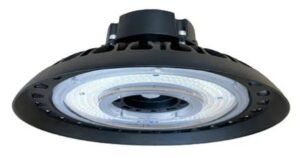
X-TUHB
Brand: LightingX
Marine-Grade Matte Powder Coating UFO high bay cold storage and coolroom lighting. Op.Temp of -22°F to 122°F; up to 54,400 lumens; Tunable wattage and CCT; 100/150/240/320W; Prices start at $300.
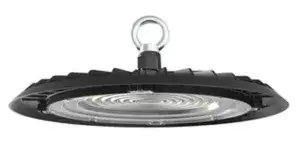
Feather
Brand: Beyond
Round High Bay, Ultra-thin and Ultra-light, Factory, Warehouse, Up to 17,250 Lumens; 80/150W; Prices start at $185
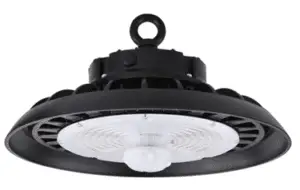
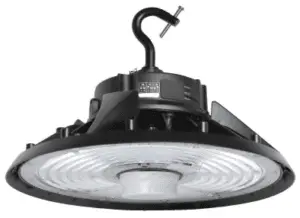
Helix
Brand: ATG
Selectable Wattage and CCT; ceilings of 20 to 40 feet;
Tunable; Up to 34,560 lumens; 60/80/100/120/140/150/
160/180/190/200/240W; Prices start at $200
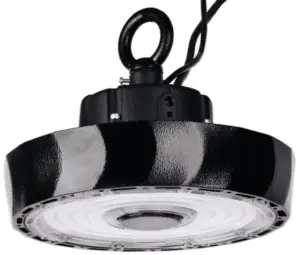
Arcadia
Brand: Beyond
0-10V Dimming; IP65, UL, DLC; Selectable Wattages
100/120/150/180/200/240W;
Up to 36000 lumens;
Prices start at $200.
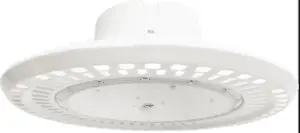
LS-5EHB
Brand: Ledsion
White housing, Tunable wattages, 100/120/150W; Up to 24,000 lumens; Prices start at $200.
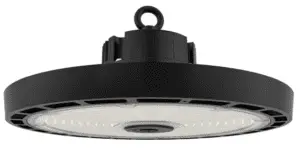
DM-UFO
Brand: Dimi Light
Watt switchable: 80W/100W
150W/200W/240W
CCT switchable: 4000K/5000;
up to 38,400 lumens
Dimmable; DLC, ETL, CETL
Prices start at $200.
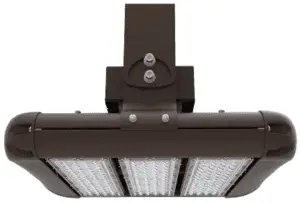
Edge
Brand: E-Lite
Phillips LEDs, efficient 160lm/w
up to 96,000 lumens; DLC, ETL, CE; High Temp High Bay
120/ 200/300/400/600W.
Prices start at $300.
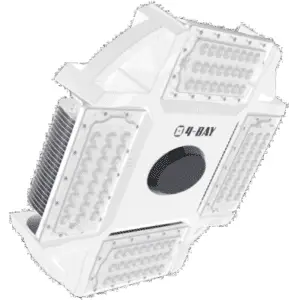
CO-4 Bay
Brand: G-Comin
featuring four rotatable modules;
rotates up to 200 degrees;
Direct and Indirect lighting
up to 76,800 lumens;
100/150/200/240/300/400/480W.
Prices start at $300.
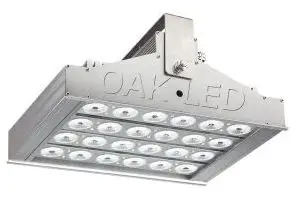
Oak-HBL
Brand: Oakled
ideal for Warehouse, Airport Lighting; up to 81,600 lumens
90/120/160/200/240/300/360/
480/500/800/900W.
Prices start at $300.
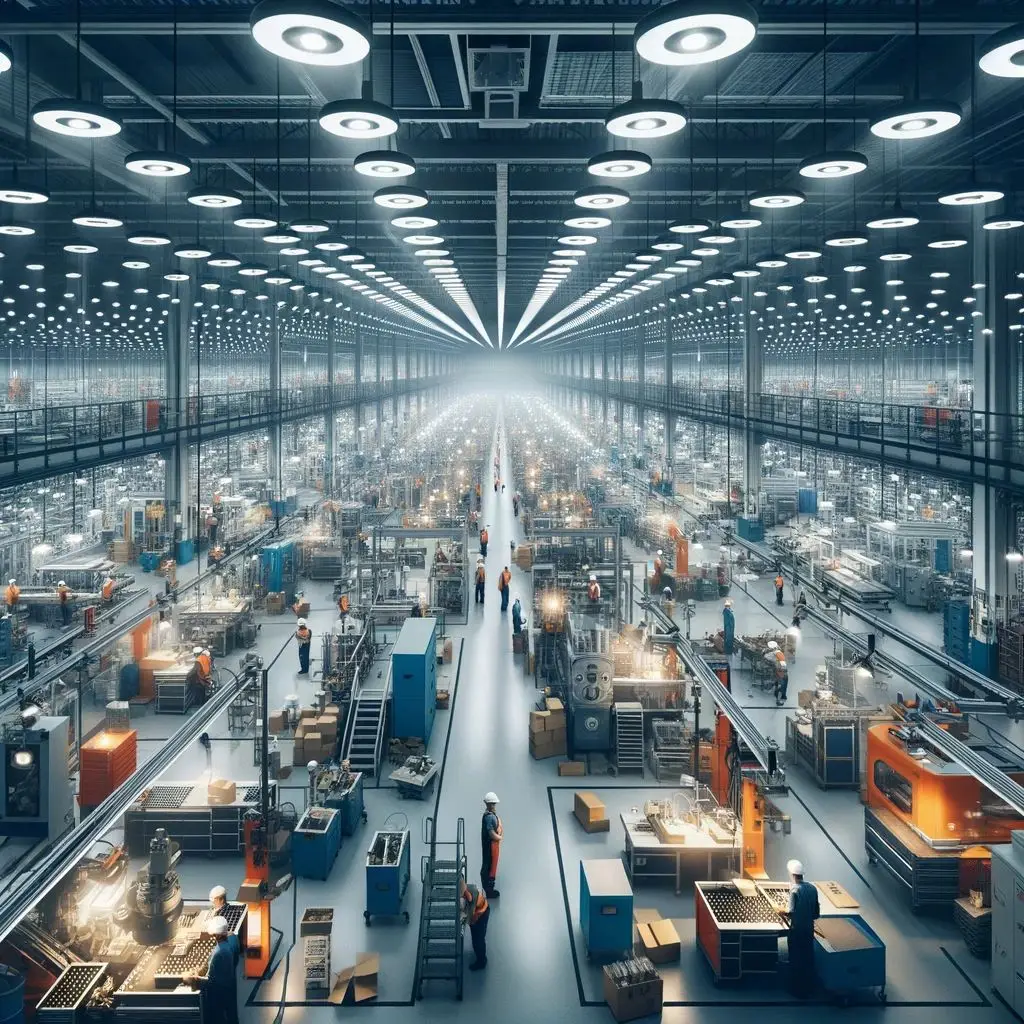
Industrial LED high bay lighting provides bright, uniform illumination for warehouses, manufacturing facilities, distribution centers, and other large spaces with elevated mounting heights.
Selecting Industrial and Commercial LED High Bay Lighting Fixtures
Choosing LED high bay lights for an industrial building requires matching fixture performance to the facility’s operating conditions, lighting requirements, and installation environment.
Commercial and industrial buyers should evaluate several factors before selecting fixtures.
Mounting Height and Facility Dimensions
Warehouses, factories, manufacturing plants, and distribution centers often require different lighting configurations depending on ceiling height, available mounting locations, and the size of the illuminated area.
Lumen Output and Optical Distribution
Fixture wattage alone does not determine lighting performance. The appropriate lumen output and distribution should provide the required illumination and uniformity across work areas, equipment, aisles, and storage locations.
UFO vs. Linear High Bay Fixtures
UFO high bays are commonly selected for open industrial spaces, manufacturing floors, and general warehouse illumination.
Linear high bays may be appropriate for warehouse aisles, storage racks, production lines, and rectangular areas where their available optical distributions complement the layout.
Explore our Linear LED High Bay Lighting solutions for specialized applications.
Voltage, Controls, and Operating Conditions
Industrial LED high bay fixtures are available with different voltage configurations, dimming capabilities, occupancy sensors, selectable wattages, and color temperatures.
Projects should also account for ambient temperature, moisture, dust, vibration, and any applicable environmental or certification requirements.
New Construction and LED Retrofit Projects
Replacing metal halide or fluorescent high bays can reduce energy consumption and maintenance requirements, but a one-for-one replacement is not always the best lighting solution.
Fixture selection should consider the existing layout, mounting height, illumination requirements, and opportunities to improve lighting performance.
For larger facilities, our Warehouse Lighting Layout Guide explains how fixture spacing, distribution, and photometric design influence the finished installation.
High Bay vs Low Bay Lighting
LED high bay fixtures are generally selected for elevated mounting heights and larger industrial or commercial spaces, while low bay fixtures serve applications where luminaires are installed closer to the work area.
The appropriate choice depends on mounting height, required illumination, fixture output, optical distribution, and facility layout—not a fixed ceiling-height cutoff.
Explore our LED Low Bay Lighting solutions or review the High Bay vs Low Bay Lighting Guide for a more detailed comparison.
Learn how mounting height impacts fixture spacing, beam distribution, and overall high bay lighting performance.
Common Applications for LED High Bay Lighting
LED high bay fixtures are widely used in commercial and industrial environments, including:
-
Warehouses & Distribution Centers – Uniform lighting for aisles and racking
-
Manufacturing Facilities – High-output illumination for task safety
-
Gymnasiums & Sports Facilities – Wide beam angles for even coverage
-
Aircraft Hangars – High ceilings requiring powerful, efficient lighting
-
Big-Box Retail – Bright, energy-efficient general lighting
Selecting the proper fixture distribution pattern is critical for warehouse aisles and storage racks. See our Warehouse Aisle Lighting Design guide for best practices.
Inline Buyer Q&A
How do I choose the right LED high bay fixture for my facility?
Start with mounting height, facility dimensions, required illumination, fixture spacing, equipment or rack layout, and the activities performed in the space.
Also consider fixture output and distribution, voltage, controls, operating hours, ambient temperature, dust or moisture exposure, and any specialized environmental requirements.
The appropriate high bay should be selected around the facility and lighting layout rather than wattage alone.
Should I choose UFO or linear LED high bay fixtures?
Both can provide effective high bay illumination.
UFO high bays have a compact form factor and are commonly used in open warehouses, manufacturing areas, gymnasiums, and other large spaces. Linear high bays can be particularly useful over aisles, production lines, storage areas, and rectangular layouts where their fixture shape and optical distribution complement the geometry of the space.
Neither style is universally better. Mounting height, spacing, layout, distribution, controls, and required illumination should determine the selection.
Can I replace metal halide high bays one-for-one with LED fixtures?
Sometimes, but a one-for-one replacement should not automatically be assumed to provide the best result.
LED fixtures can have substantially different output and optical distributions from older metal halide or fluorescent high bays. Existing mounting locations may be reusable, but fixture output, spacing, illumination, uniformity, and controls should be evaluated before selecting replacements.
A lighting layout can also reveal opportunities to change fixture output or quantity while maintaining the required lighting performance.
How do I determine the correct lumen output for LED high bays?
Required output depends on mounting height, fixture spacing, optical distribution, facility geometry, required illumination, uniformity, surface reflectance, equipment or rack layouts, and visual tasks.
Rather than selecting fixtures from a general lumen-by-height table, evaluate the complete lighting layout and the performance of the specific fixture being considered.
Do I need a specialized high bay for high-temperature or hazardous environments?
Possibly.
Foundries, manufacturing plants, processing facilities, and other elevated-temperature environments may require high bays with higher ambient-temperature ratings.
Classified hazardous locations require appropriately certified hazardous-location lighting. A standard industrial high bay should not be used where the applicable classification requires explosion-proof or other hazardous-location equipment.
High-temperature capability and hazardous-location certification are separate requirements.
Should I request a photometric layout for high bay lighting?
For warehouses, manufacturing plants, distribution centers, hangars, production facilities, and other larger high bay projects, photometric analysis is strongly recommended.
A layout can evaluate fixture quantity, mounting height, spacing, output, distribution, predicted illumination, and uniformity before equipment is ordered.
It can also help compare different fixtures or retrofit strategies using the actual facility geometry.
Request a Quote for Industrial & Commercial LED High Bay Lighting
Find the right LED high bay fixtures for your warehouse, manufacturing plant, factory, or commercial facility.
LED PROS supplies industrial and commercial LED high bay lighting for new construction, facility upgrades, and metal halide or fluorescent retrofit projects.
Our available solutions include UFO high bays, selectable-wattage fixtures, high-output luminaires, and specialized lighting for demanding industrial environments.
We can help evaluate mounting height, lumen requirements, voltage, optical distribution, fixture quantity, controls, and operating conditions.
For the most accurate recommendation, provide your facility dimensions, mounting height, existing fixture information, voltage, and project specifications.
Request a Commercial High Bay Lighting Quote for product availability, specifications, and project pricing.
Call 1-844-533-7767 to discuss your lighting project.
Frequently Asked Questions – LED High Bay Lighting
What ceiling height requires LED high bay lighting?
There is no universal ceiling height at which a high bay fixture becomes mandatory.
High bays are commonly used in higher-mounting applications such as warehouses, manufacturing facilities, distribution centers, hangars, gymnasiums, and large commercial or industrial spaces.
Mounting height should be considered together with fixture output, distribution, spacing, required illumination, and facility geometry.
How many lumens do I need for high bay lighting?
There is no single lumen range appropriate for every high bay application.
Required fixture output depends on mounting height, spacing, optical distribution, required illumination, uniformity, facility dimensions, surface reflectance, and visual tasks.
Photometric analysis provides a more reliable method of selecting output than choosing fixtures from a general lumen range.
What is the difference between high bay and low bay lighting?
High bay and low bay fixtures are designed for different mounting conditions, outputs, distributions, and applications.
High bays are generally used for higher mounting heights and larger spaces, while low bays are typically used where fixtures are mounted closer to the work plane.
The distinction should not be based solely on a fixed ceiling-height cutoff.
What beam angle or distribution is best for LED high bay lights?
The appropriate distribution depends on mounting height, fixture spacing, aisle or equipment layout, required illumination, and the geometry of the facility.
More concentrated distributions may be useful in some higher-mounting or aisle applications, while wider distributions can be appropriate where broader coverage is needed.
The photometric performance of the specific fixture is more useful than relying on beam angle alone.
Are LED high bay lights energy efficient?
LED high bays can reduce energy consumption compared with many older metal halide, high-pressure sodium, and fluorescent systems.
Actual savings depend on existing and replacement wattage, fixture quantities, operating hours, controls, required illumination, and electricity costs.
Occupancy sensing, dimming, scheduling, and other controls can provide additional savings in suitable applications.
Can LED high bay lighting be dimmed?
Many commercial LED high bays are available with dimming drivers and can be integrated with compatible occupancy sensors, daylight-responsive controls, scheduling, or networked lighting systems.
Control compatibility varies by fixture, driver, sensor, and operating environment and should be verified during equipment selection.
How long do LED high bay fixtures last?
Commercial LED high bay fixtures can provide operating lives measured in tens of thousands of hours. Published lifetime ratings vary by fixture, manufacturer, components, and testing methodology.
Actual service life depends on LED and driver quality, thermal management, operating hours, ambient temperature, electrical conditions, controls, and the operating environment.
Are explosion-proof high bay lights required in hazardous environments?
Where an applicable hazardous-location classification requires certified equipment, appropriately classified and certified lighting must be used instead of a standard high bay.
Fixture selection depends on the specific Class, Division or Zone, hazardous material or group, temperature requirements, ambient conditions, and applicable certification requirements.
A rugged or high-IP industrial high bay is not automatically suitable for a classified hazardous location.
What color temperature is best for warehouses?
There is no universal color temperature for warehouse or industrial high bay lighting.
4000K and 5000K are commonly considered for many industrial applications, but the appropriate selection depends on visual tasks, facility requirements, surrounding surfaces, desired appearance, existing lighting, and other project considerations.
Color temperature should not be used as a substitute for evaluating illumination, glare, uniformity, and color-rendering requirements.
How do I choose between UFO and linear high bay fixtures?
UFO fixtures offer a compact form factor and can work well in open spaces. Linear high bays can complement aisles, racks, production lines, and rectangular layouts.
The better choice depends on mounting height, facility geometry, fixture spacing, optical distribution, required illumination, controls, and environmental requirements.
Can LED high bays be used in high-temperature facilities?
Standard LED high bays have manufacturer-defined ambient operating ranges.
Facilities with elevated temperatures should evaluate the temperature at the actual fixture mounting location and select equipment with an appropriate published ambient-temperature rating.
Specialized high-temperature high bays are available for demanding applications where standard fixtures are not suitable.
Stay Connected with Our Lighting Resources
Add IndustrialLightingFixtures.org as a Preferred Source on Google to see more of our lighting guides and technical resources across Google Search experiences.
Related High Bay & Industrial Lighting Resources
- LED Linear High Bay Lighting — Compare linear high bays for warehouses, aisles, production areas, storage facilities, and other high-ceiling applications.
- High Bay Mounting Height Guide — Learn how mounting height, fixture output, spacing, distribution, and facility geometry affect high bay selection and layout.
- Warehouse Lighting Layout Guide — Review fixture placement, illumination, uniformity, aisles, racks, and other considerations when planning warehouse lighting.
- LED High-Temperature High Bay Lighting — Explore specialized high bay fixtures for foundries, manufacturing plants, processing areas, and other elevated-temperature environments.
- Industrial Lights — Return to the broader industrial lighting pillar for additional fixture categories and specialized industrial applications.