Industrial LED high bay lighting is designed for facilities with ceilings typically ranging from 20 to 60 feet or higher. These fixtures provide powerful, evenly distributed illumination across large open spaces while maintaining excellent visibility at floor level.
Compared to older HID and fluorescent systems, LED high bay lighting offers greater energy efficiency, longer operating life, improved light quality, and significantly lower maintenance requirements.
High bay lighting is commonly installed in warehouses, manufacturing plants, distribution centers, aircraft hangars, gymnasiums, food processing facilities, and large commercial buildings.
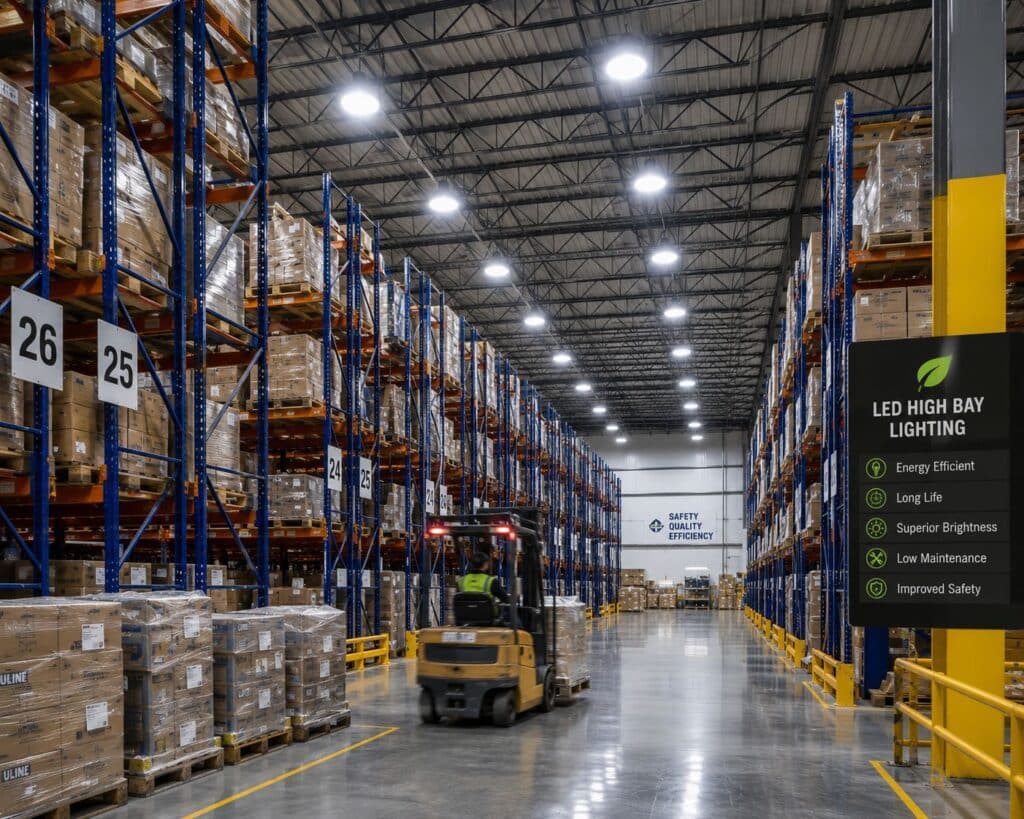
Industrial LED high bay lighting delivers bright, uniform illumination for warehouses, manufacturing facilities, distribution centers, and other industrial buildings with high ceilings while reducing maintenance and energy costs.
Need Help Selecting Industrial LED High Bay Lights?
The right high bay lighting depends on mounting height, facility layout, required illumination, fixture spacing, optical distribution, operating conditions, and the work performed below.
Explore our LED High Bay Lighting for warehouses, manufacturing plants, distribution centers, hangars, and other high-ceiling facilities.
Planning a project? Request a Quote or call 844-533-7767 for fixture selection, pricing, and photometric planning assistance.
When Should High Bay Lighting Be Used?
High bay lighting is generally recommended whenever ceiling heights exceed approximately 20 feet.
Typical applications include:
- Warehouses
- Manufacturing plants
- Distribution centers
- Aircraft hangars
- Gymnasiums
- Cold storage facilities
- Food processing plants
- Retail warehouse stores
- Industrial fabrication shops
- Logistics centers
Explore our complete selection of LED High Bay Lighting to compare commercial-grade UFO high bays, high-output fixtures, and application-specific industrial lighting solutions.
Types of LED High Bay Fixtures
UFO High Bay Lighting
UFO high bay fixtures feature a compact circular design that provides excellent thermal performance and wide-area illumination.
Ideal for:
- Warehouses
- Manufacturing
- Fabrication
- Open industrial spaces
Planning a complete facility upgrade? Visit the Industrial Lighting Guide for comprehensive guidance on industrial lighting design, fixture selection, and energy-efficient LED retrofits.
Linear High Bay Lighting
Linear high bays distribute light over longer rectangular workspaces.
Best suited for:
- Warehouse aisles
- Assembly lines
- Distribution centers
- Packaging operations
NSF High Bays
Designed for sanitary environments including:
- Food processing
- Beverage production
- Pharmaceutical facilities
High Temperature High Bays
Engineered for:
- Foundries
- Steel mills
- Manufacturing plants
- High-heat industrial environments
Recommended Mounting Heights
| Mounting Height | Common High Bay Approach | Key Selection Factors |
|---|---|---|
| Approximately 20–30 ft | UFO or linear high bay | Output, optics, spacing, glare, required illumination |
| Approximately 30–40 ft | High-output UFO or linear high bay | Photometric performance, distribution, uniformity |
| 40+ ft | High-output fixtures selected for the application | Output, optics, fixture quantity, spacing, facility geometry |
Design Note: These ranges are general planning references rather than fixture-selection rules. Mounting height alone does not determine fixture wattage, lumen output, form factor, or beam distribution. Final selection should account for target illumination, fixture spacing, optical distribution, facility geometry, surface reflectance, glare, uniformity, and photometric performance.
High Bay Lighting by Facility Type
| Facility | Recommended High Bay |
| Warehouse | UFO or Linear High Bay |
| Manufacturing Plant | UFO High Bay |
| Distribution Center | Linear High Bay |
| Aircraft Hangar | High Output LED High Bay |
| Food Processing | NSF High Bay |
| Cold Storage | Low Temperature High Bay |
| Gymnasium | High Bay Sports Lighting |
| Fabrication Shop | UFO High Bay |
Looking for aisle-optimized lighting? Visit LED Linear High Bay Lighting to learn how linear fixtures improve illumination in warehouses, distribution centers, and production lines.
Benefits of Industrial LED High Bay Lighting
Lower Energy Consumption
LED high bay fixtures significantly reduce electricity usage compared to traditional HID systems.
Longer Fixture Life
Many commercial-grade LED high bays operate for 100,000 hours or more, reducing maintenance and replacement costs.
Improved Visibility
Uniform illumination reduces shadows while improving worker safety and production accuracy.
Lower Maintenance
Long-life LEDs minimize lift rentals, relamping, and production interruptions.
Smart Control Compatibility
Modern high bay fixtures integrate with:
- Occupancy sensors
- Daylight harvesting
- Wireless controls
- Building automation systems
Learn more about the benefits of industrial high bay LED lights, including the operating and maintenance advantages they provide in large commercial and industrial facilities.
Choosing between high bay and low bay fixtures begins with understanding your facility’s ceiling height and lighting requirements. Our High Bay vs Low Bay Lighting guide explains the key differences and helps you select the right LED solution.
Designing an Effective High Bay Lighting System
Several factors influence lighting performance.
Consider:
- Ceiling height
- Beam angle
- Fixture spacing
- Foot candle requirements
- Color temperature
- Color Rendering Index (CRI)
- Occupancy patterns
- Future expansion
A professional photometric lighting layout helps optimize illumination while minimizing unnecessary energy use.
Designing a manufacturing facility? Read the Manufacturing Facility High Bay Lighting Guide for recommendations tailored to production environments.
Choosing Between UFO and Linear High Bays
Both fixture styles provide excellent performance, but each excels in different applications.
| UFO High Bay | Linear High Bay |
| Open spaces | Warehouse aisles |
| Manufacturing | Distribution centers |
| Fabrication | Assembly lines |
| Compact fixture | Rectangular light distribution |
| Wide beam options | Aisle-focused illumination |
Selecting the appropriate fixture depends on building layout, ceiling height, and work performed below.
Manufacturing Facility High Bay Lighting Guide
Common High Bay Lighting Mistakes
Avoid these common design errors:
- Selecting fixtures by wattage alone
- Incorrect mounting heights
- Poor beam angle selection
- Uneven spacing
- Ignoring lighting controls
- Over-lighting work areas
- Underestimating future expansion
Proper planning improves both lighting performance and return on investment.
High Bay Lighting and Energy Savings
Combining LED high bays with intelligent lighting controls provides additional operating savings.
Recommended control systems include:
- Occupancy sensors
- Daylight harvesting
- Wireless lighting controls
- Programmable scheduling
- Zoned lighting management
These technologies reduce unnecessary operating hours while maintaining safe illumination.
Inline Buyer Q&A
What ceiling height requires high bay lighting?
High bay lighting is generally recommended for facilities with ceilings of approximately 20 feet or higher, depending on the application and required lighting levels.
Are UFO or linear high bays better?
Both provide excellent performance. UFO fixtures are commonly used in open industrial spaces, while linear fixtures are often preferred for warehouse aisles, assembly lines, and distribution centers.
Can LED high bays replace metal halide fixtures?
Yes. Modern LED high bay fixtures are commonly used to replace metal halide, fluorescent, and HID lighting while improving energy efficiency and reducing maintenance.
Need Industrial LED High Bay Lights for Your Facility?
Selecting high bay lighting requires coordinating mounting height, fixture output, optical distribution, spacing, facility geometry, required illumination, and operating conditions.
LED PROS WorldWide supplies LED high bay and linear high bay lighting for warehouses, manufacturing plants, distribution centers, aircraft hangars, production facilities, and other high-ceiling commercial and industrial applications.
Send us your facility dimensions, mounting heights, fixture quantities, voltage requirements, operating conditions, and project specifications so we can help identify appropriate fixture options.
Request a Quote or call 844-533-7767 for pricing, fixture selection, and photometric planning assistance.
Frequently Asked Questions
What industries use LED high bay lighting?
Warehouses, manufacturing facilities, aircraft hangars, distribution centers, food processing plants, cold storage warehouses, retail warehouses, and gymnasiums commonly use high bay lighting.
How long do LED high bay fixtures last?
Many commercial-grade LED high bay fixtures are rated for approximately 100,000 hours of operation under normal conditions.
Can lighting controls be added?
Yes. Occupancy sensors, daylight harvesting, wireless controls, and building automation systems integrate well with LED high bay lighting.
Is a lighting layout recommended?
Yes. Professional photometric layouts help determine fixture quantity, spacing, and expected illumination before installation begins.
Stay Connected with Our Lighting Resources
Add IndustrialLightingFixtures.org as a Preferred Source on Google to see more of our lighting guides and technical resources across Google Search experiences.
Related High Bay Lighting Resources
- LED High Bay Lighting — Explore commercial and industrial LED high bay fixtures for warehouses, manufacturing plants, distribution centers, hangars, and other high-ceiling facilities.
- Linear LED High Bay Lighting — Review linear high bay fixtures for warehouse aisles, rack storage, assembly areas, distribution operations, and open industrial spaces.
- High Bay Mounting Height Guide — Understand how mounting height interacts with fixture output, optical distribution, spacing, glare, uniformity, and photometric performance.
- Warehouse Lighting Layout Guide — Learn how facility dimensions, mounting height, fixture spacing, rack configuration, and photometric planning influence warehouse lighting layouts.
- Manufacturing Facility High Bay Lighting — Review high bay lighting considerations for production floors, fabrication areas, assembly operations, and manufacturing environments.
- LED High-Temperature High Bay Lighting — Explore high bay fixtures designed for elevated-temperature industrial environments and demanding manufacturing applications.