What Is High Temperature High Bay Lighting?
High temperature high bay lighting consists of LED fixtures specifically engineered to operate in industrial environments where ambient temperatures regularly exceed the operating range of standard commercial lighting.
While conventional LED high bays perform well in most warehouses and manufacturing facilities, high-temperature fixtures incorporate specialized thermal management, heat-resistant electronic components, and enhanced cooling designs that allow them to maintain reliable performance in much hotter operating conditions. Ambient temperature ratings vary by manufacturer and application, so fixtures should always be selected based on the expected operating environment.
These fixtures are commonly used in facilities where heat generated by industrial processes accumulates near the ceiling, creating conditions that exceed the capabilities of standard lighting systems.
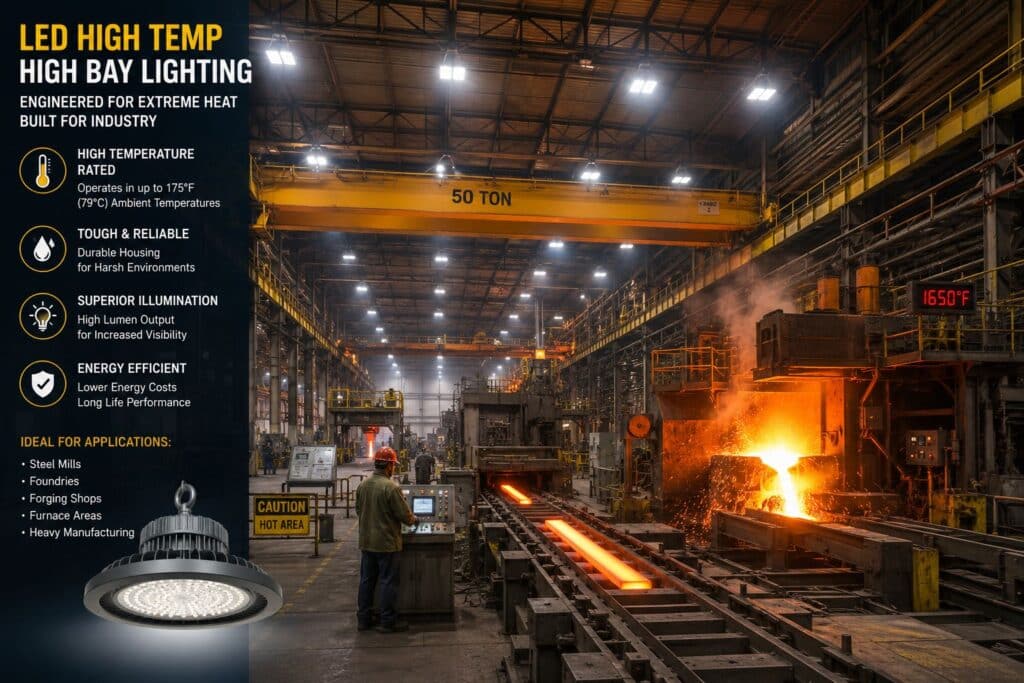
High temperature LED high bay lighting provides dependable illumination for industrial facilities operating in elevated ambient temperatures where standard LED fixtures may experience reduced performance or shortened service life.
Operating in a high-heat industrial environment?
Our lighting specialists can help you select LED high temperature high bay fixtures engineered for elevated ambient temperatures, harsh industrial conditions, and demanding manufacturing applications.
Request a Free Lighting Consultation – – https://industriallightingfixtures.org/
Why Standard High Bays May Fail
Heat is one of the primary factors affecting LED longevity.
As ambient temperatures increase, excessive heat can:
- Shorten driver life
- Reduce lumen output
- Increase maintenance requirements
- Accelerate component aging
- Reduce fixture lifespan
- Increase unexpected failures
High-temperature LED fixtures are engineered to better manage these demanding conditions through improved thermal design and appropriately rated components.
Typical High Temperature Applications
High-temperature LED high bays are commonly installed in:
- Steel mills
- Foundries
- Glass manufacturing plants
- Aluminum processing facilities
- Paper mills
- Cement plants
- Boiler rooms
- Turbine halls
- Power generation facilities
- Heat treatment plants
- Drying ovens
- Industrial processing facilities
Each application presents unique environmental conditions that should be evaluated before selecting lighting equipment.
Before specifying lighting for a steel mill, foundry, paper mill, or boiler room, review High Temperature High Bay Applications for Industrial & Commercial LED Lighting to compare common industrial applications and fixture recommendations.
Ambient Temperature Ratings
Selecting fixtures based on ambient operating temperature is one of the most important specification criteria.
| Ambient Temperature | Typical Lighting Solution |
|---|---|
| Up to 40°C (104°F) | Standard LED High Bay |
| 40–50°C (104–122°F) | Industrial LED High Bay |
| 50–65°C (122–149°F) | High Temperature High Bay |
| Above 65°C (149°F) | Specialty High Temperature Fixtures (application dependent) |
Always verify the manufacturer’s published ambient temperature rating for the specific fixture being considered. High-temperature products are commonly available with ratings well above those of standard commercial fixtures.
Key Features
High-temperature LED fixtures often incorporate:
- Heavy-duty aluminum heat sinks
- High-temperature electronic drivers
- Optimized thermal management
- Industrial-grade housings
- Corrosion-resistant finishes
- High-performance optical systems
- Long operating life
These design features help maintain lighting performance in elevated-temperature environments.
Choosing the Right Fixture
Several factors influence fixture selection.
Evaluate:
- Ambient operating temperature
- Mounting height
- Radiant heat exposure
- Ceiling clearance
- Air circulation
- Dust accumulation
- Moisture exposure
- Maintenance accessibility
- Required foot-candle levels
Proper application engineering improves fixture reliability and overall lighting performance.
Need to understand terminology? Read What Is the Difference Between Flameproof and Explosion Proof? to compare common hazardous location lighting terms.
Recommended Applications by Industry
| Industry | Recommended Lighting |
| Steel Manufacturing | High Temperature High Bays |
| Foundries | High Temperature High Bays |
| Glass Plants | Heat-Resistant High Bays |
| Paper Mills | High Temperature LED Fixtures |
| Cement Plants | Industrial High Bays |
| Boiler Rooms | High Temperature LED Lighting |
| Power Plants | High Temperature High Bays |
| Heat Treatment Facilities | High Temperature Industrial Fixtures |
Looking for application-specific examples? Read High Temp High Bay Applications for Industrial Commercial LED Lighting to see where these fixtures are commonly installed.
Benefits of High Temperature LED Lighting
Compared to conventional lighting technologies, properly specified high-temperature LED fixtures can provide:
- Lower energy consumption
- Longer operating life
- Reduced maintenance
- Improved reliability
- Better light quality
- Instant-on operation
- Compatibility with intelligent lighting controls
These benefits are especially valuable in facilities where fixture maintenance requires production shutdowns or specialized access equipment.
Mounting and Installation Considerations
Successful installations consider more than fixture wattage.
Important factors include:
- Mounting height
- Heat sources
- Structural mounting locations
- Beam angle selection
- Ventilation
- Service access
- Future maintenance
A professional lighting layout helps optimize fixture quantity and placement while maintaining safe illumination levels.
Energy Savings in High-Temperature Facilities
High-temperature industrial facilities often operate lighting systems for long hours, making energy efficiency an important factor in reducing operating costs. LED high temperature high bay fixtures can reduce electricity consumption compared to many legacy HID or fluorescent systems while improving visibility throughout the facility.
Additional savings may be achieved when fixtures are paired with:
- Occupancy sensors
- Zoned lighting controls
- Time scheduling
- Wireless controls
- Building automation systems
Maintenance and Reliability
Maintenance is especially important in high-heat industrial environments because fixtures are often mounted above production equipment, cranes, furnaces, machinery, or hard-to-access work areas.
High-temperature LED fixtures help reduce maintenance by offering:
- Longer service life
- Fewer lamp replacements
- Reduced driver failures when properly specified
- Lower lift rental costs
- Less disruption to production areas
- Improved reliability in elevated ambient temperatures
Choosing fixtures with the correct ambient temperature rating is critical to long-term performance.
Planning a broader industrial lighting upgrade? Visit the Industrial Lighting Guide for fixture selection, layout planning, and LED retrofit strategies.
Standard High Bay vs High Temperature High Bay
| Feature | Standard LED High Bay | High Temperature LED High Bay |
|---|
| Intended Environment | Warehouses and general industrial spaces | Hot industrial facilities |
| Ambient Temperature Rating | Standard commercial range | Elevated temperature range |
| Thermal Design | Standard heat sink | Enhanced thermal management |
| Driver Protection | Standard driver components | Heat-rated driver components |
| Typical Applications | Warehouses, gyms, distribution centers | Steel mills, foundries, glass plants, boiler rooms |
| Maintenance Risk in High Heat | Higher | Lower when properly specified |
Explore our complete selection of LED High Temperature High Bay Lighting to compare fixtures engineered for elevated ambient temperatures and demanding industrial environments.
Common Specification Mistakes
Avoid these common errors when selecting high-temperature lighting:
- Choosing fixtures based only on wattage
- Ignoring ambient temperature ratings
- Confusing high-temperature lighting with explosion-proof lighting
- Installing standard warehouse high bays above high-heat production areas
- Overlooking radiant heat exposure
- Failing to consider dust, moisture, or corrosion
- Not completing a lighting layout before installation
- Ignoring future maintenance access
Inline Buyer Q&A
What makes a high-temperature high bay different?
High-temperature high bays use heat-rated components, improved thermal management, and industrial-grade construction to operate reliably in elevated ambient temperatures.
Is high-temperature lighting the same as explosion-proof lighting?
No. High-temperature lighting is designed for hot environments. Explosion-proof lighting is designed for hazardous locations where combustible gases, vapors, or dust may be present.
What ambient temperature rating do I need?
The correct rating depends on the highest expected temperature at the fixture mounting location, not just the temperature at floor level.
Specify High Temperature High Bay Lighting with Confidence
High-temperature industrial environments require lighting systems engineered for elevated ambient temperatures, demanding operating conditions, and long-term reliability. Properly specified LED high temperature high bay fixtures help improve visibility, reduce maintenance, and lower operating costs in steel mills, foundries, glass manufacturing plants, boiler rooms, power generation facilities, and other high-heat applications.
Whether you’re replacing outdated fixtures or designing lighting for a new industrial process area, our lighting specialists can help you select the right fixtures based on ambient temperature, mounting height, and application requiremen
👉 Explore our complete selection of LED High Temperature High Bay Lighting to compare fixtures engineered for hot industrial environments, or contact us today for a free lighting consultation.ts.
Frequently Asked Questions
Where are high-temperature high bay lights used?
They are commonly used in steel mills, foundries, glass plants, paper mills, cement plants, boiler rooms, turbine halls, power generation facilities, and other high-heat industrial environments.
Can standard LED high bays be used in hot facilities?
Standard LED high bays may not be suitable where ambient temperatures exceed the fixture’s rating. In high-heat spaces, high-temperature-rated fixtures are recommended.
Do high-temperature LED fixtures save energy?
Yes. Properly specified LED fixtures can reduce energy consumption compared to many older HID or fluorescent systems while improving light quality and lowering maintenance.
Are high-temperature fixtures available with controls?
Yes. Many high-temperature LED fixtures can be paired with lighting controls, although the control hardware must also be appropriate for the operating environment.