Industrial lighting has advanced far beyond traditional metal halide and fluorescent fixtures. Modern LED technology offers higher efficiency, longer service life, improved visibility, and significantly lower maintenance costs while providing specialized lighting solutions for nearly every industrial application.
Choosing the correct industrial light involves more than selecting the brightest fixture. Ceiling height, work environment, moisture, temperature, hazardous materials, and lighting distribution all influence which fixture delivers the best long-term results.
This guide explores the major categories of industrial lighting and explains where each performs best.
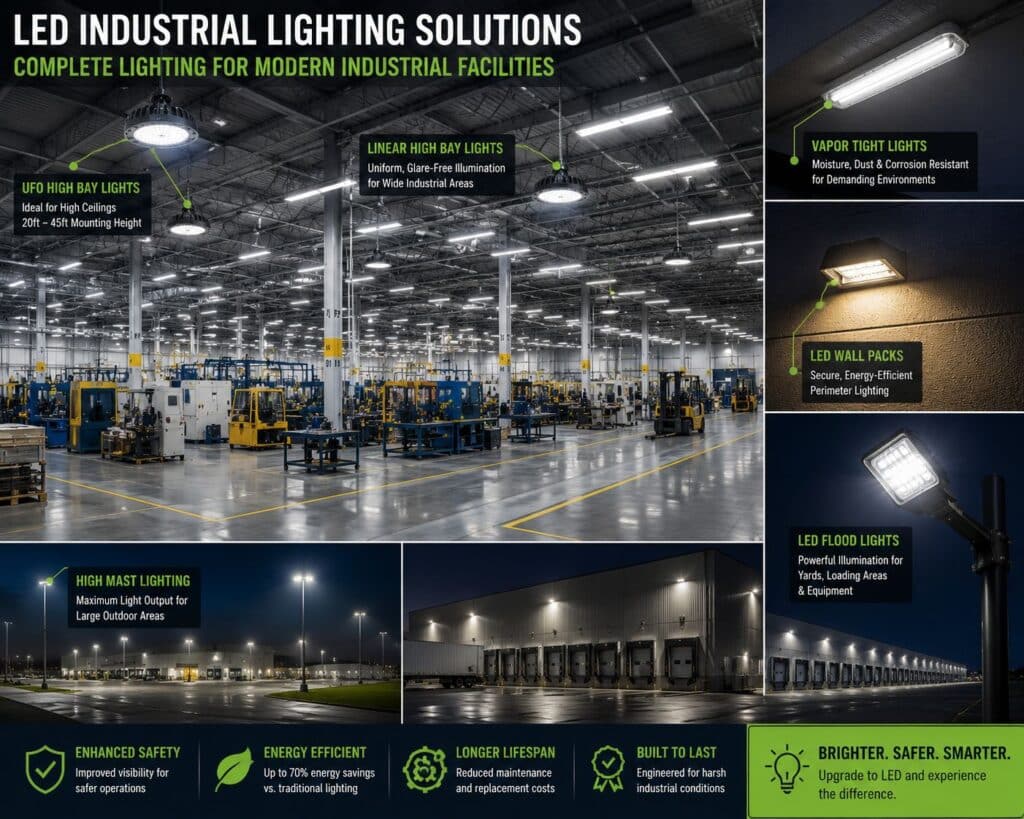
Different industrial lighting fixtures are engineered for specific environments, ceiling heights, and operating conditions to maximize safety, efficiency, and long-term performance.
Not Sure Which Type of Industrial Light You Need?
The right fixture depends on your facility and application. Ceiling height, required light levels, fixture spacing, moisture, temperature, hazardous conditions, mounting location, and operating environment all influence which industrial lighting solution will perform best.
Explore our Industrial LED Lighting solutions or call 844-533-7767 for help matching the right fixture type to your facility.
Why Different Types of Industrial Lights Exist
Every industrial facility presents unique lighting challenges.
A distribution center with 40-foot ceilings requires different optics than a fabrication shop. A food processing facility demands sealed, washdown-rated fixtures, while hazardous locations require certified explosion proof lighting designed to prevent ignition in classified environments.
Selecting application-specific fixtures improves:
- Employee safety
- Productivity
- Equipment visibility
- Maintenance efficiency
- Energy savings
- Lighting uniformity
- Regulatory compliance
Designing lighting for tall manufacturing or warehouse ceilings? Explore What Type of Manufacturing Facilities Require High Bay Lighting for high bay recommendations.
Common Types of Industrial Lights
LED High Bay Lights
High bay fixtures are designed for facilities with ceilings generally ranging from 20 to 60 feet.
Typical applications include:
- Warehouses
- Manufacturing plants
- Distribution centers
- Aircraft hangars
- Gymnasiums
- Industrial storage facilities
Benefits include:
- High lumen output
- Excellent spacing
- Reduced fixture count
- Long service life
Linear High Bay Fixtures
Linear fixtures distribute light across long aisles and workspaces.
Ideal for:
- Warehouse racking
- Logistics centers
- Production lines
- Assembly operations
Advantages include:
- Improved aisle visibility
- Better light uniformity
-
- Reduced shadows
- Excellent fixture spacing
Low Bay Fixtures
Low bay lights provide comfortable illumination in facilities with ceilings below approximately 20 feet.
Common applications include:
- Workshops
- Mechanical rooms
- Maintenance facilities
- Small manufacturing areas
Vapor Tight Fixtures
These enclosed fixtures protect internal components from dust, moisture, humidity, and washdown conditions.
Frequently installed in:
- Food processing plants
- Parking garages
- Utility tunnels
- Cold storage
- Car wash facilities
- Mechanical rooms
- Installing fixtures in wet or washdown environments? See Understanding Food Safety Lighting Requirements for recommendations on NSF-compliant industrial lighting.
-
Explosion Proof Lighting
Explosion proof fixtures are designed for classified hazardous locations where combustible gases, vapors, or dust may be present.
Typical industries include:
- Oil and gas
- Chemical processing
- Grain handling
- Paint facilities
- Refineries
- Fuel storage
Industrial Flood Lights
Flood lights illuminate large outdoor work areas.
Common uses include:
- Equipment yards
- Loading docks
- Construction sites
- Storage yards
- Rail terminals
- Outdoor manufacturing
Wall Pack Lights
Wall packs provide perimeter security lighting around industrial buildings.
Often installed at:
- Personnel entrances
- Loading docks
-
- Exterior walkways
- Utility buildings
High Mast Lighting
High mast systems illuminate very large outdoor facilities using poles typically exceeding 60 feet.
Applications include:
- Shipping terminals
- Airports
- Rail yards
- Ports
- Distribution centers
- Heavy equipment storage
Industrial Task Lighting
Task lighting supplements overhead lighting where precision work is performed.
Ideal for:
- Inspection stations
- Machine operations
- Electronics assembly
- Laboratories
- Packaging areas
Modern industrial facilities rely on LED lighting throughout nearly every workspace. Industrial LED Lighting Applications explains where different fixture types provide the greatest operational benefits.
Comparing Industrial Lighting Types
| Fixture Type | Best Application | Indoor / Outdoor | Typical Mounting Height |
|---|
| UFO High Bay | Warehouses | Indoor | 20–60 ft |
| Linear High Bay | Distribution Centers | Indoor | 20–40 ft |
| Low Bay | Workshops | Indoor | Under 20 ft |
| Vapor Tight | Wet Locations | Indoor / Outdoor | Any |
| Explosion Proof | Hazardous Areas | Indoor / Outdoor | Any |
| Flood Light | Equipment Yards | Outdoor | Pole or Building Mounted |
| Wall Pack | Building Perimeters | Outdoor | Wall Mounted |
| High Mast | Large Industrial Sites | Outdoor | 60–150 ft |
| Task Lighting | Production Areas | Indoor | Workstation |
New to industrial lighting? Start with What Is Industrial Lighting? to understand how modern LED lighting systems improve safety, efficiency, and productivity across industrial facilities.
Factors to Consider When Selecting Industrial Lights
Before purchasing industrial lighting, evaluate:
Ceiling Height
Higher mounting heights require higher lumen packages and appropriate beam distributions.
Operating Environment
Consider exposure to:
- Dust
- Moisture
- Chemicals
- Washdown procedures
- Corrosion
- High temperatures
- Cold storage conditions
Modern industrial facilities demand reliable lighting. The #1 Benefit of Vapor Tight LED Lighting explains how enclosed LED fixtures help protect against moisture, dust, and environmental contaminants.
Lighting Quality
Choose fixtures that provide:
- Uniform illumination
- Minimal glare
- Good color rendering
- Reduced shadows
- Comfortable visibility
Energy Efficiency
Modern LED systems can dramatically reduce electrical consumption while improving lighting performance.
Maintenance Requirements
Industrial LEDs minimize relamping, reduce downtime, and lower long-term operating expenses.
Before planning your next lighting upgrade, review the Industrial LED Energy Savings Guide to understand where industrial facilities achieve the greatest return on investment.
Benefits of Using the Right Industrial Lighting
| Objective | Result |
| Better Visibility | Improved employee safety |
| Higher Efficiency | Lower operating costs |
| Longer Fixture Life | Reduced maintenance |
| Improved Uniformity | Increased productivity |
| LED Technology | Lower energy consumption |
| Smart Controls | Additional utility savings |
Interested in intelligent lighting controls? Visit Lighting Controls, Occupancy and Vacancy Sensors for Energy Savings to learn how automation further improves facility efficiency.
Selecting the Best Industrial Light
The best fixture depends on your facility—not simply the highest lumen output.
Successful projects evaluate:
- Facility type
- Ceiling height
- Working environment
- Lighting layout
- Equipment locations
- Employee tasks
- Safety requirements
- Future expansion
- Maintenance accessibility
A complete lighting plan typically combines several fixture types throughout one facility.
Need help selecting fixtures for a specific application? Visit Industrial Lighting Fixtures and Their Uses to see where each lighting type performs best.
Inline Buyer Q&A
Is one industrial light suitable for every facility?
No. Different industrial environments require specialized lighting solutions based on ceiling height, environmental conditions, and operational needs.
Are LED high bays replacing metal halide fixtures?
Yes. Most industrial facilities now choose LED high bays because they consume less energy, require less maintenance, and deliver more consistent illumination.
When should vapor tight fixtures be installed?
Vapor tight fixtures are recommended wherever moisture, humidity, dust, or frequent washdowns could affect standard lighting equipment.
Upgrade Your Industrial Lighting with Expert Guidance
Selecting the right industrial lighting involves more than replacing old fixtures. Proper fixture selection improves safety, reduces maintenance, lowers operating costs, and creates a more productive work environment for years to come.
Whether you’re illuminating a warehouse, manufacturing facility, food processing plant, logistics center, or industrial yard, our lighting specialists can help you design the right LED solution for your application.
Explore our complete selection of industrial LED lights and fixtures for warehouses, manufacturing facilities, distribution centers, and demanding industrial environments.
Need help selecting the right fixture? Request a Quote or call 844-533-7767 for product recommendations, pricing, and application assistance.
Frequently Asked Questions
What is the most common industrial light?
LED high bay fixtures remain the most widely used industrial lighting solution for warehouses, manufacturing plants, and distribution facilities.
What lighting is best for food processing?
NSF-compliant vapor tight LED fixtures are commonly selected because they withstand moisture, cleaning procedures, and demanding sanitary environments.
Are industrial LEDs energy efficient?
Yes. Modern LED industrial fixtures commonly reduce lighting energy consumption by 50–80% compared to older HID or fluorescent technologies.
Can different industrial lights be used together?
Absolutely. Most facilities combine high bays, vapor tight fixtures, wall packs, flood lights, and task lighting to create a complete lighting system.
Related Industrial Lighting Resources
- Industrial Lights & LED Lighting Systems — Explore industrial LED fixtures for warehouses, manufacturing plants, distribution centers, and demanding facilities.
- Industrial Lighting Planning & Specification Guide — Learn how mounting height, light levels, fixture selection, controls, and operating conditions affect industrial lighting design.
- Industrial Lighting Fixtures and Their Uses — Compare common fixture types and where they are typically used in industrial facilities.
- Manufacturing Facility High Bay Lighting — Explore high bay lighting considerations for production floors and manufacturing environments.
- Industrial LED Energy Savings Guide — Understand the energy and operating-cost considerations involved in upgrading industrial lighting systems.
- Lighting Controls for Industrial Facilities — Learn how occupancy sensing, daylight harvesting, dimming, and other controls can improve industrial lighting performance.