
Permanent lighting provides safe everyday operation, but maintenance crews often work in areas where fixed lighting is unavailable, equipment is shut down, or temporary illumination is required. In hazardous locations, these situations demand certified explosion proof drop lights designed specifically for portable use in explosive atmospheres.
Explosion proof drop lights provide safe, dependable illumination during inspections, repairs, shutdowns, equipment maintenance, confined space entry, and emergency response. Unlike standard portable work lights, they are engineered and certified to operate safely in hazardous environments containing flammable gases, vapors, or combustible dust.
This guide explains where explosion proof drop lights are used, how they improve worker safety, and what features should be considered when selecting portable hazardous location lighting.
Looking for permanent overhead lighting solutions? Visit Explosion Proof High Bay Lighting to learn how fixed hazardous location fixtures improve facility-wide safety.
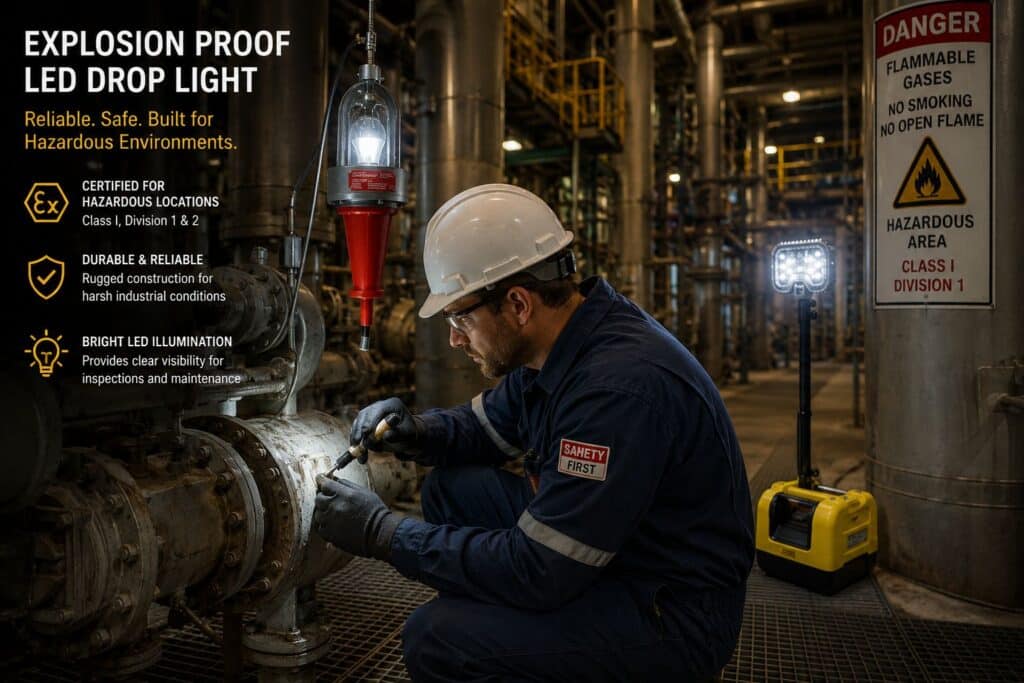
Explosion proof drop lights provide portable, certified illumination for maintenance personnel working in hazardous industrial environments.
Need Portable Explosion-Proof Lighting for Maintenance or Inspections?
Portable work in hazardous locations requires lighting matched to the classified environment. Class, Division or Zone, gas or dust group, temperature code, cord requirements, durability, and required certifications should all be considered when selecting an explosion-proof drop light.
Explore our LED Explosion-Proof Lighting solutions or call 844-533-7767 for help selecting properly rated portable lighting for your maintenance, inspection, shutdown, or confined-space application.
Why Worker Safety Depends on Portable Lighting
Many hazardous location tasks occur away from permanently illuminated work areas.
Maintenance personnel frequently work:
- Inside equipment rooms
- Around pumps and valves
- Beneath processing equipment
- Inside tanks
- In confined spaces
- During planned shutdowns
- During emergency repairs
Portable lighting helps workers safely perform these tasks while maintaining visibility throughout the work area.
What Is an Explosion Proof Drop Light?
An explosion proof drop light is a portable lighting fixture specifically designed for temporary illumination in hazardous locations.
Unlike standard construction work lights, explosion proof models are built with:
- Hazardous location certification
- Heavy-duty protective housings
- Impact-resistant lenses
- Sealed electrical connections
- Industrial-grade power cords
- Hanging hooks or mounting options
These fixtures provide temporary lighting while helping prevent ignition of hazardous atmospheres.
Common Applications
Explosion proof drop lights are commonly used during:
Equipment Maintenance
- Pump repairs
- Motor servicing
- Valve replacement
- Conveyor maintenance
Facility Shutdowns
- Planned outages
- Equipment upgrades
- Plant turnarounds
- Process modifications
Tank Inspections
- Fuel tanks
- Chemical tanks
- Storage vessels
- Process tanks
Confined Space Entry
Portable lighting is often essential when workers enter:
- Vaults
- Utility tunnels
- Process vessels
- Wet wells
- Storage tanks
Always follow confined space procedures and facility safety requirements.
Emergency Repairs
Portable hazardous location lighting helps maintenance teams respond quickly while maintaining safe visibility.
Need a broader overview of hazardous area classifications? Explore our Hazardous Location Lighting Guide covering Classes, Divisions, Groups, Zones, and temperature codes.
Worker Safety Benefits
Improved Task Visibility
Proper illumination helps workers identify:
- Equipment labels
- Leaks
- Trip hazards
- Electrical components
- Maintenance points
Improved visibility reduces the likelihood of maintenance errors and workplace accidents.
Reduced Slip and Trip Hazards
Temporary lighting helps illuminate:
- Walkways
- Stairs
- Equipment platforms
- Hose crossings
- Cable routes
This is especially valuable during shutdowns and emergency repairs.
Safe Temporary Illumination
Explosion proof drop lights provide lighting where permanent fixtures are unavailable or temporarily de-energized.
Improved Inspection Accuracy
Technicians can more easily identify:
- Corrosion
- Loose fittings
- Equipment damage
- Fluid leaks
- Mechanical wear
Better visibility contributes to more accurate maintenance decisions.
Typical Features
Certified explosion proof drop lights commonly include:
- LED light engine
- Heavy-duty cast aluminum housing
- Tempered glass or impact-resistant lens
- Protective guard
- Industrial-grade cord
- Hanging hook
- Corrosion-resistant finish
- Hazardous location certification
Many models are designed for continuous industrial use.
Choosing the Right Drop Light
Hazardous Location Rating
Verify the fixture matches the required:
- Class
- Division
- Group
- Zone
- Temperature Code
Cord Length
Choose a cord length appropriate for the work area while minimizing trip hazards.
Light Output
Select sufficient lumen output for:
- Equipment maintenance
- Inspections
- Confined spaces
- Repair work
Durability
Look for:
- Impact resistance
- Moisture resistance
- Chemical resistance
- Vibration resistance
These features improve long-term reliability.
Ready to browse certified hazardous location lighting? Explore our complete range of LED Explosion Proof Lighting designed for industrial maintenance and facility operations.
Portable Lighting Safety Best Practices
Before using explosion proof drop lights:
- Inspect cords before use
- Verify certification markings
- Protect cords from mechanical damage
- Keep electrical connections secure
- Follow lockout/tagout procedures
- Follow confined space requirements
- Remove damaged fixtures from service immediately
Portable lighting should always be incorporated into the facility’s overall safety program.
Portable Lighting Inspection Checklist
| Inspection Item | Verify |
|---|---|
| Certification Labels Visible | ✓ |
| Power Cord Undamaged | ✓ |
| Protective Guard Intact | ✓ |
| Lens Condition Acceptable | ✓ |
| Hook or Mount Secure | ✓ |
| Housing Free of Damage | ✓ |
| Electrical Connections Secure | ✓ |
Routine inspections help ensure safe operation during maintenance activities.
Inline Buyer Q&A
When are explosion proof drop lights used?
They are commonly used during inspections, maintenance, shutdowns, confined space entry, and emergency repairs.
Can standard portable work lights be used in hazardous locations?
No. Only certified hazardous location lighting should be used in classified environments.
Why are LED drop lights popular?
LED technology provides long life, excellent visibility, low maintenance, and instant illumination.
Are explosion proof drop lights permanently installed?
No. They are designed for temporary portable lighting applications.
Safe maintenance requires more than skilled technicians—it requires the right lighting. Certified explosion proof drop lights provide dependable portable illumination for inspections, repairs, confined space work, and shutdowns while helping facilities maintain hazardous location compliance and protect maintenance personnel.
Browse our complete selection of certified explosion proof lighting solutions:
https://industriallightingfixtures.org/led-explosion-proof-lighting/
Or visit our homepage to explore our full line of industrial and commercial LED lighting products:
FAQ
What is an explosion proof drop light?
It is a portable hazardous location work light designed for temporary illumination in classified environments.
Where are explosion proof drop lights commonly used?
Maintenance activities, inspections, confined spaces, shutdowns, and industrial repairs.
Can drop lights be used in oil and gas facilities?
Yes. Certified models are commonly used throughout upstream, midstream, and downstream operations.
Why are protective guards used?
Protective guards help shield the lens from accidental impacts during maintenance activities.
Do portable hazardous location lights require inspection?
Yes. Cords, housings, certification markings, and electrical components should be inspected before use.