
One of the most common questions property owners, contractors, facility managers, and engineers ask when planning an outdoor lighting project is:
“How tall should my commercial light poles be?”
The answer depends on several factors including the size of the area being illuminated, fixture output, pole spacing, local regulations, and the required light levels.
Commercial light poles can range from approximately 10 feet for pathways and pedestrian areas to 40 feet or more for large industrial facilities and outdoor storage yards. High-mast lighting systems may exceed 60 feet for airports, ports, transportation facilities, and highway interchanges. Typical commercial parking lot installations often use poles between 20 and 30 feet in height.
Selecting the correct mounting height helps maximize coverage, improve uniformity, reduce glare, and minimize the number of fixtures required.
Commercial light poles are commonly used with outdoor area lighting fixtures to illuminate parking lots, roadways, campuses, and industrial facilities. Outdoor Area Lighting
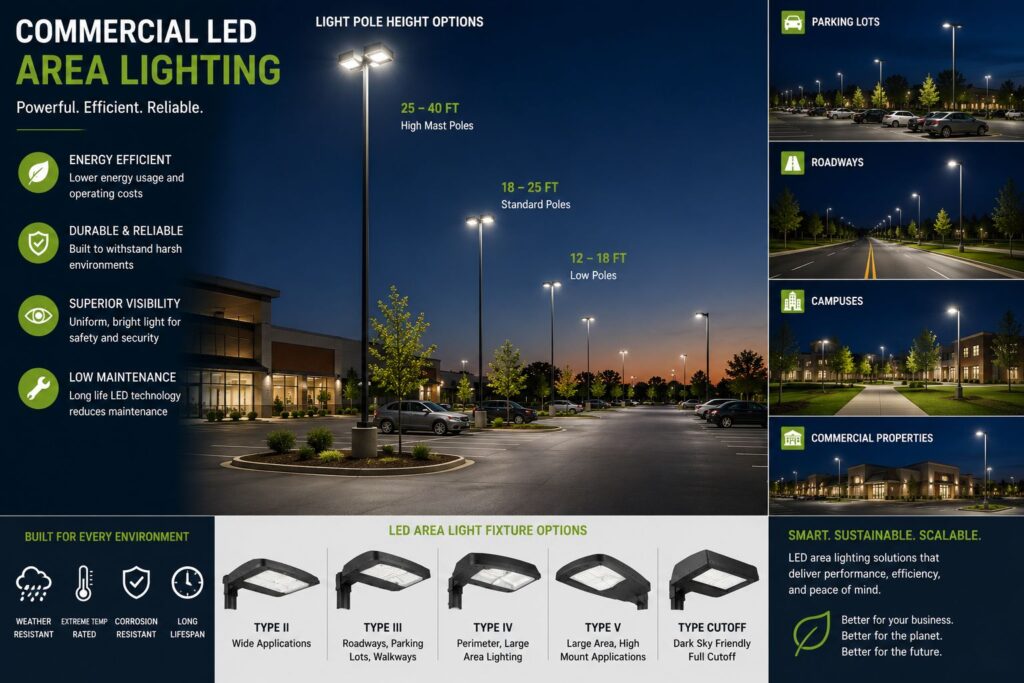
Commercial light pole height affects light distribution, fixture spacing, glare control, and overall lighting performance across a property.
Need help selecting the right pole height for your project?
Our lighting specialists can assist with pole selection, fixture matching, photometric layouts, wind load calculations, and complete outdoor lighting design recommendations.
Typical Commercial Light Pole Heights
Commercial Light Pole Height by Application
| Application | Typical Pole Height |
|---|---|
| Pathways & Walkways | 8–15 ft |
| HOA Communities | 10–16 ft |
| Campus Pathways | 10–18 ft |
| Small Parking Lots | 15–20 ft |
| Commercial Parking Lots | 20–30 ft |
| Office Complexes | 20–25 ft |
| Retail Centers | 20–30 ft |
| Industrial Facilities | 25–40 ft |
| Storage Yards | 30–40 ft |
| High Mast Applications | 60–150+ ft |
Commercial light poles are commonly used throughout parking lots, retail centers, office complexes, industrial facilities, and municipal properties. Learn more in our guide: Commercial Parking Lot Light Pole
Why Pole Height Matters
Pole height directly impacts:
- Light coverage
- Fixture spacing
- Uniformity
- Glare
- Installation cost
- Pole quantity
- Maintenance accessibility
Taller poles generally provide broader coverage but may increase spill light and require larger foundations.
Shorter poles often improve aesthetics and pedestrian comfort but require more poles and more fixtures.
Fixture selection and pole placement directly influence illumination quality. Review our Superb Illumination with a Parking Lot Light Pole resource for additional recommendations.
Small Commercial Properties
Smaller properties often benefit from lower mounting heights.
Examples include:
- Restaurants
- Medical offices
- Banks
- Small retail centers
- Churches
- Community facilities
Typical Height Range
15–20 feet
Benefits include:
- Better visual scale
- Reduced glare
- Lower installation cost
- Easier maintenance
Medium Commercial Properties
Most commercial parking lots fall into this category.
Examples include:
- Shopping centers
- Grocery stores
- Office complexes
- Schools
- Municipal buildings
Typical Height Range
20–30 feet
This range typically offers the best balance of:
- Coverage
- Uniformity
- Fixture count
- Cost efficiency
Selecting the proper pole height and fixture combination is critical for parking lot performance. Learn more in our Improve a Parking Area with a Commercial Light Pole guide.
Large Industrial Facilities
Industrial properties often require greater coverage from fewer pole locations.
Examples include:
- Distribution centers
- Manufacturing plants
- Logistics facilities
- Outdoor storage yards
- Port facilities
Typical Height Range
30–40 feet
Higher pole heights allow each fixture to illuminate a larger area, which can improve coverage across large properties and reduce the number of pole locations needed.
Some properties utilize pole-mounted flood lights instead of traditional area lights to illuminate signage, storage yards, athletic facilities, and building exteriors. LED Flood Lights
High Mast Lighting
High mast systems are used when extremely large areas require illumination.
Examples include:
- Airports
- Container terminals
- Highway interchanges
- Sports complexes
- Rail facilities
Typical Height Range
60–150 feet
High mast lighting is often selected for large outdoor facilities where broad illumination coverage is needed across expansive areas.
Pole Height vs Coverage Area
| Pole Height | Typical Coverage |
|---|---|
| 10–15 ft | Pathways & pedestrian areas |
| 15–20 ft | Small parking areas |
| 20–25 ft | Commercial parking lots |
| 25–30 ft | Large commercial sites |
| 30–40 ft | Industrial facilities |
| 60–150 ft | High mast applications |
Factors That Determine Pole Height
The correct pole height depends on:
- Property size
- Fixture lumen output
- Pole spacing
- Foot candle requirements
- Uniformity targets
- Wind loads
- Local ordinances
- Property boundaries
- Dark sky requirements
- Camera visibility
Pole height should never be selected based solely on fixture wattage.
Looking for additional information about commercial light poles and outdoor lighting applications? Visit our Commercial Light Pole guide: Commercial Light PoleInline Buyer Q&A
What is the most common commercial light pole height?
Most commercial parking lots utilize poles between 20 and 30 feet tall because they provide excellent coverage while maintaining good lighting uniformity.
Are taller light poles always better?
No. Taller poles increase coverage but can also increase glare, spill light, and foundation requirements.
What pole height is best for parking lots?
Most parking lots utilize mounting heights between 20 and 30 feet depending on fixture output and lot size.
What pole height should be used for walkways?
Pedestrian areas commonly use poles between 8 and 15 feet to create a comfortable scale and reduce glare.
Can existing poles be reused during an LED retrofit?
In many cases, yes. Existing poles can often remain in place if they meet structural and wind-load requirements.
Do taller poles require larger foundations?
Generally, yes. Pole height, fixture EPA, wind loads, and local codes influence foundation design.
Turn the Right Pole Height into the Right Lighting System
Choosing a commercial light pole height is only one part of designing an effective outdoor lighting system. Pole spacing, fixture output, beam distribution, mounting configuration, site geometry, wind loading, and foundation requirements all need to work together.
Whether you’re planning a parking lot, office complex, campus, industrial facility, storage yard, roadway, or other commercial site, our lighting specialists can help evaluate:
- Pole height and spacing
- LED fixture selection
- Photometric layouts
- Fixture mounting configurations
- Wind-load and EPA considerations
- Pole and foundation requirements
- Parking lot and commercial site lighting design
For project assistance, have your site plan, property dimensions, proposed pole locations, mounting heights, and lighting requirements available when possible.
Call 1-844-533-7767 to discuss your commercial light pole and lighting requirements.
Frequently Asked Questions
How tall is a commercial light pole?
Commercial light poles commonly range from 10 to 40 feet depending on the application.
What is the average parking lot light pole height?
Most commercial parking lot poles are between 20 and 30 feet tall.
What pole height is used for industrial facilities?
Industrial properties frequently use poles between 25 and 40 feet.
How tall are pathway light poles?
Pathway lighting typically uses poles between 8 and 15 feet.
What is high mast lighting?
High mast lighting uses poles generally exceeding 60 feet to illuminate large outdoor areas.
How does pole height affect fixture spacing?
Taller poles generally allow wider fixture spacing and broader coverage.
Does pole height affect glare?
Yes. Pole height, optics, and fixture aiming all influence glare levels.
Do local regulations limit pole height?
Many municipalities establish maximum mounting heights based on zoning and property type.
What material is best for commercial light poles?
Steel and aluminum are among the most common materials used for commercial applications.
Should a photometric plan be used when selecting pole height?
Yes. A photometric layout is often the best way to determine the proper combination of pole height, fixture output, and spacing.
Stay Connected with Our Lighting Resources
Add IndustrialLightingFixtures.org as a Preferred Source on Google to see more of our lighting guides and technical resources across Google Search experiences.

Related Commercial Light Pole & Site Lighting Resources
- Commercial Light Poles for Parking Lots — Learn how pole height, fixture selection, spacing, and site layout work together in commercial parking lot lighting design.
- Parking Lot Illumination with Commercial Light Poles — Explore practical considerations for using commercial light poles to improve parking lot coverage, visibility, and lighting uniformity.
- Commercial Outdoor Area Lighting Design Guide — Learn how fixture placement, pole spacing, mounting height, and site conditions influence outdoor area lighting performance.
- Lighting Level Recommendations — Review recommended footcandle levels for commercial and industrial applications when determining lighting requirements and system design.
- Area Lighting Pole Height Guide — Learn how mounting height affects light distribution, fixture spacing, coverage, and uniformity when designing commercial outdoor area lighting.
- LED Area Lighting Layout Guide — Explore fixture placement, pole spacing, mounting height, beam distribution, and other factors used to plan an effective LED area lighting layout.
- Commercial Site Lighting Design Guide — Learn how pole locations, fixture selection, illumination levels, and site conditions work together when planning commercial exterior lighting.
- Parking Lot Security Lighting Guide — Explore how lighting levels, uniformity, pole placement, and fixture coverage can improve nighttime visibility and support parking lot security