
Commercial light poles are a critical component of parking lot lighting systems, providing the structural support and mounting configurations needed for LED area fixtures throughout commercial properties.
Selecting a pole involves more than choosing a mounting height. Pole material, shape, wall thickness, fixture configuration, mounting method, EPA, wind conditions, foundation requirements, finish, and site conditions can all affect the appropriate pole specification.
Parking lot poles must also be coordinated with the lighting system. Fixture weight and quantity, mounting height, optical distribution, pole location, and project layout should be considered together when selecting equipment for a new installation or replacement project.
This guide explains the primary factors to consider when selecting commercial light poles for parking lots, campuses, multifamily properties, industrial facilities, and other commercial sites
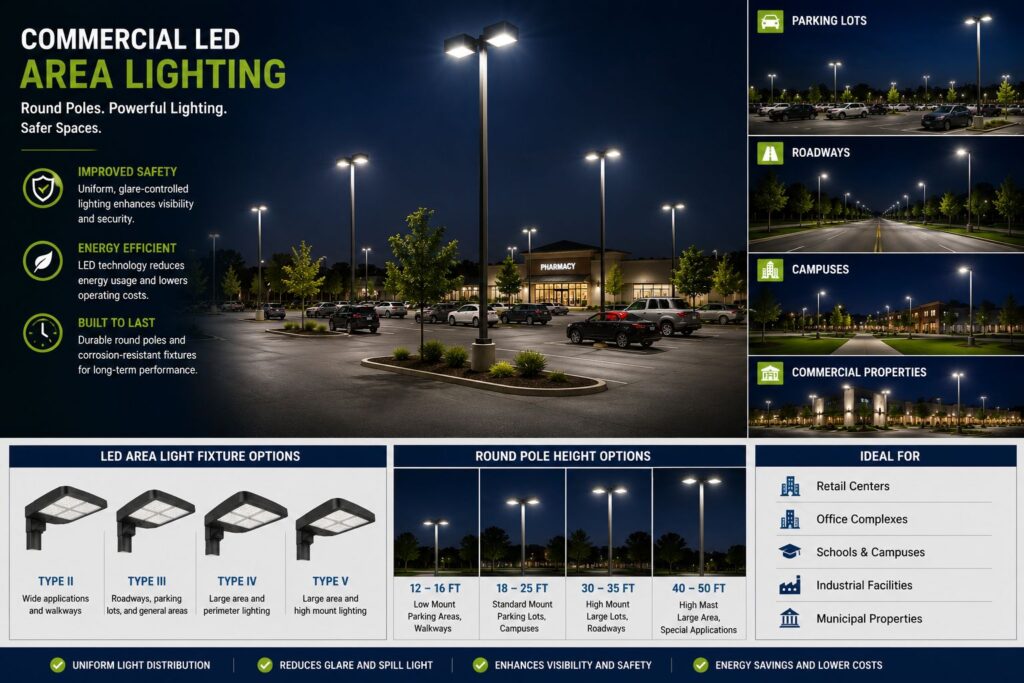
Commercial light poles support LED parking lot fixtures in configurations selected according to mounting height, fixture loading, site layout, structural requirements, and project conditions.
Selecting Commercial Light Poles for a Parking Lot Project?
Pole height is only one part of the specification. Fixture quantity and weight, mounting configuration, pole material, EPA, wind conditions, foundation requirements, and site specifications can also affect pole selection.
Explore our Commercial Light Poles, Request a Quote, or call 844-533-7767 with your required pole height, fixture configuration, project location, quantities, and specifications.
What Is a Commercial Light Pole?
A commercial light pole is a structural support designed to mount outdoor lighting fixtures above parking lots, roadways, pathways, industrial facilities, campuses, and commercial properties.
Commercial light poles are commonly manufactured from:
- Steel
- Aluminum
- Fiberglass
- Decorative materials
The pole height, fixture type, mounting configuration, and foundation design all contribute to overall lighting performance.
Pole selection can involve height, material, shape, wall thickness, base configuration, fixture mounting, fixture loading, EPA, wind conditions, finish, foundation requirements, and applicable project specifications.
The Role of Commercial Light Poles in Parking Lot Lighting
Commercial light poles provide elevated mounting locations for outdoor fixtures and must support the mechanical and structural requirements of the selected lighting equipment.
Within a parking lot lighting system, poles establish:
-
Fixture mounting height
-
Fixture location
-
Single or multiple fixture configurations
-
Arm or tenon mounting arrangements
-
Structural support for the fixture load
-
Relationship between fixtures and the site layout
-
Foundation and anchor-bolt requirements
The pole and fixture should therefore be treated as parts of the same system rather than selected independently.
.Parking lot improvements often begin with better visibility and safer lighting conditions. Learn more in our Parking Lot Light Poles for Safety, Visibility, and Security resource.
Steel vs. Aluminum Commercial Light Poles
Steel and aluminum are two common materials used for commercial parking lot light poles, with available configurations varying by manufacturer and project requirements.
Steel Light Poles
Steel poles are widely used for parking lots, roadways, industrial properties, distribution facilities, municipal sites, and other commercial applications. They are available in multiple heights, shapes, gauges, finishes, and mounting configurations.
Aluminum Light Poles
Aluminum poles are also used in commercial and architectural outdoor lighting applications and can be appropriate where corrosion resistance, appearance, pole weight, or project specifications favor aluminum construction.
Pole material should not be selected in isolation. Height, fixture loading, EPA, wind conditions, mounting configuration, finish, environment, and project specifications should all be considered.
Benefits of Commercial Light Poles
| Pole Characteristic | Why It Matters |
|---|---|
| Mounting Height | Establishes fixture elevation within the lighting layout |
| Pole Material | Influences construction, weight, corrosion considerations and available configurations |
| Pole Shape | Affects appearance, mounting options and project specifications |
| Fixture Configuration | Determines the number and arrangement of fixtures supported |
| EPA Capacity | Relates fixture and accessory wind exposure to pole capability |
| Base Configuration | Determines how the pole interfaces with the foundation or mounting surface |
| Finish | Supports appearance and environmental requirements |
| Structural Rating | Must be appropriate for the pole, fixtures, accessories and site conditions |
Many commercial light pole systems also support roadway, pathway, campus, and site lighting applications. Learn more in our Outdoor Area Lighting guide.
Typical Parking Lot Pole Heights
| Application | Typical Pole Height |
|---|---|
| Small Parking Areas | 15–20 ft |
| Retail Centers | 20–25 ft |
| Office Complexes | 20–30 ft |
| Municipal Facilities | 20–30 ft |
| Industrial Properties | 25–40 ft |
| Storage Facilities | 25–40 ft |
These ranges are general planning references, not project requirements. Pole height should be coordinated with the lighting layout, fixture photometrics, structural requirements, wind conditions, surrounding properties, and applicable project specifications.
Need help selecting fixtures and poles for your project? Visit our Commercial Lighting Fixtures page for additional guidance and product recommendations.
Coordinating Fixtures With Commercial Light Poles
Several fixture types are commonly mounted on commercial light poles.
LED Area Lights
The most common parking lot lighting solution.
Benefits include:
- Broad light distribution
- Energy efficiency
- Long service life
- Improved uniformity
LED Flood Lights
Often used for:
- Storage yards
- Building perimeters
- Signage illumination
- Security applications
Decorative Area Lights
Commonly used for:
- Campuses
- HOA communities
- Mixed-use developments
- Architectural environments
Single, Double, Triple and Quad Fixture Configurations
Commercial light poles may support one or multiple fixtures depending on the pole, mounting system, fixture characteristics, and project requirements.
Common configurations include:
-
Single fixture
-
Twin or 180-degree configuration
-
Triple fixture
-
Quad or 90-degree configuration
Adding fixtures changes the total fixture weight and effective projected area presented to wind. The complete fixture configuration should therefore be known when evaluating pole suitability rather than selecting a pole based only on height.
EPA, Fixture Loading and Wind Conditions
Commercial light pole selection should account for the fixtures and accessories mounted on the pole as well as the wind conditions applicable to the project.
Effective Projected Area (EPA) is used when evaluating the wind-exposed area of fixtures and accessories mounted to a pole. Fixture quantity, mounting arrangement, fixture shape, pole height, and other factors can affect the structural requirements of the assembly.
Pole suitability should be based on manufacturer engineering data and the applicable project requirements. Do not assume that poles of the same height are interchangeable or capable of supporting the same fixture configuration.
For quote requests, providing the project location, pole height, fixture model or dimensions, fixture quantity, mounting arrangement, and applicable structural specifications can help identify appropriate pole options.
Foundations and Anchor-Bolt Requirements
Base-mounted commercial light poles are commonly installed on concrete foundations using anchor bolts and a pole base plate.
Foundation and anchor-bolt requirements depend on factors that can include:
-
Pole height and construction
-
Fixture quantity and configuration
-
Pole and fixture loading
-
Wind conditions
-
Soil conditions
-
Foundation geometry
-
Local structural requirements
-
Manufacturer engineering information
Foundation design should be determined for the specific project rather than assumed from pole height alone.
For projects where an exposed concrete base or anchor bolts need a finished appearance, pole base covers can provide a cleaner transition between the pole and foundation.
Pole Placement and Lighting Layout
Pole location is often just as important as pole height.
Factors affecting pole placement include:
- Parking lot dimensions
- Traffic flow
- Building placement
- Property boundaries
- Landscaping
- Fixture optics
- Illumination targets
A photometric lighting plan helps determine the most effective pole locations before installation.
Replacing Existing Parking Lot Light Poles
Existing parking lot poles may need replacement because of corrosion, impact damage, structural concerns, changes in fixture configuration, property renovations, or updated project requirements.
When replacing an existing pole, useful information includes:
-
Existing pole height
-
Pole material and shape
-
Base dimensions
-
Anchor-bolt pattern
-
Fixture quantity and mounting arrangement
-
Fixture weight and dimensions
-
Existing foundation condition
-
Voltage and wiring configuration
-
Project location
-
Photographs of the existing pole and base
A replacement pole should not be assumed compatible solely because it has the same nominal height as the existing pole.
Parking lot lighting performance depends on proper pole height, fixture selection, and layout. Learn more in our Parking Lot Illumination with Commercial Light Poles guide.
Inline Buyer Q&A
What information is needed to quote a commercial light pole?
Useful information includes pole height, material or project specification, fixture quantity and mounting configuration, fixture model or dimensions, project location, quantities, finish requirements, and any applicable structural specifications.
Can an existing parking lot pole be reused with new LED fixtures?
Possibly. Existing pole condition, structural capacity, fixture weight, EPA, mounting compatibility, and the proposed fixture configuration should be evaluated before reuse.
Can I replace an existing pole with another pole of the same height?
Not necessarily. Two poles of the same height may have different materials, wall thicknesses, base dimensions, structural ratings, EPA capacities, anchor-bolt patterns, and fixture-mounting provisions.
Does fixture quantity affect pole selection?
Yes. Single, twin, triple, and quad fixture arrangements can impose different weights and effective projected areas on the pole. The complete fixture configuration should be considered.
Are steel and aluminum poles interchangeable?
Not automatically. Available structural ratings, dimensions, finishes, mounting configurations, and manufacturer specifications vary. Select the pole according to the complete project requirements.
Can you help identify a replacement for an existing pole?
Existing pole dimensions, photographs, base and anchor-bolt information, fixture details, project location, and available specifications can help identify potential replacement options.
Specify the Right Commercial Light Pole for Your Project
LED PROS WorldWide supplies commercial light poles for parking lots, industrial properties, campuses, multifamily developments, municipal sites, roadways, and other outdoor lighting applications.
For pricing and pole selection, send us your required pole height, quantity, fixture model or dimensions, number of fixtures per pole, mounting configuration, project location, finish requirements, and applicable project or structural specifications.
For replacement projects, include photos of the existing pole and base, pole dimensions, base-plate dimensions, anchor-bolt pattern, and existing fixture information when available.
Explore our Commercial Light Poles, Request a Quote, or call 844-533-7767 for pricing and application assistance.
Frequently Asked Questions
What is a commercial light pole?
A commercial light pole is a structural support used to mount outdoor lighting fixtures above parking lots, roadways, campuses, and commercial properties.
What height should parking lot light poles be?
Most parking lot lighting projects utilize poles between 20 and 30 feet, although requirements vary by application.
What fixtures are commonly mounted on commercial light poles?
LED area lights, flood lights, decorative fixtures, and roadway lighting fixtures are commonly pole mounted.
How far apart should parking lot light poles be?
Spacing depends on pole height, fixture optics, required light levels, and site layout.
Can LED fixtures improve parking lot visibility?
Yes. Modern LED fixtures provide improved light distribution, uniformity, and optical control.
What material is best for commercial light poles?
Steel and aluminum are among the most common choices for commercial outdoor lighting applications.
Do parking lot light poles improve security?
Properly designed lighting can improve visibility throughout parking areas and support surveillance systems.
Should parking lots use photometric lighting plans?
Yes. Photometric plans help determine pole placement, fixture selection, and illumination levels.
Can parking lot lighting reduce dark areas?
Proper fixture spacing and lighting design can significantly improve uniformity throughout a property.
Are decorative light poles available?
Yes. Decorative poles are commonly used in campuses, mixed-use developments, HOA communities, and architectural environments.
Stay Connected with Our Lighting Resources
Add IndustrialLightingFixtures.org as a Preferred Source on Google to see more of our lighting guides and technical resources across Google Search experiences.
Related Commercial Light Pole Resources
- Commercial Light Poles — Explore commercial pole options for parking lots, roadways, campuses, industrial properties, and outdoor lighting projects.
- Commercial Light Poles Guide — Learn more about pole materials, configurations, mounting, and project considerations.
- Area Lighting Pole Height Guide — Understand how mounting height interacts with fixture selection, optics, spacing, and site geometry.
- Parking Lot Illumination with Commercial Light Poles — Learn how poles, fixtures, mounting configurations, and site layouts work together.
- Parking Lot Base Covers — Explore covers for exposed concrete pole bases and anchor-bolt areas.
- Why Cover Light Pole Anchor Bolts? — Understand the functional and appearance considerations for exposed anchor bolts.