
Dark corners and poorly illuminated areas are among the most common problems found in commercial parking lots. These areas can develop near building edges, parking rows, landscaping features, drive aisles, loading zones, and property boundaries when lighting systems are not properly designed.
Parking lot light poles play an important role in reducing shadows and improving illumination throughout outdoor spaces. When combined with properly selected LED fixtures, pole heights, optics, and spacing, commercial lighting systems can create more consistent coverage across the property.
The goal is not simply to add more fixtures. The goal is to distribute light more effectively so visibility remains consistent throughout the parking area.
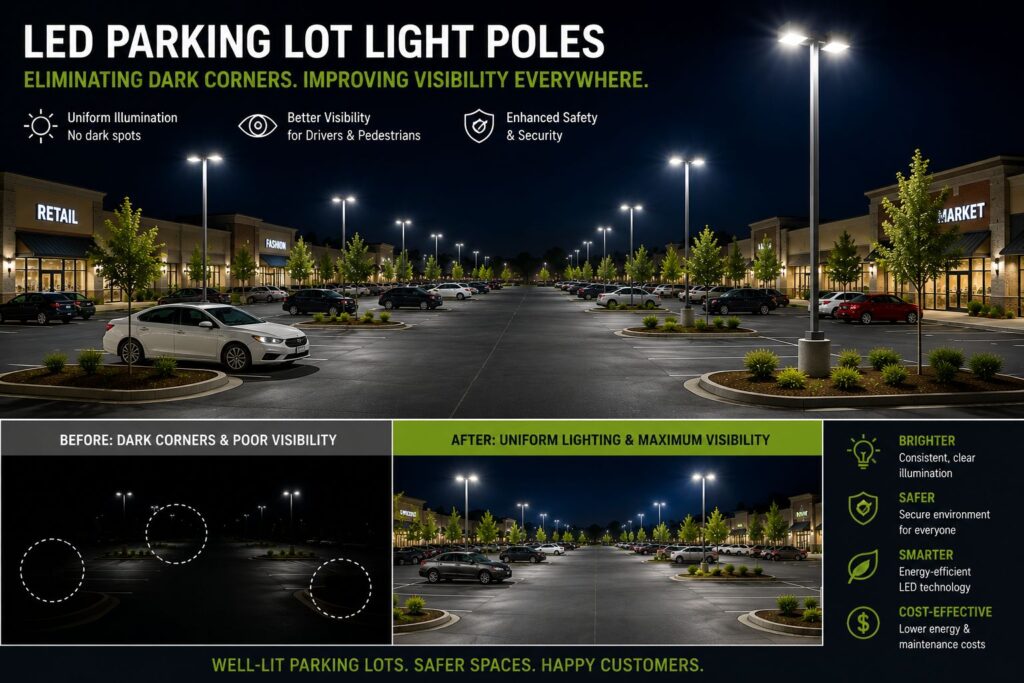
Properly positioned parking lot light poles help reduce shadows, eliminate dark areas, and improve visibility across commercial properties.
Need help eliminating dark areas in your parking lot?
Our lighting specialists can assist with pole placement, fixture selection, photometric layouts, LED retrofits, and complete parking lot lighting design recommendations.
Why Dark Areas Develop in Parking Lots
Dark areas often occur when the lighting layout fails to provide consistent coverage.
Common causes include:
- Pole spacing that is too wide
- Fixtures with improper optics
- Aging lighting systems
- Pole heights that do not match the application
- Obstructions from buildings or landscaping
- Inadequate fixture output
- Poor fixture aiming
- Property expansions that outgrow the original lighting design
Over time, these conditions can create noticeable differences between well-lit and poorly illuminated areas.
Looking for broader parking lot lighting guidance? Review our Parking Lot Illumination with Commercial Light Poles page.
Common Causes of Dark Corners
| Cause | Potential Result |
|---|
| Wide Pole Spacing | Gaps between illumination zones |
| Incorrect Optics | Light directed away from target areas |
| Obstructions | Shadows from structures or landscaping |
| Low Mounting Heights | Reduced coverage area |
| Aging Fixtures | Reduced lighting performance |
| Poor Layout Design | Uneven illumination patterns |
| Expansion Projects | Areas beyond original lighting design |
How Parking Lot Light Poles Improve Coverage
Parking lot light poles allow lighting fixtures to be mounted above the parking surface where illumination can be distributed across larger areas.
Pole placement influences:
- Coverage area
- Fixture spacing
- Uniformity
- Visibility
- Glare control
- Shadow reduction
A properly designed pole layout can help reduce abrupt transitions between bright and dark areas.
Need help with outdoor property lighting? Explore our Outdoor Area Lighting resource.
Eliminating Shadows Between Fixtures
One of the most common parking lot lighting challenges occurs between pole locations.
If fixtures are spaced too far apart:
- Illumination levels may drop significantly
- Shadows can form between coverage zones
- Pedestrian visibility may decrease
- Vehicle navigation may become more difficult
Lighting designers often address this by evaluating pole spacing, mounting height, fixture output, and optic selection together rather than focusing on any single component.
Looking for fixture recommendations? Visit our Commercial Lighting Guide.
Design Elements That Influence Uniformity
| Design Element | Effect on Dark Areas |
| Pole Height | Influences fixture coverage area |
| Pole Spacing | Affects overlap between fixtures |
| Fixture Output | Determines available illumination |
| Optics | Controls light distribution |
| Mounting Configuration | Supports broader coverage patterns |
| Photometric Layout | Identifies potential dark spots before installation |
Building Perimeters and Property Edges
Dark corners frequently develop near:
- Building walls
- Rear service areas
- Loading docks
- Property boundaries
- Storage zones
- Utility areas
These locations often receive less attention than central parking areas.
Parking lot light poles can work together with wall-mounted fixtures and perimeter lighting to improve illumination in these areas.
Landscaping and Obstructions
Trees, shrubs, monument signs, and architectural features can influence light distribution.
Potential issues include:
- Blocked fixture output
- Shadow creation
- Reduced visibility
- Uneven illumination
Lighting layouts should account for existing and future landscaping conditions whenever possible.
Uniform Illumination Creates Better Visibility
Adding more brightness does not always eliminate dark areas.
A parking lot with extreme contrasts between bright and dark zones can still feel poorly illuminated.
Uniform illumination helps:
- Improve visibility
- Reduce shadows
- Support pedestrian awareness
- Improve driver recognition
- Support surveillance systems
- Create a cleaner property appearance
Consistency often matters more than maximum brightness.
Interested in modern light pole technologies and configurations? Visit our Navigating the Landscape of Modern Commercial LED Light Poles guide.
Photometric Lighting Plans Help Identify Dark Areas
Photometric lighting layouts help evaluate:
- Fixture placement
- Pole locations
- Illumination levels
- Uniformity
- Coverage overlap
- Potential shadow zones
These layouts allow lighting designers to identify problem areas before installation.
Inline Buyer Q&A
How do I know whether I need additional light poles or different fixtures?
Dark areas do not always mean more poles are required. A photometric evaluation can help determine whether the problem is pole placement, fixture output, optics, mounting height, spacing, or an obstruction affecting light distribution.
Will taller parking lot poles eliminate dark areas?
Not necessarily. Greater mounting height can increase fixture coverage, but pole height must be coordinated with fixture output, optics, spacing, and the dimensions of the property to maintain appropriate illumination and uniformity.
Can existing parking lot poles be reused during an LED upgrade?
Often, yes. Existing poles may be suitable for new LED area lights if their condition, height, mounting configuration, and structural capacity are appropriate for the replacement fixtures.
What information is needed to plan better parking lot lighting?
Useful project information includes parking lot dimensions, existing or proposed pole locations and heights, fixture mounting details, surrounding buildings and landscaping, and the illumination requirements for the property.
Is a photometric layout worthwhile before purchasing parking lot lights?
Yes. A photometric layout can predict light levels and uniformity before installation, helping identify potential dark areas and evaluate pole locations, fixture quantities, mounting heights, and optical distributions.
Eliminate Dark Areas Before the Lights Are Installed
Effective parking lot lighting depends on the right combination of pole height, fixture placement, spacing, lumen output, and optical distribution. A properly planned system can improve uniformity and reduce poorly illuminated areas without simply adding more fixtures.
👉 Explore Commercial Parking Lot Lighting or call 1-844-533-7767 to discuss your parking lot lighting project.
Frequently Asked Questions About Parking Lot Light Poles
What are dark corners in parking lots?
Dark corners are areas that receive insufficient illumination compared to surrounding portions of the property.
Why do parking lots develop dark areas?
Dark areas often result from improper pole placement, fixture spacing, obstructions, or outdated lighting systems.
Can parking lot light poles reduce shadows?
Properly positioned poles can help improve coverage and reduce shadowed areas.
What fixtures are commonly used to improve parking lot visibility?
LED area lights are among the most common fixture types used for parking lot applications.
How does pole spacing affect illumination?
Pole spacing influences how fixture coverage overlaps throughout the parking area.
Can photometric layouts identify lighting problems?
Yes. Photometric plans help evaluate illumination levels and identify potential problem areas.
Do LED fixtures improve parking lot performance?
LED fixtures often provide improved optical control, efficiency, and illumination consistency.
What areas commonly experience poor illumination?
Building perimeters, property edges, loading areas, landscaping zones, and rear access points are common problem areas.
How can I improve parking lot uniformity?
Improving pole placement, fixture selection, spacing, and lighting layouts can significantly improve uniformity.
Should parking lot lighting be professionally designed?
Professional lighting layouts help optimize coverage, reduce dark areas, and improve overall performance.
Stay Connected with Our Lighting Resources
Add IndustrialLightingFixtures.org as a Preferred Source on Google to see more of our lighting guides and technical resources across Google Search experiences.
Related Parking Lot & Light Pole Resources
Continue planning parking lot lighting for improved coverage, uniformity, visibility, and site performance with these related pole and lighting-design resources:
-
- Improve Parking Lot Lighting — Review how commercial light poles, fixture placement, and site-lighting decisions can improve illumination throughout parking areas.
- How Tall Is a Commercial Light Pole? — Understand how mounting height affects fixture coverage, pole spacing, light distribution, and the overall performance of an outdoor lighting system.
- Commercial Light Poles Guide — Review pole heights, construction, mounting considerations, and selection factors when specifying light poles for commercial outdoor applications.
- Outdoor Area Lighting — Explore commercial area lighting solutions for parking lots, roadways, campuses, building surroundings, and other large outdoor spaces.