
Parking lot illumination is an important part of a commercial outdoor lighting system. Lighting should support driver and pedestrian visibility across parking spaces, drive lanes, entrances, walkways, and other active areas after dark.
Commercial light poles provide the structure and mounting height needed to position LED fixtures throughout a parking area. Effective illumination depends on coordinating the poles with fixture output, optical distribution, spacing, mounting configuration, site geometry, and project lighting requirements.
Selecting a commercial light pole involves more than fixture mounting. Pole height, construction, wind loading, fixture configuration, foundation requirements, and site conditions should all be considered as part of the complete lighting system.
The objective is not simply to make a parking lot brighter, but to provide appropriate illumination, uniformity, glare control, and light distribution for the property.
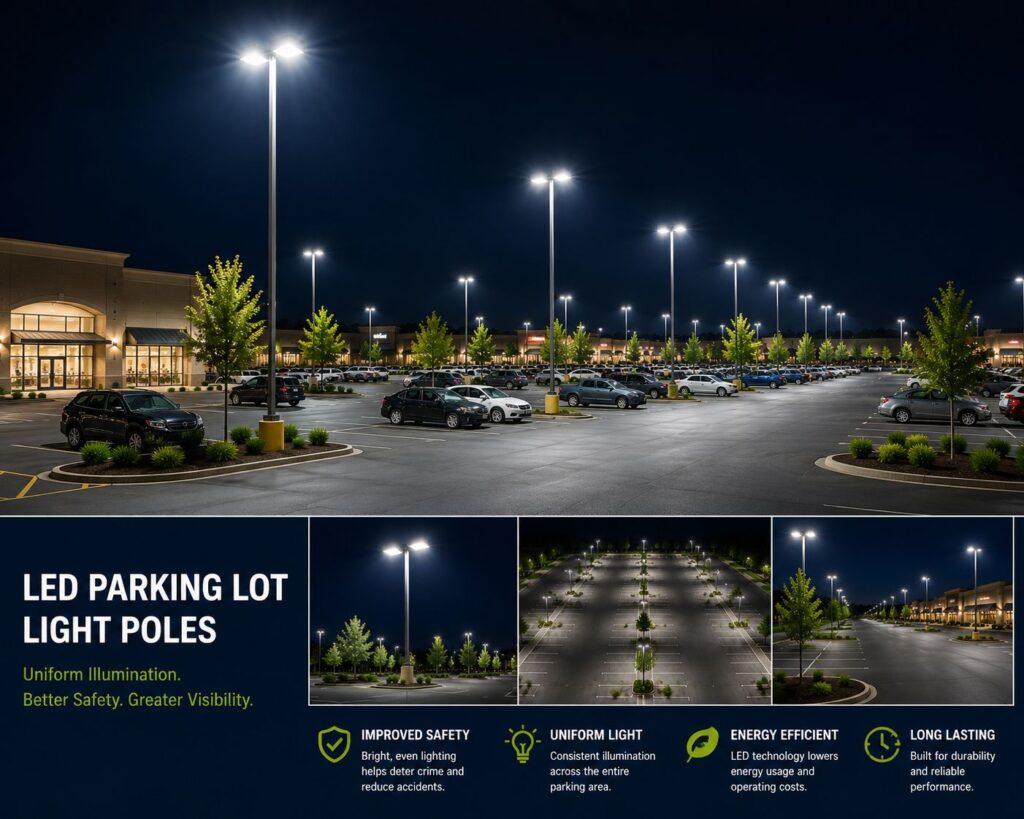
Commercial light poles position LED parking lot fixtures at selected mounting heights to coordinate illumination, optical distribution, fixture spacing, and site coverage.
Planning a Commercial Pole and Parking Lot Lighting Project?
The right combination of commercial light poles, LED fixtures, mounting heights, optical distributions, and fixture locations depends on the property and project requirements.
Explore our Commercial Light Poles and LED Parking Lot Lights, Request a Quote, or call 844-533-7767 with your site dimensions, pole requirements, fixture quantities, voltage, mounting configuration, and project specifications.
What Is Parking Lot Illumination?
Parking lot illumination refers to the amount, quality, and distribution of light across a parking area.
Good illumination should help support:
- Vehicle movement
- Pedestrian visibility
- Parking space visibility
- Building access
- Security camera performance
- Property appearance
- Nighttime navigation
Commercial light poles position fixtures above the parking surface so their optical distributions can be coordinated with the parking area and surrounding site.
Why Commercial Light Poles Matter
Commercial light poles are more than fixture supports. They directly influence how well a parking lot lighting system performs.
Pole height, spacing, mounting configuration, and fixture selection affect:
- Light coverage
- Uniformity
- Glare control
- Fixture quantity
- Pole placement
- Maintenance access
- Overall site appearance
A parking lot with poorly placed poles may have bright spots near fixtures and dark areas between them. A properly designed system creates more consistent illumination throughout the property.
Looking for complete commercial lighting guidance? Visit our Commercial Light Poles Guide.
Parking Lot Illumination Design Factors
| Design Factor | Why It Matters |
|---|
| Pole Height | Affects coverage area and light distribution |
| Fixture Output | Determines available light for the parking area |
| Pole Spacing | Affects fixture overlap and illumination patterns |
| Fixture Optics | Controls where the light is directed |
| Mounting Configuration | Supports single, double, or multiple fixture layouts |
| Property Layout | Influences pole placement and coverage needs |
| Glare Control | Improves visual comfort for drivers and pedestrians |
| Photometric Planning | Helps verify light levels before installation |
Common Parking Lot Light Pole Applications
Commercial light poles are used in many parking lot environments, including:
- Retail centers
- Office buildings
- Medical facilities
- Schools
- Churches
- Municipal buildings
- Warehouses
- Distribution centers
- Industrial facilities
- Apartment communities
- HOA properties
- Storage facilities
Each property type may require a different lighting layout depending on traffic flow, operating hours, fixture height, and visibility requirements.
Need help improving an existing parking area? Visit our Improve a Parking Area with a Commercial Light Pole guide for pole selection and layout recommendations.
Typical Commercial Light Pole Heights
Pole height should be selected based on the size of the parking area, fixture output, spacing requirements, and site conditions.
Typical Pole Heights by Parking Lot Type
| Parking Lot Type | Common Pole Height Range |
| Small Commercial Lots | 15–20 ft |
| Retail Parking Lots | 20–25 ft |
| Office Complexes | 20–30 ft |
| Municipal Parking Areas | 20–30 ft |
| Industrial Parking Lots | 25–40 ft |
| Large Outdoor Sites | 30–40 ft |
These ranges are general planning references rather than design requirements. Appropriate pole height depends on fixture output and photometrics, optical distribution, pole spacing, site geometry, surrounding properties, structural and wind requirements, and project-specific lighting criteria.
Lower poles may be appropriate for smaller lots, pedestrian-focused areas, and properties where visual scale is important. Taller poles may be used for larger lots where broader coverage is needed.
LED Fixtures for Parking Lot Illumination
Modern parking lot light poles are commonly paired with LED area lights because LED fixtures offer efficient performance, long service life, and improved optical control.
Common pole-mounted fixture options include:
LED Area Lights
LED area lights are the most common choice for parking lot illumination. They provide broad distribution for parking spaces, drive aisles, entrances, and open paved areas.
LED Flood Lights
LED flood lights may be used where directional illumination is needed, such as building perimeters, storage areas, signs, or specific security zones.
Decorative Pole Fixtures
Decorative fixtures may be used in campuses, HOA communities, retail centers, and architectural properties where appearance is a major consideration.
Selecting the proper pole involves more than fixture mounting; pole height, construction, wind loading, mounting configuration, and site requirements all need to be considered. Explore our commercial light poles for available pole types and project options.
For safety, visibility, and dark area reduction, review our Parking Lot Light Poles for Safety, Visibility, and Security resource.
Uniformity Matters Along With Illumination Levels
Average illumination alone does not describe how evenly light is distributed across a parking area.
Uniformity describes the relationship between brighter and darker portions of the illuminated area and should be evaluated together with average, minimum, and maximum illumination.
Parking lot uniformity is influenced by:
-
Fixture output
-
Optical distribution
-
Pole locations
-
Mounting height
-
Fixture spacing
-
Orientation
-
Site geometry
Increasing fixture wattage or lumen output alone does not necessarily improve uniformity. The complete lighting layout should be evaluated when determining how fixtures and poles work together across the property.
For a deeper discussion, see our Parking Lot Lighting Uniformity Guide.
Poor Illumination vs Proper Illumination
| Lighting Condition | Potential Effect |
|---|---|
| Insufficient fixture output | Illumination may fall below project criteria |
| Excessive fixture output | Increased brightness, glare, energy use, or light trespass |
| Poorly coordinated pole locations | Uneven fixture overlap or difficult-to-light areas |
| Inappropriate optical distribution | Light may not be directed effectively for the pole location |
| Mounting height poorly coordinated with fixture and layout | Changes illumination, overlap, glare, and distribution |
| Excessive spacing for the selected fixtures | Insufficient overlap between neighboring distributions |
| Poor fixture orientation | Unwanted light or reduced illumination in intended areas |
| Coordinated pole and fixture layout | Helps address project illumination, uniformity, glare, and distribution objectives |
| Photometric analysis | Models predicted performance before installation |
Pole Placement and Fixture Spacing
Pole placement should be planned around how people and vehicles move through the property.
Important considerations include:
- Parking stall layout
- Drive aisles
- Building entrances
- Pedestrian walkways
- Property boundaries
- Landscaping
- Existing utilities
- Security camera views
- Neighboring properties
- Pole foundation locations
A photometric layout can help determine where poles should be placed and how fixtures should be aimed.
Planning a broader site lighting project? See our Outdoor Area Lighting page for outdoor fixture applications.
Inline Buyer Q&A
What type of pole is best for parking lot illumination?
Steel and aluminum commercial light poles are commonly used for parking lot lighting. The best choice depends on pole height, fixture weight, wind exposure, mounting configuration, and project requirements.
How do I know what pole height to use?
Pole height depends on the size of the parking lot, fixture output, desired coverage, and lighting layout. A photometric plan is the best way to confirm the proper height and spacing.
Are LED parking lot lights better than older fixtures?
LED parking lot fixtures generally provide better optical control, longer service life, lower energy use, and reduced maintenance compared with older lighting technologies.
Can existing poles be reused?
Existing poles may be reused if they are structurally sound and compatible with the new fixture weight, mounting style, and wind load requirements.
How many light poles does a parking lot need?
The number of poles depends on parking lot dimensions, fixture output, pole height, mounting configuration, and desired illumination levels.
Should parking lot lighting be brighter or more uniform?
Uniformity is often more important than brightness alone. Even light distribution helps reduce shadows and improves visibility across the property.
Do commercial light poles require foundations?
Yes. Commercial light poles typically require properly designed foundations based on pole height, fixture load, soil conditions, and local requirements.
Coordinate the Poles and Fixtures for Your Parking Lot Project
Commercial light poles and LED parking lot fixtures should be selected as parts of the same lighting system. Pole height, construction, mounting configuration, fixture output, optical distribution, spacing, electrical requirements, and site conditions all influence the final equipment selection.
Send us your site plan or property dimensions, required pole heights if specified, fixture and pole quantities, mounting configuration, voltage, wind or structural requirements, existing equipment when applicable, and project specifications.
LED PROS WorldWide can help identify commercial light pole and LED fixture options appropriate for new construction, property upgrades, and parking lot retrofit projects.
Explore our Commercial Light Poles and LED Parking Lot Lights, Request a Quote, or call 844-533-7767 for pricing and project assistance.
Frequently Asked Questions
What is parking lot illumination?
Parking lot illumination is the lighting coverage provided across parking spaces, drive aisles, walkways, entrances, and outdoor property areas.
Why are commercial light poles used in parking lots?
Commercial light poles elevate fixtures so light can be distributed across wider outdoor areas.
What fixtures are used on parking lot light poles?
LED area lights, flood lights, and decorative outdoor fixtures are commonly mounted on parking lot light poles.
How tall should parking lot light poles be?
Pole height depends on the size of the lot, fixture output, pole spacing, and lighting requirements.
What causes dark spots in parking lots?
Dark spots may result from poor pole placement, inadequate fixture output, wide spacing, blocked light, or improper optics.
Can LED lighting improve parking lot illumination?
Yes. LED fixtures can improve light distribution, uniformity, and energy efficiency when properly selected and installed.
What is a photometric lighting plan?
A photometric lighting plan models fixture placement, light levels, and coverage before installation.
How far apart should parking lot poles be?
Spacing depends on pole height, fixture optics, output, and the desired illumination pattern.
Are decorative light poles suitable for parking lots?
Yes. Decorative poles and fixtures can be used when appearance, architectural style, or community design standards are important.
What is the best way to improve parking lot lighting?
The best approach is to evaluate pole placement, fixture type, mounting height, illumination levels, and uniformity using a proper lighting layout.
Stay Connected with Our Lighting Resources
Add IndustrialLightingFixtures.org as a Preferred Source on Google to see more of our lighting guides and technical resources across Google Search experiences.
Related Parking Lot & Commercial Pole Resources
- Commercial Light Poles — Explore steel, aluminum, square, round, and other commercial pole options for outdoor lighting projects.
- LED Parking Lot Lights — Explore commercial LED area fixtures and optical distributions for parking areas.
- Area Lighting Pole Height Guide — Understand how mounting height interacts with fixture output, optics, spacing, and site geometry.
- LED Area Lighting Layout Guide — Coordinate pole locations, fixture placement, mounting height, and optical distribution.
- Parking Lot Lighting Uniformity Guide — Learn how fixture overlap, pole spacing, optics, and output influence lighting uniformity.
- Parking Lot Foot-Candle Requirements — Evaluate average, minimum, and maximum illumination and project-specific lighting criteria.