
Parking lot lighting affects far more than visibility alone. A properly illuminated parking area can help drivers navigate more confidently, improve pedestrian awareness, support surveillance systems, and create a greater sense of security throughout a property.
Commercial parking lot light poles elevate lighting fixtures above parking spaces, travel lanes, sidewalks, and building entrances to distribute illumination across the property. When pole height, fixture selection, and lighting layout are properly planned, parking lot lighting can help reduce shadows, improve visibility, and create a safer experience for employees, customers, visitors, and tenants.
Planning a new installation or replacing existing poles? Explore our Commercial Light Poles for steel and aluminum pole configurations, mounting options, and outdoor LED lighting applications.
Whether serving a retail center, office complex, school, medical facility, apartment community, or industrial property, parking lot light poles play a critical role in nighttime safety and security.
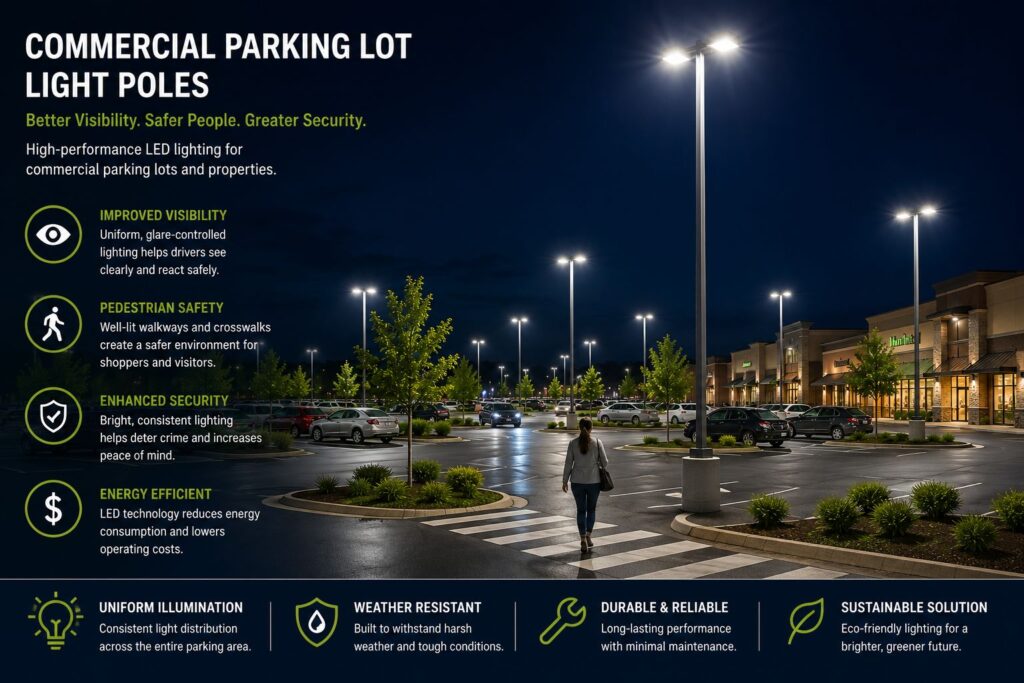
Properly designed parking lot light pole systems help improve visibility, reduce dark areas, and support safer outdoor environments.
Need help improving parking lot visibility and safety?
Our lighting specialists can help with commercial light poles, LED parking lot lighting, fixture selection, pole height recommendations, and photometric lighting layouts.
Why Parking Lot Safety Starts with Lighting
Many parking lot safety concerns are directly related to visibility.
Poorly illuminated areas can make it difficult to:
- Identify pedestrians
- See obstacles
- Locate entrances
- Navigate traffic patterns
- Monitor activity
- Support security cameras
A well-designed lighting system helps create a more predictable and comfortable environment for both drivers and pedestrians.
Safety Benefits of Parking Lot Light Poles
| Benefit | Impact |
|---|
| Improved Visibility | Easier navigation throughout the property |
| Better Pedestrian Awareness | Improved recognition of walkways and crossings |
| Reduced Dark Areas | Fewer shadowed locations |
| Enhanced Security | Improved visibility around buildings and vehicles |
| Camera Support | Better surveillance coverage |
| Traffic Guidance | Improved visibility of lanes and parking spaces |
| Increased Comfort | Creates a more welcoming environment |
| Property Appearance | Enhances the professional appearance of the site |
Looking for broader illumination guidance? Review our Parking Lot Illumination with Commercial Light Poles guide to learn how pole placement and fixture selection affect overall lighting performance.
Reducing Dark Areas Throughout the Property
Dark areas often develop when:
- Poles are spaced too far apart
- Fixtures use improper optics
- Pole heights are inconsistent
- Landscaping blocks illumination
- Existing fixtures have deteriorated
The goal of a parking lot lighting system should be to provide balanced illumination across the property rather than creating isolated bright spots.
Proper pole placement helps maintain visibility across:
- Parking stalls
- Drive lanes
- Sidewalks
- Building entrances
- Loading zones
- Property edges
Modern LED light pole systems help improve coverage and reduce dark areas throughout commercial properties. Explore additional recommendations in our Banish Dark Corners with a Parking Lot Light Pole resource.
Visibility for Drivers and Pedestrians
Parking lots are shared environments where vehicles and pedestrians interact continuously.
Lighting can help improve visibility for:
- Drivers entering and exiting parking spaces
- Pedestrians crossing drive lanes
- Customers approaching entrances
- Employees leaving after dark
- Visitors navigating unfamiliar properties
Good lighting design improves awareness of surroundings and supports safer movement throughout the site.
Need recommendations for improving an existing parking area? Visit our Improve a Parking Area with a Commercial Light Pole resource for additional planning guidance.
Areas That Benefit from Parking Lot Lighting
| Area | Lighting Objective |
| Parking Spaces | Vehicle and pedestrian visibility |
| Drive Aisles | Traffic movement |
| Building Entrances | Safe access |
| Sidewalks | Pedestrian navigation |
| Crosswalks | Improved visibility |
| Loading Areas | Operational safety |
| Property Perimeters | Security visibility |
| Gathering Areas | Occupant comfort |
Supporting Security Objectives
While lighting alone cannot provide security, it can support broader security strategies.
Parking lot lighting can help:
- Improve visibility throughout the property
- Support camera performance
- Improve recognition of activity
- Increase awareness around entrances and exits
- Reduce shadowed areas
- Improve sightlines between buildings and parking areas
A properly illuminated property often feels safer and more welcoming to visitors.
Pole Height and Visibility
Pole height influences how light is distributed throughout a parking lot.
Factors affected by pole height include:
- Coverage area
- Uniformity
- Fixture spacing
- Glare control
- Visual comfort
The ideal mounting height depends on the size of the property, fixture output, parking lot layout, and illumination goals.
Improving Visibility Around Building Entrances
Building entrances often experience the highest levels of pedestrian activity.
Lighting around entrances should support:
- Door visibility
- Wayfinding
- Sidewalk illumination
- Security camera coverage
- Visitor comfort
Parking lot light poles often work together with wall-mounted fixtures and canopy lighting to illuminate these areas.
Uniform Lighting Creates Better Visibility
Uniform lighting is often more important than brightness alone.
Benefits of improved uniformity include:
- Reduced shadows
- Improved visibility between fixtures
- Better driver awareness
- Improved pedestrian recognition
- More comfortable visual conditions
A photometric lighting layout can help determine the best combination of pole height, spacing, and fixture selection.
Inline Buyer Q&A
How do parking lot light poles improve visibility?
Light poles elevate fixtures so illumination can be distributed across parking spaces, drive aisles, pedestrian routes, entrances, and other portions of the property.
Pole height, placement, fixture output, and optical distribution work together to determine how effectively the light reaches the intended areas.
Can better pole placement reduce dark areas?
Yes. Appropriate pole locations, mounting heights, fixture spacing, and optical distributions can reduce poorly illuminated areas and excessive differences between bright and dark portions of a parking lot.
A photometric layout can identify potential coverage problems before fixtures and poles are installed.
What pole height is best for a parking lot?
There is no single ideal parking lot pole height.
The appropriate mounting height depends on property size and geometry, existing or proposed pole locations, fixture output, optical distribution, required illumination, surrounding properties, and lighting objectives.
Photometric analysis can help evaluate different mounting heights before the system is specified.
Does brighter lighting automatically improve parking lot visibility?
Not necessarily. Simply increasing fixture output can create excessive brightness, glare, spill light, and stronger contrast between illuminated and darker areas.
A well-designed parking lot lighting system considers useful illumination, uniformity, fixture distribution, pole placement, glare control, and surrounding conditions rather than maximizing brightness alone.
Can existing parking lot poles be reused for an LED retrofit?
Many existing poles can remain in service when they are structurally suitable and compatible with the proposed LED fixtures.
Pole condition, corrosion, anchor bolts, foundations, mounting configuration, fixture weight, EPA, wind loading, and other structural considerations should be evaluated before reuse.
How do I know how many poles and fixtures my parking lot needs?
The required quantity depends on parking-lot dimensions and geometry, pole locations, mounting heights, fixture output, optical distributions, required light levels, uniformity objectives, property boundaries, and surrounding conditions.
A photometric lighting plan provides the most reliable method for evaluating pole and fixture quantities before installation.
Need Help Improving Parking Lot Visibility and Safety?
Effective parking lot lighting depends on the relationship between poles, mounting heights, LED fixtures, optical distributions, spacing, and overall site layout.
Whether you’re upgrading an existing parking lot or planning a new installation, our lighting specialists can help evaluate commercial light poles, LED parking lot fixtures, retrofit options, mounting heights, and photometric layouts.
Call 1-844-533-7767 to discuss your commercial parking lot lighting project.
Frequently Asked Questions
What are parking lot light poles?
Parking lot light poles are structural supports used to position outdoor luminaires at appropriate mounting heights above parking areas, drive aisles, pedestrian routes, and other portions of commercial properties.
The pole, fixture, mounting hardware, foundation, and electrical system work together as part of the overall lighting installation.
Why is parking lot lighting important?
Properly designed parking lot lighting supports nighttime visibility, pedestrian awareness, vehicle navigation, identification of entrances and pathways, and the overall nighttime appearance of a property.
Lighting can also complement other site-design and security measures, but illumination alone does not guarantee safety or security.
Can parking lot lighting improve security?
Lighting can improve nighttime visibility and reduce poorly illuminated areas, which may support broader property-security objectives.
However, security depends on multiple factors including site design, access control, surveillance, landscaping, property management, and other measures. Lighting should be considered one component of the overall strategy.
What causes dark areas in parking lots?
Dark or poorly illuminated areas can result from inadequate pole placement, inappropriate mounting heights, insufficient fixture output, unsuitable optical distributions, obstructions, failed equipment, or an inconsistent lighting layout.
Photometric analysis can help identify these conditions during the design process.
What fixtures are commonly mounted on parking lot poles?
LED area lights are commonly used because their optical distributions can be selected for different pole locations and parking-lot geometries.
Depending on the property and application, other outdoor luminaires may also be pole mounted. Fixture selection should be based on the required lighting performance rather than fixture style alone.
How tall should parking lot light poles be?
Pole height is project-specific and should be coordinated with fixture output, optical distribution, pole spacing, property dimensions, required illumination, surrounding conditions, and applicable structural requirements.
There is no universal mounting height appropriate for every commercial parking lot.
What is lighting uniformity?
Lighting uniformity describes the relationship between illumination levels across an area.
Good uniformity helps limit excessive differences between brighter and darker portions of a parking lot and can contribute to more consistent nighttime visibility.
Are LED parking lot lights energy efficient?
LED area lights can provide substantial energy savings compared with many older metal halide, high-pressure sodium, and other legacy lighting systems.
Actual savings depend on existing and replacement wattage, fixture quantities, operating hours, controls, and lighting requirements.
What is a photometric lighting plan?
A photometric plan models predicted lighting performance across a property before installation.
It can evaluate fixture locations, mounting heights, optical distributions, predicted illumination levels, uniformity, and potential spill light. This allows different lighting configurations to be compared before poles and fixtures are finalized.
How can I improve visibility in an existing parking lot?
Start by evaluating existing illumination, pole locations and heights, fixture condition and distribution, dark areas, excessive brightness, glare, controls, and surrounding conditions.
Depending on the findings, improvements may involve replacing fixtures, changing optics or output, repositioning or adding poles, adjusting mounting configurations, or redesigning portions of the lighting layout.
Stay Connected with Our Lighting Resources
Add IndustrialLightingFixtures.org as a Preferred Source on Google to see more of our lighting guides and technical resources across Google Search experiences.
Related Parking Lot Lighting Resources
- Parking Lot Security Lighting Guide — Learn how uniformity, fixture placement, glare control, pedestrian visibility, and dark areas influence commercial parking-lot lighting design.
- How Tall Is a Commercial Light Pole? — Review how application, fixture output, optics, site dimensions, and lighting objectives influence commercial pole height.
- Commercial Light Poles Guide — Learn how pole height, material, mounting configuration, wind loading, EPA, and structural considerations affect commercial pole selection.
- Outdoor Area Lighting — Explore commercial area-lighting solutions for parking lots, roadways, campuses, industrial properties, and other large outdoor spaces.
- Improve Parking Lot Lighting — Review additional strategies for coordinating commercial light poles and fixtures to improve parking-area illumination.