
Construction site lighting levels directly affect how well workers can see equipment, materials, walking surfaces, obstacles, and the tasks being performed around them. Providing enough light is particularly important during nighttime construction, inside unfinished buildings, and in areas where permanent lighting has not yet been installed.
Determining how much light a jobsite needs involves more than selecting fixtures with high lumen ratings. Contractors must consider required foot-candle levels, work area size, mounting height, beam distribution, fixture spacing, shadows, glare, and changing construction conditions.
Understanding these factors makes it easier to develop a temporary lighting layout that delivers usable illumination where workers actually need it.
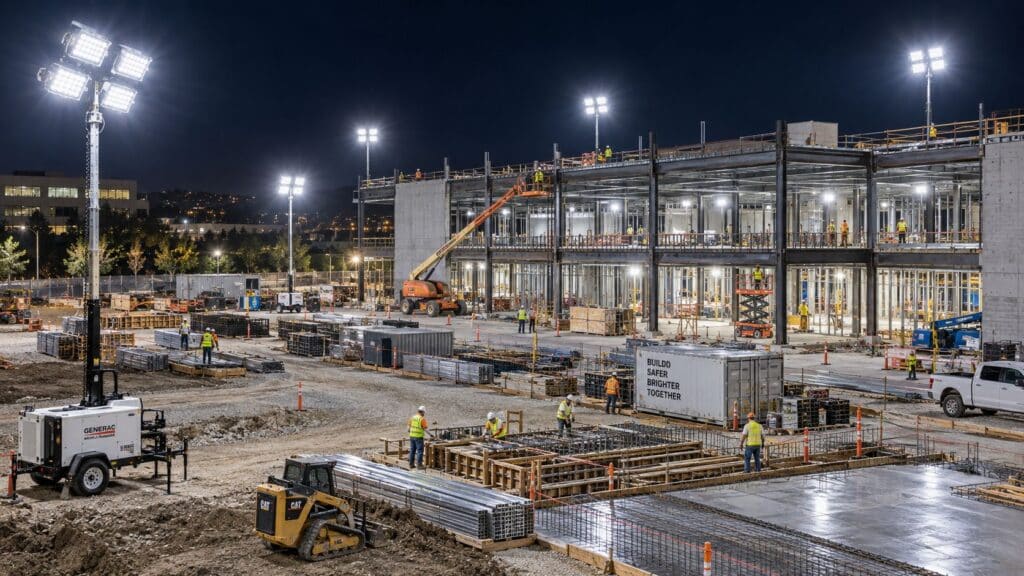
Proper construction site lighting combines adequate foot-candle levels with effective fixture placement, mounting height, and beam distribution to provide usable illumination across active work areas.
Plan Construction Lighting Around the Work Area
A fixture’s lumen rating only tells part of the story. Mounting height, beam angle, spacing, obstructions, and the size of the work zone determine how much of that light actually reaches the working surface.
Explore our Construction Site Lighting Guide to compare temporary LED lighting options, including portable work lights, floodlights, string lights, and light towers for commercial jobsites.
What Are Construction Site Lighting Levels?
Construction site lighting levels describe the amount of illumination reaching a surface or work area.
In the United States, jobsite illumination is commonly expressed in foot-candles (fc).
One foot-candle represents one lumen of light distributed over one square foot of surface area.
This distinction is important because lumens and foot-candles measure different things.
Lumens describe the quantity of visible light produced by a light source. Foot-candles describe how much illumination reaches a particular surface.
A high-lumen fixture therefore does not automatically guarantee adequate illumination throughout a construction area.
Lumens vs. Foot-Candles on a Construction Site
Understanding the relationship between lumens and foot-candles can prevent one of the most common mistakes in temporary lighting design: selecting fixtures based only on their advertised lumen output.
| Measurement | What It Describes | Why It Matters |
|---|---|---|
| Lumens | Total visible light produced by a fixture | Helps compare fixture output |
| Foot-candles | Illumination reaching a surface | Helps determine whether the work area has adequate light |
| Beam distribution | How fixture output is spread | Influences coverage and uniformity |
| Mounting height | Distance between fixture and work surface | Affects intensity and coverage |
| Fixture spacing | Distance between luminaires | Influences dark areas and overlap |
| Fixture aiming | Direction in which light is projected | Affects visibility, glare, and usable illumination |
Construction lighting should ultimately be evaluated according to the illumination produced where work is actually taking place.
OSHA Minimum Construction Lighting Levels
OSHA 29 CFR 1926.56 establishes minimum illumination intensities for construction areas and specific operations while work is in progress.
The applicable minimum depends on the area or activity.
| Construction Area or Operation | Minimum Illumination |
|---|---|
| General construction area lighting | 5 foot-candles |
| Concrete placement, excavation and waste areas, access ways, active storage areas, loading platforms, refueling and field maintenance areas | 3 foot-candles |
| Indoor warehouses, corridors, hallways and exitways | 5 foot-candles |
| Tunnels, shafts and general underground work areas | 5 foot-candles |
| Tunnel and shaft headings during drilling, mucking and scaling | 10 foot-candles |
| General construction plants and shops | 10 foot-candles |
| First aid stations, infirmaries and offices | 30 foot-candles |
These values are minimum requirements rather than a complete lighting design specification. A particular construction task may require additional illumination to provide appropriate visibility.
For a broader discussion of temporary jobsite requirements, see our Temporary Construction Lighting Requirements guide.
Why Minimum Foot-Candles Are Only the Starting Point
Meeting a required minimum at one location does not necessarily mean an entire work zone is effectively illuminated.
Consider a large construction area containing several high-output floodlights. A meter reading directly beneath a fixture might show ample illumination while areas behind equipment, structural columns, material stacks, or temporary walls remain considerably darker.
Effective construction lighting therefore requires consideration of both light level and light distribution.
A good layout should reduce severe variations between brightly illuminated and poorly illuminated areas workers regularly encounter.
Where Should Construction Lighting Be Measured?
Lighting should be evaluated where illumination is needed to perform the work or safely use the area.
Depending on the application, measurement locations may include:
- Working surfaces
- Floors and walking areas
- Stairs and ramps
- Equipment operating areas
- Loading and unloading zones
- Excavation areas
- Temporary corridors
- Workstations
- Material handling areas
Measuring only next to the lighting fixture can produce a misleading picture of actual jobsite conditions.
The more useful question is whether sufficient illumination reaches the surfaces and locations workers need to see.
How Are Foot-Candles Measured?
A light meter provides a practical method of measuring illumination.
The meter is positioned at the surface or location being evaluated and provides an illumination reading.
For larger areas, readings should be taken at multiple representative locations rather than relying on a single measurement.
For example, measurements across a work zone may reveal that the center receives sufficient illumination while the perimeter or areas behind equipment fall below the desired level.
This allows contractors to identify where fixtures should be added, relocated, elevated, lowered, or re-aimed.
Why Fixture Mounting Height Changes Light Levels
Mounting height has a major influence on construction lighting performance.
Raising a fixture can increase the area it covers, but the illumination reaching the work surface generally decreases as the distance increases.
Lower mounting heights can provide greater intensity over a smaller area but may create:
- Uneven coverage
- Strong shadows
- Increased glare
- More physical obstructions
- Greater exposure to accidental impacts
The goal is to balance mounting height with fixture output and beam distribution.
This is one reason LED light towers are useful on large outdoor jobsites. Elevating the luminaires helps distribute light over broad areas while keeping fixtures above much of the equipment and activity below.
Fixture Spacing and Lighting Uniformity
Fixture spacing determines how effectively individual lighting patterns overlap.
Fixtures spaced too far apart can create alternating bright and dark areas. Fixtures positioned unnecessarily close together can produce excessive illumination and waste available power.
A practical layout creates enough overlap between adjacent fixtures to maintain useful illumination across the work zone.
| Layout Condition | Potential Result | Possible Adjustment |
|---|
| Fixtures too far apart | Dark areas between fixtures | Reduce spacing or add fixtures |
| Fixtures too close together | Excessive brightness and wasted output | Increase spacing or reduce output |
| Fixtures mounted too low | Small bright areas and stronger glare | Increase mounting height |
| Fixtures mounted too high | Insufficient illumination at the work surface | Increase output or adjust mounting height |
| Poor fixture aiming | Glare or wasted light | Redirect fixtures toward the work area |
| Obstructions between fixture and task | Shadows and low illumination | Reposition or supplement fixtures |
Account for Shadows and Construction Equipment
Construction sites contain large objects that can interfere with light distribution.
Excavators, cranes, lifts, trucks, structural framing, containers, temporary offices, scaffolding, and stored building materials can all create shadows.
The problem becomes more significant when a large area depends on only one or two lighting locations.
Using illumination from multiple directions can reduce severe shadows and improve visibility around equipment.
Temporary lighting layouts should also be reevaluated as equipment and materials move around the site.
Selecting Beam Patterns for Construction Lighting
Two fixtures with similar lumen output can perform very differently because of their optical distribution.
Wide Beam Distribution
Wide-beam fixtures distribute illumination across larger nearby areas and are useful for general construction lighting, staging areas, and broad work zones.
More Concentrated Distribution
A narrower distribution directs more light toward a smaller target area and can be useful when greater distance or more localized illumination is required.
Adjustable Floodlighting
Adjustable LED floodlights allow contractors to redirect illumination as working conditions change.
The correct distribution depends on mounting height, coverage area, fixture location, and the work being performed.
Interior Construction Lighting Levels
Outdoor construction sites often require illumination over much larger areas.
Typical applications include:
- Excavation
- Roadwork
- Concrete placement
- Utility construction
- Material staging
- Equipment maintenance
- Building construction
- Loading areas
- Nighttime infrastructure projects
Elevated floodlights and mobile light towers are commonly used because mounting luminaires above the site can increase coverage and reduce interference from equipment.
Outdoor layouts should also consider glare and light spill beyond the work area.
Avoid Solving Every Lighting Problem with More Lumens
Adding higher-output fixtures is not always the best solution.
If the existing lighting is poorly positioned, increasing lumen output may simply create brighter hot spots while leaving shadows elsewhere.
Before increasing fixture output, evaluate:
- Fixture placement
- Mounting height
- Beam distribution
- Fixture aiming
- Obstructions
- Spacing
- Actual foot-candle readings
Sometimes repositioning an existing fixture can improve usable illumination more effectively than adding another high-output light.
Construction Lighting Planning Table
A preliminary lighting plan should consider several variables together.
| Planning Factor | Questions to Ask |
|---|
| Required light level | What minimum illumination applies to the work area? |
| Work activity | Does the task require greater visibility than general area lighting? |
| Area dimensions | How large and irregular is the space being illuminated? |
| Mounting height | How high can fixtures safely and practically be positioned? |
| Beam distribution | Is broad coverage or concentrated illumination required? |
| Fixture spacing | Will adjacent beams overlap sufficiently? |
| Obstructions | Will equipment, walls or materials create shadows? |
| Glare | Can workers or equipment operators see comfortably? |
| Power | What temporary electrical service or generator capacity is available? |
| Site changes | How will the lighting layout need to change as construction progresses? |
Verify Lighting After Installation
Lighting calculations and fixture specifications are useful planning tools, but actual site conditions ultimately determine performance.
After temporary lighting is installed, evaluate the illuminated area during the conditions in which workers will use it.
Check:
- Representative foot-candle readings
- Dark areas between fixtures
- Shadows around equipment
- Walking routes
- Stairs and elevation changes
- Equipment operator sightlines
- Glare
- Newly created obstructions
Lighting should be checked again when significant changes occur on the project.
Inline Buyer Q&A
How many foot-candles does a construction site need?
The required minimum depends on the area or operation. OSHA specifies levels ranging from 3 foot-candles for several general construction activities to 30 foot-candles for first aid stations, infirmaries, and offices. The appropriate design level may be higher depending on the task and site conditions.
Can I determine construction lighting from lumens alone?
No. Fixture lumens describe total light output but do not indicate how much illumination reaches the work surface. Mounting height, beam distribution, fixture spacing, aiming, and obstructions all affect actual foot-candle levels.
How do I know whether my construction site has enough light?
A light meter can be used to measure illumination at representative work surfaces and locations. Multiple measurements across the area can help identify dark zones and uneven illumination.
Does mounting a construction light higher improve coverage?
Increasing mounting height generally expands coverage, but it can reduce the illumination reaching the work surface. Fixture output and optical distribution must be matched to the mounting height.
Are light towers better than portable work lights?
They serve different purposes. Light towers are well suited to illuminating large outdoor areas, while portable work lights are useful for localized tasks and work zones that frequently change.
Should construction lighting levels be checked throughout a project?
Yes. Walls, equipment, scaffolding, stored materials, and changing work areas can alter lighting conditions. Periodic checks help identify locations requiring repositioned or supplemental lighting.
Get Help Planning Commercial Construction Lighting
Construction lighting performance depends on more than fixture wattage or lumen output. Mounting height, beam distribution, work area dimensions, operating conditions, and required illumination all influence the lighting equipment needed for a project.
LED PROS WorldWide can help contractors, project managers, facility teams, and commercial buyers evaluate LED construction lighting for temporary indoor and outdoor applications.
Request a Commercial Construction Lighting Quote or call 844-533-7767 to discuss your project requirements.
Frequently Asked Questions About Construction Site Lighting Levels
What is a foot-candle in construction lighting?
A foot-candle is a measurement of illumination at a surface. It represents one lumen distributed over one square foot and is commonly used to evaluate lighting levels on construction sites.
What is the OSHA minimum for general construction lighting?
OSHA Table D-3 lists 5 foot-candles for general construction area lighting. Other listed construction activities and areas have different minimum requirements.
How many lumens equal one foot-candle?
One foot-candle represents one lumen per square foot. However, fixture lumens cannot simply be divided by the total jobsite area to predict actual lighting because mounting height, optical distribution, aiming, losses, and site conditions affect how much light reaches the surface.
Where should a light meter be placed on a construction site?
Measurements should represent the surface or area where illumination is needed. Depending on the application, this could include a working surface, floor, walkway, equipment zone, or other location where workers need visibility.
Why are some parts of a jobsite darker even with high-output lights?
Equipment, structures, materials, fixture spacing, mounting height, and beam direction can create shadows or prevent sufficient light from reaching certain areas. Additional output alone may not correct poor distribution.
Do construction site lighting levels change as a project progresses?
The regulatory minimum for an applicable work area does not change simply because the project advances, but actual lighting conditions can change considerably. New walls, equipment, stored materials, and changing work zones may require the temporary lighting layout to be adjusted.
Stay Connected with Our Lighting Resources
Add IndustrialLightingFixtures.org as a Preferred Source on Google to see more of our lighting guides and technical resources across Google Search experiences.

Related Resources
Continue researching temporary and commercial construction lighting:
- Construction Site Lighting Guide — Compare temporary construction lighting types, applications, mounting options, and jobsite lighting considerations.
- Temporary Construction Lighting Requirements — Review OSHA illumination requirements, temporary lighting safety considerations, and planning factors for commercial jobsites.
- LED Portable Work Lights — Explore portable LED lighting for construction, maintenance, inspection, and changing work areas.
- Industrial Lighting Guide — Learn about broader commercial and industrial lighting selection, performance, and application considerations.