
Solar parking lot lights provide a reliable and energy-independent lighting solution for commercial properties, municipal infrastructure, industrial facilities, and recreational spaces. Unlike traditional parking lot lighting systems that require underground electrical wiring and utility power connections, solar lighting systems operate entirely off-grid using photovoltaic panels and integrated battery storage.
Modern solar parking lot lighting systems combine high-efficiency LED luminaires with solar energy generation and intelligent lighting controls. These integrated systems collect solar energy during the day and store it in onboard batteries, providing dependable nighttime illumination without drawing electricity from the grid.
Solar lighting is increasingly used in parking lots because it eliminates the need for trenching electrical lines and reduces infrastructure installation costs. In addition, the absence of underground copper wiring significantly reduces the risk of copper theft that frequently affects traditional parking lot lighting systems.
Solar Parking Lot Lighting
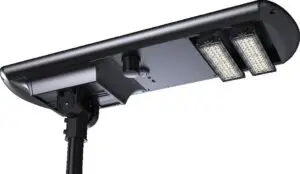
Triton
Brand: E-Lite
foldable solar panel extension; large battery capacity; 28,500 lumens; working temperature is -30°C to +80°C; 30/40/50/60/70/80
90/120/150W; Prices start at $500.
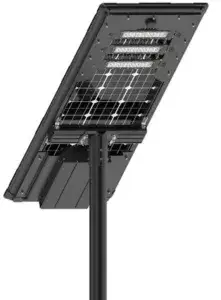
Athens
Brand: Beyond
Integrated, all in one solar area light; up to 18,000 lumens; with Bifacial Solar Panel and Rotatable LED Module; 80/100W; Prices start at $1140.
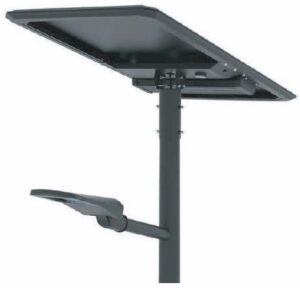
Natron
Brand: Beyond
Solar powered area light with separate panel; up to 15,000 lumens; 30/40/60/80/100W and 2x50W; Prices start at $1500.

SLS
Brand: Ledsion
Integrated, all in one solar area light; up to 9,00 lumens; 100W; Prices start at $550.
For municipalities, property managers, and developers seeking cost-effective and resilient outdoor lighting solutions, solar parking lot lights provide a practical alternative to conventional grid-powered systems.

What Are Solar Parking Lot Lights?
Solar parking lot lights are outdoor lighting systems designed to illuminate parking areas using solar energy instead of grid electricity. Each lighting unit operates as an independent off-grid system powered by a photovoltaic panel mounted above or integrated into the lighting fixture.
A typical commercial solar parking lot lighting system includes several components:
• Photovoltaic solar panel
• LED lighting fixture
• Lithium battery storage system
• Charge controller
• Mounting pole and bracket system
• Motion or adaptive lighting controls
During daylight hours, solar panels capture sunlight and convert it into electrical energy. The energy is stored in batteries that power the LED luminaire throughout the night. Advanced systems incorporate programmable lighting profiles that adjust brightness levels during low-activity hours to conserve stored energy while maintaining safety and visibility.
Planning an off-grid parking area or evaluating solar as an alternative to conventional parking lot lighting? Our Commercial Solar Parking Lot Lighting Guide covers system planning, site considerations, energy savings, and practical applications for commercial properties.
Why Solar Parking Lot Lighting Is Increasingly Popular
Solar lighting systems are gaining popularity across commercial and municipal projects due to several advantages over conventional lighting systems.
Reduced Installation Costs
Installing traditional parking lot lighting often requires trenching electrical conduits, installing underground wiring, and coordinating electrical permits and inspections. These infrastructure requirements can significantly increase project costs.
Solar parking lot lights eliminate trenching and underground electrical work, allowing fixtures to be installed quickly with minimal disruption.
Elimination of Copper Theft Risk
Copper wire theft has become a growing problem in many cities and commercial areas. When underground electrical wiring is stolen, parking lots can be left without lighting until expensive repairs are completed.
Because solar lighting systems operate independently without underground copper wiring, they remove one of the primary targets for theft.
Energy Independence
Solar parking lot lights generate their own electricity, eliminating monthly energy costs associated with traditional lighting systems. This makes them particularly attractive for properties with large parking areas requiring multiple lighting fixtures.
Reliable Operation During Power Outages
Unlike grid-connected lighting systems, solar lighting continues to operate during electrical outages. This can improve safety and visibility in commercial areas during emergencies or grid disruptions.
Planning a larger commercial parking area requires more than selecting a solar fixture. Pole placement, required light levels, solar exposure, battery capacity, operating profiles, and site conditions all influence system performance. Our Commercial Solar Parking Lot Lighting Guide provides additional guidance for evaluating and planning off-grid parking lot lighting projects.
Key Components of Solar Parking Lot Lighting Systems
Solar Panels
High-efficiency photovoltaic panels convert sunlight into electrical energy. Panels are typically mounted at the top of the lighting pole and angled to maximize solar exposure.
Battery Storage
Energy generated during daylight hours is stored in battery systems for nighttime operation. Many commercial solar parking lot lighting systems use lithium iron phosphate (LiFePO4) batteries due to their durability, safety, and long operational lifespan.
Battery systems are often designed to provide multiple nights of operation during cloudy conditions.
LED Lighting Fixtures
LED luminaires are essential to solar lighting systems because they provide high lumen output while consuming minimal energy. Efficient LED optics allow solar lighting systems to illuminate large parking areas using relatively small energy storage capacity.
Intelligent Lighting Controls
Advanced solar lighting systems often include smart control systems that optimize energy usage. These features may include:
• Motion sensors
• Programmable dimming schedules
• Adaptive brightness control
• Remote monitoring capabilities
Applications for Solar Parking Lot Lights
Solar parking lot lighting is widely used across a variety of environments.
Commercial Properties
Retail centers, office complexes, hotels, and shopping centers use solar parking lot lights to illuminate parking areas while reducing energy costs.
Industrial Facilities
Warehouses, logistics yards, and manufacturing facilities frequently deploy solar lighting to illuminate parking areas and equipment yards where electrical infrastructure may be limited.
Industrial facilities often deploy multiple off-grid lighting solutions depending on the site layout. For a closer look at how to choose the right system, read our article on which solar lighting solutions will suit an industrial setting.
Municipal Infrastructure
Cities and municipalities use solar lighting in public parking lots, transportation hubs, and park facilities where extending grid power can be expensive.
Parks and Recreational Areas
Solar lighting provides safe nighttime visibility in parks, sports facilities, and recreational areas without disrupting landscaping through electrical trenching.
Solar Parking Lot Lighting Design Considerations
When designing solar parking lot lighting systems, several factors must be considered to ensure reliable performance.
Lighting Distribution
Pole height, LED optics, and fixture placement determine how evenly light is distributed across the parking lot.
Solar Exposure
Solar panels should be installed in locations that receive unobstructed sunlight for most of the day.
Battery Autonomy
Most commercial solar lighting systems are designed to provide three to five nights of operation without direct sunlight.
Structural Design
Lighting poles must be designed to withstand environmental conditions including wind loads and weather exposure.
For related outdoor lighting systems used in commercial environments, explore:
Advantages of Solar Parking Lot Lights
| Feature | Benefit |
|---|---|
| Off-grid operation | No electrical infrastructure required |
| No trenching | Faster installation |
| No copper wiring | Reduces theft risk |
| Energy independence | Eliminates electricity costs |
| Renewable energy | Supports sustainability initiatives |
| Flexible installation | Ideal for remote or expanding properties |
Inline Buyer Q&A
How do I know if solar parking lot lights are right for my property?
Start by evaluating the project location, available solar exposure, required illumination, nightly operating schedule, pole locations, mounting heights, and the cost or difficulty of extending electrical service.
Solar can be particularly attractive for new parking areas, remote locations, property expansions, and sites where trenching, conduit, pavement restoration, or utility extensions would be costly or disruptive.
Shading and seasonal solar conditions should also be evaluated before selecting a system.
What determines the size of a commercial solar parking lot lighting system?
The lighting load and required operating profile drive the system design.
Fixture output, nightly runtime, dimming schedule, battery autonomy, solar availability, temperature, panel capacity, battery capacity, controls, and system losses all influence sizing.
The solar panel, battery, fixture, and controller should be designed as a coordinated system rather than selected independently.
Can solar parking lot lights provide the same illumination as grid-powered LED fixtures?
They can be designed to meet similar project illumination objectives when site and system conditions support the application.
The comparison should be based on delivered illumination, uniformity, fixture distribution, mounting height, pole spacing, runtime, and project requirements rather than fixture wattage alone.
A photometric layout can help evaluate the lighting performance of the proposed system.
Should I choose dusk-to-dawn operation or adaptive dimming?
That depends on how the property is used.
Some projects require consistent illumination throughout the night, while others can use scheduled dimming or motion-based controls during periods of reduced activity.
Adaptive controls can reduce the nightly energy load and help manage battery capacity, but the control strategy should still meet the operating requirements of the property.
What information should I provide for a solar parking lot lighting recommendation?
Useful project information includes:
- Project location
- Parking-lot dimensions or site plan
- Required or desired illumination
- Existing or proposed pole locations
- Mounting heights
- Nightly operating hours
- Dimming or motion-control requirements
- Desired battery autonomy
- Solar exposure and potential shading
- Temperature and environmental conditions
- Existing lighting for retrofit projects
- Wind and structural requirements
- Dark Sky or light-trespass objectives
- Photographs or drawings when available
These details help determine whether solar is suitable and how the system should be configured.
Build the Solar Parking Lot System Around Your Property
Commercial solar parking lot lighting should be selected as a complete system—not simply by fixture wattage or advertised lumen output.
Solar exposure, required illumination, nightly runtime, battery capacity, autonomy, mounting height, optical distribution, controls, temperature, shading, and structural conditions all influence system performance.
Our lighting specialists can help evaluate solar parking-lot systems for commercial properties, municipalities, HOAs, campuses, schools, industrial facilities, and other off-grid applications.
Call 1-844-533-7767 to discuss your commercial solar parking lot lighting project.
Frequently Asked Questions About Solar Parking Lot Lights
Are solar parking lot lights bright enough for commercial parking areas?
Yes, when the system is properly designed for the application.
Commercial solar LED fixtures can provide illumination suitable for parking areas, but performance depends on fixture output, optical distribution, mounting height, pole spacing, site geometry, and the project’s illumination requirements.
Brightness alone should not be used to evaluate the system. Uniformity and distribution are also important.
How long do solar parking lot lights operate each night?
Runtime depends on the system design.
Battery capacity, solar-panel sizing, fixture load, operating schedule, dimming profile, seasonal solar availability, temperature, and charging conditions all influence how long the system can operate.
Systems can be designed for dusk-to-dawn operation where appropriate.
Do solar parking lot lights work during cloudy weather?
They can continue operating during periods of reduced sunlight using energy stored in the battery.
How long the system can operate with limited solar charging depends on battery capacity, available solar energy, lighting load, controls, temperature, and the autonomy incorporated into the system design.
What does battery autonomy mean in solar lighting?
Battery autonomy describes the system’s ability to support its lighting load during periods when solar charging is limited.
The appropriate amount of reserve depends on project location, weather patterns, operating schedule, lighting load, battery design, and required performance.
There is no universal number of autonomy days appropriate for every solar-lighting project.
Do solar parking lot lights require electrical wiring?
Off-grid solar parking lot systems do not require a conventional utility connection or underground branch wiring back to a grid-powered lighting circuit.
The solar system itself still contains electrical connections between components such as the solar panel, battery, controller, and LED fixture.
System configuration varies by manufacturer.
Can solar parking lot lights eliminate trenching?
In many off-grid applications, yes.
Because individual solar-lighting systems can operate without extending utility power to the pole, they can avoid trenching and underground conduit associated with conventional grid-powered parking-lot lighting.
Site-specific installation and structural work may still be required.
Why do municipalities consider solar parking lot lighting?
Solar can be attractive where extending electrical infrastructure is difficult, disruptive, or expensive.
Potential applications include municipal parking areas, parks, remote facilities, transportation properties, and expansions where off-grid operation offers practical advantages.
Project economics and lighting requirements should be evaluated for the individual site rather than assuming solar will always be less expensive.
Can solar parking lot lighting reduce copper-theft exposure?
Off-grid solar systems can eliminate long underground electrical feeder runs associated with conventional parking-lot lighting, reducing some opportunities for theft of underground copper conductors.
The equipment itself still requires appropriate physical security and installation practices.
What type of batteries are used in solar parking lot lights?
Battery technology varies among commercial systems.
Lithium-based batteries, including LiFePO4 designs, are used in many contemporary solar-lighting systems.
Battery chemistry should be considered along with capacity, operating temperature, expected cycling, charging characteristics, warranty, enclosure, and replacement requirements.
How long do solar parking lot light batteries last?
Battery service life varies.
Chemistry, depth of discharge, charge cycles, temperature, system sizing, charging conditions, controls, and manufacturer design can all affect battery life.
Review the battery specifications and warranty for the particular system rather than assuming a fixed replacement interval.
What mounting height should be used for solar parking lot lights?
There is no universal mounting height for commercial solar parking-lot lighting.
Fixture output, optical distribution, pole spacing, required illumination, uniformity, site geometry, solar-panel configuration, and structural requirements should be considered together.
A photometric layout can help evaluate proposed mounting heights and fixture configurations.
Can motion sensors be used with solar parking lot lights?
Yes, when supported by the system.
Motion sensing, scheduled dimming, and other adaptive controls can reduce energy consumption during low-activity periods and help manage stored battery energy.
The control strategy should still provide the lighting performance required by the property.
Are solar parking lot lights maintenance-free?
No.
Maintenance can include solar-panel inspection or cleaning, battery evaluation and eventual replacement, controller checks, LED fixture inspection, pole and mounting-system inspection, and checking for new shading from vegetation or surrounding development.
Maintenance requirements vary by system and environment.
Are solar parking lot lights Dark Sky friendly?
They can be designed with Dark Sky objectives in mind, but solar power itself does not make a fixture Dark Sky friendly.
Optical distribution, shielding, uplight, glare, output, color temperature, light trespass, mounting, and controls should be considered as part of the complete lighting design.
Can existing poles be converted to solar lighting?
Potentially.
Adding solar panels, batteries, brackets, and other equipment can change the weight, projected area, wind loading, and structural demands on an existing pole.
Pole condition and structural suitability should be evaluated before converting an existing installation.
Can solar parking lot lighting be used for new construction?
Yes.
New construction can be a strong application because solar may allow the lighting system to be planned without extending conventional electrical infrastructure to each pole.
Solar exposure, photometric requirements, structural design, system sizing, and project economics should be evaluated during the planning process.
Stay Connected with Our Lighting Resources
Add IndustrialLightingFixtures.org as a Preferred Source on Google to see more of our lighting guides and technical resources across Google Search experiences.
Related Solar Parking Lot Lighting Resources
- Commercial Solar Parking Lot Lighting Guide — Learn how solar availability, battery capacity, autonomy, runtime, controls, mounting, and photometric design affect commercial parking-lot systems.
- Solar Lighting — Explore the broader commercial solar-lighting category for parking areas, roadways, pathways, signs, buildings, and other off-grid applications.
- Solar Lighting Battery and Backup Guide — Understand how battery capacity, autonomy, nightly runtime, charging conditions, and operating profiles affect solar-lighting performance.
- Solar vs. Traditional LED Lighting — Compare off-grid solar lighting with utility-powered LED systems when evaluating infrastructure, operating requirements, and site suitability.
- LED Parking Lot Lights — Review grid-powered commercial parking-lot fixtures, optics, controls, mounting, and layout considerations when comparing conventional LED with solar.