Specialty lighting encompasses engineered LED systems designed for applications that fall outside conventional commercial, industrial, or architectural lighting categories. These solutions are specified when environmental conditions, regulatory constraints, ecological considerations, or performance demands require tailored optical, structural, or control characteristics.
Unlike general-purpose luminaires, specialty LED lighting systems are developed for clearly defined operational scenarios — from marine-adjacent installations and wildlife-sensitive environments to high-intensity search operations, horticultural growth applications, and collection-driven architectural statements.
This guide outlines the major specialty lighting categories, explains when each is appropriate, and highlights the performance considerations that influence proper selection.
When Specialty LED Lighting Is Specified
Specialty lighting systems are specified when:
-
Environmental exposure exceeds typical commercial conditions
-
Illumination must meet ecological or regulatory mandates
-
Task performance requires non-standard optical distribution
-
Mobile, remote, or tactical lighting is required
-
Plant growth or spectral performance is central to the application
-
Architectural design calls for curated collection-based fixtures
Selection is driven by environmental demands, performance objectives, and compliance requirements — not by generic lumen output alone.
Specialty Lighting Systems by Application
Specialty lighting spans a wide range of engineered use cases where standard luminaires are insufficient.
Marine and waterfront environments frequently incorporate above water fishing lights engineered to manage reflection, corrosion exposure, and nighttime visibility across docks, marinas, and piers.
Security and long-distance visibility applications may require high-intensity searchlight systems designed for directional output and extended beam throw in tactical or surveillance scenarios.
Controlled agricultural environments rely on horticultural LED lighting systems optimized for plant growth cycles, spectral output, and photosynthetic efficiency.
Coastal and environmentally sensitive installations may specify turtle-friendly amber lighting systems engineered to reduce disruption to nocturnal wildlife while maintaining pathway visibility.
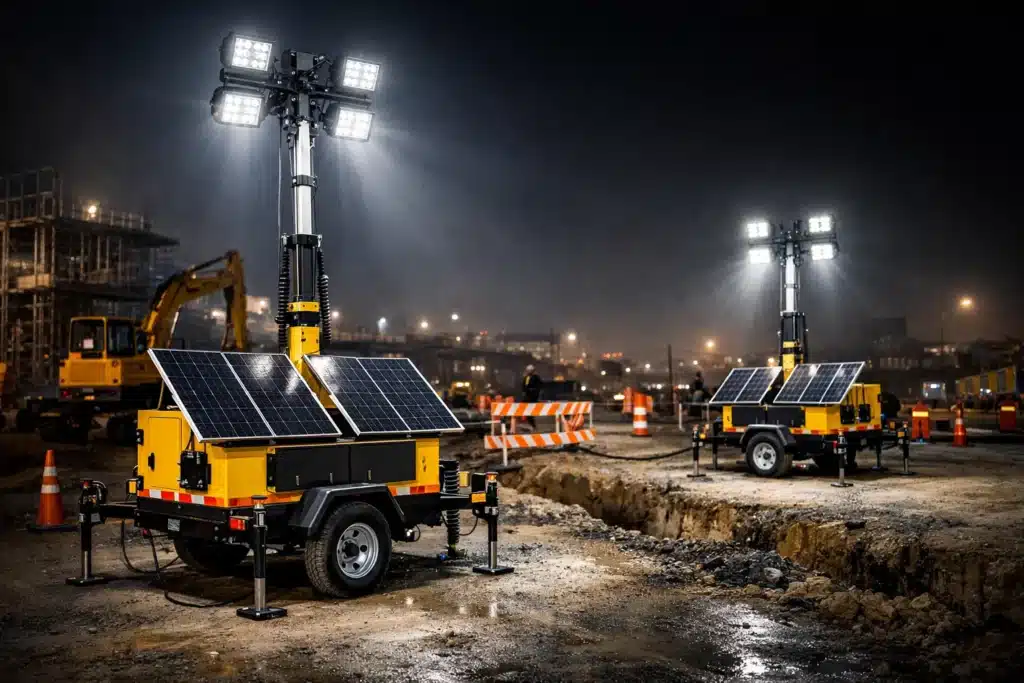
Temporary, mobile, or maintenance-focused environments often utilize rugged portable work lights designed for deployment flexibility and task-oriented illumination.
Projects requiring regulatory planning may reference lighting level recommendations to establish appropriate foot-candle targets and uniformity thresholds.
Municipal and residential-adjacent projects may integrate dark-sky compliant post lighting to reduce uplight, glare, and light trespass while supporting night-sky preservation initiatives.
Architectural Lighting Collections for Coordinated Outdoor Design
Many commercial developments, residential communities, and corporate campuses require coordinated lighting designs that maintain consistent architectural styling across multiple outdoor lighting applications.
Architectural lighting collections provide families of luminaires designed to work together visually while delivering different illumination functions such as pathway lighting, plaza lighting, and streetscape lighting.
Using fixtures from the same collection allows lighting designers to maintain a unified appearance across an entire property while tailoring illumination levels for specific areas.
Explore our architectural LED lighting collections:
• The Janus Collection – Premium Architectural LED Lighting
• The Pulsar Collection – Modern Architectural Post-Top Lighting
• The Odin Collection – Contemporary Architectural Lighting Systems
• The Creo Collection – Minimalist Architectural Pathway Lighting
• The 5001 Collection – Versatile Architectural Outdoor Lighting
• The Bell Collection – Classic Bell-Style Architectural Lighting
These coordinated lighting families allow designers to maintain consistent outdoor lighting aesthetics across campuses, commercial developments, hospitality properties, and residential communities.
Architectural Lighting Collections for Coordinated Outdoor Design
Many commercial developments, residential communities, and corporate campuses require coordinated lighting designs that maintain consistent architectural styling across multiple outdoor lighting applications.
Architectural lighting collections provide families of luminaires designed to work together visually while delivering different illumination functions such as pathway lighting, plaza lighting, and streetscape lighting.
Using fixtures from the same collection allows lighting designers to maintain a unified appearance across an entire property while tailoring illumination levels for specific areas.
Explore our architectural LED lighting collections:
• The Janus Collection – Premium Architectural LED Lighting
https://industriallightingfixtures.org/the-janus-collection/
• The Pulsar Collection – Modern Architectural Post-Top Lighting
https://industriallightingfixtures.org/the-pulsar-collection/
• The Odin Collection – Contemporary Architectural Lighting Systems
https://industriallightingfixtures.org/the-odin-collection/
• The Creo Collection – Minimalist Architectural Pathway Lighting
https://industriallightingfixtures.org/the-creo-collection/
• The 5001 Collection – Versatile Architectural Outdoor Lighting
https://industriallightingfixtures.org/the-5001-collection/
• The Bell Collection – Classic Bell-Style Architectural Lighting
https://industriallightingfixtures.org/the-bell-collection/
These coordinated lighting families allow designers to maintain consistent outdoor lighting aesthetics across campuses, commercial developments, hospitality properties, and residential communities.
Coordinated Architectural Lighting Collections for Community & Campus Design
In many lighting projects, fixture selection is driven not only by performance requirements but also by the need for visual consistency across multiple lighting applications. Residential communities, corporate campuses, hospitality properties, and mixed-use developments often require coordinated lighting families that maintain a unified architectural appearance while serving different functional roles.
Architectural LED lighting collections provide this design continuity by offering matching fixture styles across multiple product types, including pathway lights, wall-mounted luminaires, pole-mounted area lights, bollards, and accent lighting. Using fixtures from the same collection allows designers to maintain consistent finishes, materials, and form factors across an entire property while tailoring the optical performance for each specific location.
This coordinated approach is commonly used in:
-
Master-planned residential communities
-
Corporate campuses and office parks
-
Universities and institutional facilities
-
Resorts, hotels, and hospitality developments
-
Municipal plazas and public gathering spaces
For example, a community may specify post-top luminaires for roadways, bollards for pedestrian pathways, and wall-mounted fixtures for building entrances, all drawn from the same architectural lighting collection. The result is a cohesive nighttime environment that reinforces the overall design identity of the property.
Coordinated lighting collections simplify project planning, maintain aesthetic continuity, and allow property owners to expand or renovate facilities over time while preserving a consistent lighting language throughout the site.
Specialty Lighting Performance Considerations
Specialty lighting design requires evaluation beyond lumen output. Key factors include:
-
Optical control — Precision distribution, cutoff, and directional shaping
-
Environmental resilience — Resistance to moisture, salt exposure, heat, or corrosive atmospheres
-
Regulatory compliance — Wildlife protection standards, dark-sky mandates, or safety codes
-
Spectral performance — Required for plant growth or ecological sensitivity
-
Control integration — Scheduling, dimming, scene management, or adaptive output
-
Maintenance planning — Accessibility, lifecycle cost, and long-term durability
Specialty LED systems are engineered around application demands rather than generic lighting metrics.
Specialty Lighting Selection Principles
Specialty LED lighting systems are specified based on environmental exposure, regulatory requirements, optical performance objectives, and application-specific functionality. Selection criteria are driven by operational demands rather than generic illumination levels, ensuring that each system aligns precisely with site conditions and performance expectations.
Marine and waterfront installations often incorporate above water fishing lights designed to attract baitfish while illuminating docks and piers.
Inline Buyer Q&A
How do I know if my project requires specialty lighting?
Start with the conditions that make the application different from a conventional commercial or industrial lighting project.
Specialty lighting may be appropriate when the installation involves unusual environmental exposure, wildlife-sensitive areas, color-changing or programmable lighting, horticultural requirements, marine environments, temporary work areas, portable illumination, or other application-specific performance requirements.
The fixture should be selected around the actual operating environment and project objective rather than simply by wattage or lumen output.
What information should I provide when selecting specialty LED lighting?
Useful project information can include:
- Application and facility type
- Project location
- Indoor or outdoor installation
- Required illumination or lighting objective
- Mounting location and height
- Voltage and electrical conditions
- Temperature range
- Moisture, salt, corrosion, or chemical exposure
- Portable or permanent installation
- Required controls
- Color or spectral requirements
- Wildlife or environmental restrictions
- Applicable certifications or project specifications
- Photographs, drawings, or site plans when available
The information required will vary substantially between specialty applications.
Can standard commercial LED fixtures be used for specialty applications?
Sometimes, but only when the fixture’s construction, ratings, optical performance, controls, and other characteristics meet the requirements of the application.
A fixture suitable for a conventional outdoor property may not be appropriate for a marine environment, wildlife-sensitive coastline, horticultural facility, temporary construction site, or programmable architectural-lighting system.
The application should determine the fixture requirements.
Are specialty LED fixtures available with different optics and controls?
Many are.
Depending on the product category, options can include different beam distributions, mounting configurations, dimming, motion sensing, timers, photocontrols, programmable color control, and other application-specific capabilities.
Available options depend on the individual fixture and control system.
Do specialty lighting projects require photometric planning?
It depends on the application.
Projects involving larger areas, defined illumination requirements, mounting-height decisions, uniformity, glare control, or precise fixture placement can benefit from photometric analysis.
Other specialty applications may depend more heavily on environmental requirements, spectral characteristics, portability, controls, or specialized fixture construction.
Are environmental conditions especially important when selecting specialty lighting?
Yes.
Salt exposure, moisture, temperature, wind, dust, vibration, chemicals, wildlife restrictions, washdown conditions, and other environmental factors can significantly affect fixture selection.
Relevant ratings and construction requirements should be verified for the actual installation rather than assuming that a general outdoor rating is sufficient.
Can different specialty lighting systems be used on the same property?
Yes.
A large property may require different lighting approaches for different environments. For example, a coastal development might use wildlife-sensitive lighting near protected shoreline areas, corrosion-resistant fixtures around waterfront facilities, and conventional commercial lighting farther inland.
Each area should be evaluated according to its own application and operating requirements.
Find the Right Lighting System for a Specialized Application
Specialty lighting projects often begin with a requirement that conventional fixtures were not designed to address.
Environmental exposure, application-specific optics, controls, color or spectral requirements, portability, mounting conditions, wildlife considerations, and project specifications can all influence the correct solution.
Our lighting specialists can help evaluate specialty LED lighting for commercial, municipal, marine, architectural, horticultural, construction, recreational, and other specialized applications.
Call 1-844-533-7767 to discuss your specialty lighting requirements.
Frequently Asked Questions About Specialty LED Lighting
What qualifies as specialty lighting?
Specialty lighting includes lighting systems designed or selected for unusual environmental, functional, optical, ecological, or application-specific requirements that may not be addressed by conventional commercial or industrial fixtures.
The defining requirement varies by application.
What environments use specialty LED lighting?
Applications can include marine and waterfront properties, horticultural facilities, wildlife-sensitive coastal areas, temporary construction sites, architectural color-changing installations, portable work environments, recreational areas, and other projects requiring specialized lighting characteristics.
Are specialty lighting systems customizable?
Many specialty lighting products offer configurable features such as optics, mounting arrangements, output levels, controls, finishes, color characteristics, or electrical options.
Available configurations vary by fixture and manufacturer.
What makes marine lighting different from standard outdoor lighting?
Marine and waterfront environments can expose lighting equipment to moisture, salt, corrosion, wind, and other demanding conditions.
Fixture materials, finishes, seals, mounting hardware, environmental ratings, and maintenance requirements should be evaluated for the specific installation.
An ordinary outdoor rating does not automatically establish suitability for every marine environment.
What is wildlife-friendly lighting?
Wildlife-friendly lighting is designed and applied to reduce potential effects of artificial nighttime illumination on sensitive wildlife.
Requirements can involve wavelength or color, fixture shielding, mounting, orientation, output, visibility from protected areas, and operating controls.
Applicable requirements depend on the species, location, jurisdiction, and project.
Is turtle-friendly lighting the same as Dark Sky lighting?
No.
The two approaches can share principles such as controlling unnecessary light, but they address different objectives.
Turtle-friendly lighting focuses on reducing impacts on sea turtles in sensitive coastal environments, while Dark Sky lighting generally addresses issues such as uplight, glare, light trespass, excessive illumination, and nighttime sky glow.
A project can potentially need to consider both.
What is RGB or RGBW specialty lighting used for?
RGB and RGBW LED systems can produce programmable colors and lighting effects for architectural façades, hospitality properties, entertainment environments, landmarks, landscapes, and other applications.
More sophisticated installations may use control protocols such as DMX512 to coordinate fixtures, scenes, colors, and effects.
How is horticultural lighting different from ordinary commercial lighting?
Horticultural lighting is selected around plant-growth objectives rather than human visual requirements alone.
Spectral output, intensity, photoperiod, mounting, crop type, growing environment, heat management, and controls can all influence system design.
What is portable specialty lighting used for?
Portable lighting can be used for construction, maintenance, temporary work areas, emergency operations, events, remote work locations, and other applications where permanently installed fixtures are impractical.
Durability, portability, power source, runtime, mounting, output, environmental exposure, and task requirements should be considered.
Can specialty lighting be used for construction sites?
Yes.
Temporary and portable lighting systems can support construction sites, maintenance projects, temporary work zones, and other changing environments.
Fixture selection depends on the work being performed, mounting options, power availability, environmental conditions, required coverage, and applicable jobsite requirements.
Does specialty lighting always require a specially manufactured fixture?
No.
Sometimes a conventional commercial or industrial LED product already has the construction, ratings, optics, controls, or other characteristics required for the application.
In other cases, specialized equipment is necessary.
The important issue is whether the selected equipment meets the actual project requirements.
Can specialty LED lighting support energy-efficiency objectives?
Yes, depending on the application and equipment.
LED technology can provide efficient light generation, optical control, dimming, scheduling, sensing, and other energy-management capabilities.
Actual energy performance depends on fixture efficiency, required output, operating hours, controls, and the lighting system being replaced.
Are specialty LED fixtures maintenance-free?
No.
LED systems can reduce some maintenance compared with older lighting technologies, but fixtures, drivers, controls, seals, mounting hardware, batteries where applicable, and other components can still require inspection, service, or eventual replacement.
Environmental conditions can also influence maintenance requirements.
Stay Connected with Our Lighting Resources
Add IndustrialLightingFixtures.org as a Preferred Source on Google to see more of our lighting guides and technical resources across Google Search experiences.
Related Specialty Lighting Resources
- Turtle-Friendly Amber Lighting — Explore specialized coastal lighting designed around sea-turtle-sensitive environments, including wavelength, shielding, placement, and light-control considerations.
- LED Above-Water Fishing Lights — Review specialized dock and waterfront lighting systems used for above-water nighttime fishing applications.
- LED Horticultural Lighting Systems — Explore commercial horticultural lighting for greenhouses, indoor farming, vertical agriculture, research facilities, and controlled-growing environments.
- Dark Sky Compliant Post Lights — Review outdoor post-top lighting designed around controlled distribution, reduced uplight, glare management, and Dark Sky objectives.
- LED Portable Work Lights — Explore portable illumination for construction, industrial maintenance, temporary work areas, and applications requiring flexible lighting placement.
- LED Searchlights — Explore high-intensity directional lighting for marine, security, search-and-rescue, and industrial applications requiring focused long-distance illumination.