
Dark Sky Lighting Doesn’t Mean Making Properties Dark
One of the most persistent misconceptions about Dark Sky friendly lighting is that reducing light pollution means sacrificing visibility, security, or nighttime usability.
It doesn’t.
Good outdoor lighting design is about putting the right amount of light in the right place, at the right time.
A well-designed system can illuminate pedestrian walkways, entrances, parking areas, roadways, gathering spaces, and other active areas while reducing the unwanted light that escapes upward, crosses property lines, shines into windows, or produces uncomfortable glare.
The objective isn’t simply less light.
It’s better-controlled light.
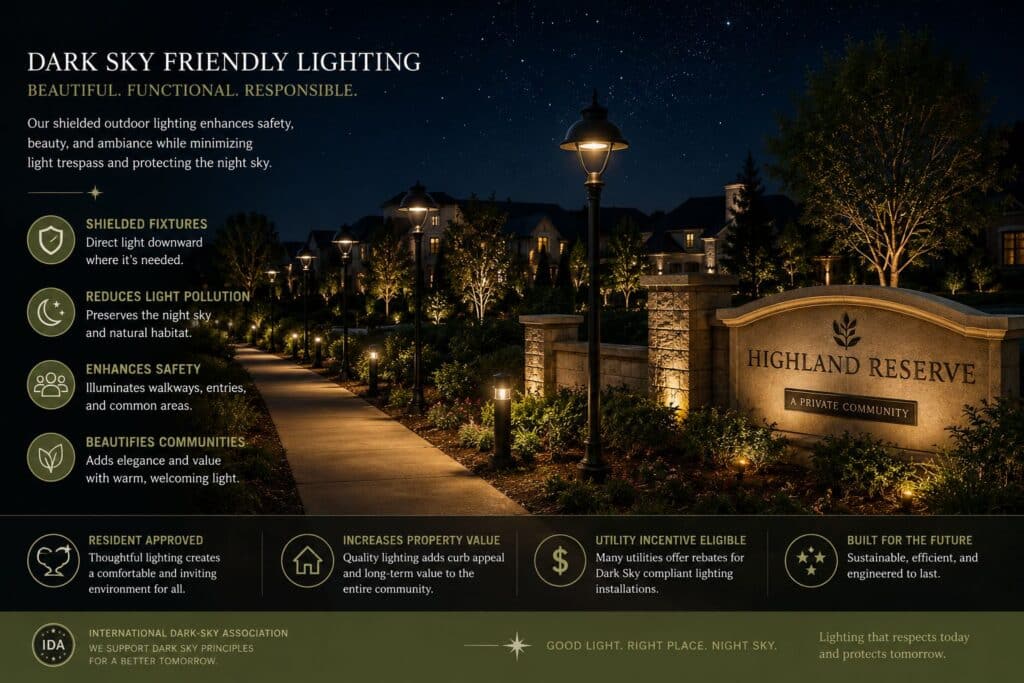
Well-designed Dark Sky friendly lighting directs illumination where it is needed while reducing glare, uplight, light trespass, and unnecessary nighttime illumination.
Planning a Dark Sky Friendly Outdoor Lighting Project?
Whether you’re replacing decorative post tops in an HOA community, upgrading a commercial property, or planning lighting for a campus or municipal streetscape, selecting properly shielded fixtures with appropriate output, distribution, and color temperature can help satisfy both project goals and local requirements.
👉 Explore Dark Sky Compliant Post Lights or call 1-844-533-7767 to discuss your outdoor lighting project.
What Makes Outdoor Lighting Dark Sky Friendly?
Dark Sky friendly lighting involves several complementary design strategies rather than a single fixture specification.
A successful project typically considers:
🌙 Shielding
Fixtures should direct illumination toward the intended area rather than allowing unnecessary light above the horizontal plane.
Proper shielding can dramatically reduce uplight and sky glow while keeping useful illumination on the ground.
💡 Appropriate Light Levels
More light isn’t automatically better light.
Excessive illumination can waste energy, increase light trespass, create harsh visual environments, and actually make nighttime visibility more difficult when high contrast or glare is introduced.
Lighting should be designed around the actual visual task and application.
A pedestrian walkway doesn’t necessarily need the same illumination as a busy commercial entrance or vehicle circulation area.
🌡️ Appropriate Color Temperature
Correlated color temperature (CCT) has become an increasingly important consideration in outdoor lighting.
Many Dark Sky-oriented projects use 3000K or warmer/lower-CCT lighting, although the appropriate—or required—CCT depends on the application and local requirements.
Warmer light can reduce the blue-rich portion of nighttime illumination while still providing useful visibility for pedestrians and vehicles.
↘️ Controlled Light Distribution
Where the light goes matters just as much as how much light the fixture produces.
Fixture optics and distribution should direct illumination toward:
- Walkways
- Parking areas
- Entrances
- Roadways
- Gathering spaces
- Other intended activity areas
while limiting illumination toward neighboring properties, windows, environmentally sensitive areas, and the night sky.
⏱️ Lighting Controls
Outdoor lighting doesn’t always need to operate at full output throughout the entire night.
Timers, photocells, motion sensors, dimming systems, and scheduled reductions can lower light levels during periods of reduced activity.
This concept—light when needed—is becoming increasingly important in responsible outdoor-lighting design.
Dark Sky Friendly vs. Dark Sky Compliant
These terms are often used interchangeably, but there is an important practical difference.
Dark Sky friendly lighting describes the broader design philosophy of reducing unnecessary nighttime illumination through shielding, appropriate light levels, warmer color temperatures, controls, and careful fixture placement.
Dark Sky compliant lighting generally means a project or fixture is intended to satisfy specific requirements established by an applicable ordinance, specification, community standard, or lighting program.
The distinction matters because there is no single universal Dark Sky requirement that applies to every property.
A fixture that works perfectly for one project may not satisfy the requirements of another jurisdiction.
Our Dark Sky Friendly Lighting Compliance Guide takes a deeper look at shielding, BUG ratings, CCT, photometrics, controls, and other technical considerations that may influence compliance.
🏛️ Dark Sky Requirements Are Becoming a Local Planning Issue
Dark Sky lighting is increasingly moving beyond voluntary sustainability initiatives.
Cities, counties, municipalities, and communities are adopting or updating outdoor-lighting requirements intended to reduce glare, uplight, light trespass, excessive illumination, and unnecessary nighttime operation.
For commercial property owners, developers, HOAs, campuses, hospitality properties, and facility managers, this means outdoor lighting decisions may now involve local regulations as well as lighting performance.
Depending on the jurisdiction, an outdoor-lighting ordinance may address:
- Fixture shielding
- Maximum uplight
- Light trespass at property lines
- Maximum illumination levels
- Correlated color temperature
- Glare
- Fixture lumen output
- Operating hours
- Lighting curfews
- Automatic controls
- Sign and façade lighting
- Parking lot lighting
- Pedestrian-area lighting
Requirements can vary considerably from one community to another.
Before replacing or specifying exterior fixtures, project owners should determine whether the property is subject to a local outdoor-lighting ordinance and what requirements apply to the particular project.
Replacement Projects Deserve Special Attention
Existing lighting doesn’t necessarily tell you what you’re permitted to install today.
A commercial property may have operated the same outdoor fixtures for 15 or 20 years. Those fixtures may predate the community’s current outdoor-lighting ordinance.
When the fixtures are eventually replaced, the project may need to satisfy requirements that didn’t exist when the original lighting was installed.
That creates an important question:
Does replacing an existing fixture trigger compliance with today’s outdoor-lighting requirements?
The answer depends on the jurisdiction.
Some ordinances distinguish between existing installations, replacements, major renovations, and new construction. Others may establish different timelines or exemptions.
For that reason, “We’re replacing it with what we already have” isn’t always an adequate lighting specification.
🏘️ HOAs and Planned Communities Have Unique Considerations
HOAs, condominium communities, multifamily developments, and planned residential communities are particularly good examples.
An established community may have hundreds of outdoor fixtures installed throughout:
- Streets
- Sidewalks
- Clubhouse areas
- Entrances
- Parking areas
- Mailbox areas
- Pools
- Parks
- Landscaped common areas
As these systems age, the association may begin replacing decorative post tops, bollards, wall-mounted fixtures, or other outdoor luminaires.
The HOA may need to consider two different layers of requirements:
Local government requirements established by the city, county, or municipality.
and
Community architectural standards established through HOA design guidelines or governing documents.
A replacement fixture therefore needs to do more than simply match the appearance of the old luminaire.
It may also need to satisfy current requirements for shielding, CCT, light trespass, controls, or other nighttime-lighting characteristics.
For communities that want to retain an upscale architectural appearance while improving nighttime lighting control, our Dark Sky Compliant Post Lights include decorative options designed for commercial, municipal, HOA, and campus applications.
Responsible Lighting and Architectural Design Can Coexist
Dark Sky design doesn’t mean every property has to look the same.
This is especially important for:
🏘️ Upscale residential communities
🏫 College and corporate campuses
🏨 Resorts and hospitality properties
🏛️ Municipal streetscapes
🏢 Mixed-use developments
🌳 Parks and pedestrian districts
Decorative post-top luminaires, bollards, architectural wall fixtures, and other visually distinctive products can still be incorporated into a responsible nighttime-lighting strategy.
The key is combining architectural character with appropriate:
Optics + shielding + output + CCT + placement + controls.
A community can maintain its identity and architectural character without sending unnecessary light into bedroom windows or the night sky.
Safety, Security and Dark Sky Design Are Not Opposites
Another misconception is that reducing light pollution automatically reduces security.
Poorly controlled lighting can actually create its own visibility problems.
An excessively bright fixture may produce glare that makes it difficult for pedestrians, drivers, or security personnel to see beyond the immediate illuminated area.
Similarly, extreme differences between bright and dark areas can make visual adaptation more difficult.
Good outdoor lighting instead aims for:
- Appropriate illumination
- Reasonable uniformity
- Controlled glare
- Clear pedestrian visibility
- Useful facial and object recognition
- Reduced spill beyond the intended area
The goal is not to create the brightest property in the neighborhood.
It’s to create a property where people can see comfortably and safely without unnecessary light escaping beyond the areas being used.
💡 Design Insight
When evaluating an existing outdoor-lighting system, don’t begin by asking:
“What wattage should replace these fixtures?”
Begin with:
“Where do we actually need light, how much do we need, and where should that light stop?”
That change in thinking is at the heart of effective Dark Sky friendly design.
Wattage, lumens, optics, pole height, spacing, shielding, CCT, and controls can then be selected around the needs of the property rather than simply reproducing an outdated lighting system.
Local Dark Sky Ordinances and Commercial Lighting Design
Outdoor lighting requirements are becoming increasingly localized.
A fixture that is appropriate for a commercial property in one city may not satisfy the outdoor-lighting requirements of another municipality—even when the properties and applications appear nearly identical.
Cities and counties may establish requirements addressing shielding, light trespass, color temperature, operating hours, controls, illumination levels, and other aspects of exterior lighting.
For property owners, HOAs, contractors, architects, and facility managers, this makes one step increasingly important:
Check the local outdoor-lighting requirements before specifying or purchasing fixtures.
This is especially important for large replacement projects where dozens or hundreds of fixtures may be ordered at once.
🏛️ What Can a Local Outdoor Lighting Ordinance Regulate?
There is no single nationwide Dark Sky ordinance governing every commercial property.
Local jurisdictions establish their own requirements, and the details can vary considerably.
Depending on the city or county, requirements may address several aspects of an outdoor-lighting system.
Full Shielding
Many ordinances require certain outdoor fixtures to be fully shielded or designed so that light isn’t emitted above specified angles.
This helps reduce:
- Uplight
- Sky glow
- Glare
- Unnecessary illumination beyond the property
Shielding is particularly important for pole-mounted area lighting, decorative post tops, wall-mounted fixtures, and other luminaires installed above eye level.
🌡️ Maximum Color Temperature
Some jurisdictions establish maximum correlated color temperature (CCT) requirements for outdoor lighting.
A 3000K maximum is increasingly encountered in Dark Sky-oriented specifications and ordinances, although requirements vary by jurisdiction and application.
Other projects may call for even warmer light.
This means a property owner replacing an existing 4000K or 5000K outdoor fixture shouldn’t automatically assume that the same CCT is appropriate—or permitted—for the replacement.
Always verify the applicable local requirements.
↔️ Light Trespass at Property Lines
A commercial property doesn’t exist in isolation.
Light from parking lots, pathways, building perimeters, signs, and decorative fixtures can cross property lines and affect:
- Adjacent homes
- Hotels
- Residential communities
- Neighboring businesses
- Environmentally sensitive areas
- Roadways
Local ordinances may establish maximum illumination levels measured at or beyond the property boundary.
This makes fixture distribution and placement just as important as fixture wattage.
A well-shielded fixture can still cause problems if it is positioned incorrectly or uses optics that throw too much light toward neighboring properties.
⏰ Operating Hours and Lighting Curfews
Some local outdoor-lighting regulations go beyond the fixture itself and regulate when lighting can operate at full output.
Requirements may call for lighting to be:
- Turned off after business hours
- Reduced after a specified time
- Dimmed when an area is unoccupied
- Controlled by occupancy sensors
- Controlled by timers
- Operated through photocells
- Exempted only where security or safety requires continuous illumination
This is particularly relevant for:
🏢 Office properties
🛍️ Retail centers
🏨 Hospitality facilities
🏫 Campuses
🏭 Industrial properties
🏘️ HOA common areas
Lighting controls therefore shouldn’t be considered only an energy-saving feature. In some jurisdictions, they can become part of the compliance strategy.
Existing Fixtures May Not Establish Today's Requirements
One of the easiest mistakes during a retrofit is assuming:
“We’re replacing what’s already there, so we’ll order the same type of light.”
The existing installation may have been designed 10, 15, or 25 years ago.
Since then, the jurisdiction may have adopted new requirements governing:
- Shielding
- CCT
- Uplight
- Light trespass
- Controls
- Operating hours
- Maximum output
An existing fixture may be legally permitted to remain while a new replacement fixture must satisfy current requirements.
Whether that’s the case depends on the local ordinance.
Before purchasing replacements, determine whether the project is considered routine maintenance, fixture replacement, substantial modification, renovation, or new construction under the applicable rules.
🏘️ HOA Lighting Projects: Check Both Sets of Rules
HOA communities present an additional challenge because the lighting project may be governed by both:
Municipal or county outdoor-lighting requirements
and
HOA architectural or community design standards.
For example, an association may want to replace aging decorative post-top luminaires while preserving a particular architectural style.
The city, meanwhile, may require:
- Full shielding
- Lower CCT
- Reduced uplight
- Light-trespass limitations
- Automatic controls
The solution isn’t necessarily abandoning decorative lighting.
Instead, the association can evaluate modern Dark Sky compliant decorative post lights that combine architectural appearance with improved optical control.
This is particularly valuable for upscale communities where appearance remains an important part of the property’s identity.
Don't Start With Wattage—Start With the Site
Once applicable requirements are understood, actual lighting design should begin with the property.
Before selecting fixtures, evaluate:
- Existing pole locations
- Pole heights
- Pole spacing
- Building entrances
- Walkways
- Parking areas
- Roadways
- Property boundaries
- Nearby residences
- Landscaping
- Existing electrical infrastructure
- Areas requiring nighttime activity
- Areas that don’t require continuous lighting
Only then should the project team determine the appropriate fixtures, output, optics, and controls.
Mounting Height Matters
Mounting height affects virtually every aspect of outdoor-lighting performance.
Higher mounting can provide broader coverage, but it also changes:
- Fixture spacing
- Required lumen output
- Beam distribution
- Glare potential
- Visibility from neighboring properties
Lower decorative post-top fixtures create an entirely different lighting environment than 25- or 30-foot parking-lot poles.
The fixture must therefore be evaluated as part of a pole + mounting height + optics + spacing system, rather than as an isolated product.
Our Outdoor Lighting Pole Height Guide provides additional guidance on matching pole heights to commercial outdoor applications.
Select the Right Light Distribution
Two fixtures producing the same number of lumens can create dramatically different results.
Why?
Because their optics distribute the light differently.
Depending on the application, outdoor projects may use Type II, Type III, Type IV, Type V, or other distributions to direct illumination toward specific areas.
For example:
Walkways and narrow roadways may benefit from elongated distributions.
Parking areas often require broader asymmetric coverage.
Property perimeters may require optics that push light inward rather than across the property line.
Open gathering spaces may benefit from broader symmetrical distributions.
The objective is to place useful light where it’s needed while limiting wasted light elsewhere.
Photometrics Are Particularly Valuable for Dark Sky Projects
Guesswork becomes increasingly risky when a project has strict limits on light trespass, glare, or illumination levels.
A photometric study can model:
- Average illumination
- Minimum illumination
- Maximum illumination
- Uniformity
- Fixture spacing
- Pole locations
- Light distribution
- Property-line illumination
This allows the design team to evaluate the proposed lighting system before fixtures and poles are installed.
For parking facilities and other large outdoor areas, our LED Area Lighting Layout Guide explores the relationship between fixture placement, mounting height, distribution, and site coverage.
Don't Forget Buildings and Landscaping
Lighting layouts aren’t created on an empty sheet of paper.
Real properties contain:
- Buildings
- Trees
- Walls
- Fences
- Monument signs
- Covered walkways
- Parking structures
- Landscaping
- Elevation changes
These features can block, reflect, or redirect light.
A fixture that appears perfectly positioned on a simple site plan may perform very differently when mature trees, architectural features, or nearby buildings are considered.
This is another reason Dark Sky design should be approached as site planning, not simply fixture selection.
Glare Can Defeat the Purpose of Better Lighting
Glare is one of the most overlooked aspects of outdoor lighting.
A very bright source within someone’s field of vision can reduce visual comfort and make surrounding areas appear darker by comparison. Increasing fixture wattage or lumen output can therefore make a poorly designed installation less comfortable and potentially less useful, rather than improving nighttime visibility.
This is especially important around:
- Pedestrian walkways
- Building entrances
- Vehicle intersections
- Parking areas
- Security checkpoints
- Residential boundaries
- Senior communities
The objective should be useful visibility, not maximum apparent brightness.
Shielding, mounting height, optics, output, and fixture placement all contribute to glare control.
What Does a BUG Rating Tell You?
One tool used to evaluate outdoor luminaires is the BUG rating, which stands for:
B — Backlight
Light emitted behind the fixture, which can contribute to light trespass onto neighboring properties.
U — Uplight
Light emitted above the fixture, contributing to sky glow and unnecessary nighttime illumination.
G — Glare
High-angle forward light that can create visual discomfort or reduce visibility for pedestrians and drivers.
A lower rating in a particular category generally indicates better control of light in that portion of the distribution.
For Dark Sky-oriented projects, the U component is particularly important, but Backlight and Glare shouldn’t be ignored. A fixture with little or no uplight can still create problems if excessive light crosses a property line or produces uncomfortable high-angle glare.
This is why selecting a fixture based solely on wattage, lumens, or even a “full cutoff” description doesn’t provide the complete picture.
For a deeper explanation of BUG ratings, shielding, photometrics, and other compliance considerations, see our Dark Sky Friendly Lighting Compliance Guide.
📋 A Practical Pre-Purchase Checklist
Before ordering outdoor fixtures for a Dark Sky-oriented commercial project, determine:
1. What local outdoor-lighting ordinance applies?
2. Does the ordinance apply to replacement fixtures as well as new construction?
3. Is full shielding required?
4. Is there a maximum CCT?
5. Are there property-line light-trespass limits?
6. Are there restrictions on uplight or fixture output?
7. Are automatic controls or after-hours reductions required?
8. What areas actually require nighttime illumination?
9. What are the existing pole heights and spacing?
10. Is a photometric plan required—or simply advisable—for the project?
For more detailed technical guidance on these requirements, see our Dark Sky Friendly Lighting Compliance Guide.
💡 Project Planning Tip
For a large retrofit, collect the following before requesting fixture recommendations:
Project address + fixture quantity + existing fixture type + pole height + pole spacing + voltage + desired CCT + photographs/site plan + any local lighting requirements.
Providing this information early can make it much easier to identify appropriate fixtures and determine whether photometric analysis should be part of the project.
Applying Dark Sky Lighting Across Commercial Properties
A successful Dark Sky lighting plan rarely uses one fixture type or one illumination level throughout an entire property.
A commercial site may include parking areas, pedestrian walkways, building entrances, roadways, landscaped spaces, gathering areas, signs, and property boundaries—each with different nighttime lighting needs.
The objective is to create a coordinated system where each area receives enough useful illumination for its purpose without allowing unnecessary light to spill into surrounding areas or the night sky.
That requires looking at the property as a complete nighttime environment.
🚶 Walkways and Pedestrian Areas
Pedestrian lighting should make people feel comfortable moving through a property without creating an excessively bright environment.
Walkways generally benefit from:
- Controlled, downward illumination
- Good uniformity
- Reduced glare
- Appropriate fixture spacing
- Lower mounting heights
- Warmer color temperatures where appropriate
Bollards and decorative post-top fixtures can be particularly useful because they bring illumination closer to the pedestrian environment.
However, fixture design matters.
An unshielded decorative fixture that allows light in every direction may produce considerable uplight and glare even when its overall wattage is relatively low.
Modern commercial LED bollard lighting can provide more controlled pedestrian illumination while complementing landscaping, pathways, entrances, and other architectural features.
🚗 Parking Lots and Vehicle Areas
Parking areas require a different approach.
Drivers and pedestrians need sufficient visibility to identify:
- Vehicles
- Curbs
- Crosswalks
- Pedestrians
- Obstacles
- Building entrances
But simply installing higher-output fixtures doesn’t necessarily create a safer parking lot.
Excessive brightness can produce glare, harsh contrast, and unnecessary illumination beyond the property.
A better approach considers:
Pole height + fixture output + distribution + spacing + shielding + controls.
Proper optics can direct illumination across parking surfaces while limiting backlight toward neighboring properties.
This becomes especially important where a commercial parking lot borders residential properties.
Our Parking Lot Foot-Candle Requirements Guide discusses appropriate illumination, uniformity, and other considerations for commercial parking areas.
🏢 Building Entrances and Transitional Areas
Building entrances often require greater visual emphasis than surrounding walkways.
Customers, employees, residents, and visitors need to quickly identify:
- Doors
- Steps
- Ramps
- Changes in elevation
- Signage
- Access-control points
The challenge is providing that visual emphasis without creating a bright island surrounded by darkness.
Lighting should transition gradually between parking areas, pathways, entrances, and interior spaces.
Shielded wall-mounted fixtures, architectural luminaires, canopy fixtures, bollards, and nearby post-top lighting can all contribute to this layered approach.
🏘️ HOA and Multifamily Communities
HOAs and multifamily developments are particularly interesting Dark Sky applications because the lighting system must serve several objectives simultaneously:
Safety
Architectural appearance
Resident comfort
Property identity
Local compliance
An established community may have decorative lighting installed along streets, sidewalks, clubhouses, pools, entrances, and landscaped common areas.
Replacing those fixtures with generic commercial area lights may solve one technical problem while damaging the architectural character of the property.
There is a better approach.
✨ Dark Sky Lighting Doesn't Have to Look Industrial
Dark Sky design is sometimes associated with purely utilitarian fixtures.
That’s unnecessary.
Decorative post-top luminaires can incorporate shielding and controlled optics while retaining the architectural appearance expected in:
🏘️ Upscale residential communities
🏨 Resorts
🏫 College campuses
🏢 Corporate campuses
🏛️ Civic developments
🛍️ Mixed-use communities
🌳 Parks and pedestrian districts
This is where your fixture selection can accomplish two objectives at once:
Preserve the character of the property while improving control of nighttime light.
Our Dark Sky Compliant Post Lights include architectural and decorative options for projects where appearance is just as important as shielding, optical control, and nighttime performance.
🏛️ Municipal Streetscapes and Downtown Districts
Municipal lighting often needs to support pedestrians, vehicles, businesses, public spaces, and community identity simultaneously.
A downtown district may include:
- Sidewalks
- Crosswalks
- Restaurants
- Storefronts
- Parking
- Public plazas
- Landscaping
- Monument features
- Historic architecture
The objective shouldn’t be to illuminate every surface equally.
Instead, lighting can establish a hierarchy.
Higher activity areas receive appropriate functional illumination.
Pedestrian routes receive comfortable, consistent lighting.
Architectural features receive carefully controlled accent lighting.
Inactive areas can operate at lower levels or be reduced later at night.
This approach can improve the nighttime environment while reducing unnecessary energy use and light pollution.
🏫 Campuses Require a Layered Lighting Strategy
College, corporate, healthcare, and institutional campuses often contain several different lighting environments within one property.
A campus may include:
Roadways → area lighting
Parking → pole-mounted lighting
Walkways → post tops or bollards
Building entrances → architectural lighting
Service areas → wall-mounted fixtures
Gathering spaces → decorative pedestrian lighting
Trying to illuminate every area with the same fixture or light level usually produces poor results.
Instead, each layer should serve a specific purpose while contributing to a consistent overall nighttime environment.
This is also where lighting controls become particularly valuable because campus activity changes significantly throughout the night.
🌳 Parks, Courtyards and Gathering Spaces
Outdoor gathering areas require a more human-scale approach.
These spaces may contain:
- Seating
- Landscaping
- Walkways
- Pavilions
- Recreation areas
- Public art
- Water features
High-output area lighting may provide adequate illumination but create an uncomfortable atmosphere.
Lower-mounted decorative lighting can often provide better visual comfort while keeping illumination closer to the intended area.
Post tops, bollards, shielded architectural fixtures, and carefully positioned accent lighting can create a more inviting nighttime environment.
For landscaped commercial and mixed-use properties, our Commercial Outdoor Lighting Guide provides additional guidance on selecting fixtures for different exterior applications.
🧱 Building Perimeters and Wall-Mounted Lighting
Wall-mounted lighting deserves particular attention in Dark Sky projects.
Traditional wall packs can produce substantial forward and upward light if the optics aren’t controlled.
Modern shielded or full-cutoff wall-mounted fixtures can direct illumination downward toward:
- Doors
- Loading areas
- Walkways
- Building perimeters
- Service areas
while reducing light emitted toward neighboring properties and the sky.
Again, wattage alone tells you very little about whether the fixture is appropriate.
The distribution of the light is what matters.
🪧 Signs and Architectural Features Need Restraint
Commercial properties often illuminate:
- Monument signs
- Building façades
- Flags
- Landscaping
- Sculptures
- Entry monuments
These elements can contribute significantly to nighttime identity—but they can also become major sources of wasted light.
Where accent lighting is permitted, fixtures should be carefully aimed and sized so that the light lands primarily on the intended surface.
A narrow architectural feature shouldn’t be illuminated with a beam that sends half its output beyond the target.
Controls can also reduce or turn off decorative lighting after business or activity hours.
🌲 Property Boundaries Need Special Attention
Some of the most important Dark Sky design decisions occur at the edges of the property.
A parking lot may be well illuminated internally while creating significant problems for neighboring homes because perimeter fixtures throw light beyond the site.
Properties bordering:
🏘️ Residential neighborhoods
🏨 Hotels
🌳 Parks
🌊 Sensitive environmental areas
🏥 Healthcare facilities
may require particularly careful control of backlight and glare.
This is where shielding, fixture orientation, pole placement, and asymmetric optics become extremely valuable.
A fixture located at the edge of a parking lot should generally be selected to push useful light into the property rather than beyond it.
🌙 Not Every Area Needs the Same Light All Night
One of the most important concepts in modern outdoor-lighting design is adaptive illumination.
Consider a mixed-use commercial property at:
7:00 PM — restaurants, stores, parking areas, and pedestrian spaces are active.
11:00 PM — most businesses have closed and pedestrian activity has declined.
3:00 AM — only security, emergency access, and limited operational areas remain active.
Does every fixture need to operate at 100% output during all three periods?
Usually not.
A Dark Sky strategy can use:
- Scheduling
- Dimming
- Occupancy sensing
- Zoning
- Photocells
- Networked controls
to adjust illumination as activity changes.
This reduces both energy consumption and unnecessary nighttime light.
🔄 Retrofit Projects vs. New Construction
Dark Sky design is often easier with new construction because pole locations, mounting heights, fixture types, circuits, and controls can be planned together.
Retrofit projects require more creativity.
An existing property may have:
- Fixed pole locations
- Excessively tall poles
- Poor spacing
- Old electrical infrastructure
- Decorative poles the owner wants to retain
- Existing architectural standards
That doesn’t mean the entire lighting system must be replaced.
Modern LED fixtures, improved optics, shielding, controls, and appropriate lumen packages can often significantly improve an existing installation while retaining useful infrastructure.
For decorative properties, retaining existing poles while replacing outdated luminaires can also preserve the architectural appearance of the site.
🏗️ Project Spotlight: Updating an Upscale HOA Community
Consider an established residential community replacing aging decorative post-top fixtures installed throughout its streets, sidewalks, clubhouse, and common areas.
The association wants to preserve the upscale architectural character of the community but also needs to address:
- Resident complaints about glare
- Light entering bedroom windows
- Aging fixtures
- High maintenance requirements
- Local outdoor-lighting requirements
- Energy consumption
Instead of replacing the existing fixtures with higher-output conventional LEDs, the project evaluates shielded decorative luminaires with controlled optical distributions and warmer color temperatures.
Existing decorative poles are retained where practical.
Fixtures near residential boundaries are selected and oriented to reduce backlight, while pedestrian areas receive lower-level illumination appropriate for walking.
Controls reduce lighting in low-activity common areas later at night while maintaining necessary illumination for security and access.
The result is not a darker community.
It is a more controlled, comfortable, efficient, and architecturally consistent nighttime environment.
💡 Design Insight: Create Layers of Light
A well-designed commercial property shouldn’t appear as one uniformly bright surface.
Instead, think in layers:
Parking areas → functional visibility
Walkways → comfortable pedestrian illumination
Entrances → visual emphasis and wayfinding
Architecture → selective accent lighting
Landscaping → restrained illumination where appropriate
Property boundaries → controlled spill
Inactive areas → reduced or no unnecessary illumination
This approach can create a more attractive property while simultaneously supporting Dark Sky objectives.
Turning Dark Sky Principles Into a Complete Lighting Strategy
Dark Sky friendly lighting works best when fixture selection, site design, controls, operating schedules, and local requirements are considered together.
A fully shielded fixture alone does not guarantee a successful project.
Likewise, reducing wattage or selecting a warmer color temperature cannot compensate for poor fixture placement, excessive illumination, uncontrolled operating hours, or light directed beyond the intended area.
The strongest projects treat outdoor lighting as a complete system.
Controls Complete the Dark Sky Strategy
Fixture efficiency determines how much electricity a luminaire consumes while operating.
Controls determine when that fixture needs to operate—and at what output.
That distinction becomes particularly important for commercial properties where exterior lighting may otherwise remain at full output from dusk until dawn.
Modern outdoor-lighting controls can include:
Photocells
Automatically activate lighting as daylight decreases and turn fixtures off after sunrise.
Timers and Scheduling
Allow property managers to establish different lighting schedules based on operating hours.
Occupancy Sensors
Increase illumination when pedestrians or vehicles enter an area and reduce output when the area is unoccupied.
Dimming
Allows fixtures to operate at reduced output during periods of lower activity instead of simply switching completely off.
Zoned Controls
Different areas of a property can follow different schedules.
A parking area, building entrance, walkway, monument sign, and loading area don’t necessarily need identical operating hours.
Full Output All Night May Be Unnecessary
Consider a commercial property that closes at 10:00 PM.
Parking and pedestrian areas may require normal illumination while customers and employees are present.
After closing, however, activity can decline substantially.
Instead of maintaining every fixture at full output until sunrise, a properly designed control strategy might:
Dusk–10:00 PM
Normal operating illumination.
10:00 PM–1:00 AM
Reduced output as activity declines.
1:00 AM–Dawn
Lower security levels in appropriate areas, with occupancy sensors increasing illumination when activity is detected.
The exact strategy depends on the property, safety needs, local requirements, and operating conditions.
The important principle is:
Light should respond to actual nighttime activity rather than automatically operating at maximum output all night.
Dark Sky Design Can Also Reduce Energy Consumption
Dark Sky lighting and energy efficiency naturally complement one another.
Energy savings can come from several layers:
Efficient LED fixtures reduce connected wattage.
Appropriate lumen packages prevent unnecessary over-lighting.
Better optics put more useful light on the intended area.
Dimming reduces consumption during low-activity periods.
Occupancy controls increase output only when needed.
Scheduling prevents unnecessary operation.
This means a Dark Sky-oriented project can improve nighttime lighting quality while also reducing wasted electricity.
Retrofit the Problem—not Just the Fixture
When upgrading an existing property, first identify what’s actually wrong with the existing lighting system.
Is the problem:
- Excessive uplight?
- Light entering neighboring windows?
- Glare?
- Poor uniformity?
- Excessive wattage?
- Inadequate illumination?
- Poor fixture spacing?
- Outdated color temperature?
- Lack of controls?
- Aging fixtures?
- Frequent maintenance?
Different problems require different solutions.
Replacing every 250-watt fixture with a 100-watt LED might save energy, but it doesn’t automatically correct glare, poor distribution, or light trespass.
The retrofit should address the lighting problem, not merely the old wattage.
Can Existing Poles Be Reused?
Often, yes.
For established HOAs, campuses, commercial properties, and municipal streetscapes, existing poles may represent a significant investment and contribute to the property’s architectural appearance.
Before replacing them, evaluate:
- Pole condition
- Mounting configuration
- Existing height
- Spacing
- Electrical condition
- Tenon or mounting dimensions
- Wind-loading considerations
- Compatibility with replacement luminaires
In many projects, retaining sound poles while replacing outdated luminaires can substantially reduce project cost and disruption.
For older decorative installations, new luminaires may also allow the community to retain its familiar architectural character while improving shielding, efficiency, optics, and nighttime performance.
Verify Local Requirements Before Final Fixture Selection
Because outdoor-lighting ordinances vary by jurisdiction, project owners shouldn’t assume that a fixture described as “Dark Sky friendly” automatically satisfies their local requirements.
Before finalizing a significant project, verify whether the applicable city, county, municipality, HOA, or project specification establishes requirements for:
- Shielding
- Uplight
- CCT
- Light trespass
- Illumination levels
- Controls
- Operating hours
- Sign lighting
- Façade lighting
- Replacement fixtures
For technically detailed planning, our Dark Sky Friendly Lighting Compliance Guide explains shielding, BUG ratings, photometric considerations, CCT, controls, and other factors that can affect compliance.
What About DLC LUNA?
Some outdoor commercial projects may encounter DLC LUNA, a DesignLights Consortium qualification addressing energy-efficient outdoor lighting while adding requirements intended to reduce light pollution and unnecessary nighttime illumination.
LUNA is considerably less common in everyday fixture requests than general DLC qualification or local Dark Sky requirements, but it may occasionally appear in municipal, institutional, utility, or environmentally focused project specifications.
It should not be treated as interchangeable with a local Dark Sky ordinance or wildlife-lighting requirement.
For an explanation of DLC qualification, the Qualified Products List, utility incentives, SSL V6.0, controls, and LUNA, see our DLC Qualified LED Lighting Guide.
💬 Inline Buyer Q&A
Questions to Ask Before Selecting Dark Sky Friendly Lighting
Does a fixture have to be 3000K to be Dark Sky friendly?
Not necessarily in every application or jurisdiction.
However, 3000K maximum CCT is increasingly encountered in Dark Sky-oriented specifications and local outdoor-lighting requirements. Some projects may require even warmer light.
Always verify the requirements applicable to the project rather than assuming one CCT applies everywhere.
Is a full-cutoff fixture automatically Dark Sky compliant?
Not necessarily.
Full cutoff or shielding can be an important part of responsible outdoor lighting, but compliance may also involve CCT, lumen output, BUG ratings, property-line illumination, controls, operating hours, or other requirements.
Can decorative post-top lighting be Dark Sky compliant?
Yes.
Decorative lighting does not inherently require exposed lamps or uncontrolled illumination.
Modern architectural luminaires can incorporate shielding and controlled optics while retaining the appearance desired for HOAs, campuses, resorts, municipal streetscapes, and upscale commercial developments.
Explore our Dark Sky Compliant Post Lights for examples of decorative options intended for these applications.
Can I replace an existing fixture with the same type of fixture?
Possibly, but don’t assume that an existing installation represents today’s requirements.
If the original lighting was installed years ago, the jurisdiction may have adopted new outdoor-lighting requirements since then.
Determine whether replacing the fixture triggers current shielding, CCT, controls, or other requirements before ordering a large quantity.
Do I need a photometric plan?
Not every project requires one, but photometric analysis becomes increasingly valuable as project size and complexity increase.
It can be particularly useful where the project involves:
- Large parking areas
- Multiple pole heights
- Property-line restrictions
- Residential neighbors
- Strict illumination targets
- Unusual site geometry
- Significant fixture quantities
A photometric plan lets the project team evaluate predicted illumination and light distribution before equipment is installed.
Can brighter lighting improve security?
Not automatically.
Excessive brightness can create glare and extreme contrast, potentially making surrounding areas more difficult to see.
Effective security lighting depends on appropriate illumination, uniformity, glare control, fixture placement, and maintaining visibility where people and vehicles actually move.
Can existing decorative poles usually be retained?
Often they can, provided they remain structurally and electrically suitable and can accommodate the replacement luminaires.
This can be especially valuable for HOAs and established communities where the poles contribute to the architectural character of the property.
Ready to Plan a Dark Sky Friendly Commercial Lighting Project?
Dark Sky lighting doesn’t require sacrificing visibility, security, or architectural character.
The right combination of fixture design, shielding, optics, CCT, mounting height, controls, and site planning can create a comfortable nighttime environment while reducing glare, uplight, light trespass, energy waste, and unnecessary illumination.
For HOAs, commercial developments, campuses, municipalities, resorts, multifamily communities, and other outdoor properties, we can help identify lighting appropriate for your site’s architectural and performance requirements.
👉 Explore Dark Sky Compliant Post Lights or call 1-844-533-7767 to discuss your commercial outdoor lighting project.
Frequently Asked Questions
What is Dark Sky friendly lighting?
Dark Sky friendly lighting uses strategies such as shielding, appropriate light levels, controlled distribution, warmer CCT where appropriate, and controls to reduce unnecessary nighttime illumination.
What causes sky glow?
Sky glow occurs when artificial light is emitted or reflected upward and scattered through the atmosphere, brightening the nighttime sky.
What is light trespass?
Light trespass occurs when illumination extends beyond the property or area where it is intended—for example, parking-lot lighting entering neighboring residential windows.
What does BUG stand for in outdoor lighting?
BUG stands for Backlight, Uplight, and Glare. BUG ratings provide information about how much light a luminaire emits into different zones around the fixture.
Is 3000K required for outdoor lighting?
Not universally. Some jurisdictions and specifications establish a maximum CCT of 3000K or lower, while others have different requirements.
Always verify the applicable local ordinance and project specification.
Are Dark Sky requirements the same in every city?
No.
Outdoor-lighting requirements can vary significantly between cities, counties, municipalities, communities, and individual projects.
Do Dark Sky ordinances apply to existing lighting?
It depends on the jurisdiction.
Some regulations primarily affect new installations or replacement fixtures, while others may contain compliance deadlines, exemptions, or provisions affecting existing lighting.
Can HOAs establish lighting requirements beyond city regulations?
Potentially, yes.
HOAs may maintain architectural or community lighting standards in addition to applicable municipal or county requirements. A project may therefore need to satisfy both sets of requirements.
Stay Connected with Our Lighting Resources
Add IndustrialLightingFixtures.org as a Preferred Source on Google to see more of our lighting guides and technical resources across Google Search experiences.
Related Dark Sky Friendly Outdoor Lighting Resources
Continue planning responsible outdoor illumination with these related resources covering Dark Sky requirements, fixture selection, pole height, and outdoor lighting design:
- Dark Sky Friendly Lighting Compliance Guide — Review the factors commonly considered when evaluating outdoor lighting requirements, including shielding, CCT, uplight, glare, light trespass, controls, and local ordinances.
- Dark Sky Compliant Post Lights — Explore decorative post-top lighting designed to combine architectural appearance with controlled illumination for HOAs, campuses, municipalities, resorts, and commercial properties.
- Commercial Outdoor Lighting — Explore outdoor lighting systems for parking areas, roadways, pedestrian spaces, commercial properties, campuses, multifamily communities, and other exterior environments.
- Outdoor Lighting Pole Height Guide — Learn how pole height influences fixture spacing, illumination coverage, glare, uniformity, and overall outdoor lighting performance.
- LED Area Lighting Layout Guide — Review fixture placement, mounting height, spacing, distribution, and photometric considerations when planning commercial area lighting.