What Does DLC Qualified Lighting Mean?
If you’ve compared commercial LED fixtures, reviewed a utility rebate application, or worked from an architect’s lighting specification, you’ve probably encountered the term DLC Qualified.
But what does it actually mean?
The DesignLights Consortium (DLC) is a nonprofit organization that establishes technical requirements for commercial and industrial lighting products and maintains searchable Qualified Products Lists (QPLs). These lists give utilities, energy-efficiency programs, contractors, specifiers, facility managers, and buyers a standardized way to identify lighting products that meet applicable DLC performance requirements.
For commercial LED lighting, DLC qualification can involve criteria related to energy efficiency, light output, color quality, controllability, product reliability, and documentation, depending on the applicable product category and technical requirements.
This makes DLC considerably more than another logo printed on a specification sheet.
For many commercial projects, it becomes part of the product-selection and verification process.
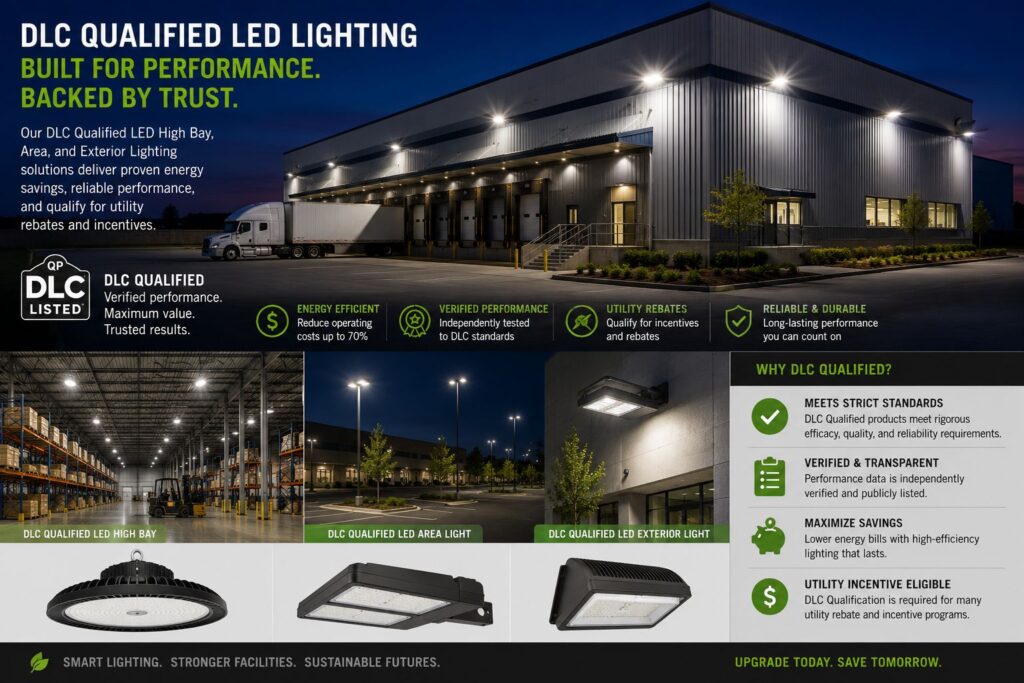
DLC Qualified LED lighting helps commercial and industrial buyers identify products that meet established performance requirements and may satisfy product eligibility requirements for participating energy-efficiency programs.
Need DLC Qualified LED Fixtures for Your Project?
If your project specification, utility incentive program, or customer requires DLC Qualified lighting, we can help identify commercial LED lighting solutions that meet your application, performance, efficiency, and project requirements.
👉 Request DLC Qualified Fixture Pricing or call 1-844-533-7767 to discuss your commercial LED lighting project.
DLC Qualified vs. DLC Certified: An Important Distinction
You’ll frequently hear people refer to a fixture as “DLC Certified.”
The more accurate terminology is:
DLC Qualified
or
DLC Listed
Products meeting applicable DLC requirements can appear on a DLC Qualified Products List, commonly referred to as a QPL.
That distinction is worth maintaining throughout project documentation, RFQs, specifications, and product discussions.
A manufacturer may state that a product is DLC Qualified, but when qualification matters to a project, the specific model should ultimately be verified against the applicable QPL.
Why Does DLC Matter to Commercial Lighting Buyers?
For a homeowner replacing a porch light, DLC qualification probably isn’t a major purchasing consideration.
For a warehouse, manufacturing plant, parking facility, distribution center, commercial building, municipality, or other large lighting project, it can be considerably more important.
There are several reasons.
💰 Utility Rebates and Energy-Efficiency Programs
One of the most common reasons buyers encounter DLC is when pursuing a utility incentive.
Many North American energy-efficiency programs use DLC Qualified Products Lists as part of their process for determining which commercial LED products are eligible for lighting incentives.
That does not mean:
DLC Qualified = guaranteed rebate
Rebate programs establish their own eligibility requirements, which can include fixture category, wattage reduction, operating hours, existing equipment, installation date, geographic location, and preapproval requirements.
Think of DLC qualification as one potential product eligibility requirement, rather than the rebate itself.
📋 Project Specifications
DLC requirements also appear frequently in commercial project specifications.
A specification might require:
- DLC Qualified
- A particular DLC classification
- Minimum efficacy
- Specific lumen output
- Dimming capability
- Occupancy controls
- Particular CCT or CRI
- Additional project-specific performance requirements
In these situations, finding a fixture that merely looks similar to the specified product isn’t enough.
The proposed fixture must be evaluated against the actual project requirements.
This is particularly important for large LED high bay lighting projects, where differences in wattage, lumen output, optics, controls, and qualification status can affect both the lighting design and project economics.
Energy Efficiency
Energy efficiency remains at the heart of the DLC program.
Commercial lighting projects frequently involve hundreds—or even thousands—of fixtures operating for long periods every day. Small improvements in fixture efficacy can therefore translate into substantial differences in total facility energy consumption.
Consider a warehouse replacing older HID high bays.
The project isn’t simply asking:
“Can we install LEDs?”
The better questions are:
- How many watts can we eliminate?
- How much light does the replacement fixture produce?
- Does the new system maintain appropriate illumination?
- Can controls reduce consumption further?
- Does the proposed product satisfy the project specification?
- Could the fixture qualify under the local utility’s incentive program?
Our Industrial Lighting Guide explores these broader considerations when planning lighting for warehouses, manufacturing facilities, distribution centers, and other demanding industrial environments.
Verified Product Information
Another important benefit of the DLC Qualified Products List is standardized product information.
Rather than relying exclusively on marketing claims, project teams can use QPL data as another source for evaluating qualifying products.
Depending on the product and program requirements, this may include information related to:
- Manufacturer and model
- Wattage
- Light output
- Efficacy
- Color characteristics
- Controls
- Product classification
- Qualification status
This becomes particularly useful when comparing several proposed fixtures for a large project.
Two luminaires may look almost identical on paper while having meaningful differences in performance or qualification status.
Procurement and Project Documentation
DLC can also simplify the procurement process.
Facility managers, contractors, ESCOs, engineers, distributors, and purchasing departments may need to document exactly which fixture was proposed, approved, purchased, and installed.
The specific model number matters.
This is especially important when an incentive program or project specification requires a qualifying product. A fixture belonging to a product family with some DLC Qualified models does not necessarily mean that every configuration or model number should automatically be assumed to qualify.
Verification should occur before ordering whenever DLC status is a project requirement.
Where You're Most Likely to Encounter DLC Requirements
DLC qualification commonly appears in commercial and industrial projects involving applications such as:
🏭 Warehouses and manufacturing facilities
📦 Distribution centers
🚗 Parking lots and parking structures
⛽ Gas station and commercial canopies
🏢 Commercial buildings
🧊 Cold storage and refrigerated facilities
🏫 Institutional facilities
🌳 Exterior commercial properties
Fixtures frequently evaluated for these projects include high bays, linear fixtures, vapor-tight luminaires, area lights, parking lot fixtures, canopy lights, wall packs, and other commercial LED products.
💡 Buyer Insight: Don’t Buy the Logo
One of the most important lessons for commercial buyers is:
Don’t select a fixture simply because the specification sheet displays a DLC logo.
If DLC qualification matters to your project, verify the specific model and current qualification status.
Model numbers can vary because of wattage, lumen package, CCT, controls, optics, or other configurable features. Qualification requirements can also change as DLC technical standards evolve.
That makes the Qualified Products List—not an old PDF or marketing graphic—the appropriate place to verify current status.
DLC as Part of the Bigger Lighting Decision
DLC qualification is valuable, but it should never replace proper lighting design.
A DLC Qualified fixture can still be the wrong product if it has:
- The wrong lumen output
- An inappropriate beam distribution
- The wrong mounting configuration
- Insufficient environmental protection
- Incompatible controls
- The wrong color characteristics
- Poor suitability for the application
The objective isn’t simply to specify a DLC Qualified fixture.
The objective is to select the right fixture for the application while also satisfying any DLC, utility, energy-efficiency, or project requirements that apply.
For broader guidance on fixture performance, specifications, planning, and commercial lighting technologies, our Commercial & Industrial Lighting Resources hub provides additional technical references for project owners, contractors, engineers, and facility managers.
Specification Tip
When requesting pricing for a project requiring DLC Qualified products, provide the application, fixture type, existing wattage, desired replacement wattage or lumen output, quantity, controls requirements, and project location whenever possible.
The project location is especially useful when utility incentives are involved because rebate requirements vary considerably between utilities and territories.
How to Use the DLC Qualified Products List
When a project specification or utility incentive requires DLC Qualified lighting, seeing “DLC” on a manufacturer’s specification sheet isn’t enough. The safest approach is to verify the specific product and model configuration using the DesignLights Consortium’s Qualified Products List.
Before specifying or purchasing a fixture for a project that requires DLC qualification, use the official DesignLights Consortium Qualified Products Lists to verify the current status of the specific model. The DLC provides searchable lists for commercial LED lighting, LUNA-qualified outdoor products, horticultural lighting, and networked lighting controls.
The QPL serves as a centralized database of lighting products that have satisfied the applicable DLC technical requirements.
For contractors, distributors, facility managers, engineers, and commercial buyers, it provides an additional layer of verification before products are specified, purchased, or submitted for an incentive program.
🔎 Verify the Exact Model Number
This is perhaps the most important step when checking DLC qualification.
Commercial LED fixtures frequently belong to configurable product families. One basic fixture platform may be offered with different:
- Wattages
- Lumen packages
- Color temperatures
- Optics
- Drivers
- Controls
- Voltage configurations
- Sensors
- Emergency options
Because of these variations, don’t assume every configuration within a manufacturer’s product family has identical qualification status.
When DLC qualification is required, compare the complete model number being proposed with the applicable product information in the QPL.
This is especially important when evaluating configurable LED linear high bay fixtures, where wattage, lumen output, controls, and other options can vary substantially within the same product series.
Don't Rely on an Old Specification Sheet
Manufacturers frequently update products.
LED chips change. Drivers change. Product families evolve. DLC technical requirements also change over time.
As a result, a PDF downloaded several years ago may not accurately represent a product’s current qualification status.
An old specification sheet might still display:
DLC Qualified
or
DLC Premium
even though the specific product configuration should be verified against the current QPL before being used for a new project.
What Information Can You Find on the QPL?
The Qualified Products List contains considerably more information than simply whether a product qualifies.
Depending on the product category and applicable DLC requirements, buyers may encounter information such as:
Manufacturer
Identifies the company responsible for the qualified product.
Model Number
One of the most important fields for procurement and rebate verification.
Product Category
Identifies the applicable lighting category or use.
Wattage
Shows the electrical power consumed by the listed configuration.
Light Output
Provides lumen information that helps buyers compare actual fixture performance.
Efficacy
Expressed in lumens per watt (lm/W), efficacy indicates how efficiently the fixture converts electrical power into useful light.
Color Characteristics
Depending on the product, information may include CCT, CRI, and other relevant characteristics.
Controls Information
Qualified products may include information related to dimming, sensors, field adjustability, and other control capabilities.
Qualification Status
This is critical when the QPL is being used to support a project specification or utility incentive application.
Understanding Efficacy
Efficacy is one of the most useful specifications when comparing LED products.
It is calculated as:
Lumens ÷ Watts = Lumens per Watt
For example:
A 150-watt fixture producing 22,500 lumens delivers:
150 lm/W
A different 150-watt fixture producing 27,000 lumens delivers:
180 lm/W
Both fixtures consume the same amount of electricity, but the second fixture produces considerably more light for every watt consumed.
That doesn’t automatically make it the better fixture—optics, glare, distribution, environmental ratings, controls, and application requirements still matter—but efficacy provides an important measure of energy performance.
For a deeper explanation of this relationship, see our Lumen vs. Watt Efficiency Guide.
DLC Standard and DLC Premium
Commercial lighting buyers may also encounter products identified as DLC Standard or DLC Premium, depending on the applicable program requirements and product listing.
Historically, DLC Premium has identified products meeting higher performance thresholds than the base qualification level, particularly around efficacy and other technical characteristics.
Why does that matter?
Some utility incentive programs have historically:
- Required DLC qualification
- Offered different incentive levels
- Applied additional requirements to higher-performing products
However, buyers should never assume that selecting a Premium product automatically generates a larger rebate.
The utility program—not DLC—determines the incentive.
Always verify the current requirements of the specific utility or energy-efficiency program serving the project location.
📋 DLC Qualification Is Only One Specification
A product appearing on the QPL does not mean it’s automatically appropriate for your project.
Imagine you’re replacing warehouse high bays.
Two products might both be DLC Qualified but have substantially different:
- Lumen output
- Beam distribution
- Glare characteristics
- Operating temperature
- IP rating
- Controls
- Mounting options
- Warranty
- Expected service life
For a cold storage facility, for example, qualification alone isn’t sufficient. The fixture also needs to perform reliably at the required operating temperatures and environmental conditions.
Our Cold Storage Lighting resource discusses the additional performance considerations involved in refrigerated warehouses, freezers, food distribution facilities, and similar environments.
The lesson is simple:
DLC helps verify qualifying performance characteristics. It doesn’t replace application-specific fixture selection.
Field-Adjustable Fixtures Require Extra Attention
Modern commercial LED fixtures increasingly offer selectable wattage, selectable CCT, adjustable lumen packages, integrated sensors, or other field-configurable features.
These products provide tremendous flexibility.
For example, a contractor may be able to use one fixture platform across several mounting heights or facility areas by adjusting wattage during installation.
But field adjustability also makes model verification more important.
When DLC qualification or a utility incentive is required, confirm that the proposed configuration and operating settings satisfy the applicable program requirements rather than assuming every possible field setting receives identical treatment.
This is particularly relevant when specifying modern commercial LED high bay lighting and other configurable commercial fixtures.
🧾 Verify Before You Order—Not After Installation
The worst time to discover a DLC qualification problem is after hundreds of fixtures have been installed.
For projects involving specifications or potential utility incentives, establish verification early in the purchasing process.
A good workflow is:
1. Identify the application.
Determine the fixture type and required lighting performance.
2. Review the project specification.
Identify DLC, efficacy, controls, environmental, warranty, and other requirements.
3. Select candidate fixtures.
Evaluate products that satisfy the actual lighting application.
4. Verify the specific DLC listing.
Confirm the proposed model/configuration against the current QPL.
5. Confirm utility incentive requirements.
If rebates are involved, verify eligibility with the applicable program before ordering.
6. Preserve the documentation.
Keep model numbers, specification sheets, QPL information, invoices, and other documentation required by the project or incentive program.
That final step is especially important on large retrofit projects where rebate documentation may be reviewed after installation.
💡 Buyer Insight: Model Numbers Matter
When requesting a quote for a DLC-required project, don’t simply ask:
“Is this fixture DLC?”
Instead ask:
“Is this specific model/configuration currently DLC Qualified for my application?”
That small distinction can prevent problems during specification review, procurement, and utility incentive approval.
When DLC Status Is Especially Important
Take extra care with QPL verification when:
- The specification explicitly requires DLC.
- A utility rebate is part of the project economics.
- Hundreds or thousands of fixtures are being purchased.
- Products are being submitted as equals or substitutions.
- Field-adjustable fixtures are being specified.
- The project requires particular controls.
- Older product documentation is being used.
- A DLC technical-requirements transition is underway.
That last point is particularly relevant in 2026.
DLC’s SSL V6.0 transition introduces new performance and documentation requirements, meaning buyers should be especially cautious about relying on older qualification information when planning projects extending into late 2026 and 2027.
A Useful Resource for Project Planning
DLC verification is only one part of commercial fixture selection. Photometrics, mounting heights, environmental conditions, controls, voltage, warranties, and application-specific standards may also affect the final specification.
Our Commercial & Industrial Lighting Resources center brings these technical planning guides together for contractors, engineers, facility managers, and commercial buyers.
DLC Qualified Lighting, Utility Rebates & the New SSL V6.0 Requirements
For many facility managers, contractors, and property owners, the first time they encounter DLC qualification is during an LED retrofit project when someone asks:
“Is the fixture DLC Qualified?”
Often, the reason behind that question is a potential utility rebate.
Across North America, utilities and energy-efficiency programs use DLC Qualified Products Lists to help establish product eligibility for commercial lighting incentive programs. However, DLC qualification and rebate eligibility are not the same thing.
Understanding that distinction can prevent costly assumptions during project planning.
💰 Does DLC Qualification Guarantee a Utility Rebate?
No.
A DLC Qualified fixture may satisfy an important product requirement for a utility incentive program, but the utility or program administrator—not the DLC—determines whether a project qualifies for an incentive.
Individual programs may consider factors such as:
- Existing fixture technology
- Existing wattage
- Proposed LED wattage
- Fixture quantity
- Annual operating hours
- Building or facility type
- Product category
- DLC qualification level
- Lighting controls
- Installation date
- Project location
- Preapproval requirements
Some programs also change incentive amounts periodically as LED technology, electricity costs, building codes, and market adoption evolve.
For this reason, rebate eligibility should be investigated before fixtures are purchased or installed.
Verify the Utility Program Before Ordering Fixtures
Imagine a warehouse planning to replace 250 existing high bays.
The proposed LED high bay fixtures are DLC Qualified, substantially reduce connected wattage, and provide the required lumen output.
It would still be a mistake to automatically calculate a rebate based solely on the DLC listing.
Before ordering, the project team should determine:
- Which utility or energy-efficiency program serves the facility?
- Does the proposed fixture category qualify?
- Is the exact model eligible under the current program?
- Does the program require DLC Standard, Premium, or another qualification level?
- Does the utility maintain its own approved product list?
- Are controls required or separately incentivized?
- Is project preapproval required before equipment is purchased?
- Must an approved contractor or participating Trade Ally perform the work?
- Can the customer purchase the fixtures independently, or must equipment be supplied through the program?
- What documentation, inspections, and installation verification are required?
These questions are particularly important because program structures vary significantly. Some utilities simply require documentation showing that qualifying products were installed, while others require preapproval, an existing-lighting inspection, approved products, participating contractors, installation verification, and final project documentation.
🛠️ Some Utility Programs Require Approved Contractors
Not every commercial lighting incentive program allows the building owner to independently select a fixture, purchase it, hire an installer, and then apply for a rebate.
Some utilities operate approved-contractor, trade ally, or direct-install programs. Under these programs, participating contractors may perform much of the project process for the customer.
Depending on the utility and program, an approved contractor may:
- Conduct an onsite lighting assessment
- Inventory existing fixtures and wattages
- Recommend eligible LED replacements
- Select products from an approved product list
- Calculate estimated energy savings
- Prepare incentive documentation
- Obtain required preapproval
- Supply the qualifying fixtures
- Complete the installation
- Dispose of or recycle replaced lighting equipment
- Submit final project documentation
In some programs, the customer may have relatively little involvement in fixture selection because the utility or program administrator has already established an approved product list from which participating contractors must select.
This is particularly common with direct-install and small-business energy-efficiency programs, where the objective is to simplify the retrofit process for the property owner.
Approved Products May Be More Restrictive Than the DLC QPL
This creates another important distinction:
A product can be DLC Qualified without necessarily being approved for a particular utility program.
A utility may use DLC qualification as an initial technical requirement while maintaining its own narrower list of approved fixtures, manufacturers, wattages, or product categories.
Therefore, buyers should determine whether the program requires:
DLC Qualified product
or
DLC Qualified + utility-approved product
or
Utility-selected product installed by an approved contractor.
Those are three very different purchasing situations.
⚠️ Don't Purchase Equipment Before Checking Program Rules
This is especially important for customers planning a large retrofit.
Purchasing fixtures independently before contacting the utility could potentially affect incentive eligibility if the program requires:
- Preapproval
- An existing-lighting inspection
- An approved contractor
- Approved products
- Installation through the utility program
The safer sequence is:
Check utility → determine program structure → verify contractor/product requirements → obtain approval → purchase/install.
For customers who are free to select their own equipment, we can then help identify appropriate commercial LED lighting fixtures that satisfy the project’s performance and qualification requirements.
Beyond Energy Efficiency: DLC, LUNA & Smarter Commercial Lighting Decisions
DLC qualification began primarily as a way to identify energy-efficient commercial lighting products, but today’s lighting decisions increasingly involve more than lumens per watt.
Controls, nighttime environmental impact, product longevity, light distribution, color characteristics, and application-specific requirements have become increasingly important.
This evolution is particularly apparent with DLC LUNA, which addresses the intersection of energy efficiency and responsible outdoor lighting.
🌙 What About DLC LUNA?
Commercial outdoor lighting projects may occasionally encounter DLC LUNA, a qualification that builds on DLC’s solid-state lighting requirements with additional criteria intended to reduce light pollution, sky glow, and light trespass.
LUNA is most relevant to outdoor applications where responsible nighttime lighting is part of the project specification. It should not be confused with general Dark Sky design requirements or wildlife-specific lighting requirements.
Most commercial buyers are still far more likely to encounter a requirement for DLC Qualified or DLC Premium fixtures than a specific request for LUNA. However, understanding the designation can be useful when working on municipal, campus, community, or environmentally sensitive outdoor projects.
For related outdoor-lighting strategies, see our Dark Sky Compliant Post Lights guide.
🐢 What About Amber and Low-CCT Lighting?
Outdoor lighting is increasingly being designed around the needs of the surrounding environment.
In sensitive coastal locations, for example, projects may use amber or long-wavelength lighting to reduce potential effects on nesting sea turtles and hatchlings.
However, DLC qualification and wildlife-lighting requirements should not be treated as interchangeable.
A fixture being DLC or LUNA Qualified does not automatically mean it is wildlife certified or approved for a particular coastal project.
Likewise, an amber fixture designed to support wildlife-sensitive lighting strategies isn’t automatically DLC Qualified.
Our Turtle-Friendly Amber Lighting guide discusses fixture selection, shielding, amber wavelengths, and compliance considerations for coastal properties where wildlife-sensitive lighting is required.
This is another example of why commercial buyers must evaluate all applicable project requirements together.
🌱 DLC Horticultural Lighting
DLC also maintains technical requirements and a Qualified Products List specifically for horticultural lighting.
This matters because evaluating grow lights requires different performance metrics than evaluating warehouse high bays or parking lot fixtures.
Horticultural lighting focuses on delivering useful light for plant growth, making characteristics such as photosynthetic photon efficacy and photosynthetic photon flux important performance considerations.
For commercial growers, greenhouses, indoor farms, research facilities, and controlled-environment agriculture, DLC horticultural qualification may also be relevant to energy-efficiency programs.
Our LED Horticultural Lighting Systems resource explores commercial grow-light technologies and applications in greater detail.
🔎 Check the Official DLC Qualified Products Lists
When DLC qualification matters to a project, verify the specific manufacturer and model number rather than relying solely on marketing literature or an older specification sheet.
The official DLC database provides access to its commercial LED, LUNA, horticultural, and networked lighting controls Qualified Products Lists.
Search the Official DLC Qualified Products Lists
Qualification requirements and product status can change, particularly during technical-requirement transitions, so current verification should be part of the specification and procurement process.
Where DLC Qualified Lighting Commonly Fits
DLC qualification can influence fixture selection across a wide range of commercial and industrial applications.
🏭 Warehouses & Manufacturing Facilities
High bays, linear high bays, and other industrial luminaires are frequently involved in energy-efficiency retrofits where efficacy, controls, and utility incentives are important.
🧊 Cold Storage & Refrigerated Warehouses
Lighting must combine energy efficiency with reliable operation at low temperatures and, depending on the facility, moisture and sanitation requirements.
🚗 Parking Lots & Parking Structures
Exterior area lights and garage fixtures can operate for thousands of hours annually, making energy efficiency and controls particularly valuable.
Our LED Parking Lot Lighting resources cover fixture selection, mounting heights, distributions, and commercial parking applications.
⛽ Gas Stations & Commercial Canopies
Canopy lighting frequently operates for long nighttime periods, making LED efficiency, appropriate light levels, and long fixture life important considerations.
🏢 Commercial Interiors
Troffers, linear fixtures, and other commercial luminaires may be evaluated for efficiency, controls, occupant comfort, and utility incentive eligibility.
🌳 Outdoor Commercial Properties
Area lights, wall packs, floodlights, and other exterior fixtures increasingly combine energy efficiency with controls and responsible nighttime-lighting practices.
Our Commercial Outdoor Lighting guide covers the broader design considerations involved in exterior commercial projects.
DLC vs. ENERGY STAR: What's the Difference?
The distinction between DLC and ENERGY STAR created considerably more confusion during the earlier years of LED adoption. Today, commercial and industrial lighting buyers are much more likely to encounter DLC qualification, particularly when working with project specifications and utility incentive programs.
Although both programs are associated with energy-efficient products, they serve different roles.
DLC focuses heavily on commercial and industrial lighting technologies, including solid-state lighting, horticultural lighting, and networked lighting controls.
ENERGY STAR covers a much broader range of energy-efficient consumer and commercial products.
For most commercial lighting projects, the practical question today isn’t “DLC or ENERGY STAR?” It’s whether the proposed fixture meets the specific DLC, utility-program, and project requirements applicable to the installation.
💬 Inline Buyer Q&A
Questions Commercial Lighting Buyers Frequently Ask
Does my project require DLC Qualified fixtures?
Not necessarily. DLC qualification isn’t universally required for commercial lighting installations. However, a project specification, utility incentive program, owner requirement, or procurement standard may require qualifying products.
Always review the project’s actual requirements before selecting fixtures.
Does DLC qualification guarantee a utility rebate?
No.
Many utilities use DLC qualification as part of their product-eligibility requirements, but the utility or program administrator establishes the actual incentive rules.
Some programs also maintain their own approved product lists or require installation through participating contractors.
Can I purchase the fixtures myself and still receive the rebate?
It depends entirely on the utility program.
Some programs allow customers or contractors to purchase eligible fixtures independently and submit the required documentation.
Others operate through approved contractors, Trade Allies, or direct-install programs that may specify the products, supply the fixtures, complete the installation, and process the incentive.
Check the program requirements before purchasing equipment.
If a fixture is DLC Qualified, is every configuration qualified?
Don’t assume so.
Commercial fixtures frequently have multiple wattages, lumen packages, CCTs, controls, drivers, and other configurations.
Verify the specific model number required for your project.
How can I determine whether a fixture is currently DLC Qualified?
Use the official DLC Qualified Products Lists and search the specific manufacturer and model number.
Verify a Product on the DLC QPL
This is preferable to relying exclusively on an old specification sheet or a DLC logo displayed on marketing material.
Can a DLC Qualified fixture still be wrong for my project?
Absolutely.
DLC qualification doesn’t determine whether a fixture has the correct:
- Lumen output
- Light distribution
- Mounting configuration
- Environmental rating
- Operating temperature
- Voltage
- Controls
- CCT
- Warranty
- Application-specific certifications
Qualification should be considered one part of the complete specification process.
Ready to Specify DLC Qualified Lighting for Your Project?
Selecting a commercial LED fixture involves more than finding a DLC logo. The right product must satisfy your lighting requirements, environmental conditions, controls strategy, project specifications, and—when applicable—the requirements of your utility incentive program.
Whether you’re planning a warehouse retrofit, parking lot upgrade, manufacturing facility, commercial building, or large exterior lighting project, we can help identify fixtures appropriate for your application.
👉 Request DLC Qualified LED Lighting Pricing or call 1-844-533-7767 to discuss your commercial or industrial lighting project.
Frequently Asked Questions
What does DLC stand for?
DLC stands for DesignLights Consortium.
What is the DLC QPL?
QPL stands for Qualified Products List. DLC maintains searchable lists of products meeting the applicable requirements of its lighting programs.
Is DLC qualification required by law?
Generally, no. However, project specifications, utility programs, procurement requirements, or other authorities may require DLC Qualified products for a particular project.
Is DLC the same as a utility rebate program?
No. DLC establishes technical requirements and maintains Qualified Products Lists. Utilities and energy-efficiency program administrators establish their own incentive programs.
What is DLC SSL V6.0?
SSL V6.0 is the latest generation of DLC technical requirements for qualifying commercial solid-state lighting products, incorporating updated efficiency, controllability, and product-information requirements.
What is DLC Premium?
Premium identifies qualifying products meeting additional performance requirements beyond the applicable Standard level. Whether Premium status provides an additional financial benefit depends on the individual utility or incentive program.
What is DLC LUNA?
LUNA adds nighttime environmental-lighting requirements to eligible DLC Qualified outdoor luminaires, helping project teams consider energy efficiency alongside responsible nighttime illumination.
Can DLC qualification change?
Yes. Products and qualification requirements can change over time. When DLC status is required for a specification or incentive, verify the product’s current status before making a major purchase.
Related Commercial Lighting Resources
Continue your commercial lighting research with these technical and application guides:
Commercial & Industrial Lighting Resources
Industrial Lighting Guide
LED High Bay Lighting
Commercial Outdoor Lighting
Dark Sky Compliant Post Lights
LED Horticultural Lighting Systems
Turtle-Friendly Amber Lighting
Commercial Solar Lighting