
LED light towers provide elevated, high-output illumination for construction sites where large outdoor work areas must remain visible after daylight hours. By raising multiple LED floodlights above equipment, materials, and workers, a light tower can distribute illumination across significantly larger areas than most ground-level portable fixtures.
Selecting the right construction light tower requires more than comparing total lumen output. Mast height, fixture quantity, beam distribution, tower placement, power source, runtime, environmental exposure, glare, and the dimensions of the work area all influence lighting performance.
Understanding these factors helps contractors and project managers select LED light towers that provide effective illumination without unnecessarily increasing equipment, energy use, or light spill.
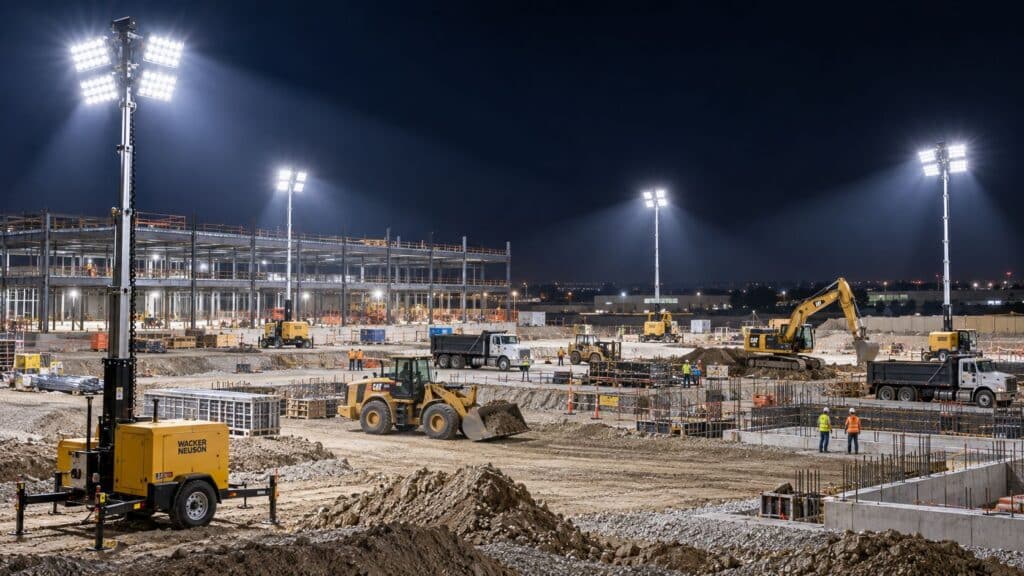
LED construction light towers elevate high-output floodlights above equipment and obstructions to distribute illumination across large nighttime work areas.
Illuminate Large Jobsites with Commercial LED Construction Lighting
Large construction projects require lighting that can cover broad work areas while remaining adaptable as equipment, materials, and active work zones move throughout the project.
Explore our Construction Site Lighting Guide to compare light towers with portable work lights, temporary string lights, floodlights, and other LED construction lighting solutions.
What Is an LED Construction Light Tower?
An LED construction light tower is a portable lighting system that uses an elevated mast to position one or more high-output LED luminaires above a work area.
The elevated mounting position allows light to travel over equipment and many ground-level obstructions while increasing the area illuminated by each fixture.
A typical system may include:
- Multiple LED floodlights
- Telescoping or extendable mast
- Portable trailer or wheeled base
- Generator or external electrical connection
- Controls
- Stabilizing outriggers
- Adjustable fixture heads
Configurations vary considerably depending on the application and manufacturer.
Where Are Construction Light Towers Used?
Light towers are particularly useful when large outdoor areas require temporary illumination.
Common applications include:
- Commercial construction
- Highway and road projects
- Bridge construction
- Excavation
- Utility work
- Concrete placement
- Equipment staging
- Large material yards
- Infrastructure projects
- Emergency repair work
- Nighttime maintenance
- Remote jobsites
They can also supplement fixed temporary lighting when work extends beyond the originally illuminated portion of a project.
Why LEDs Are Well Suited to Construction Light Towers
Older mobile lighting systems commonly relied on high-intensity discharge technologies.
LED technology provides several advantages for temporary construction lighting.
Instant Illumination
LED fixtures reach usable output immediately without the extended warm-up or restrike characteristics associated with some traditional HID lamps.
Lower Power Demand
Efficient LED luminaires can produce substantial illumination while reducing electrical demand compared with older lighting technologies designed for similar applications.
Directional Light
LED optics allow manufacturers to control how fixture output is distributed across the work area.
Reduced Lamp Maintenance
LED luminaires eliminate conventional replaceable HID lamps and their associated lamp-change cycles.
Dimming and Controls
Some LED systems provide adjustable output, allowing operators to reduce illumination when full output is unnecessary.
Light Tower Selection Factors
A construction light tower should be selected around the jobsite rather than simply choosing the system with the largest advertised lumen number.
| Selection Factor | Why It Matters |
|---|---|
| Total light output | Determines available fixture output |
| Mast height | Influences coverage, intensity, glare, and shadows |
| Beam distribution | Determines where the light is delivered |
| Number of fixtures | Affects aiming flexibility and coverage |
| Power source | Determines how and where the tower can operate |
| Runtime | Important for generator and battery-powered systems |
| Portability | Affects relocation as work areas change |
| Environmental protection | Important for outdoor dust and weather exposure |
| Stabilization | Helps maintain safe operation when the mast is elevated |
| Controls | Can provide output adjustment or automated operation |
Lumens Are Not the Same as Jobsite Illumination
Total lumen output is useful when comparing lighting equipment, but it does not tell a contractor how much illumination will reach the ground.
Actual jobsite lighting depends on:
- Mast height
- Fixture optics
- Fixture aiming
- Distance from the tower
- Number of luminaires
- Work area dimensions
- Equipment and structural obstructions
- Surface conditions
Two towers with similar lumen ratings can therefore produce substantially different lighting patterns.
Our Construction Site Lighting Levels Guide explains how foot-candles, mounting height, spacing, and beam distribution affect usable illumination.
How Mast Height Affects Light Tower Performance
One of the primary advantages of a light tower is its elevated mounting position.
Increasing mast height generally allows illumination to spread across a larger area and can help light travel over vehicles, equipment, materials, and other obstructions.
However, increasing the distance between the luminaires and work surface also affects illumination intensity.
A taller mast therefore does not automatically produce a better result.
The appropriate height depends on:
- Fixture output
- Optical distribution
- Desired coverage
- Required illumination
- Tower position
- Site obstructions
- Glare considerations
Mast height and fixture performance should be evaluated together.
Beam Distribution and Fixture Aiming
Many construction light towers use several individually adjustable luminaires.
This allows operators to aim fixtures toward different portions of the jobsite rather than directing all available output toward the same location.
For example, a four-fixture tower might be configured so individual luminaires cover separate portions of a broad work zone.
Proper aiming can help:
- Expand useful coverage
- Reduce dark areas
- Limit excessive overlap
- Reduce wasted light
- Improve visibility around equipment
- Control glare
Fixtures should generally be directed toward working surfaces rather than toward the eyes of workers or equipment operators.
Light Tower Placement
Where a light tower is positioned can be as important as the tower’s specifications.
A poorly located tower may create long shadows, illuminate unused portions of the site, or interfere with construction traffic.
Consider:
Equipment Movement
Avoid locations where the tower obstructs vehicle and equipment routes.
Work Direction
Position luminaires so workers are not consistently looking toward high-output fixtures.
Site Obstructions
Structures, containers, cranes, trucks, and material stacks can block light.
Ground Conditions
The tower needs an appropriate operating surface and adequate stability.
Changing Work Zones
Construction activity moves. Tower placement should remain flexible enough to accommodate those changes.
One Large Light Tower vs. Multiple Lighting Positions
Using one extremely bright tower is not always the best approach.
A single lighting position can create pronounced shadows behind large equipment and structures.
Multiple lighting positions can illuminate a work area from different directions, reducing severe shadowing and improving uniformity.
| Layout | Advantages | Considerations |
|---|---|---|
| One central tower | Simple setup and fewer pieces of equipment | Greater potential for shadows and uneven perimeter lighting |
| Multiple towers | Better directional coverage and reduced shadowing | Requires additional equipment and placement planning |
| Tower plus portable lights | Broad area lighting plus localized task illumination | Requires coordination between lighting systems |
| Several lower-output positions | Can improve uniformity | May require more power connections and equipment |
The best approach depends on site geometry and the activities taking place.
Generator-Powered LED Light Towers
Generator-powered light towers remain useful where utility power is unavailable or unreliable.
They are commonly used for:
- Remote construction
- Highway projects
- New developments
- Utility work
- Emergency operations
- Large undeveloped sites
When comparing generator-powered systems, contractors should consider fuel capacity, expected runtime, generator loading, noise, maintenance requirements, and the electrical demand of the lighting system.
LED efficiency can reduce the lighting load placed on the generator compared with less-efficient fixture technologies.
Electric Light Towers
Electric light towers can be practical where reliable temporary or permanent electrical service is available.
Potential advantages include:
- No onboard engine
- Reduced fuel handling
- Lower operating noise
- Reduced engine maintenance
- No local engine exhaust during operation
The practical limitation is access to suitable electrical power and distribution equipment.
Electric systems can be particularly useful on established commercial properties, interior construction projects with sufficient clearance, and sites where temporary electrical infrastructure is already available.
Battery and Hybrid Light Towers
Battery-powered and hybrid systems provide another option for applications where reduced noise, emissions, or fuel consumption is desirable.
Battery systems can be useful around:
- Occupied facilities
- Healthcare properties
- Residential-adjacent construction
- Nighttime urban work
- Locations with noise restrictions
Runtime becomes a critical selection factor.
Hybrid systems can combine stored battery power with another charging or generating source to extend operating periods.
Mobile Solar LED Light Towers for Off-Grid Construction Sites
Mobile solar LED light towers provide another option for construction projects where grid power is unavailable, generator operation is undesirable, or lighting equipment needs to be deployed without temporary electrical infrastructure.
These systems combine LED luminaires, photovoltaic panels, battery storage, controls, and an adjustable mast on a portable platform. Solar energy collected during daylight hours is stored in the battery system and used to operate the lighting after dark.
For construction applications, mobile solar towers can be particularly useful for:
- Remote jobsites without electrical service
- Road and infrastructure projects
- Temporary equipment and material staging areas
- Utility construction
- Nighttime work near occupied properties
- Projects with noise or emissions restrictions
- Locations where running temporary electrical service would be difficult or expensive
Unlike generator-powered towers, fully solar-powered systems can operate without continuous fuel delivery, engine noise, or local generator emissions. However, successful operation depends on properly matching the solar array and battery storage to the lighting load, required nightly runtime, seasonal solar conditions, and expected periods of limited sunlight.
Solar Light Tower Planning Considerations
| Planning Factor | What to Evaluate |
|---|---|
| Required illumination | Foot-candle target and size of the work area |
| Nightly runtime | Number of hours the lights must operate |
| Solar exposure | Available direct sunlight and potential shading |
| Battery capacity | Required runtime and reserve autonomy |
| Solar-panel capacity | Ability to replenish energy used overnight |
| Mast height | Coverage, fixture distribution, and obstructions |
| Fixture aiming | Work-area coverage, glare, and light spill |
| Controls | Scheduling, dimming, motion response, or remote operation |
| Mobility | Frequency and distance of tower relocation |
| Site conditions | Ground stability, weather, equipment traffic, and clearance |
Solar towers should not be selected from LED lumen output alone. Lighting requirements and energy requirements have to work together. A tower may provide
sufficient fixture output but still be unsuitable if the battery and photovoltaic system cannot support the required operating schedule.
Projects with long nighttime shifts, seasonal reductions in sunlight, shading, or several consecutive low-solar days may require additional battery capacity, increased photovoltaic capacity, programmed dimming, or another power configuration.
Explore our Mobile Solar LED Light Towers for off-grid construction and temporary lighting systems designed for portable deployment without conventional electrical infrastructure.
Comparing Construction Light Tower Power Options
| Power Configuration | Potential Advantage | Primary Consideration |
|---|
| Generator | Independent operation at remote sites | Fuel, noise and engine maintenance |
| Electric | Quiet operation without onboard engine | Requires suitable electrical service |
| Battery | Quiet operation with no engine during discharge | Runtime and charging requirements |
| Hybrid | Can reduce generator runtime and fuel use | Greater system complexity |
| Solar | Off-grid operation without continuous fuel or electrical service | Solar exposure, battery capacity and required autonomy |
Controlling Glare from Construction Light Towers
High-output fixtures mounted above a construction site can create substantial glare when they are improperly aimed.
Glare can reduce visibility for:
- Equipment operators
- Truck drivers
- Workers approaching the tower
- Motorists on nearby roads
- Occupants of adjacent properties
Increasing brightness does not correct a glare problem.
Better solutions may include:
- Re-aiming fixtures
- Changing tower location
- Increasing mounting height where appropriate
- Using different beam distributions
- Illuminating from multiple directions
- Reducing unnecessary output
Light should be directed toward the work rather than toward the observer.
Inline Buyer Q&A
How many lumens should an LED construction light tower have?
There is no single lumen rating that works for every construction site. Required output depends on the size and shape of the work area, mast height, beam distribution, fixture aiming, required foot-candle level, obstructions, and the number and placement of towers. Evaluate usable illumination at the work surface rather than selecting a tower solely by its advertised lumen output.
How tall should a construction light tower be?
The appropriate mast height depends on the fixture output, beam distribution, desired coverage, and jobsite conditions. Raising the luminaires can expand coverage and help light travel over equipment and materials, but increasing the distance from the work surface also affects illumination intensity.
Can one light tower illuminate an entire construction site?
It may be possible for a smaller or relatively open work area, but one lighting position can create significant shadows behind equipment, structures, containers, and stored materials. Larger or obstructed jobsites may benefit from multiple lighting positions to improve uniformity.
Should I choose a generator, electric, battery, or solar light tower?
The best power source depends on the project. Generator towers provide independent operation in remote locations, electric towers work well where suitable power is available, battery systems can reduce noise during operation, and solar towers can provide off-grid lighting without continuous generator operation or temporary electrical service.
When does a mobile solar LED light tower make sense?
Mobile solar LED light towers are particularly useful for remote construction, roadwork, infrastructure projects, staging areas, and other temporary applications where grid power is unavailable or generator noise, fuel use, and engine maintenance are undesirable. Solar exposure, battery capacity, nightly runtime, and required reserve autonomy should be evaluated before selecting the system.
Explore our Mobile Solar LED Light Towers for portable off-grid lighting options designed for construction, infrastructure, and temporary commercial applications.
How should construction light towers be positioned?
Tower placement should consider equipment travel routes, active work areas, site obstructions, ground conditions, worker sightlines, nearby roads, and neighboring properties. Fixtures should be aimed toward the work surface while minimizing direct glare and unnecessary light spill.
Get Help Selecting LED Light Towers for Your Construction Project
Selecting a construction light tower involves more than comparing wattage or lumen output. Work area dimensions, required illumination, mast height, beam distribution, power availability, operating hours, environmental conditions, and tower placement all affect the system needed for a project.
LED PROS WorldWide can help contractors, project managers, municipalities, and commercial buyers evaluate LED light towers and temporary construction lighting systems for large outdoor, nighttime, and off-grid applications.
Request a Commercial Construction Lighting Quote or call 844-533-7767 to discuss your construction lighting requirements.
Frequently Asked Questions About LED Construction Light Towers
What is an LED construction light tower?
An LED construction light tower is a portable lighting system that elevates one or more high-output LED luminaires on an adjustable mast. The increased mounting height allows the fixtures to distribute illumination across larger temporary work areas.
What are construction light towers commonly used for?
Construction light towers are commonly used for commercial development, road and bridge construction, excavation, utility projects, concrete placement, equipment staging, infrastructure work, emergency repairs, and other nighttime operations.
Are LED light towers suitable for outdoor construction?
Yes, when the complete lighting system is designed for the outdoor conditions where it will operate. Environmental exposure, weather, dust, ground conditions, stabilization, and manufacturer operating limitations should all be considered.
Do construction light towers need to meet OSHA lighting requirements?
OSHA establishes minimum illumination levels for specified construction areas and operations. A light tower can be used to provide that illumination, but compliance depends on the actual light reaching the work area rather than the specifications of the tower alone.
For applicable minimum illumination levels and temporary lighting considerations, see our Temporary Construction Lighting Requirements guide.
How do I determine how many light towers a construction site needs?
The number depends on the size and geometry of the site, required foot-candle levels, tower output, mast height, optical distribution, fixture aiming, obstructions, and placement. Representative light-level measurements can help verify whether the completed layout provides adequate illumination.
Our Construction Site Lighting Levels guide explains how foot-candles, fixture spacing, mounting height, and beam distribution affect usable jobsite illumination.
Can solar light towers be used for construction sites?
Yes. Properly sized mobile solar LED light towers can provide temporary off-grid illumination for construction and infrastructure projects. The solar array, battery capacity, LED load, required nightly runtime, local solar conditions, and desired reserve autonomy must be considered together.
Stay Connected with Our Lighting Resources
Add IndustrialLightingFixtures.org as a Preferred Source on Google to see more of our lighting guides and technical resources across Google Search experiences.

Related LED Construction Light Tower Resources
Continue researching LED construction and temporary jobsite lighting:
- Construction Site Lighting Guide — Compare construction lighting types, applications, mounting methods, and temporary jobsite lighting considerations.
- Construction Site Lighting Levels — Learn how foot-candles, mounting height, fixture spacing, beam distribution, and measurement affect usable construction-site illumination.
- Temporary Construction Lighting Requirements — Review OSHA illumination levels, temporary electrical considerations, and construction lighting safety requirements.
- Mobile Solar LED Light Towers — Explore portable solar-powered LED towers for construction sites, roadwork, infrastructure projects, remote locations, and other off-grid temporary lighting applications.
- LED Portable Work Lights — Explore portable LED lighting for localized construction, maintenance, inspection, and changing work areas.