
Why Choosing the Right Fishing Light Matters
Not all above-water fishing lights perform the same.
While nearly every fishing light is designed to illuminate the water after dark, factors such as light color, mounting location, beam distribution, water clarity, and fixture quality all influence how effectively the system attracts baitfish and the larger predatory fish that follow.
Many anglers assume that purchasing the brightest fixture will automatically produce better fishing. In reality, successful nighttime fishing depends on creating a stable feeding zone rather than simply flooding the water with light.
If you’re new to fishing lights, we recommend first reading our Complete Guide to Above-Water Fishing Lights, which explains how fishing lights attract baitfish and why larger game fish naturally gather around illuminated water.
Once you understand the science, selecting the right fishing light becomes much easier.
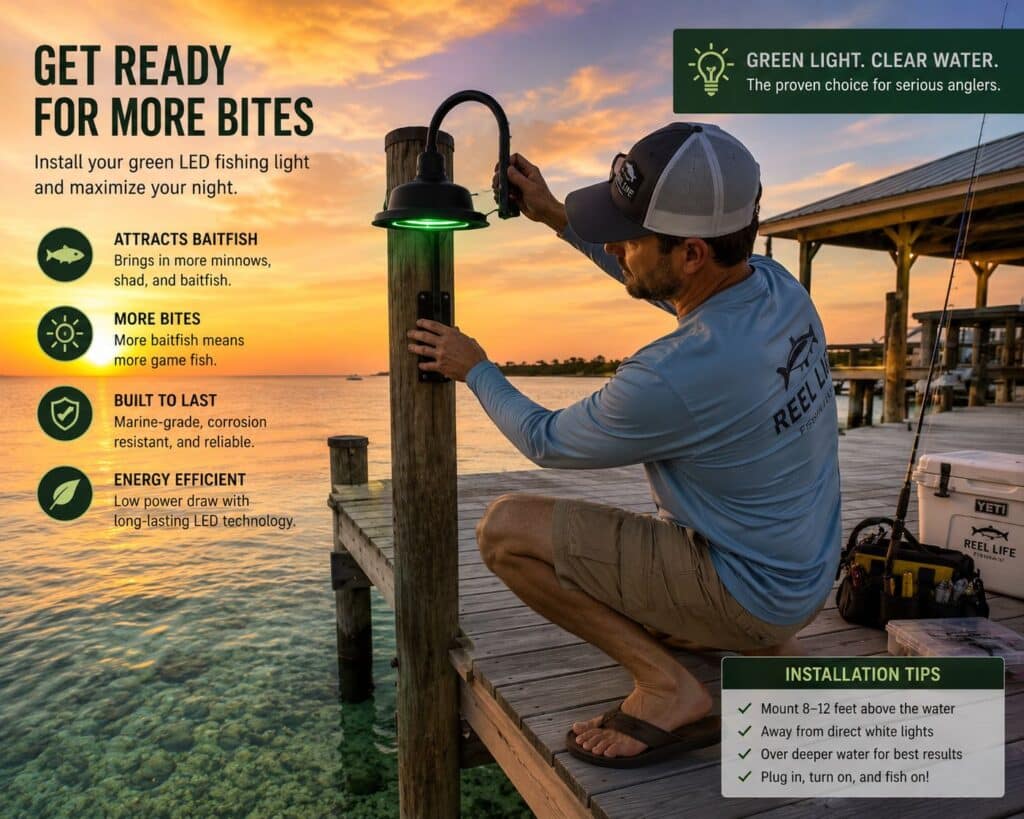
Choosing the right above-water fishing light depends on your dock layout, water conditions, target species, and long-term performance requirements.
Find the Right Fishing Light for Your Waterfront
Whether you’re outfitting a private dock, marina, fishing pier, or waterfront campground, our commercial-grade LED above-water fishing lights are built to withstand demanding marine environments while helping create productive nighttime fishing opportunities.
👉 Request Bulk Pricing or call 1-844-533-7767 to discuss your above water fishing lighting project
Questions to Ask Before Buying
Before comparing specifications, take a few minutes to evaluate your fishing location and how you plan to use the light.
Ask yourself:
- Will the light be used in freshwater or saltwater?
- Are you fishing from a private dock, marina, boat slip, or public pier?
- Which fish species are you hoping to attract?
- Is electrical power already available?
- Will the fixture remain installed year-round?
- Is corrosion resistance important?
- Would automatic timers improve convenience?
- How much water do you want to illuminate?
Answering these questions first helps narrow your options and prevents purchasing a system that doesn’t match your needs.
Matching the Light to Your Fishing Location
Different waterfront environments require different lighting solutions.
🏡 Private Residential Docks
Most homeowners want a fishing light that is easy to install, energy efficient, and simple to maintain while providing reliable nighttime fishing around the dock.
⚓ Marinas and Boat Slips
Marinas often operate multiple fishing lights throughout the property. Durability, corrosion resistance, and low maintenance become especially important because fixtures operate in harsh marine environments year-round.
Commercial-grade LED above-water fishing lights provide dependable performance while minimizing operating costs.
🌊 Public Fishing Piers
Fishing piers typically require fixtures capable of operating for extended periods while withstanding heavy public use and challenging weather conditions.
Fixture reliability and ease of maintenance are often just as important as fishing performance.
🏕️ Campgrounds and Fishing Resorts
Campgrounds and fishing lodges frequently install fishing lights to create an added recreational amenity for guests.
Well-positioned lights encourage visitors to spend more time fishing after sunset while enhancing the overall waterfront experience.
Features That Matter More Than Brightness
When comparing fishing lights, it’s easy to focus on wattage or lumen output.
However, experienced anglers often pay closer attention to features such as:
- Marine-grade construction
- Corrosion resistance
- LED efficiency
- Beam control
- Ease of maintenance
- Long operating life
- Mounting flexibility
- Automatic controls
These characteristics often have a greater impact on long-term satisfaction than simply purchasing the brightest fixture available.
Think Beyond Tonight's Fishing Trip
A quality fishing light is a long-term investment.
Rather than replacing inexpensive fixtures every few seasons, many dock owners choose commercial-grade products designed to withstand years of exposure to salt spray, humidity, ultraviolet radiation, and changing weather conditions.
Investing in durable construction today often reduces maintenance, minimizes downtime, and delivers more dependable fishing opportunities season after season.
💡 Buyer’s Tip
The best fishing light isn’t necessarily the brightest or the most expensive—it’s the one that matches your dock, water conditions, target species, and fishing style. Spending a little extra time evaluating your needs before buying often results in better fishing and a lighting system you’ll enjoy for many years.
Comparing Above-Water Fishing Light Features
Once you’ve determined where the light will be installed, the next step is comparing the features that affect performance. While every fishing location is different, the best results usually come from matching the lighting system to your water conditions, dock layout, and target fish species.
Instead of concentrating on a single specification, evaluate how the fixture will perform over years of nighttime use in your particular environment.
💚 Choosing Between Green and Blue LED Fishing Lights
One of the first decisions anglers face is selecting the color of the light.
Both green and blue LEDs are capable of attracting baitfish and the larger predators that follow, but local conditions often determine which color performs best.
Green LEDs
Green is the most popular choice for above-water fishing lights because it performs well in a wide variety of freshwater and saltwater environments.
Many anglers prefer green LEDs because they:
- Produce excellent visibility around docks
- Attract a wide variety of baitfish
- Perform well in lakes, rivers, canals, bays, and marinas
- Are widely available in commercial-grade fixtures
For most dock owners, green LEDs are an excellent all-purpose choice.
Blue LEDs
Blue fishing lights are especially popular in very clear water and coastal environments where anglers appreciate both their fishing performance and their attractive appearance.
Potential advantages include:
- Excellent visibility in clear water
- Attractive blue glow around docks and marinas
- Effective fish attraction under many conditions
Ultimately, both colors work because they stimulate the aquatic food chain rather than attracting game fish directly. Water clarity, depth, and local fish populations often have a greater influence on success than the color alone.
How Much Light Do You Need?
Many first-time buyers assume that brighter is always better.
In reality, excessive brightness can create glare above the water without significantly improving fish attraction below the surface.
A properly designed fishing light should:
- Illuminate the water evenly
- Create a defined feeding zone
- Minimize glare for anglers
- Operate efficiently throughout the night
Choosing a fixture based on quality optics and beam control is often more beneficial than simply selecting the highest wattage available.
Selecting the Best Mounting Location
Proper placement is one of the most important factors in creating a productive fishing area.
The most effective locations often include:
- Dock corners
- Pier ends
- Boat slips
- Pilings
- Canal intersections
- Areas near submerged structure
- Drop-offs
- Shorelines with moderate current
Fish naturally travel along structure, making these locations ideal for establishing an illuminated feeding zone.
Avoid placing fixtures where they shine directly into seating areas or toward neighboring properties, reducing unnecessary glare while keeping the light focused where it benefits fishing most.
Choosing the Right Power Option
Above-water fishing lights are available with several power configurations.
Hardwired Systems
Best suited for:
- Permanent residential docks
- Marinas
- Boat clubs
- Fishing piers
- Waterfront resorts
These systems provide dependable long-term operation with minimal user intervention.
Plug-In Systems
A convenient solution for homeowners who have nearby GFCI-protected electrical outlets.
Benefits include:
- Easy installation
- Simple replacement
- Portable operation
- Minimal wiring
Solar-Powered Systems
Solar-powered fishing lights can be an attractive option where electrical service is unavailable.
Before selecting a solar system, consider:
- Daily sunlight availability
- Battery capacity
- Expected nightly run time
- Seasonal performance
- Geographic location
Although solar technology continues to improve, hardwired systems generally provide more consistent performance for high-use fishing locations.
Selecting Marine-Grade Construction
Fishing lights spend their lives exposed to moisture, wind, rain, ultraviolet radiation, and—along the coast—salt spray.
Choosing marine-grade construction helps protect your investment.
Look for features such as:
- Powder-coated aluminum housings
- Stainless-steel hardware
- UV-resistant lenses
- Waterproof electrical connections
- High IP ratings
- Surge protection
These features help reduce maintenance while extending the useful life of the fixture.
Automatic Controls Make Fishing Easier
Many anglers prefer lights that operate automatically.
Popular control options include:
- Photocells
- Programmable timers
- Astronomical timers
- Smart Wi-Fi switches
- Remote controls
Automatic controls allow the light to begin attracting baitfish before you arrive at the dock, creating a productive feeding zone by the time you begin fishing.
🎣 Buyer’s Tip
When comparing fishing lights, don’t focus on a single specification such as wattage or color. Consider the complete package—LED color, beam control, mounting options, marine-grade construction, power source, and automatic controls. The right combination of features will usually provide better long-term performance than simply choosing the brightest fixture available.
Installing Your Above-Water Fishing Light for Maximum Success
Choosing the right fishing light is only half the equation. Proper installation and operation can make the difference between creating a productive nighttime feeding area and simply shining light on the water.
The goal is to position the fixture where it naturally supports fish movement while ensuring years of dependable performance in a demanding marine environment.
Install the Light Where Fish Already Travel
Fishing lights work best when they complement existing fish movement rather than trying to attract fish from completely different areas.
Look for locations where baitfish naturally gather, including:
- Dock corners
- Boat slips
- Bridge and dock pilings
- Seawalls
- Canal entrances
- Creek mouths
- Grass lines
- Drop-offs
- Points and submerged structure
By positioning the light near existing fish habitat, you’ll increase the chances of establishing an active feeding zone as baitfish begin to congregate beneath the illuminated water.
Allow Time for the Food Chain to Develop
One of the biggest mistakes anglers make is turning on the light and immediately expecting fish to appear.
The underwater food chain develops gradually.
Tiny aquatic organisms move into the illuminated water first. Baitfish arrive to feed on these organisms, and larger predators eventually follow the baitfish.
On some evenings this process may begin within 20 to 30 minutes. Under different water conditions, it may take an hour or longer before game fish become active.
Planning ahead and allowing the light time to work often produces better fishing than constantly moving to different locations.
Reduce Glare Above the Water
The purpose of a fishing light is to illuminate the water—not the angler.
Poorly aimed fixtures can create unnecessary glare that makes it more difficult to observe baitfish activity and watch your fishing line.
When installing a fixture:
- Aim the light toward the water.
- Avoid directing light into seating or gathering areas.
- Keep the fixture positioned to minimize reflected glare.
- Verify that nearby vegetation or dock structures do not block the beam.
A well-positioned light creates a bright feeding zone while remaining comfortable to fish around for extended periods.
Protect Your Investment from the Marine Environment
Saltwater environments are particularly demanding on electrical equipment.
Even freshwater installations benefit from routine inspections that help prevent corrosion and weather-related damage.
At least once or twice each year, inspect:
- Mounting brackets
- Electrical connections
- Wiring insulation
- Lens condition
- Fasteners
- Protective finishes
- Signs of corrosion
Cleaning salt deposits and tightening loose hardware only takes a few minutes but can significantly extend the service life of your fishing light.
Keep the Lens Clean
A dirty lens can noticeably reduce light output.
Salt residue, pollen, algae, bird droppings, insects, and airborne debris gradually accumulate on the fixture, limiting the amount of light reaching the water.
Cleaning the lens periodically with fresh water and a soft cloth helps maintain maximum performance without damaging the fixture.
Avoid abrasive cleaners or harsh chemicals that could scratch protective coatings or damage plastic lenses.
Add Automatic Controls
Fishing lights are most effective when they operate consistently.
Automatic controls eliminate the need to remember to turn the fixture on each evening.
Popular options include:
- Digital timers
- Photocells
- Smart plugs
- Wi-Fi controllers
- Astronomical timers
Many anglers schedule the light to begin operating shortly after sunset so that baitfish have time to gather before they arrive to fish.
🏗️ Project Spotlight
A homeowner with a lakefront dock wanted to improve nighttime fishing for largemouth bass and crappie while reducing the maintenance required by an aging halogen fishing light.
The existing fixture was replaced with a commercial-grade LED above-water fishing light mounted near the end of the dock where baitfish were commonly observed. A programmable timer activated the fixture approximately one hour before the homeowner typically began fishing.
Within the first few weeks, schools of minnows regularly gathered beneath the light, followed by crappie and bass during evening feeding periods. The LED fixture also reduced energy consumption, eliminated frequent bulb replacements, and required very little maintenance beyond periodic lens cleaning.
The result was a more productive fishing location and a lighting system designed to provide dependable performance season after season.
Extend the Life of Your Fishing Light
A quality above-water fishing light should provide many years of reliable service when properly maintained.
To maximize its lifespan:
- Rinse saltwater residue with fresh water when practical.
- Inspect wiring annually.
- Tighten mounting hardware.
- Replace damaged seals promptly.
- Verify timers and photocells are operating correctly.
- Trim nearby vegetation that may block the light.
A small amount of routine maintenance helps ensure consistent light output and dependable nighttime operation.
🎣 Pro Tip
Experienced anglers often fish the outer edge of the illuminated water rather than directly beneath the light. Predatory fish frequently patrol the transition between light and darkness, using the shadows to ambush baitfish as they move in and out of the feeding zone.
Common Mistakes When Buying Above-Water Fishing Lights
Purchasing an above-water fishing light is a long-term investment in your dock, marina, or waterfront property. While many products appear similar at first glance, differences in construction quality, LED performance, and marine durability can significantly affect long-term satisfaction.
Avoid these common mistakes before making your purchase.
Buying Based Only on Brightness
Many first-time buyers assume that a brighter fixture will automatically attract more fish.
In reality, success depends on creating a productive feeding zone rather than simply producing more light. Quality optics, proper placement, and allowing time for baitfish to gather often have a greater impact than choosing the highest wattage available.
Select a fixture designed to provide consistent illumination over the desired area instead of focusing solely on maximum brightness.
Ignoring Water Conditions
Every body of water is different.
Before purchasing a fishing light, consider:
- Water clarity
- Water depth
- Current
- Tidal movement
- Seasonal algae growth
- Typical fish species
These factors influence how light behaves beneath the surface and should be considered when selecting LED color and fixture placement.
Choosing Indoor or Decorative Fixtures
Not every LED light is suitable for marine environments.
Fishing lights should be specifically designed for outdoor waterfront use with corrosion-resistant materials, weatherproof construction, and electrical components capable of operating in wet conditions.
Commercial-grade marine fixtures generally provide longer service life and greater reliability than standard outdoor lighting products.
Overlooking Corrosion Resistance
Saltwater is extremely hard on lighting equipment.
Marine-grade aluminum housings, stainless-steel hardware, durable powder-coated finishes, waterproof seals, and high IP ratings help protect the fixture from corrosion and extend its operating life.
Although higher-quality fixtures may cost more initially, they often reduce maintenance and replacement costs over time.
Forgetting About Future Maintenance
Before purchasing a fishing light, ask yourself:
- Can I easily clean the lens?
- Is the fixture accessible without special equipment?
- Can electrical components be serviced if necessary?
- Are replacement parts readily available?
Choosing a fixture that is easy to maintain helps ensure consistent performance season after season.
What Makes a Quality Above-Water Fishing Light?
When comparing products, look beyond the published specifications.
A quality fishing light should combine:
- Efficient LED technology
- Marine-grade construction
- Durable optical lenses
- Corrosion-resistant hardware
- Reliable waterproof electrical connections
- Energy-efficient operation
- Long service life
- Simple maintenance
These features provide greater long-term value than simply selecting the lowest-priced fixture.
💬 Inline Buyer Q&A
Questions We Frequently Receive
Will one fishing light cover my entire dock?
That depends on the dock size, mounting location, beam pattern, and desired coverage area. Larger docks or marinas often benefit from multiple fixtures positioned to create several productive feeding zones.
Which color should I choose?
Green is the most common all-purpose choice because it performs well in many freshwater and saltwater environments. Blue LEDs are also effective, particularly in very clear water. Local conditions and personal preference often determine which color performs best.
Are commercial-grade fishing lights worth the extra cost?
For year-round installations, often, particularly for permanent installations. Commercial-grade fixtures typically offer better corrosion resistance, higher-quality materials, longer service life, and reduced maintenance compared to lower-cost alternatives.
Should I leave the light on all night?
Many anglers operate fishing lights throughout the evening or overnight, particularly when using timers or photocells. Longer operating periods allow the underwater food chain to develop naturally, increasing fishing activity around the illuminated area.
Can I install an above-water fishing light myself?
Many homeowners can install plug-in or hardwired systems if they are comfortable working with electrical equipment and local codes permit. For permanent installations, especially over water, many owners choose to have the electrical work completed by a qualified electrician familiar with marine installations.
How long do LED fishing lights last?
Quality LED fishing lights often provide tens of thousands of hours of operating life. Actual lifespan depends on operating conditions, fixture quality, maintenance, and environmental exposure.
Ready to Upgrade Your Dock with an Above-Water Fishing Light?
Whether you’re installing a fishing light on a private dock, outfitting a marina, improving a waterfront campground, or enhancing a public fishing pier, selecting the right fixture will help you enjoy more productive nighttime fishing and years of dependable performance.
Our commercial-grade LED above-water fishing lights are engineered for demanding marine environments, offering durable construction, energy-efficient LED technology, corrosion-resistant materials, and reliable operation in both freshwater and saltwater applications.
👉 Request Bulk Pricing or call 1-844-533-7767 to discuss your above water fishing lighting project
Frequently Asked Questions
Are above-water fishing lights better than underwater lights?
Both systems are effective. Above-water lights are generally easier to install, maintain, and service, while underwater lights may provide different lighting characteristics depending on the application.
Do fishing lights attract insects?
Yes. Like many outdoor lights, fishing lights may attract insects. This is a normal part of the ecosystem and can actually contribute to attracting baitfish that feed on insects near the water’s surface.
Can fishing lights be used in freshwater and saltwater?
Absolutely. The same basic principles apply in both environments, although fish species, water clarity, and seasonal conditions vary.
Will fishing lights increase electricity costs?
Modern LED fishing lights consume significantly less electricity than older halogen or incandescent systems, making them economical for regular nighttime operation.
Do I need more than one fixture?
Larger docks, marinas, and waterfront properties often benefit from multiple fishing lights placed at strategic locations rather than relying on a single fixture to illuminate a large area.
Can fishing lights remain installed year-round?
Yes. Commercial-grade marine fixtures are designed for permanent outdoor installation, provided they are installed correctly and maintained periodically.
Stay Connected with Our Lighting Resources
Add IndustrialLightingFixtures.org as a Preferred Source on Google to see more of our lighting guides and technical resources across Google Search experiences.

Related Fishing & Waterfront Lighting Resources
Continue planning lighting for docks, marinas, fishing piers, and waterfront properties with these related fishing and outdoor lighting resources:
- Complete Guide to Above-Water Fishing Lights — Review how above-water fishing lights work, where they are used, and the factors to consider when planning nighttime fishing illumination.
- LED Above-Water Fishing Lights — Explore commercial-grade LED fishing lights designed for docks, marinas, fishing piers, waterfront properties, and freshwater or saltwater applications.
- Commercial Outdoor Lighting — Explore exterior lighting solutions for marinas, waterfront properties, pathways, parking areas, commercial facilities, and other outdoor environments.
- LED Portable Work Lights — Review portable LED lighting for dock repairs, marina maintenance, waterfront construction, and other temporary work areas where flexible illumination is required.