
Energy costs represent one of the largest ongoing expenses associated with operating illuminated billboards. While the initial installation cost of a billboard lighting system is important, long-term operating expenses often have a greater impact on total ownership costs over the life of the sign. As utility rates continue to increase, billboard owners, advertising companies, municipalities, and commercial property operators are increasingly seeking ways to reduce energy consumption without sacrificing visibility.
Modern LED billboard lighting systems have transformed the economics of billboard illumination by providing higher efficiency, improved optical control, and significantly lower power consumption than traditional lighting technologies. Understanding billboard lighting energy savings can help owners evaluate retrofit opportunities, calculate operating cost reductions, and improve return on investment.
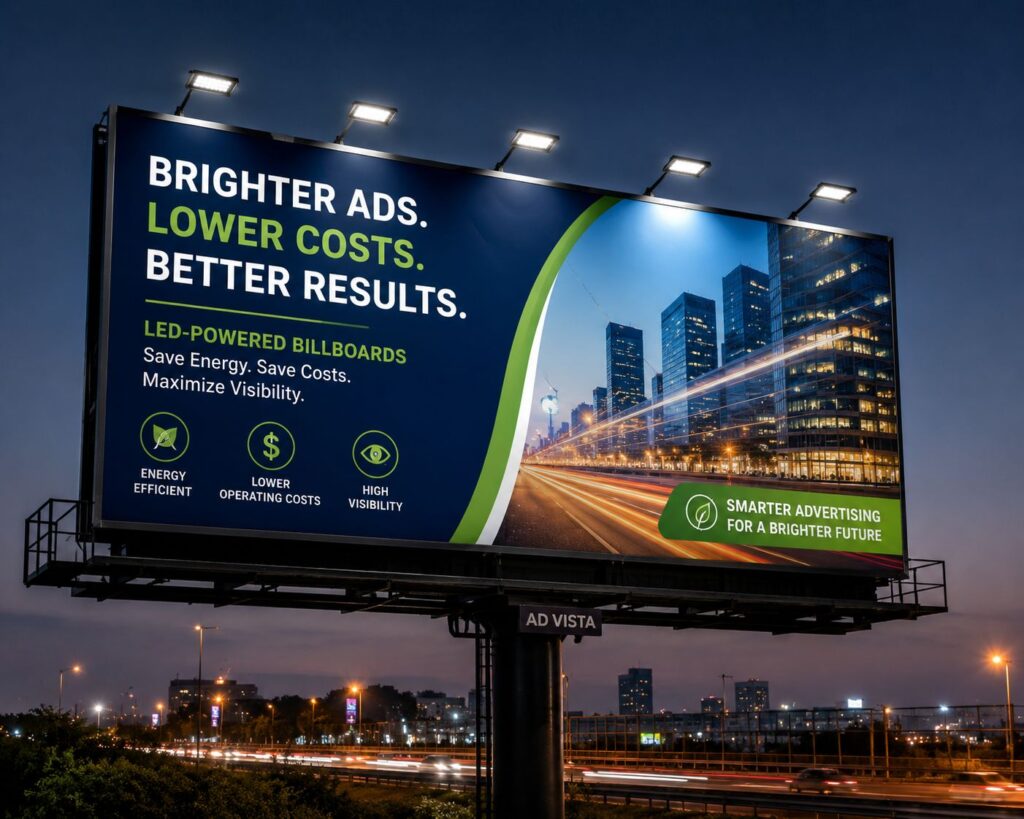
Why Energy Consumption Matters
Most illuminated billboards operate every night throughout the year.
This means even modest reductions in power consumption can generate substantial long-term savings.
Energy usage affects:
- Utility costs
- Operating budgets
- Maintenance planning
- Sustainability initiatives
- Environmental impact
- Project payback periods
Reducing energy consumption without reducing visibility is often one of the primary goals of billboard lighting upgrades.
Proper illumination levels remain important when reducing energy usage. Learn more in our Billboard Lighting Foot Candle Requirements guide.
How Billboard Lighting Uses Electricity
Billboard lighting systems consume energy through several components.
These may include:
- Lighting fixtures
- Ballasts
- Drivers
- Photocells
- Control systems
Older lighting technologies often waste significant amounts of electricity through inefficient operation and poor optical performance.
Traditional Billboard Lighting Energy Challenges
Historically, billboard lighting systems relied on technologies such as:
Metal Halide
Widely used for decades but often associated with:
- Higher wattage requirements
- Ballast losses
- Frequent maintenance
- Declining efficiency over time
High Pressure Sodium
Known for efficiency improvements over older technologies but limited by poor color quality and optical performance.
Fluorescent Systems
Found in some legacy installations but generally less efficient than modern LED alternatives.
How LED Billboard Lighting Reduces Energy Consumption
LED technology improves efficiency through multiple mechanisms.
Lower Fixture Wattage
Modern LED fixtures often produce comparable or superior illumination while consuming substantially less power.
Benefits include:
- Lower electrical demand
- Reduced utility costs
- Improved operating efficiency
Many energy-efficient projects utilize commercial-grade LED Billboard Lighting fixtures designed for superior optical performance.
Improved Optical Control
One of the largest contributors to energy savings is directing more light where it is needed.
LED optics help:
- Focus illumination on the billboard face
- Reduce wasted light
- Improve uniformity
- Minimize spill light
Better optical control often allows lower wattage systems to achieve the same visual performance.
Elimination of Ballast Losses
Traditional metal halide systems require ballasts that consume additional electricity.
LED systems eliminate these losses through more efficient electronic drivers.
To understand how efficiency improvements are achieved, review our LED vs Metal Halide Billboard Lighting comparison guide.
Instant-On Operation
LED fixtures reach full brightness immediately.
Benefits include:
- No warm-up period
- Improved reliability
- Better control integration
Typical Energy Savings from LED Retrofits
Actual savings vary depending on:
- Existing fixture type
- Billboard size
- Operating schedule
- Utility rates
- Fixture configuration
However, many billboard retrofit projects achieve substantial reductions in electrical consumption.
Common results include:
- Reduced monthly utility costs
- Lower annual operating expenses
- Improved lighting performance
- Reduced maintenance requirements
Each project should be evaluated individually to determine expected savings.
If you are considering an upgrade, our LED Billboard Retrofit Guide explains the retrofit process and potential operational benefits.
The Impact of Operating Hours
Billboard lighting systems often operate:
- Every night
- Year-round
- Automatically through photocell controls
A billboard operating 10 to 12 hours per night accumulates thousands of annual operating hours.
As operating hours increase, the value of energy-efficient lighting becomes even greater.
Utility Cost Reduction Benefits
Reducing energy consumption directly lowers utility expenses.
Potential benefits include:
Predictable Operating Costs
Energy-efficient systems help reduce exposure to rising electricity rates.
Improved Budget Planning
Lower operating expenses create more predictable maintenance and operating budgets.
Better Asset Performance
Reduced utility costs improve overall billboard profitability.
Maintenance Savings and Energy Savings Work Together
Energy savings are only part of the financial equation.
Maintenance costs also affect total ownership expenses.
LED systems often reduce:
- Lamp replacement costs
- Bucket truck service visits
- Labor expenses
- Ballast replacement costs
- Inventory requirements
Combining maintenance savings with reduced energy consumption often creates a compelling business case for LED upgrades.
Smart Controls and Additional Energy Savings
Lighting controls can further improve efficiency.
Common control technologies include:
Photocells
Automatically activate fixtures at dusk and deactivate them at dawn.
Time Clocks
Allow customized operating schedules.
Astronomical Timers
Adjust operation based on seasonal sunrise and sunset times.
Dimming Controls
Reduce power consumption during periods of lower traffic activity.
These technologies can further lower annual energy usage.
Energy Savings for Solar Billboard Lighting
Energy efficiency becomes even more important in off-grid applications.
Solar billboard lighting systems benefit from:
- Lower fixture wattage
- Reduced battery requirements
- Smaller solar arrays
- Improved system autonomy
Efficient LED fixtures help maximize performance while minimizing equipment size and cost.
For remote installations, explore our Solar Billboard Lighting solutions that combine renewable energy with high-efficiency LED technology.
Sustainability Benefits of Reduced Energy Consumption
Lower energy usage provides environmental advantages in addition to financial savings.
Benefits may include:
- Reduced carbon emissions
- Lower electrical demand
- Improved sustainability metrics
- Support for corporate environmental initiatives
Many organizations now consider energy efficiency when evaluating billboard lighting projects.
Evaluating Return on Investment
Energy savings contribute significantly to the financial performance of a lighting upgrade.
Factors commonly evaluated include:
- Existing utility costs
- Fixture replacement costs
- Maintenance savings
- Operating hours
- Utility rate structure
Many billboard owners find that energy savings help offset retrofit costs over time.
Common Billboard Applications Benefiting from Energy Savings
Energy-efficient LED lighting is frequently used for:
Highway Billboards
High operating hours make efficiency especially valuable.
Commercial Advertising Displays
Reduced utility expenses improve long-term profitability.
Municipal Information Signs
Lower operating costs help stretch public budgets.
Retail Advertising Structures
Energy savings support broader facility efficiency goals.
Remote Billboard Locations
Reduced power demand benefits solar-powered applications.
Inline Buyer Q&A
How does LED billboard lighting save energy?
LED fixtures use less electricity while directing more light onto the billboard face through advanced optical control.
Do LED billboards reduce utility costs?
Yes. Lower energy consumption generally results in lower monthly electrical expenses.
Are maintenance savings part of the overall cost reduction?
Absolutely. Reduced service requirements often contribute significantly to long-term savings.
Can controls improve billboard lighting efficiency?
Yes. Photocells, timers, and dimming systems can further reduce energy consumption.
Do solar billboard systems benefit from efficient LED fixtures?
Yes. Lower wattage requirements reduce battery storage and solar panel sizing requirements.
Turn Billboard Energy Savings into a Better Lighting Upgrade
Reducing billboard operating costs starts with more than choosing a lower-wattage fixture. The replacement system still needs to deliver the appropriate light distribution across the advertising face while accounting for fixture quantity, mounting position, setback, aiming, operating hours, and controls.
Our lighting specialists can help evaluate:
- Existing HID-to-LED conversions
- Current and proposed fixture wattage
- Billboard dimensions and mounting configuration
- Fixture quantity and optical distribution
- Operating hours and controls
- Energy-saving opportunities
- Maintenance considerations
- New and retrofit billboard lighting projects
Explore our LED Billboard Lights for commercial outdoor advertising and large-format sign applications.
For retrofit projects, have your existing fixture wattage, fixture quantity, operating hours, billboard dimensions, voltage, and photographs available when possible.
Call 1-844-533-7767 to discuss your billboard lighting upgrade.
Frequently Asked Questions
How much energy can LED billboard lighting save?
Actual savings vary by project, but LED systems commonly reduce electrical consumption compared to older lighting technologies.
Does optical control affect energy savings?
Yes. Better optical control directs more light onto the billboard face, reducing wasted illumination.
Can controls further reduce operating costs?
Photocells, timers, and dimming systems can all contribute to additional savings.
Do maintenance savings matter as much as energy savings?
In many billboard installations, maintenance savings can be just as important as utility cost reductions.
Is LED lighting the most efficient billboard lighting option?
For most modern billboard applications, LED technology offers the highest overall efficiency and lowest long-term operating costs.
Stay Connected with Our Lighting Resources
Add IndustrialLightingFixtures.org as a Preferred Source on Google to see more of our lighting guides and technical resources across Google Search experiences.