
Temporary construction lights must adapt as a commercial construction project progresses. Open floors, corridors, equipment areas, active work zones, and detailed installation tasks can each require a different type of illumination before permanent building lighting is available.
No single temporary fixture is ideal for every situation. Construction string lights and linkable LED work lights can distribute illumination across extended work areas, balloon lights can provide broad diffused illumination around active crews, and portable LED work lights can deliver concentrated light directly where individual tasks are being performed.
Construction string lights are temporary jobsite lighting systems consisting of multiple work lights connected along a power cable or through linkable fixtures to distribute illumination across active work areas. They should not be confused with LED rope lights, which use continuous flexible illuminated tubing and serve different commercial lighting applications.
Choosing the right combination helps contractors create a flexible temporary lighting system for construction that can change along with the jobsite.
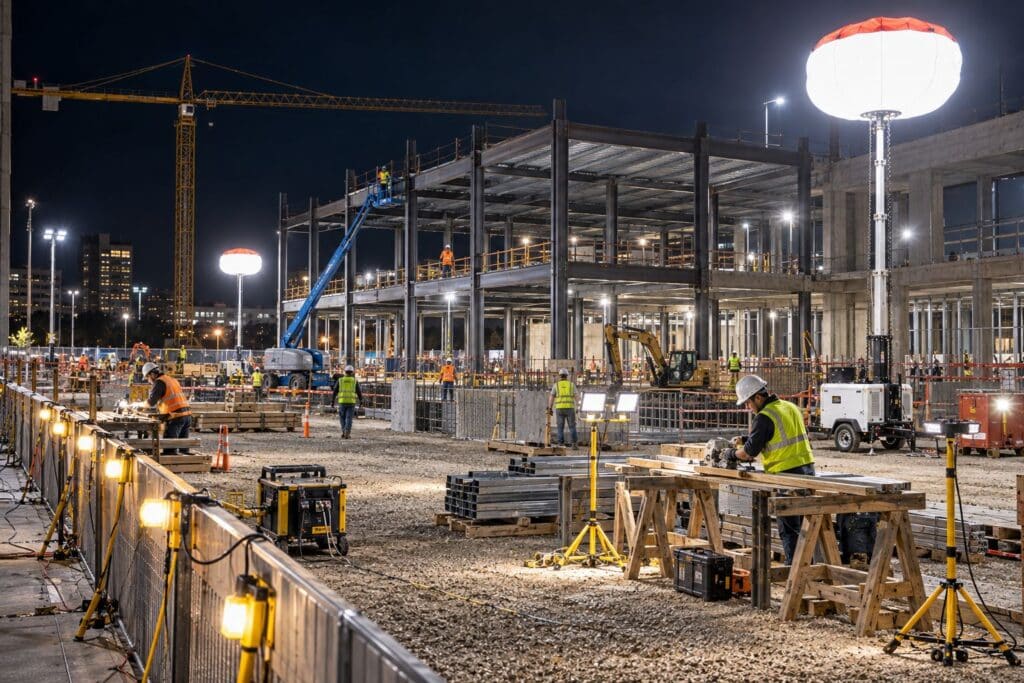
Temporary jobsite lighting can combine linkable work lights, balloon lights, and portable LED fixtures to provide general, area, and task illumination as construction progresses.
Match Temporary Lighting to the Construction Work Area
Commercial jobsites rarely have one uniform lighting requirement. Open floors, corridors, equipment areas, detailed workstations, and exterior work zones can each require a different approach to temporary illumination.
Explore our Construction Site Lighting Guide for a broader look at construction light types, mounting options, temporary applications, safety considerations, and jobsite lighting planning.
What Types of Temporary Jobsite Lighting Are Available?
Temporary construction lighting can be organized according to the type of illumination each system provides.
Common options include:
- Linkable LED work lights
- LED balloon lights
- Portable LED work lights
- Tripod and stand-mounted work lights
- Temporary LED floodlights
- Mobile LED light towers
The appropriate choice depends on whether a project needs distributed general illumination, diffused area lighting, localized task lighting, or large-area exterior illumination.
General, Area, Task, and Large-Area Lighting
A useful way to plan temporary jobsite lighting is to first determine what the lighting needs to accomplish.
| Lighting Function | Primary Purpose | Lighting to Consider |
|---|---|---|
| General illumination | Provide visibility throughout an extended work area | Linkable LED work lights |
| Area illumination | Illuminate an active crew or work zone | Balloon lights, portable floodlights |
| Task illumination | Add light directly where detailed work occurs | Portable LED work lights |
| Large-area illumination | Cover broad exterior work zones | LED light towers |
Linkable LED Work Lights for Distributed Illumination
Linkable LED work lights provide a flexible way to distribute multiple light sources throughout an extended construction area.
Rather than relying on a single centralized fixture, individual lights can be positioned at different locations along corridors, open construction floors, mechanical spaces, or other areas requiring general illumination.
The linkable work-light configuration available through LED PROS WorldWide includes a connection that allows another compatible fixture to be plugged into the light, enabling multiple work lights to operate together.
This approach can be useful for:
- Commercial building interiors
- Corridors and hallways
- Open construction floors
- Warehouses under construction
- Mechanical spaces
- Multifamily projects
- Renovations
- Temporary work areas
Distributed lighting can help reduce severe differences between brightly illuminated areas near a single fixture and darker areas farther away.
Construction String Lights for Distributed Jobsite Illumination
Construction string lights provide a practical way to distribute temporary illumination across extended commercial work areas before permanent lighting systems are operational. Rather than relying on a single high-output fixture, multiple light sources are positioned along the work area to create more consistent illumination where crews are moving, installing equipment, or performing general construction tasks.
Modern LED construction string lights may use fixtures positioned along a common power cable or individual linkable LED work lights that can be connected together. This allows contractors to extend temporary lighting as the project progresses and reposition fixtures when work areas change.
Where Construction String Lights Work Best
Construction string lights are particularly useful in areas where illumination needs to extend through a long or changing workspace. Typical applications include:
- Interior floors under construction
- Corridors and passageways
- Mechanical and equipment areas
- Warehouses and large open interiors
- Renovation and remodeling projects
- Temporary work zones without permanent overhead lighting
Because the light is distributed across multiple points, construction string lighting can help reduce the excessively bright and dark areas that may occur when a work zone depends on only one portable fixture.
Linkable LED Work Lights vs. Traditional Construction Light Strings
Traditional construction light strings typically position multiple lamps or fixtures at intervals along a power cable. Linkable LED work lights accomplish a similar objective using individual fixtures designed to connect electrically, allowing contractors to build a temporary lighting arrangement appropriate for the work area.
Linkable fixtures can be especially useful when a project requires flexibility. Lights can be positioned around equipment, along work areas, or through successive sections of a building as construction progresses.
When selecting either system, contractors should consider fixture spacing, lumen output, beam distribution, mounting location, cord routing, environmental exposure, and the illumination level required for the work being performed.
Construction String Lights Are Not LED Rope Lights
Although the terminology can sound similar, construction string lights and LED rope lights are different lighting systems.
Construction string lights use multiple individual light sources to provide functional temporary illumination for active work areas. LED rope lights use LEDs enclosed within continuous flexible tubing and are commonly used for architectural outlining, pathway identification, accent lighting, and other specialized commercial applications.
For temporary construction lighting, the fixture should be selected according to the required illumination, work environment, electrical conditions, and installation method—not simply because it provides a continuous or extended run of light.
When to Use Another Type of Temporary Construction Light
Construction string lights are not the best solution for every part of a jobsite. Balloon lights can be more appropriate when crews need broad, diffused illumination across an active work area, while portable LED work lights are better suited to concentrated task lighting. Large exterior work zones may require elevated LED light towers to distribute illumination over equipment, vehicles, and expansive construction areas.
Using these temporary construction lights together allows contractors to match the lighting method to each work zone rather than relying on one fixture type throughout the entire project.
Why Fixture Spacing Matters
The effectiveness of linkable work lights depends on more than individual fixture output.
Spacing fixtures too far apart can create alternating bright and dark areas. Installing fixtures unnecessarily close together can increase electrical demand without producing a proportional improvement in useful illumination.
Consider:
- Individual fixture output
- Mounting height
- Beam distribution
- Width of the work area
- Required illumination
- Structural obstructions
- Surface reflectance
- Fixture orientation
Actual illumination at the work surface should determine whether the layout is effective.
LED Balloon Lights for Broad, Diffused Illumination
Balloon lights provide a different approach to temporary area lighting.
A diffusing enclosure spreads illumination broadly around the fixture rather than concentrating output in a narrow direction. This can provide more comfortable area illumination around active crews and help reduce harsh direct glare.
Balloon lights can be useful for:
- Commercial construction
- Interior renovations
- Equipment installation
- Concrete work
- Maintenance and repair
- Temporary work zones
- Nighttime projects
- Applications where glare control is important
Their portability also allows them to move as crews progress through a project.
Explore our LED Balloon Light Portable Work Lights for temporary construction, maintenance, and commercial work-area illumination.
When Should You Choose a Balloon Light?
concentrated around an active work area.
For example, workers installing mechanical equipment may need good visibility around a particular installation zone without requiring the entire building floor to receive the same level of illumination.
A portable balloon light can be repositioned as the crew moves.
Diffused illumination can also be beneficial when direct glare from conventional high-output work lights would interfere with worker or equipment-operator visibility.
Portable LED Work Lights for Localized Tasks
Portable LED work lights provide another layer of flexibility.
These fixtures can be positioned close to the work being performed rather than illuminating an entire construction area.
Common applications include:
- Electrical installation
- Mechanical work
- Plumbing
- Equipment repair
- Inspection
- Interior finishing
- Maintenance
- Detailed assembly
Portable work lights can supplement general jobsite lighting where a particular task requires additional illumination.
Explore our LED Portable Work Lights for construction, maintenance, inspection, repair, and temporary commercial lighting applications.
Linkable Work Lights vs. Balloon Lights vs. Portable Work Lights
The appropriate fixture depends largely on how work is distributed throughout the jobsite.
| Jobsite Situation | Lighting to Consider | Primary Benefit |
|---|---|---|
| Long corridor or hallway | Linkable LED work lights | Distributed illumination along an extended area |
| Open construction floor | Multiple linkable work lights | General illumination across the work zone |
| Concentrated crew location | Balloon light | Broad diffused area illumination |
| Detailed installation | Portable LED work light | Light concentrated close to the task |
| Frequently changing work area | Balloon or portable light | Easier relocation |
| Large defined area | Temporary LED floodlight | Directional high-output coverage |
| Large exterior project | LED light tower | Elevated broad-area illumination |
| General illumination plus detailed tasks | Linkable + portable lights | Layered general and task lighting |
Temporary construction lighting is therefore often better planned as a combination of fixture types rather than selecting one product for the entire project.
Combining Linkable Work Lights, Balloon Lights, and Portable Lighting
Different fixture types can complement one another.
For example, linkable LED work lights might provide general illumination throughout an unfinished commercial floor.
Balloon lights can then be positioned around crews performing concentrated work.
Portable LED work lights can provide additional illumination for installation, inspection, or other detailed tasks.
A layered approach can be organized as:
Linkable LED work lights → distributed general illumination
Balloon lights → broad diffused work-area illumination
Portable LED work lights → localized task illumination
This allows each lighting method to perform the function for which it is best suited.
How Much Light Does a Construction Work Area Need?
Fixture selection should ultimately be connected to the amount of illumination required where work is performed.
OSHA 29 CFR 1926.56 establishes minimum illumination intensities for specified construction areas and operations. For example, OSHA lists 5 foot-candles for general construction area lighting and indoor warehouses, corridors, hallways, and exitways; other listed construction activities have different minimums.
Our Construction Site Lighting Levels guide takes a closer look at foot-candles, mounting height, fixture spacing, beam distribution, and measuring usable illumination.
Lumens Alone Do Not Determine Jobsite Lighting
A fixture’s lumen rating represents light output, but it does not by itself determine how well a work area will be illuminated.
Usable illumination depends on several factors.
| Factor | Why It Matters |
|---|---|
| Lumen output | Determines available fixture output |
| Mounting height | Influences coverage and illumination at the work surface |
| Beam distribution | Determines how output spreads |
| Diffusion | Influences how broadly light is distributed |
| Fixture spacing | Affects uniformity |
| Obstructions | Can create shadows and dark areas |
| Fixture placement | Determines where useful light reaches |
| Surface conditions | Influence reflected illumination |
These factors become especially important when comparing fundamentally different fixtures such as a diffused balloon light and a more directional portable work light.
Mounting and Positioning Temporary Lights
Temporary lighting should provide useful illumination without creating unnecessary interference with construction activity.
Consider:
- Worker sightlines
- Equipment movement
- Ladders
- Scaffolding
- Material handling
- Doorways
- Temporary walls
- Workstation locations
- Physical clearance
- Potential impact damage
Mounting height should balance broader coverage against the amount of illumination reaching the working surface.
Controlling Glare on Active Jobsites
More light does not automatically produce better visibility.
A high-output fixture positioned directly in a worker’s or equipment operator’s line of sight can create glare that makes surrounding objects more difficult to see.
Glare can often be reduced by:
- Repositioning fixtures
- Increasing mounting height where appropriate
- Changing fixture direction
- Using diffused lighting
- Illuminating the work area from more than one position
- Avoiding excessive output where it is unnecessary
Balloon lighting can be particularly useful where broad illumination with reduced direct harshness is desirable.
Temporary Electrical and Safety Considerations
Temporary jobsite lighting is part of the construction project’s temporary electrical system.
OSHA 1926.405 includes requirements for temporary electrical power and lighting. General-illumination lamps must be protected against accidental contact or breakage, and temporary lights cannot be suspended by their electrical cords unless the equipment is designed for that method of suspension. Flexible cords and cables must also be protected from damage.
OSHA further specifies that flexible cords used with temporary and portable lighting be designed for hard or extra-hard usage.
For a broader discussion of these requirements, see our Temporary Construction Lighting Requirements guide.
Selecting Temporary Lighting for the Environment
Construction conditions should influence fixture selection.
Temporary lighting may encounter:
- Dust
- Dirt
- Rain
- Moisture
- Condensation
- Temperature changes
- Moving equipment
- Falling materials
- Accidental impacts
A lighting system suitable for a dry interior renovation should not automatically be assumed suitable for an exposed outdoor project.
Verify that the fixture, cord, connections, and other system components are appropriate for the actual operating environment.
Choosing Temporary Jobsite Lighting by Application
| Construction Application | Lighting to Consider |
|---|---|
| Commercial interior build-out | Linkable work lights + portable task lighting |
| Corridor construction | Linkable LED work lights |
| Mechanical installation | Balloon lights + portable work lights |
| Renovation | Portable or balloon lighting |
| Warehouse under construction | Distributed linkable lighting + supplemental area lighting |
| Detailed finishing | Portable LED work lights |
| Exterior staging area | Temporary floodlights |
| Road or infrastructure construction | LED light towers |
| Remote exterior construction | Mobile solar or other off-grid light towers |
For large exterior applications, our LED Light Towers for Construction Sites guide covers mast height, fixture placement, beam distribution, power options, glare, and off-grid lighting.
Temporary Jobsite Lighting Planning Checklist
| Planning Question | What to Evaluate |
|---|
| What areas need illumination? | Work zones, corridors, stairs and access areas |
| What type of illumination is needed? | General, area, task or large-area |
| How large is the work area? | Dimensions, layout and obstructions |
| Will crews frequently relocate? | Portability requirements |
| What illumination level is required? | Applicable minimums and work activity |
| What power is available? | Voltage, circuits and temporary distribution |
| What environmental conditions exist? | Moisture, dust, weather and temperature |
| How will fixtures be positioned? | Mounting, spacing and clearance |
| Could glare affect visibility? | Worker and equipment-operator sightlines |
| Will conditions change? | Construction stages and future work areas |
Reevaluate Lighting as Construction Progresses
Temporary lighting should change along with the project.
A layout that performs well when a building has an open floor plan may become less effective after framing, ductwork, piping, equipment, and stored materials are added.
As construction progresses:
- Inspect newly created work areas
- Look for new shadows
- Reposition portable fixtures
- Relocate or expand linkable lighting
- Add task lighting where necessary
- Remove lighting no longer required
- Verify illumination in critical areas
Adaptability is one of the primary advantages of portable and temporary LED jobsite lighting.
Buyer Q&A: Choosing Temporary Jobsite Lighting
What type of temporary construction light is best for large interior work areas?
The best approach depends on the size and layout of the work area. Construction string lights and linkable LED work lights can distribute illumination across extended floors and corridors, while balloon lights provide broad diffused illumination around active crews. Portable LED work lights are better suited for localized tasks requiring concentrated light.
When should contractors use construction string lights?
Construction string lights are well suited for commercial interiors, corridors, warehouses, mechanical areas, renovations, and other locations where temporary illumination must extend across a long or changing work area. Multiple light sources can provide more consistent coverage than relying on a single portable fixture.
How many temporary construction lights are needed for a jobsite?
The number of fixtures depends on required illumination levels, lumen output, beam distribution, mounting height, fixture spacing, obstructions, and the dimensions of the work area. Contractors should design the temporary lighting layout around the illumination required at the working surface rather than selecting fixtures by quantity alone.
Are linkable LED work lights suitable for changing construction layouts?
Yes. Linkable LED work lights can be useful on projects where illuminated areas change as construction progresses. Individual fixtures can be positioned throughout the work zone and connected to create distributed temporary lighting without depending on permanent building fixtures.
When are balloon lights preferable to construction string lights?
Balloon lights are particularly useful when crews need broad, diffused illumination around an active work area. Construction string lights are generally better when lighting must extend through corridors, across floors, or along other elongated work zones. Some projects benefit from using both.
What should contractors evaluate before purchasing temporary jobsite lighting?
Evaluate required light levels, fixture lumen output, beam distribution, mounting options, electrical requirements, cord and connection methods, environmental exposure, durability, portability, and how frequently the lighting layout will need to change. The lighting system should also be appropriate for applicable jobsite electrical and safety requirements.
What lighting should be used when working on construction sites during nighttime or low-light conditions?
Nighttime and low-light construction work requires temporary lighting that provides sufficient illumination for workers to safely see work surfaces, equipment, access routes, and potential hazards. The appropriate system may combine construction string lights or linkable LED work lights for distributed illumination, balloon lights for broad diffused coverage, portable LED work lights for individual tasks, and elevated light towers for large exterior work areas. Fixture placement should also minimize excessive glare, deep shadows, and poorly illuminated areas.
Get Help Selecting Temporary Jobsite Lighting
Choosing temporary construction lighting involves more than selecting the highest-output fixture. General illumination, active work areas, detailed tasks, portability, mounting conditions, available power, environmental exposure, and required light levels all influence the appropriate solution.
LED PROS WorldWide can help contractors, project managers, facility teams, and commercial buyers evaluate linkable LED work lights, balloon lights, portable fixtures, and other temporary jobsite lighting solutions.
Request a Commercial Construction Lighting Quote or call 844-533-7767 to discuss your project requirements.
Frequently Asked Questions About Temporary Construction Lights
What are construction string lights?
Construction string lights are temporary lighting systems that distribute multiple light sources across a jobsite. They may use fixtures positioned along a common power cable or linkable LED work lights connected together to illuminate extended construction areas.
Are construction string lights the same as LED rope lights?
No. Construction string lights use individual light sources to provide functional illumination for active work areas. LED rope lights use LEDs enclosed in continuous flexible tubing and are generally used for different commercial applications such as architectural outlining, accent lighting, pathway identification, and specialized supplemental illumination.
Where are temporary construction lights commonly installed?
Temporary construction lights are commonly used on unfinished building floors, corridors, stair and access areas, warehouses, mechanical spaces, renovation projects, equipment areas, and exterior work zones where permanent lighting is unavailable or insufficient.
How should construction string lights be spaced?
There is no universal spacing that works for every jobsite. Spacing depends on fixture output, beam distribution, mounting height, obstructions, work-area dimensions, and the required illumination at the working surface. Lighting levels should be verified after installation rather than assuming a fixed spacing will provide adequate coverage.
Can LED construction string lights reduce dark areas?
They can. Distributing multiple LED light sources throughout an extended work area can produce more uniform illumination than relying on a small number of concentrated fixtures. Proper spacing and placement remain important because equipment, walls, materials, and structural elements can create shadows and obstruct light.
Can different types of temporary construction lights be used together?
Yes. Commercial jobsites frequently benefit from combining lighting methods. Construction string lights or linkable work lights can provide distributed general illumination, balloon lights can illuminate active crew areas, portable work lights can handle detailed tasks, and LED light towers can provide elevated illumination for large exterior work zones.
Stay Connected with Our Lighting Resources
Add IndustrialLightingFixtures.org as a Preferred Source on Google to see more of our lighting guides and technical resources across Google Search experiences.

Related Temporary Construction Lights Resources
- Construction Site Lighting Guide — Review construction lighting types, temporary applications, mounting options, safety considerations, and overall jobsite lighting planning.
- LED Portable Work Lights — Explore portable and linkable LED work lights for construction, inspection, maintenance, and temporary applications.
- LED Balloon Light Portable Work Lights — Explore broad, diffused portable lighting for construction, maintenance, and temporary commercial work areas.
- Temporary Construction Lighting Requirements — Review OSHA illumination requirements, temporary electrical considerations, and jobsite lighting safety.
- Construction Site Lighting Levels — Learn how foot-candles, mounting height, fixture spacing, distribution, and measurement affect usable jobsite illumination.
- LED Light Towers for Construction Sites — Review elevated lighting, mast height, placement, power options, glare control, and large exterior construction applications.