
Commercial lighting is more than selecting fixtures. It is a coordinated system of illumination designed to enhance safety, improve visibility, support operational efficiency, and strengthen the visual identity of a property. Whether lighting a retail center, parking structure, campus, fueling station, or mixed-use development, successful commercial lighting design requires careful planning, proper mounting strategies, code awareness, and long-term performance considerations.
Modern LED technology has transformed commercial lighting from high-maintenance, high-wattage systems into energy-efficient, durable, and strategically layered illumination solutions. However, specifying commercial lighting correctly still requires understanding how exterior and interior zones interact, how light distribution affects safety, and how different fixture categories serve distinct functional purposes.
This guide provides a structured overview of commercial lighting systems, applications, planning considerations, and upgrade strategies to support informed specification decisions.
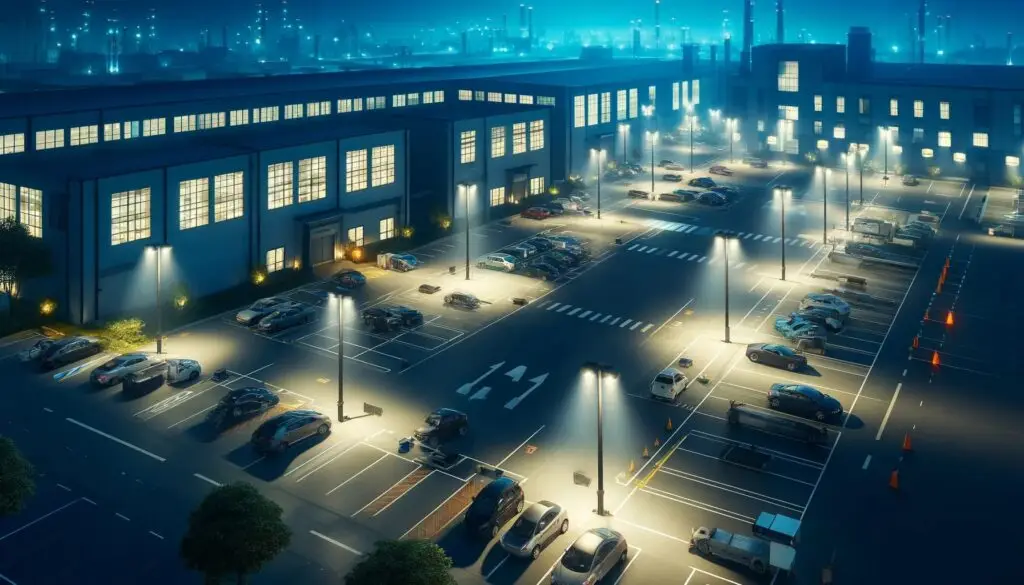
High-output LED area lighting and wall-mounted fixtures providing uniform nighttime visibility across an industrial facility parking area.
Understanding Commercial Lighting Classifications
Commercial lighting systems are typically categorized by application, mounting strategy, and functional intent.
Interior vs Exterior Commercial Lighting
Interior commercial lighting focuses on task visibility, merchandising presentation, and occupant comfort within buildings. Retail environments may also upgrade refrigerated display systems with specialized LED cooler door retrofit lighting solutions to improve product visibility and efficiency.
Exterior commercial lighting addresses property safety, wayfinding, vehicle movement, and architectural presence.
Exterior lighting often includes parking areas, pedestrian pathways, entry points, building facades, and perimeter zones. Certain legacy fixtures may be modernized using high-output LED corn cob light bulbs compatible with existing socket configurations.
Area Lighting vs Accent Lighting
Area lighting delivers broad, uniform illumination for vehicle and pedestrian movement. Accent lighting emphasizes architectural features, signage, or landscape elements.
A parking lot luminaire provides area coverage. A façade fixture provides accent illumination.
Both are essential in a complete commercial lighting plan.
Safety vs Aesthetic Lighting
Some lighting applications are primarily safety-driven — such as perimeter security or garage lighting. Others are aesthetic-driven — such as architectural façade lighting or landscape highlights.
Effective commercial lighting balances both objectives.
Exterior Commercial Lighting Applications
Exterior lighting represents one of the most visible and safety-critical aspects of commercial design. Each application serves a distinct purpose within the overall property ecosystem.
Parking Lot Lighting
Parking lot illumination provides wide-area coverage for vehicle movement and pedestrian safety. Pole-mounted luminaires distribute light across open spaces, minimizing shadowing and supporting surveillance systems.
Modern LED parking lot lighting systems emphasize uniform distribution, reduced glare, and energy efficiency.
Large open vehicle areas rely on properly spaced LED parking lot lighting systems to deliver balanced illumination and maintain safe nighttime visibility.
Parking Garage Lighting
Enclosed and semi-enclosed parking structures require uniform ceiling-mounted illumination that supports visibility in low-ceiling environments. LED parking garage lighting systems prioritize glare control, consistent output, and compatibility with occupancy sensors.
Garage lighting should integrate with exterior area lighting to create a seamless transition from outdoor to indoor spaces.
Enclosed parking structures require uniform, glare-controlled coverage often achieved through engineered LED parking garage lighting systems.
Canopy & Covered Area Lighting
Covered exterior spaces — such as walkways, entrances, and fuel station canopies — require downward-focused, glare-controlled luminaires. These fixtures enhance visibility in sheltered environments while protecting occupants from shadowed zones.
Canopy lighting design must consider mounting height, reflectance surfaces, and uniformity across entry points.
Covered entryways and service zones benefit from dedicated commercial LED canopy lighting designed to provide downward-focused illumination without excessive glare.
Fueling facilities and forecourts often incorporate specialized LED gas station canopy lighting systems engineered for high-traffic petroleum environments.
Perimeter & Security Lighting
Security-focused lighting prioritizes high-contrast visibility around property edges, loading zones, and entry gates. Properly designed security lighting reduces dark spots, supports surveillance systems, and deters unauthorized activity.
Layering security fixtures with broader area lighting enhances overall site coverage.
Building-mounted LED wall pack lighting provides vertical surface illumination and reinforces security along exterior perimeters.
Pedestrian Path & Bollard Lighting
Low-level lighting along walkways and landscaped areas improves pedestrian guidance and enhances architectural aesthetics. Bollard luminaires distribute light laterally, offering comfortable nighttime visibility without excessive glare.
These fixtures often complement pole-mounted area lights for layered illumination.
Low-level pedestrian guidance is often achieved through strategically spaced commercial LED bollard lights along walkways and landscaped zones.
Architectural & Facade Lighting
Facade lighting highlights building materials, textures, and brand presence. Carefully selected optics provide controlled wall-wash effects that enhance nighttime curb appeal without excessive spill light.
Architectural lighting is often integrated with signage and perimeter systems to create a cohesive exterior presentation.
Architectural elements and vertical surfaces are highlighted using precision LED façade lighting systems that enhance building presence at night.
Structural & Mounting Considerations
Lighting performance depends not only on fixture selection but also on mounting strategy and structural support.
Mounting height directly impacts light distribution and uniformity. Pole-mounted fixtures provide wide-area coverage, while wall-mounted luminaires support close-range visibility. Canopy fixtures must balance ceiling height with glare control.
Commercial light poles serve as the structural backbone for exterior area lighting systems. Engineered for wind load and environmental exposure, properly specified poles ensure safe and stable operation over time.
Ground-level safety and hardware protection may be enhanced with durable clam shell pole base covers that conceal anchor bolts and mounting assemblies.
At ground level, accessories such as base covers protect anchor hardware and improve safety presentation.
Proper mounting height and distribution are achieved using engineered commercial light poles designed to withstand environmental loads and ensure structural stability.
Uniformity, Visibility & Safety Standards
Effective commercial lighting is not defined by brightness alone. It is defined by uniformity, contrast control, and visibility performance across functional zones. Over-lighting certain areas while leaving others dim creates visual imbalance and safety concerns.
Footcandles & Illumination Levels
Lighting levels are commonly measured in footcandles (fc), which quantify light intensity on a surface. Different commercial applications require varying illumination levels:
-
Open parking areas: moderate, evenly distributed levels
-
Parking garages: consistent, glare-controlled coverage
-
Pedestrian walkways: comfortable, balanced illumination
-
Security zones: enhanced contrast for camera clarity
Designing to recommended illumination levels helps reduce dark spots and improve overall visual comfort.
Uniformity Ratios
Uniformity refers to how evenly light is distributed across a surface. It is typically expressed as a ratio between the brightest and darkest points in a given area.
Poor uniformity creates:
-
Harsh brightness contrasts
-
Visual fatigue
-
Reduced surveillance clarity
-
Increased perceived safety risk
Proper pole spacing, mounting height, and optic selection are critical to achieving balanced uniformity in parking lots and perimeter zones.
Glare Control
Glare negatively impacts driver visibility, pedestrian comfort, and camera performance. Modern LED luminaires use precision optics and shielding to direct light downward and outward without creating excessive brightness at viewing angles.
In commercial settings, glare control is especially important in:
-
Parking garages
-
Fuel canopies
-
Entry drives
-
Mixed-use developments
Selecting fixtures with controlled distribution enhances both safety and aesthetics.
Light Trespass & Dark-Sky Considerations
Commercial properties must balance illumination with environmental responsibility. Light trespass — unwanted spill into adjacent properties — can create compliance issues and community concerns.
Shielded luminaires, proper aiming, and full cut-off optics help:
-
Minimize upward light
-
Reduce neighborhood impact
-
Improve energy efficiency
-
Maintain regulatory compliance
Strategic design ensures lighting enhances property performance without creating external disruption.
Energy Codes & Efficiency Standards
Energy performance is a central consideration in modern commercial lighting design. LED systems provide dramatic reductions in wattage compared to legacy HID and fluorescent systems, but compliance standards still apply.
DLC Certification
The DesignLights Consortium (DLC) establishes performance criteria for commercial LED products. DLC-listed fixtures often qualify for utility rebates and ensure minimum efficacy and longevity standards.
IECC & ASHRAE Standards
Energy codes such as the International Energy Conservation Code (IECC) and ASHRAE 90.1 regulate lighting power density, control requirements, and efficiency thresholds.
These standards may require:
-
Occupancy sensors
-
Daylight harvesting controls
-
Automatic shutoff
-
Reduced wattage per square foot
Understanding code requirements during planning prevents costly redesigns.
Utility Rebates & Incentives
Many municipalities offer incentives for upgrading to LED systems. Projects involving:
-
Parking lot retrofits
-
Garage lighting modernization
-
Canopy conversions
-
Interior lighting upgrades
may qualify for financial rebates when fixtures meet certification standards.
Evaluating rebate eligibility during project planning improves ROI projections.
When Retrofit Makes Sense
Retrofit kits are ideal when:
-
Existing housings are structurally sound
-
Mounting infrastructure is reusable
-
Budget constraints limit full replacement
-
Installation downtime must be minimized
Retrofit solutions convert legacy fixtures to LED technology while preserving existing enclosures. When existing housings remain structurally sound, upgrading with commercial LED retrofit kits can significantly improve energy efficiency without full fixture replacement.
When Full Replacement Is Recommended
Full fixture replacement is often preferred when:
-
Housings are corroded or outdated
-
Optical performance is inadequate
-
Structural mounting requires redesign
-
Energy code upgrades require integrated controls
New luminaires often provide improved optics, better thermal management, and longer lifecycle performance compared to adapted systems.
Layered Lighting Strategy
High-performing commercial properties rarely rely on a single fixture type. Instead, they implement layered lighting systems that combine multiple luminaire categories.
Parking Lot + Bollard Lighting
Pole-mounted area luminaires provide broad vehicle coverage, while bollards guide pedestrian movement along sidewalks and landscaped pathways.
This layering ensures:
-
Vehicle safety
-
Pedestrian clarity
-
Balanced site aesthetics
Canopy + Wall Pack Integration
Covered areas such as entry drives and pump islands benefit from downward canopy lighting, while wall-mounted luminaires enhance perimeter visibility and vertical surface illumination.
Together, they provide seamless coverage from structure to building façade.
Garage + Security Coordination
Interior parking structures often transition directly to exterior perimeter zones. Coordinating garage fixtures with security luminaires ensures consistent visibility from entry to exit.
Layered security lighting reduces shadowed zones and supports camera performance.
Properties frequently supplement area lighting with dedicated LED outdoor security lighting to enhance surveillance clarity and perimeter protection.
Facade + Sign Illumination
Architectural wall wash fixtures highlight building features, while sign lighting reinforces brand presence and wayfinding.
When integrated thoughtfully, these systems elevate nighttime curb appeal without over-lighting.
Exterior branding and wayfinding benefit from integrated commercial LED sign lighting that reinforces nighttime visibility.
Specifying Commercial Lighting Correctly
Successful lighting projects begin with structured evaluation.
Step 1: Site Assessment
-
Property layout
-
Mounting locations
-
Existing infrastructure
-
Electrical capacity
Understanding the physical environment prevents installation conflicts.
Step 2: Determine Illumination Goals
Clarify:
-
Safety priorities
-
Aesthetic goals
-
Security needs
-
Operational hours
Lighting must support real-world usage patterns.
Step 3: Mounting & Structural Planning
Evaluate:
-
Pole height
-
Wall mounting conditions
-
Ceiling clearances
-
Wind load requirements
Structural integrity is as important as optical performance.
Step 4: Photometric Analysis
Professional lighting plans use photometric layouts to model:
-
Footcandle distribution
-
Uniformity ratios
-
Glare impact
-
Pole spacing
Photometric planning ensures predicted performance before installation.
Step 5: Control & Automation Integration
Modern commercial systems may integrate:
-
Occupancy sensors
-
Motion sensors
-
Daylight harvesting
-
Timers
-
Networked controls
Smart control systems reduce energy use while maintaining safety.
Final Considerations: Long-Term Performance & Maintenance
LED technology significantly reduces maintenance cycles compared to traditional lighting systems. However, proper fixture selection, environmental rating verification, and installation quality directly influence long-term reliability.
Commercial lighting should be evaluated based on:
-
Lifespan
-
Warranty
-
Environmental durability
-
Driver performance
-
Surge protection
Investing in quality components protects both operational budgets and property reputation.
Frequently Asked Questions About Commercial Lighting
What is commercial lighting?
Commercial lighting refers to illumination systems designed for business properties such as retail centers, office buildings, parking facilities, campuses, and industrial sites. These systems prioritize safety, visibility, efficiency, and long-term performance rather than residential aesthetics.
What are the main types of commercial exterior lighting?
Common commercial exterior lighting types include parking lot lights, parking garage fixtures, canopy lights, wall packs, bollard lighting, security luminaires, façade lighting, and sign illumination systems. Each serves a specific functional role within a complete site lighting strategy.
How bright should commercial parking lot lighting be?
Brightness levels vary based on property type and local regulations. Lighting design typically focuses on achieving balanced illumination and proper uniformity ratios rather than maximum brightness. Photometric planning ensures safe, evenly distributed coverage.
What is the difference between retrofit and full fixture replacement?
Retrofit lighting upgrades convert existing fixture housings to LED technology, while full replacement involves installing entirely new luminaires. Retrofits reduce upfront cost, whereas full replacement may offer improved optical performance and structural upgrades.
Do commercial lighting systems require permits?
Permit requirements vary by municipality. Many commercial lighting installations require electrical permits, and some exterior systems must comply with local lighting ordinances, energy codes, or zoning regulations.
What is a uniformity ratio in commercial lighting?
Uniformity ratio measures the difference between the brightest and darkest points within a lighting area. Balanced uniformity improves visibility, reduces harsh contrast, and enhances perceived safety.
How long does commercial LED lighting last?
Most commercial-grade LED luminaires are rated for 50,000 hours or more, significantly reducing maintenance cycles compared to legacy HID or fluorescent systems.
Do commercial lighting projects qualify for rebates?
Many commercial LED lighting systems qualify for utility rebates if they meet energy-efficiency certification requirements. Rebate programs vary by region and may require approved product listings.
What factors should be evaluated before specifying commercial lighting?
Key considerations include mounting height, fixture spacing, energy codes, structural support, glare control, electrical capacity, maintenance access, and long-term operational goals.
How do you design a layered commercial lighting system?
Layered lighting combines multiple fixture types — such as pole-mounted area lights, bollards, wall-mounted luminaires, and façade fixtures — to ensure balanced illumination across pedestrian, vehicle, and architectural zones.
Plan Smarter. Specify Confidently. Illuminate Strategically.
Commercial lighting is a system — not a single fixture choice. From parking areas and garages to canopy structures, façades, and security zones, coordinated lighting design enhances safety, performance, and long-term efficiency.
Explore our full portfolio of commercial LED lighting solutions to build a system tailored to your property’s needs.