
While parking lot lights illuminate large outdoor spaces, much of a property’s activity occurs immediately adjacent to the building itself. Employees arrive through designated entrances, customers approach storefronts, deliveries are made at loading docks, and maintenance personnel access equipment rooms after dark. These areas require lighting that is specifically designed to illuminate the building and its surrounding spaces.
Commercial outdoor wall mount fixtures provide this essential layer of illumination. Installed directly onto exterior walls, columns, and structural surfaces, they deliver focused lighting exactly where people interact with the building. These fixtures help improve pedestrian safety, enhance visibility around entrances, support security, and contribute to the property’s architectural appearance.
Today’s specification-grade LED wall-mounted fixtures are available in a wide variety of styles and optical configurations. From contemporary architectural fixtures that enhance a corporate headquarters to rugged industrial luminaires designed for loading docks and service corridors, wall-mounted lighting has become an integral component of modern commercial lighting design.
Rather than replacing pole-mounted area lighting, outdoor wall mount fixtures complement it by filling the spaces between parking areas and the building itself, creating a complete and well-balanced exterior lighting system.
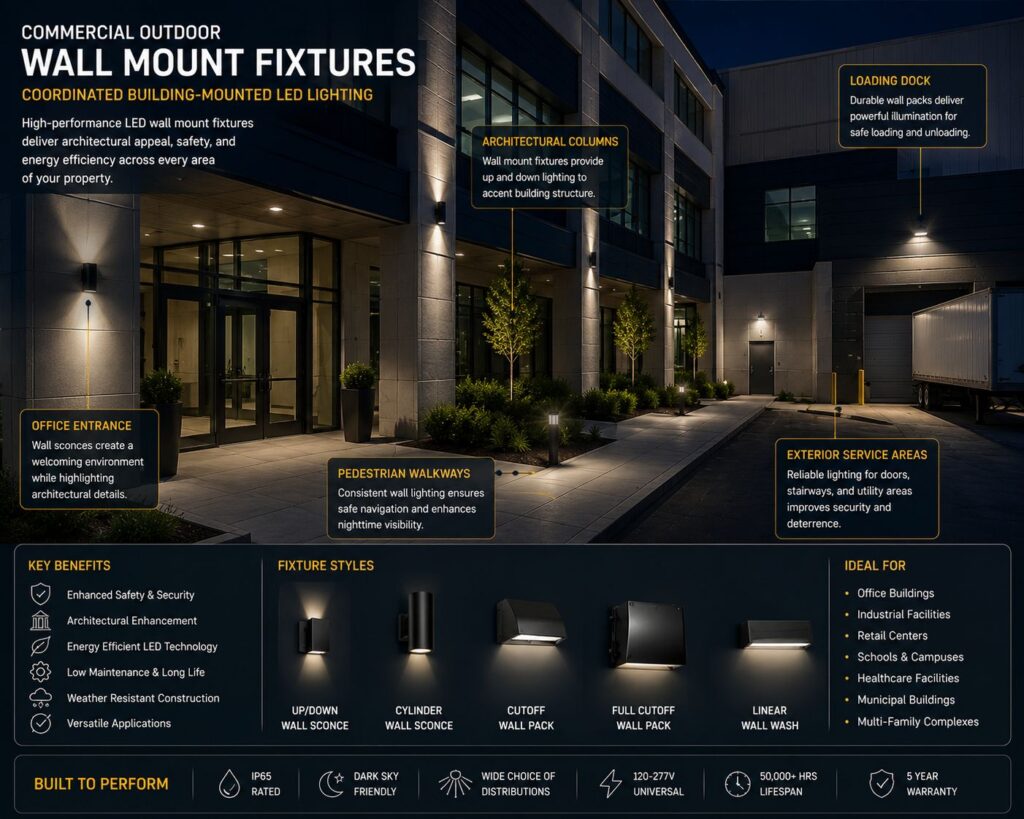
Commercial outdoor wall mount fixtures provide targeted illumination for building entrances, walkways, loading docks, service areas, and architectural features while complementing pole-mounted site lighting.
Looking for Commercial Outdoor Wall Mount Fixtures?
Whether you’re illuminating a building entrance, service corridor, loading dock, office complex, or commercial facility, selecting the right wall-mounted fixture improves safety, visibility, and long-term performance.
👉 Browse our complete collection of Commercial Outdoor LED Wall Mount Fixtures or contact one of our lighting specialists for assistance selecting the best solution for your project.
Commercial Outdoor Wall Mount Lighting at a Glance
| Feature | Benefit |
|---|---|
| Building-Mounted Installation | Illuminates areas adjacent to the structure |
| Multiple Fixture Styles | Supports architectural and industrial applications |
| Precision LED Optics | Directs light exactly where needed |
| Intelligent Controls | Improves energy efficiency |
| Long Service Life | Reduces maintenance costs |
| Durable Construction | Designed for demanding outdoor environments |
What Are Commercial Outdoor Wall Mount Fixtures?
Commercial outdoor wall mount fixtures are exterior lighting luminaires installed directly onto building walls rather than poles or freestanding structures. Their primary purpose is to illuminate the areas immediately surrounding a building, providing targeted light for entrances, sidewalks, loading docks, service doors, parking garage access points, and other locations where people regularly interact with the facility.
Unlike pole-mounted area lights that distribute illumination over broad parking areas, wall-mounted fixtures focus light closer to the building. This creates a smooth transition between parking lots and the structure itself while eliminating dark areas that could affect safety or security.
Modern LED wall mount fixtures are available in numerous styles, beam patterns, and mounting configurations, allowing designers to balance functional illumination with architectural aesthetics. They are commonly incorporated into layered lighting systems alongside area lights, wall packs, bollards, post top fixtures, and landscape lighting to create comprehensive outdoor lighting solutions.
Key Benefits
Commercial outdoor wall mount fixtures offer numerous advantages beyond simply illuminating building exteriors.
- Improves visibility around building entrances
- Enhances pedestrian safety
- Supports security around service areas
- Complements parking lot lighting
- Highlights architectural features
- Reduces installation costs compared to additional light poles
- Improves wayfinding for employees and visitors
- Provides long-lasting, energy-efficient LED performance
Common Commercial Applications
Outdoor wall-mounted fixtures are used throughout commercial and industrial properties wherever building-mounted illumination is required.
Main Building Entrances
Public entrances often create the first impression of a property. Properly selected wall-mounted fixtures provide welcoming illumination while helping visitors safely locate doors, sidewalks, and entry plazas after dark.
Many office buildings, healthcare facilities, hotels, educational campuses, and retail centers combine wall-mounted fixtures with Commercial LED Area Lights to create a seamless transition between parking lots and the building entrance.
Employee Entrances
Employee entrances typically receive heavy use during early morning and evening hours. Consistent illumination improves visibility, enhances personal safety, and supports employee access throughout all work shifts.
Wall-mounted fixtures positioned above or adjacent to entry doors help eliminate shadows while improving security camera performance.
Loading Docks
Distribution centers, warehouses, and manufacturing facilities rely on wall-mounted fixtures to illuminate loading docks where truck operators, forklift drivers, and warehouse personnel work during nighttime operations.
Proper lighting improves visibility around dock doors, trailer connections, shipping lanes, and equipment staging areas while reducing accident risks.
Service Areas
Mechanical rooms, utility entrances, maintenance corridors, equipment yards, and refuse collection areas often require durable lighting designed for continuous outdoor operation.
Commercial wall-mounted fixtures provide dependable illumination without requiring additional pole installations.
Exterior Corridors
Hotels, apartment communities, hospitals, schools, and institutional buildings frequently use wall-mounted fixtures to illuminate covered walkways, breezeways, exterior corridors, and connecting buildings.
Proper fixture spacing creates comfortable pedestrian environments while maintaining consistent visibility throughout the property.
Parking Garage Entrances
Vehicle entrances to parking structures require carefully controlled lighting that helps drivers transition between daylight and interior garage lighting conditions.
Wall-mounted fixtures positioned around entrance portals improve visibility while helping define traffic lanes and pedestrian crossings.
🛠️Field Experience
Exterior lighting evaluations often reveal a noticeable imbalance between open site lighting and the building itself. Many facilities have invested in new LED parking lot fixtures over the years, yet the wall-mounted luminaires installed around entrances, loading docks, stairwells, and service doors remain older HID or first-generation LED fixtures. The result is a well-lit parking area that transitions into comparatively dim building access points.
Treating the building and surrounding site as a single lighting system produces much better results. Upgrading wall-mounted fixtures alongside pole-mounted lighting creates smoother transitions between spaces, improves visibility where pedestrians and vehicles interact, enhances security around frequently used entrances, and presents a more cohesive nighttime appearance for the entire property.
Selecting the Proper Mounting Height
Mounting height has a significant impact on both lighting performance and visual comfort.
Lower mounting heights generally provide more concentrated illumination for pedestrians and building entrances, while higher installations increase coverage for larger service areas and loading zones.
Typical mounting heights include:
| Mounting Height | Typical Applications |
|---|---|
| 8–10 ft | Building entrances, sidewalks, courtyards |
| 10–12 ft | Office buildings, retail storefronts, schools |
| 12–15 ft | Service corridors, loading docks, industrial buildings |
| 15–20 ft | Warehouses, distribution centers, parking garage entrances |
Selecting the proper mounting height helps balance fixture spacing, brightness, glare control, and overall lighting uniformity.
📋 Specification Tip
Avoid installing wall-mounted fixtures at identical spacing simply for appearance. Building entrances, loading docks, service doors, pedestrian walkways, and outdoor gathering areas each have different lighting requirements. Position fixtures according to how people use the building rather than maintaining perfectly equal spacing along every wall.
Selecting the Best Mounting Location
The location of a wall-mounted fixture often has a greater impact on lighting performance than the fixture itself. Even a high-output LED luminaire cannot compensate for poor placement. Before selecting fixture wattage or beam pattern, evaluate how people and vehicles move around the building after dark.
Rather than mounting fixtures at equal intervals for visual symmetry, identify the property’s activity zones. Main entrances, employee access doors, loading docks, outdoor equipment, and pedestrian routes all have different lighting objectives and may require different fixture spacing or optical distributions.
Carefully positioned wall-mounted fixtures improve visibility while minimizing glare, reducing unwanted light spill, and creating a more comfortable environment for employees, visitors, and customers.
Main Building Entrances
Entrances should be illuminated as destinations rather than simply lit as part of the building façade. Visitors need sufficient vertical illumination to recognize signage, identify door hardware, and comfortably see other people approaching the entrance.
Fixtures installed on either side of an entrance often produce more balanced illumination than a single fixture mounted directly above the doorway.
Loading Docks and Service Areas
Loading docks require lighting that supports truck maneuvering, material handling, and employee safety. Fixtures should illuminate dock doors, trailer positions, pedestrian routes, and staging areas without directing excessive glare toward approaching drivers.
Many facilities supplement wall-mounted fixtures with Commercial LED Flood Lights when larger equipment yards or trailer parking areas require broader illumination.
Exterior Corridors and Walkways
Hotels, hospitals, schools, apartment communities, and office campuses often rely on wall-mounted fixtures to define pedestrian circulation between buildings. Consistent lighting helps people identify changes in elevation, directional signage, and potential obstacles while creating a more welcoming nighttime environment.
Where pedestrian traffic extends away from the building, combining wall-mounted fixtures with Commercial LED Bollard Lights provides more uniform pathway illumination.
Choosing the Right Fixture Style
Commercial outdoor wall-mounted fixtures are available in a wide range of designs. The best choice depends on whether the primary objective is architectural appearance, general building illumination, security, or task lighting.
Traditional Wall-Mounted Fixtures
These versatile fixtures provide broad illumination for entrances, walkways, service areas, and building perimeters. Their straightforward design makes them one of the most common choices for commercial and industrial properties.
Architectural Wall Fixtures
Architectural wall-mounted fixtures are selected when appearance is as important as illumination. Office buildings, hotels, educational campuses, and municipal buildings often use decorative fixtures that complement the building’s architecture while providing functional exterior lighting.
Projects emphasizing decorative lighting may also incorporate Commercial LED Wall Sconces around primary entrances and public gathering spaces.
Cylinder Fixtures
Cylinder fixtures direct light upward, downward, or in both directions. They are commonly specified for contemporary commercial buildings where controlled accent lighting enhances architectural features without overwhelming the façade.
Linear Wall Fixtures
Long, low-profile fixtures provide uniform illumination across larger wall surfaces and are frequently used on schools, office complexes, parking structures, and public buildings.
Decorative Fixtures
Decorative wall-mounted luminaires combine architectural styling with modern LED performance and are often selected for hospitality, mixed-use developments, multifamily housing, and civic buildings where aesthetics contribute to the overall visitor experience.
Understanding Light Distribution
Selecting the proper fixture style is only part of the specification process. Designers must also determine where the light should be directed.
Different optical distributions produce very different results, even when using identical fixtures.
Downward Distribution
Provides comfortable pedestrian lighting while minimizing uplight and glare. Frequently used around entrances, sidewalks, and commercial storefronts.
Up-and-Down Distribution
Creates both functional illumination and architectural interest. This style is commonly specified for office buildings, hotels, and institutional facilities.
Forward Throw Distribution
Projects light away from the building to illuminate sidewalks, service drives, and parking areas adjacent to the structure.
Wall Wash Distribution
Designed to evenly illuminate large wall surfaces, improving building visibility while highlighting architectural materials and textures.
Asymmetrical Distribution
Directs the majority of the light toward one side of the fixture. This approach is especially useful along property lines, loading docks, and pedestrian corridors where light should be concentrated in a specific direction.
📋 Specification Tip
Avoid selecting a fixture solely because its lumen output appears higher than another model. Optical distribution determines how effectively those lumens are used. A lower-output fixture with the correct beam pattern often produces better illumination than a higher-output fixture directing light into areas where it provides little practical benefit.
Mounting Configuration Matters
he mounting method influences installation flexibility, maintenance, and ultimately how effectively light reaches the intended area.
Surface Mount
The most common mounting configuration for commercial wall-mounted fixtures. Surface-mounted luminaires attach directly to the building façade, providing a clean installation for entrances, walkways, and building perimeters.
Adjustable Mount
Adjustable mounting systems allow installers to fine-tune fixture orientation after installation. This added flexibility is valuable when lighting loading docks, service yards, or irregular building layouts where precise aiming improves coverage.
Yoke (Trunnion) Mount
Yoke-mounted fixtures are commonly specified when lighting equipment yards, service areas, or architectural features requiring adjustable aiming. The trunnion bracket allows the luminaire to be tilted to accommodate varying mounting heights and lighting objectives.
Corner Mount Applications
Buildings with intersecting pedestrian routes or multiple access points may benefit from corner-mounted fixtures that illuminate two sides of the structure simultaneously, reducing the number of fixtures required while improving visibility around the building.
🏗️ Project Spotlight
Regional Medical Office Campus
A regional medical office campus was experiencing complaints about poor nighttime visibility around employee entrances, despite recently upgrading its parking lot lighting. A site evaluation found that the pole-mounted fixtures adequately illuminated the parking areas, but the building itself remained underlit.
The solution wasn’t additional parking lot fixtures—it was strategically adding wall-mounted luminaires at employee entrances, covered walkways, and service corridors. By creating distinct layers of light, the campus improved pedestrian visibility, enhanced wayfinding for evening visitors, and provided a smoother visual transition between the parking lots and the building entrances without increasing overall energy consumption.
Common Design Mistakes
Many outdoor lighting projects underperform because wall-mounted fixtures are treated as secondary elements rather than integral components of the lighting design.
Common mistakes include:
- Mounting fixtures solely for visual symmetry instead of activity zones.
- Using the same fixture type across every exterior application.
- Ignoring vertical illumination at entrances.
- Overlooking service doors, utility areas, and employee entrances.
- Selecting beam patterns without considering where light is actually needed.
- Mixing inconsistent color temperatures around the same building.
- Installing fixtures that cannot accommodate future lighting controls.
Designing the building perimeter as carefully as the parking lot results in safer, more attractive, and more functional commercial properties.
Selecting Lighting Controls
Modern outdoor wall-mounted fixtures offer much more than efficient LED illumination. Integrating lighting controls allows facilities to reduce energy consumption, extend fixture life, and adapt lighting levels to changing site conditions throughout the night.
The most effective control strategy depends on how each area of the property is used.
Photocells
Photocells automatically switch fixtures on at dusk and off at sunrise, making them the standard choice for building entrances, exterior corridors, and parking garage access points.
Because operation is based on available daylight rather than a fixed schedule, photocells provide dependable year-round performance with little maintenance.
Motion Sensors
Some areas experience only occasional nighttime activity. Employee entrances, maintenance yards, refuse collection areas, and equipment enclosures often benefit from occupancy-based lighting.
Motion sensors allow fixtures to operate at reduced output until movement is detected, increasing illumination only when needed.
This approach reduces energy consumption while maintaining a safe environment for employees and contractors.
Bi-Level Dimming
Facilities operating around the clock often prefer bi-level lighting rather than simple on/off control.
During periods of low activity, fixtures operate at a reduced light level before automatically increasing output when pedestrians or vehicles approach.
Bi-level operation is especially effective around:
- Loading docks
- Distribution centers
- Parking garage entrances
- Manufacturing facilities
- Healthcare campuses
Networked Lighting Controls
Larger commercial properties increasingly integrate exterior lighting into centralized building management systems.
Networked controls can provide:
- Remote scheduling
- Energy monitoring
- Fixture diagnostics
- Adaptive dimming
- Maintenance alerts
- Utility demand-response capability
Planning for these technologies during the initial installation makes future upgrades significantly easier.
📋 Specification Tip
When specifying new wall-mounted fixtures, consider both current and future control requirements. Selecting luminaires compatible with advanced lighting controls today can eliminate costly fixture replacements when facility automation systems are expanded later.
Choosing the Right Color Temperature
Color temperature influences not only the appearance of a building but also how occupants perceive safety, comfort, and architectural character after dark.
Rather than selecting one color temperature for every application, many commercial properties use different color temperatures to complement the function of each area.
| Color Temperature | Typical Commercial Applications |
|---|---|
| 3000K | Hotels, restaurants, outdoor seating, upscale retail, multifamily developments |
| 4000K | Office buildings, schools, healthcare facilities, municipal buildings, commercial campuses |
| 5000K | Warehouses, distribution centers, manufacturing plants, loading docks, equipment yards |
Maintaining a consistent color temperature around a building generally creates a cleaner, more professional nighttime appearance than mixing multiple white light colors on the same façade.
Commercial Application Matrix
| Building Type | Recommended Fixture Style | Typical Mounting Height | Recommended Controls |
|---|---|---|---|
| Office Buildings | Architectural Wall Fixtures | 10–15 ft | Photocells + Scheduling |
| Retail Centers | Decorative Wall Fixtures | 10–15 ft | Photocells |
| Hotels & Hospitality | Cylinder / Decorative Fixtures | 8–12 ft | Photocells + Scheduling |
| Healthcare Facilities | General Wall Mount Fixtures | 10–15 ft | Photocells + Bi-Level |
| Warehouses | Industrial Wall Mount Fixtures | 12–20 ft | Motion Sensors + Bi-Level |
| Distribution Centers | Industrial Wall Fixtures | 15–20 ft | Motion Sensors + Network Controls |
| Schools & Universities | Architectural Wall Fixtures | 10–15 ft | Photocells + Scheduling |
| Municipal Buildings | Decorative Wall Fixtures | 10–15 ft | Networked Controls |
Inline Buyer Q&A
How are outdoor wall mount fixtures different from wall packs?
While both mount directly to a building, outdoor wall mount fixtures encompass a broader range of styles and applications. Wall packs are typically selected for security and utility lighting, whereas wall-mounted fixtures may also provide architectural illumination, pedestrian lighting, or decorative accents.
Can wall-mounted fixtures replace parking lot lighting?
No. Wall-mounted fixtures are intended to illuminate areas adjacent to the building. Larger parking areas generally require <a href=”https://industriallightingfixtures.org/led-area-lights/”>Commercial LED Area Lights</a> or other pole-mounted luminaires to provide adequate coverage.
What mounting height works best?
Most commercial installations range between 10 and 15 feet above finished grade, although loading docks, warehouse facilities, and parking structures may require higher mounting elevations depending on the lighting objectives and building design.
Can decorative fixtures still provide commercial-grade performance?
Yes. Many specification-grade architectural fixtures combine contemporary styling with high-performance LED optics, durable construction, and commercial control options, making them suitable for demanding outdoor environments.
Ready to Improve Your Building's Exterior Lighting?
Well-designed outdoor wall-mounted lighting creates a safer, more welcoming environment while enhancing the appearance and functionality of commercial properties. From office buildings and healthcare campuses to warehouses, schools, hotels, and distribution centers, selecting the right fixture style, mounting location, optical distribution, and control strategy ensures long-term performance and value.
Explore our complete selection of Commercial Outdoor LED Wall Mount Fixtures or speak with one of our lighting specialists to develop a lighting solution tailored to your project.
Frequently Asked Questions
Are outdoor wall mount fixtures suitable for industrial facilities?
Yes. Rugged commercial models are widely used on warehouses, manufacturing plants, distribution centers, utility buildings, and service facilities where dependable building-mounted illumination is required.
Can existing wall-mounted fixtures be upgraded to LED?
In many cases, yes. Replacing older HID or fluorescent fixtures with modern LED luminaires can improve light quality, reduce maintenance, and significantly lower energy consumption while using existing mounting locations.
Do wall-mounted fixtures contribute to building security?
Absolutely. Properly positioned fixtures improve visibility around entrances, service areas, and pedestrian routes while supporting surveillance cameras and helping occupants identify potential hazards after dark.
Should every fixture around the building be identical?
Not necessarily. Different areas of a property often have different lighting requirements. Entrances, loading docks, outdoor gathering spaces, and service corridors may benefit from different fixture styles, beam patterns, or control strategies while maintaining a coordinated overall appearance.
Stay Connected with Our Lighting Resources
Add IndustrialLightingFixtures.org as a Preferred Source on Google to see more of our lighting guides and technical resources across Google Search experiences.