
Turtle-friendly amber LED lighting is designed to provide safe nighttime illumination in coastal environments while minimizing disruption to sea turtle nesting and hatchling behavior. Along many shorelines, artificial lighting from buildings, pathways, and streets can confuse sea turtles that rely on natural moonlight reflections to navigate between nesting beaches and the ocean.
To reduce this impact, coastal lighting systems often use long-wavelength amber LEDs combined with controlled fixture design to limit glare and light spill toward the beach. These specialized systems provide sufficient visibility for people while protecting sensitive marine wildlife habitats.
Turtle-friendly lighting represents a specialized category within specialty LED lighting systems designed for environmentally sensitive and high-performance applications.
While selecting the proper amber LED fixture is essential, a successful installation depends on much more than the light source itself. Our Sea Turtle-Friendly Coastal Lighting Design Guide explains how fixture placement, optics, mounting height, shielding, and photometric planning work together to protect nesting beaches while maintaining safe commercial environments.
For a broader overview of lighting engineered for unique environments, see our Specialty LED Lighting Systems Guide:
Turtle-Friendly Amber Lighting
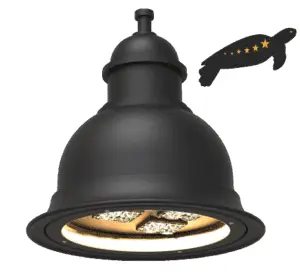
Bell Area Light
Brand: Crystal
Area lighting with Amber color LEDs is an excellent choice for commercial and condominium buildings to provide adequate security lighting while remaining sea turtle friendly in the lighting design; up to 20,900 lumens;
45/55/65/85/105/125/155/188/210W.
Prices start at $600.
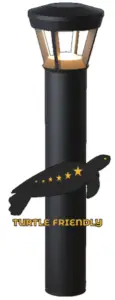
Pulsar Bollard
Brand: Crystal
Amber LED bollard lights provide shielded pathway, walkway lighting for
beachfront and coastal areas; Up to 4,520 lumens; 20/25/35/45W.
Prices start at $600.
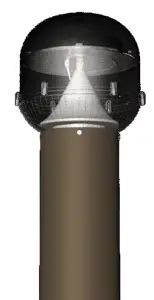
Sundial Bollard
Brand: SolTech
Marine-Life-Friendly Bollard uses custom LED chips that only emit long 580-595 nanometer amber-colored
light; choose from three heights; features a full 360 design to track full sunlight source; 300 lumens; IK10;
Prices start at $400.
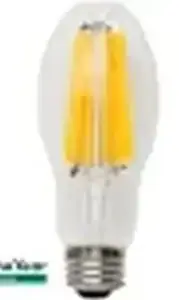
LED Turtle Lights
Brand: TCP
produce light of 560nm; E26 Base
Prices start at $10.
What Is Turtle-Friendly Lighting?
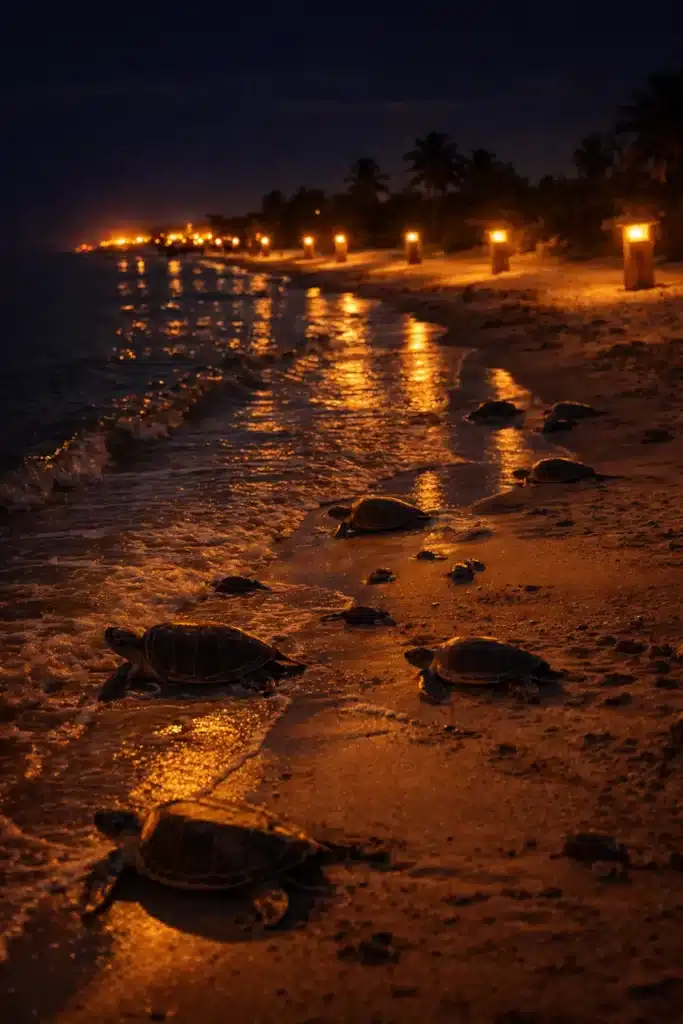
Turtle-friendly lighting refers to outdoor lighting designed to minimize the negative effects of artificial light on sea turtles. Hatchlings typically emerge from nests at night and instinctively move toward the brightest natural light source, which is normally the reflection of the moon over the ocean.
Artificial white lighting can disrupt this behavior, causing hatchlings to crawl inland instead of toward the water. Turtle-safe lighting helps reduce this disorientation by using specific wavelengths and controlled fixture design.
These lighting systems are commonly installed in:
• beachfront properties
• coastal walkways
• marinas and docks
• beachfront resorts
• residential coastal communities
Selecting an amber LED fixture is only one step toward a successful coastal lighting project. Our Sea Turtle-Friendly Lighting Requirements for Coastal Properties explains how mounting height, shielding, optics, controls, and overall site design work together to support responsible coastal lighting.
Why Amber Lighting Is Used for Turtle Protection
Research has shown that sea turtles are far less sensitive to long-wavelength light such as amber, orange, or red compared with white or blue light.
Most turtle-friendly lighting systems emit wavelengths above approximately 560 nanometers, which appear amber in color and are less disruptive to sea turtle navigation.
In many coastal areas, lighting regulations specifically require these wavelengths to protect nesting habitats.
Selecting the right amber light source is only one part of a successful coastal lighting project. Our Commercial Turtle-Friendly Amber LED Lighting Guide compares fixture types, specification considerations, and product selection strategies to help architects, engineers, and property owners choose the best lighting solution for their application.
How Turtle-Friendly Lighting Works
Effective turtle-friendly lighting systems rely on several coordinated design strategies.
Long-Wavelength Light Sources
Amber LED emitters produce wavelengths that are less visible to sea turtles.
Shielded Fixtures
Lighting fixtures are designed to direct illumination downward while minimizing light spill toward the beach.
Reduced Light Intensity
Lower light levels help maintain visibility while reducing the brightness visible from nesting areas.
Strategic Placement
Lighting systems are positioned so that the beach itself remains dark.
Together, these strategies allow property owners to maintain safe nighttime visibility without interfering with natural wildlife behavior.
Key Features of Turtle-Friendly Lighting Systems
Modern coastal lighting solutions incorporate specialized design features to support wildlife protection.
True Amber LED Technology
Monochromatic amber LEDs provide wavelengths suitable for turtle-safe lighting requirements.
Full Cutoff Optics
Downward-directed optics prevent light from spilling toward nesting beaches.
Marine-Grade Construction
Fixtures are engineered to resist corrosion from salt air and coastal environments.
Dark-Sky Compatibility
Many turtle-friendly lighting systems also support dark-sky lighting initiatives by reducing light pollution.
Energy Efficiency
LED technology reduces energy consumption while providing reliable outdoor illumination.
Common Applications
Turtle-friendly lighting is commonly used in coastal environments where wildlife protection is a priority.
Beachfront Walkways
Amber pathway lighting helps guide pedestrians without illuminating nearby beaches.
Coastal Residential Communities
Homes and condominiums near nesting beaches often incorporate turtle-safe lighting to comply with local regulations.
Resorts and Hotels
Beachfront hospitality properties use wildlife-friendly lighting to balance guest safety with environmental responsibility.
Marinas and Waterfront Developments
Dock areas and coastal infrastructure may incorporate amber lighting to protect nearby wildlife habitats.
Coastal Parks and Public Spaces
Municipal lighting systems in protected coastal zones frequently follow turtle-friendly lighting guidelines.
Turtle-Friendly Lighting Technology Comparison
| Feature | Amber Turtle-Friendly LED | Standard White LED |
|---|---|---|
| Wildlife Impact | Low | High |
| Wavelength | 560 nm or higher | Broad spectrum |
| Light Spill | Controlled | Often uncontrolled |
| Coastal Compliance | Meets many regulations | Often non-compliant |
| Environmental Impact | Reduced | Higher ecological disruption |
Lighting designed specifically for wildlife protection helps maintain coastal ecosystems while still providing safe illumination.
For coastal sites where trenching or grid power is impractical, solar turtle-friendly lighting combines wildlife-sensitive amber illumination with completely off-grid operation.
Installation Considerations
Proper lighting design is essential for protecting wildlife habitats.
Mounting Height
Fixtures should be installed as low as practical to limit long-distance visibility.
Shielding
Full cutoff fixtures should direct light downward.
Light Output
Use the lowest lumen output necessary to maintain safety.
Fixture Placement
Lighting should avoid directly illuminating the beach or shoreline.
These design principles help maintain dark coastal environments where turtles can nest and hatch successfully.
Environmental and Regulatory Considerations
Many coastal regions have established lighting guidelines to protect sea turtles and other wildlife. These guidelines often include requirements for amber lighting, shielding, and reduced brightness.
Compliance with wildlife lighting standards can help property owners:
• meet environmental regulations
• reduce ecological impact
• support conservation efforts
• protect endangered species habitats
Proper lighting design allows coastal development to coexist with sensitive marine ecosystems.
Inline Buyer Q&A
How do I determine whether a light fixture is appropriate for a turtle-sensitive coastal property?
Start with the requirements that apply to the specific project location.
Fixture selection may involve light source or wavelength, shielding, mounting height, orientation, output, visibility from the beach, operating schedule, and applicable local or wildlife-agency requirements.
Do not assume that a fixture is appropriate simply because it produces amber-colored light.
Is amber light automatically turtle-friendly?
No.
Color is only one part of a turtle-friendly lighting strategy. Wavelength, intensity, shielding, fixture placement, mounting height, orientation, controls, and whether the light source is directly visible from nesting areas can all matter.
The complete installation should be evaluated for the coastal environment.
What wavelength should I specify for turtle-friendly lighting?
There is no single wavelength specification that should be applied universally to every project.
Longer-wavelength amber or red light is commonly used in turtle-sensitive environments, and some programs, products, or jurisdictions may specify particular wavelength criteria.
The applicable wildlife-agency guidance, local ordinance, project specification, and fixture documentation should be checked before specifying equipment.
What types of fixtures are available for turtle-friendly projects?
Depending on the property, turtle-sensitive lighting can potentially include bollards, post-top fixtures, wall-mounted luminaires, area lights, pathway fixtures, and other exterior fixture types designed or configured for the application.
The correct fixture depends on the area being illuminated, mounting conditions, required visibility, environmental exposure, and applicable coastal-lighting requirements.
Can turtle-friendly lighting provide useful illumination for commercial properties?
Yes, when the lighting system is properly designed.
The objective is to provide the illumination needed for pedestrian circulation and property use while controlling unnecessary light near turtle-sensitive areas.
Fixture output, distribution, shielding, placement, mounting, and controls should be coordinated rather than simply increasing brightness.
What information should I provide when selecting turtle-friendly lighting?
Useful project information includes:
- Project location
- Property type
- Distance and orientation relative to the beach or nesting area
- Areas requiring illumination
- Existing lighting
- Proposed fixture locations
- Mounting heights
- Local coastal-lighting requirements
- Required wavelength or certification, if specified
- Fixture shielding requirements
- Operating hours
- Dimming or control requirements
- Salt, moisture, and corrosion exposure
- Photographs, drawings, or site plans when available
These details help determine which lighting approach is appropriate for the project.
Plan Coastal Lighting Around the Environment
Turtle-friendly lighting requires more than selecting an amber LED fixture.
Wavelength, output, shielding, mounting height, fixture orientation, visibility from nesting areas, controls, environmental exposure, and applicable coastal-lighting requirements should all be considered as part of the system.
Our lighting specialists can help evaluate turtle-friendly lighting for beachfront resorts, condominiums, multifamily properties, restaurants, marinas, parks, pathways, parking areas, and other coastal developments.
Call 1-844-533-7767 to discuss your turtle-friendly lighting project.
Frequently Asked Questions About Turtle-Friendly Amber Lighting
What color lighting is commonly used for turtle-friendly applications?
Longer-wavelength amber, orange, or red light is commonly used in turtle-sensitive coastal environments because these wavelengths can reduce potential impacts compared with shorter-wavelength white or blue-rich light.
Color alone, however, does not establish that a fixture or installation meets applicable turtle-friendly requirements.
Why does artificial lighting affect sea turtles?
Artificial nighttime lighting near nesting beaches can interfere with the visual cues used by sea turtles.
Hatchlings can become disoriented or move away from the ocean when artificial light competes with natural seaward visual cues.
Lighting near nesting habitat should therefore be carefully controlled.
What wavelength is considered turtle-friendly?
There is no single wavelength threshold that should be treated as universally applicable to every turtle-lighting project.
Some wildlife programs, jurisdictions, project specifications, or approved products may use defined wavelength criteria.
Always verify the requirements that apply at the project’s location rather than relying on a generic wavelength number.
Are turtle-friendly lights required by regulation?
They may be.
Coastal municipalities and other jurisdictions can have lighting ordinances or requirements intended to protect sea turtles and nesting habitat.
Requirements vary by location, so the applicable local regulations and wildlife-agency guidance should be checked for each project.
Can turtle-friendly lighting still provide useful nighttime visibility?
Yes.
Proper fixture selection and lighting design can provide useful illumination for pathways, building surroundings, parking areas, and other property functions while reducing unnecessary light near turtle-sensitive environments.
Required illumination and applicable coastal-lighting restrictions should be considered together.
Is turtle-friendly lighting the same as Dark Sky lighting?
No.
The two approaches can share principles such as shielding, reducing unnecessary light, controlling glare, and limiting light trespass, but their objectives are different.
Turtle-friendly lighting focuses specifically on reducing potential effects on sea turtles and nesting habitat. Dark Sky lighting more broadly addresses issues such as uplight, sky glow, glare, excessive illumination, and light trespass.
A coastal project may need to consider both.
Does a full-cutoff fixture automatically qualify as turtle-friendly?
No.
Shielding and optical control can be important, but turtle-friendly suitability can also depend on wavelength, output, mounting, orientation, fixture visibility, location, controls, and applicable requirements.
Can white LED lighting be used near turtle nesting beaches?
That depends on the location and applicable requirements.
Because shorter-wavelength and blue-rich light can be more problematic in turtle-sensitive environments, coastal projects may restrict or discourage conventional white lighting in areas visible from nesting habitat.
The requirements for the specific project location should determine fixture selection.
Can turtle-friendly lighting be used in parking areas?
Potentially.
Parking-area lighting near turtle-sensitive coastal environments may require careful control of fixture output, distribution, shielding, mounting height, orientation, and visibility from the beach.
A site-specific lighting layout can help evaluate coverage and light control.
Can turtle-friendly lighting be used for pathways and pedestrian areas?
Yes.
Bollards, low-mounted fixtures, shielded luminaires, and other appropriately designed equipment can be considered for pedestrian areas.
Fixture placement, output, distribution, wavelength, and direct visibility from sensitive areas should be evaluated.
Do beachfront properties need corrosion-resistant fixtures?
Coastal environments can expose lighting equipment to salt, moisture, wind, and corrosive conditions.
Materials, finishes, seals, mounting hardware, environmental ratings, and maintenance requirements should therefore be evaluated separately from the fixture’s turtle-friendly characteristics.
A turtle-friendly light source is not automatically suitable for severe coastal exposure.
Are turtle-friendly fixtures maintenance-free?
No.
Fixtures, shielding, lenses, controls, mounting hardware, finishes, and other components can require inspection and maintenance.
Coastal exposure can make routine inspection particularly important.
Changes to landscaping, property configuration, or surrounding development can also affect how light is visible from sensitive areas.
Stay Connected with Our Lighting Resources
Add IndustrialLightingFixtures.org as a Preferred Source on Google to see more of our lighting guides and technical resources across Google Search experiences.

Related Turtle-Friendly and Coastal Lighting Resources
- Turtle-Friendly Exterior Lighting Guide — Learn how wavelength, shielding, fixture placement, output, and controls work together when designing exterior lighting near turtle-sensitive coastal environments.
- A Beacon of Hope: Navigating Sea Turtle-Friendly Lighting — Explore the environmental considerations behind sea turtle-friendly lighting and how coastal properties can reduce potentially disruptive nighttime illumination.
- Dark Sky Compliant Post Lights — Review post-top lighting designed around controlled distribution, reduced uplight, glare management, and Dark Sky objectives.
- LED Bollard Lights — Explore pedestrian-scale bollard lighting that can be considered for pathways, landscaped areas, and coastal properties when appropriately specified for the project.
- Specialty Lighting — Explore additional LED lighting systems for specialized environmental, ecological, marine, horticultural, and functional applications.