
Temporary construction lighting provides the illumination workers need to safely navigate and perform tasks before a building’s permanent lighting system is operational. From interior renovations and new commercial construction to excavation areas and nighttime projects, temporary lighting must provide sufficient visibility while adapting to constantly changing jobsite conditions.
A successful construction lighting plan involves more than placing bright fixtures around a work area. Contractors must consider illumination levels, fixture placement, electrical safety, changing work zones, shadows, glare, weather exposure, and the durability of equipment used in demanding construction environments.
Understanding temporary construction lighting requirements helps contractors develop a safer and more effective lighting system throughout every stage of a project.
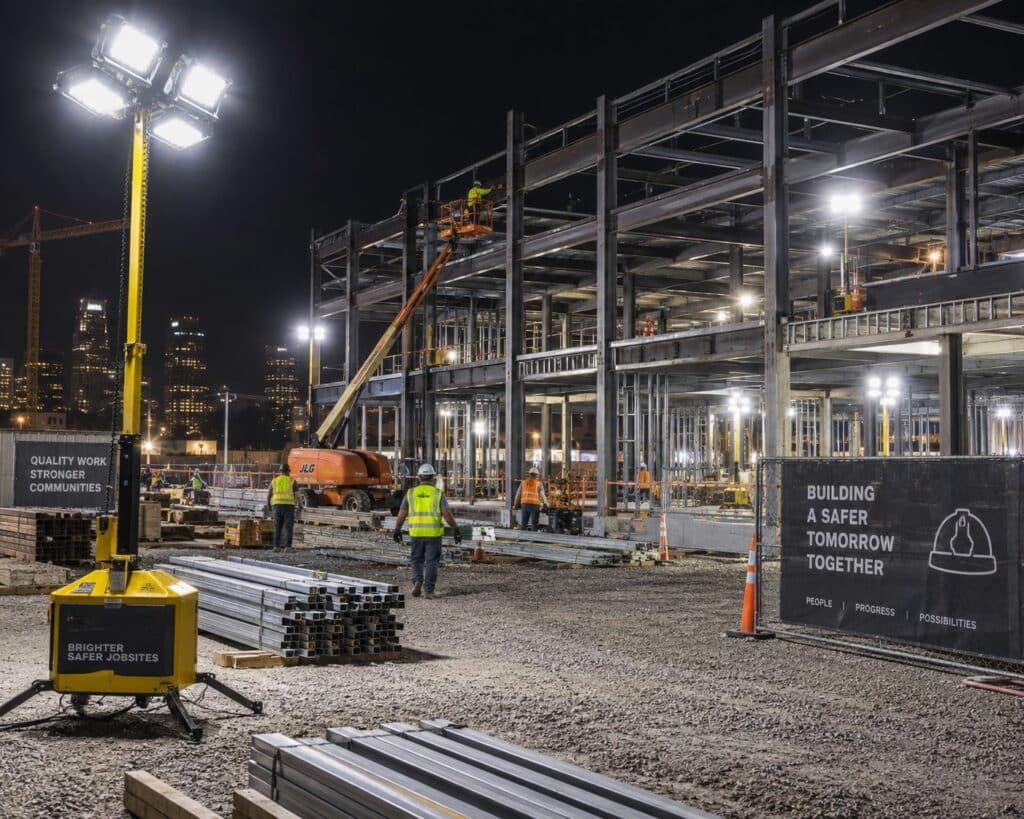
Properly planned temporary LED construction lighting helps provide consistent illumination across active commercial jobsites, work areas, access routes, and equipment zones.
Improve Jobsite Visibility with Commercial LED Construction Lighting
Temporary construction lighting must provide dependable illumination while adapting to changing work zones, equipment locations, access routes, and project stages. Commercial LED construction lights provide flexible, energy-efficient options for both indoor and outdoor jobsites.
Explore our Construction Site Lighting Guide to compare temporary LED lighting options, including portable work lights, light towers, string lights, and floodlights for commercial construction applications.
What Is Temporary Construction Lighting?
Temporary construction lighting is an illumination system installed for the duration of construction, renovation, maintenance, or repair work.
Unlike permanent building lighting, temporary systems are expected to move, expand, or change as the project progresses. Walls may be erected, equipment relocated, access routes changed, and new work areas opened throughout construction.
Temporary lighting may include:
- LED string lights
- Portable LED work lights
- Tripod-mounted lights
- Portable LED floodlights
- Temporary overhead fixtures
- LED light towers
- Telescoping mast lights
- Task lighting
The appropriate combination depends on the size of the project, available electrical power, work being performed, and whether the site is indoors or outdoors.
For a broader overview of these systems, see our Construction Site Lighting Guide.
OSHA Construction Lighting Requirements
Construction areas where work is taking place must have adequate natural or artificial illumination. OSHA establishes minimum illumination requirements under 29 CFR 1926.56.
Minimum requirements vary according to the type of work area.
General Construction Areas
OSHA identifies 5 foot-candles as the minimum illumination level for general construction area lighting.
Excavation, Access, Loading and Similar Areas
A minimum of 3 foot-candles applies to several construction environments, including general construction areas, concrete placement, excavation and waste areas, access ways, active storage areas, loading platforms, refueling areas, and field maintenance areas.
Indoor Corridors and Exitways
Indoor warehouses, corridors, hallways, and exitways require a minimum of 5 foot-candles.
Tunnels and Underground Work
Tunnels, shafts, and general underground work areas generally require at least 5 foot-candles. Certain work at tunnel and shaft headings requires higher illumination.
Construction Plants and Shops
General construction plants and shops require a minimum of 10 foot-candles. Examples include equipment rooms, carpenter shops, active storerooms, workrooms, and similar areas.
First Aid Stations and Offices
First aid stations, infirmaries, and offices require a minimum of 30 foot-candles.
These figures represent regulatory minimums. Meeting a minimum value does not automatically mean that a lighting layout is appropriate for every construction task. Detailed work, equipment operation, inspection, or areas containing significant hazards may benefit from additional illumination.
OSHA Minimum Construction Illumination Levels
| Construction Area or Activity | Minimum Illumination |
|---|---|
| General construction areas | 5 foot-candles |
| General construction, concrete placement, excavation and waste areas, access ways, active storage areas, loading platforms, refueling and field maintenance areas | 3 foot-candles |
| Indoor warehouses, corridors, hallways and exitways | 5 foot-candles |
| Tunnels, shafts and general underground work areas | 5 foot-candles |
| General construction plants and shops | 10 foot-candles |
| First aid stations, infirmaries and offices | 30 foot-candles |
These are minimum illumination requirements. The appropriate lighting level for a specific task may be higher depending on the work being performed, equipment movement, hazards, shadows, and the level of visual detail required.
Meeting the applicable minimum is only the first step in developing an effective layout. See Construction Site Lighting Levels for a closer look at foot-candle measurement, fixture spacing, mounting height, beam distribution, and lighting uniformity.
Why Lighting Uniformity Matters on Construction Sites
Average brightness alone does not determine whether a construction site is effectively illuminated.
A site can contain enough total light while still having dangerous dark areas. Large equipment, temporary walls, structural columns, stored materials, scaffolding, and partially completed construction can create shadows.
Lighting should therefore be distributed according to how workers actually use the space.
Important areas include:
- Stairs and changes in elevation
- Walkways and access routes
- Equipment operating zones
- Material handling areas
- Loading areas
- Entrances and exits
- Temporary workstations
- Areas around obstacles
Using several appropriately positioned fixtures can often produce better visibility than concentrating the same amount of light in one location.
Temporary Lighting and Electrical Safety
Temporary construction lighting systems are also temporary electrical installations and must be treated accordingly.
OSHA’s construction electrical requirements address temporary wiring used for power and lighting. Temporary wiring is permitted during construction but must be removed when construction or the purpose for which the wiring was installed is completed.
Temporary lighting installations should be planned so wiring and equipment are protected from the physical conditions encountered on a jobsite.
Flexible cords and cables should be protected from damage, including sharp edges and other locations where they could be crushed or cut.
Temporary lights also should not simply be hung by their electrical cords unless the cord and lighting assembly are specifically designed for that method of suspension.
Protect Temporary Lamps from Damage
Construction environments expose lighting equipment to impacts that would be unusual in a completed commercial building.
Tools, ladders, building materials, lifts, and other equipment can contact temporary fixtures.
Lamps used for general illumination must be protected against accidental contact or breakage. Portable hand lamps also require appropriate construction and guarding.
LED construction lighting can be particularly useful because solid-state light sources eliminate the fragile filaments associated with older lamp technologies. However, the complete fixture still needs to be suitable for the conditions where it will be used.
Temporary Lighting in Wet Locations
Wet and conductive environments require additional consideration.
Portable electrical lighting used in wet or conductive locations may require low-voltage operation or appropriate ground-fault protection depending on the application and electrical configuration.
Outdoor construction lighting should also be selected for expected exposure to rain, dust, dirt, and changing weather.
A fixture designed for a dry indoor renovation should not automatically be assumed appropriate for an exposed outdoor jobsite.
LED String Lights for Temporary Interior Lighting
LED string lights can provide continuous illumination through corridors, rooms, stairways, and large interior construction areas.
Instead of moving a small portable fixture each time workers change locations, a properly planned string-light system can establish a basic layer of illumination throughout an active work zone.
Potential applications include:
- Commercial renovations
- New building interiors
- Hallways
- Stairwells
- Mechanical spaces
- Temporary passageways
- Multifamily construction
- Warehouses under construction
String lighting can then be supplemented with portable task lights where higher localized illumination is required.
Portable LED Work Lights for Changing Work Areas
Portable work lights provide flexibility when crews frequently move between locations.
These fixtures can be positioned near:
- Electrical work
- Plumbing installations
- Mechanical equipment
- Framing
- Interior finishing
- Equipment repairs
- Inspection areas
Tripod and stand-mounted fixtures can increase mounting height and spread light across a wider area.
Portable lighting is particularly useful when a fixed temporary system cannot keep pace with rapidly changing construction activity.
LED Light Towers for Large Outdoor Construction Sites
Large outdoor projects often require illumination over significantly greater distances.
LED light towers and telescoping mast systems elevate multiple luminaires above equipment and obstructions, allowing light to cover broad work areas.
Common applications include:
- Road construction
- Excavation
- Concrete placement
- Utility projects
- Large commercial developments
- Equipment staging areas
- Nighttime construction
- Emergency work
Mounting height, beam distribution, fixture aiming, lumen output, and tower location all influence the usable illumination produced on the ground.
Controlling Glare on Nighttime Jobsites
More light is not always better.
Poorly aimed high-output fixtures can produce glare that makes it harder for equipment operators and workers to see. Excessive brightness directed toward neighboring properties or roadways can also create unnecessary light spill.
Effective nighttime construction lighting should direct illumination toward the work surface rather than toward workers’ eyes.
When positioning floodlights and light towers, consider:
- Equipment travel direction
- Worker viewing angles
- Adjacent roadways
- Nearby buildings
- Reflective surfaces
- Fixture mounting height
- Beam angle
Repositioning or re-aiming a fixture may improve visibility more effectively than simply increasing lumen output.
Construction Lighting Should Change with the Project
One of the most important characteristics of temporary lighting is adaptability.
A lighting layout that works during excavation may not work once structural framing begins. Likewise, lighting installed during the open-shell stage of a building may become obstructed after interior walls and equipment are installed.
Construction lighting should be reviewed as work progresses.
Contractors may need to:
- Relocate fixtures
- Add lighting to new work zones
- Raise or lower mounting heights
- Re-aim floodlights
- Extend temporary string lighting
- Remove obsolete lighting
- Add task lighting
- Reevaluate shadows and access routes
Temporary lighting should be considered an evolving system rather than a one-time installation.
One of the most important characteristics of temporary lighting is adaptability
A lighting layout that works during excavation may not work once structural framing begins. Likewise, lighting installed during the open-shell stage of a building may become obstructed after interior walls and equipment are installed.
Construction lighting should be reviewed as work progresses.
Contractors may need to:
- Relocate fixtures
- Add lighting to new work zones
- Raise or lower mounting heights
- Re-aim floodlights
- Extend temporary string lighting
- Remove obsolete lighting
- Add task lighting
- Reevaluate shadows and access routes
Temporary lighting should be considered an evolving system rather than a one-time installation.
When evaluating temporary construction lighting, consider the actual jobsite rather than lumen output alone.
Important selection factors include:
Light Output
The fixture must provide enough usable illumination for the intended area and work activity.
Beam Distribution
Wide-beam fixtures are useful for general area lighting, while more concentrated distributions can help illuminate specific work zones or greater distances.
Mounting Method
Construction lights may be suspended, tripod mounted, attached to temporary structures, mounted on stands, or installed on portable towers.
Durability
Fixtures used around heavy equipment and active crews should be designed to tolerate demanding environments.
Environmental Protection
Outdoor and exposed applications require fixtures appropriate for moisture, dust, and weather conditions.
Portability
Portable fixtures should be practical for workers to relocate as the project changes.
Power Requirements
Available voltage, circuit capacity, generator power, temporary distribution systems, and cord requirements should be evaluated before equipment is selected.
Planning a Temporary Construction Lighting Layout
A useful lighting plan begins by dividing the project into functional areas rather than attempting to illuminate the entire property with one type of fixture.
For example, a commercial project might use:
Light towers for large exterior work zones.
Temporary string lights for interior circulation and general illumination.
Portable floodlights for changing work areas.
Task lights for detailed installation or inspection work.
This layered approach allows each lighting system to perform the job it is best suited for while reducing unnecessary equipment and excessive illumination.
Fixture selection also depends on how illumination needs to be distributed throughout the project. Our Temporary Jobsite Lighting Guide compares linkable work lights, balloon lights, portable task lighting, and other temporary options.
Construction Lighting Planning Checklist
| Planning Factor | What to Evaluate |
|---|
| Required illumination | Work activity and applicable minimum light levels |
| Coverage | Size and shape of the work area |
| Mounting height | Beam spread, shadows and usable light at the work surface |
| Fixture placement | Equipment, structures, access routes and changing work zones |
| Glare | Worker sightlines, vehicle operators and nearby roadways |
| Power | Available voltage, circuits, generators and temporary distribution |
| Environment | Indoor, outdoor, wet, dusty or exposed conditions |
| Portability | How frequently fixtures need to move as construction progresses |
| Durability | Potential impacts from tools, equipment and building materials |
Inline Buyer Q&A
How many lumens are needed for a construction site?
There is no single lumen requirement that applies to every construction site. Required illumination depends on the size of the area, mounting height, fixture distribution, work activity, obstructions, and required light level. Lighting layouts should be based on usable illumination at the work surface rather than fixture lumens alone.
Are LED lights suitable for temporary construction lighting?
Yes. LED fixtures are well suited to temporary construction applications because they provide high light output with relatively low power consumption and are available in portable, string, flood, and tower-mounted configurations.
Can temporary construction lights be used outdoors?
Yes, provided the lighting equipment is designed for the environmental conditions where it will operate. Outdoor jobsites may expose fixtures and electrical components to rain, dust, dirt, temperature changes, and physical impacts.
Are light towers necessary for every construction site?
No. Light towers are most useful when large outdoor areas need broad illumination from elevated mounting heights. Smaller projects and interior construction may be better served by string lights, portable work lights, or temporary overhead fixtures.
Should construction lighting be redesigned as the project progresses?
Yes. Structural changes, new walls, equipment placement, material storage, and changing access routes can alter how light reaches work surfaces. Periodic lighting reviews help identify new shadows and under-illuminated areas.
Get Help Selecting Commercial Construction Lighting
Every construction site presents different lighting challenges, from temporary interior work areas and access routes to large outdoor projects requiring portable floodlights or LED light towers.
LED PROS WorldWide can help you evaluate fixture types, light output, mounting requirements, operating conditions, and available power for your project.
Request a Commercial Construction Lighting Quote or call 844-533-7767 to discuss your construction lighting requirements
Frequently Asked Questions About Temporary Construction Lighting
What is the minimum lighting requirement for a construction site?
OSHA specifies different minimum illumination levels depending on the work area. General construction area lighting is listed at 5 foot-candles, while several activities and locations have different minimum requirements.
Does OSHA require temporary lighting on construction sites?
Construction areas and other specified locations where work is in progress must have natural or artificial illumination meeting applicable minimum requirements.
What type of lighting is best for construction sites?
The best system depends on the application. String lights can provide general interior illumination, portable LED lights support changing work areas, and light towers can illuminate large exterior jobsites.
How high should construction lights be mounted?
There is no single mounting height suitable for every project. Fixture output, beam angle, site geometry, equipment, glare, shadows, and required coverage should determine mounting height.
Can construction lights hang from their power cords?
Temporary lights should not be suspended by their electrical cords unless the cords and lights are specifically designed for that type of suspension.
Why are LED lights commonly used for temporary construction lighting?
LED construction lights combine energy efficiency, high output, long operating life, instant illumination, and a wide range of portable and temporary fixture configurations.
Stay Connected with Our Lighting Resources
Add IndustrialLightingFixtures.org as a Preferred Source on Google to see more of our lighting guides and technical resources across Google Search experiences.

Related Temporary Construction Lighting Resources
Continue researching construction and temporary commercial lighting:
- Construction Site Lighting Guide — Compare construction lighting types, applications, mounting options, and considerations for temporary jobsites.
- LED Portable Work Lights — Explore portable LED lighting for construction, maintenance, inspection, and temporary work areas.
- Industrial Lighting Guide — Learn how to evaluate commercial and industrial lighting based on application, environment, performance, and operating requirements.