
The best commercial outdoor lighting does far more than illuminate sidewalks. It creates welcoming environments, improves wayfinding, enhances architectural features, increases pedestrian safety, and encourages people to enjoy outdoor spaces long after sunset.
Modern LED post top fixtures have become one of the most versatile tools in commercial site design because they combine decorative architectural styling with advanced lighting performance. Whether installed along campus walkways, municipal parks, hospitality properties, apartment communities, or public plazas, thoughtfully designed post top lighting creates outdoor environments that are both functional and visually memorable.
Successful lighting projects begin with an overall design strategy rather than selecting fixtures one at a time. By coordinating lighting layouts, fixture styles, color temperatures, landscaping, and architectural elements, commercial properties can create outdoor spaces that are attractive during the day and equally impressive at night.
Creating a welcoming property involves more than selecting attractive fixtures. Read our Commercial Outdoor Lighting for Customer Safety Guide to learn how lighting improves pedestrian comfort, accessibility, wayfinding, and the overall customer experience.
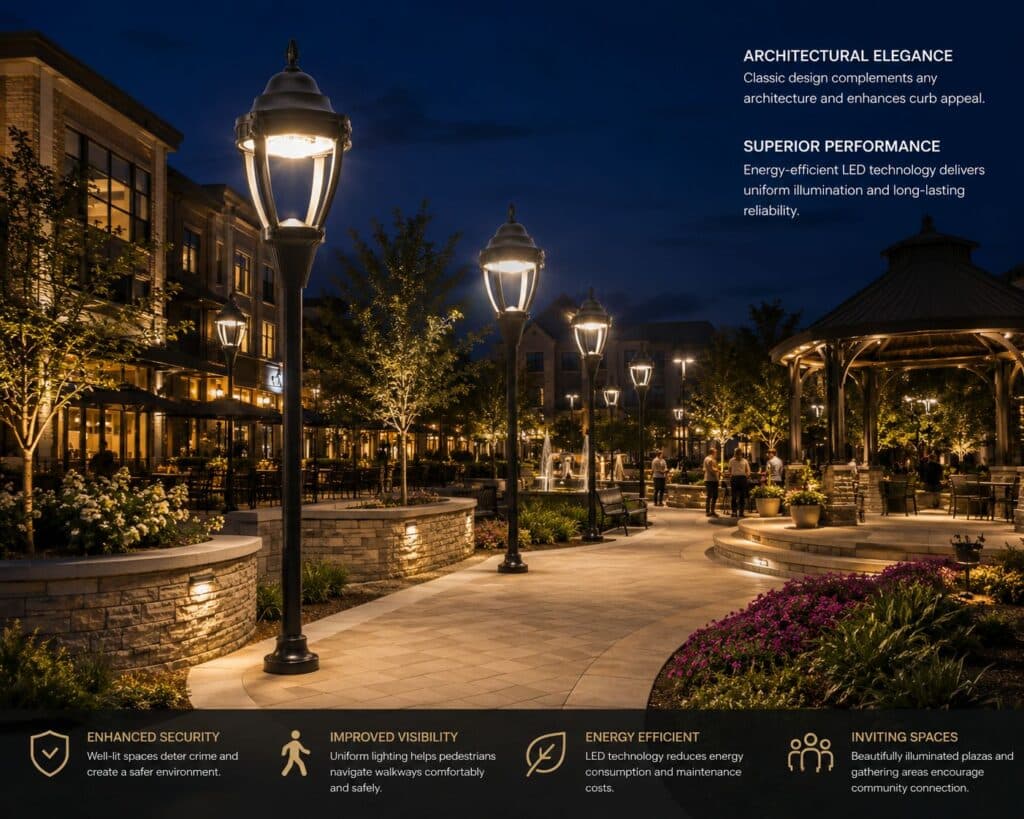
Thoughtfully designed commercial LED post top lighting creates attractive, safe, and inviting outdoor environments while enhancing architectural character and pedestrian comfort.
Designing a new outdoor space or upgrading an existing property?
Our lighting specialists help architects, landscape architects, engineers, municipalities, contractors, and commercial property owners create outdoor lighting systems that balance architectural beauty, pedestrian safety, energy efficiency, and long-term performance.
👉 Explore our complete selection of Commercial LED Post Top Fixtures for parks, campuses, courtyards, plazas, and commercial outdoor environments.
Commercial Outdoor Lighting Specifications at a Glance
| Specification | Typical Commercial Recommendation |
|---|
| Pole Height | 10–20 feet |
| Color Temperature | 3000K • 4000K • 5000K |
| Optical Distribution | Type II • III • IV • V |
| Mounting Options | Pole Mount • Pier Mount • Bull Horn Arms |
| Controls | Photocells • Motion Sensors • Wireless Controls • 0–10V Dimming |
| Fixture Styles | Architectural • Lantern • Acorn • Courtyard |
| Typical Applications | Campuses • Parks • Mixed-Use • Hospitality • Municipal Streetscapes |
Budgeting for a commercial lighting project involves more than fixture pricing. Continue with our Commercial LED Post Top Lighting Retrofit Costs & ROI Guide to learn how to evaluate the total cost of ownership.
Begin with a Comprehensive Lighting Master Plan
Beautiful outdoor lighting starts long before the first fixture is installed.
Professional lighting designers begin by understanding how people will move through and interact with the property.
Questions typically include:
- Where do visitors enter?
- Which walkways receive the most pedestrian traffic?
- Where do people gather after dark?
- What architectural features deserve emphasis?
- Which landscape elements should become focal points?
- How should parking areas transition into pedestrian spaces?
By identifying these activity zones early in the design process, the lighting plan becomes more cohesive, efficient, and visually appealing.
Before developing a lighting layout, choose the right fixture for your application. Read our Commercial LED Post Top Lighting Buyer’s Guide to compare fixture styles, optics, controls, mounting methods, and warranties.
Layer Lighting Instead of Relying on One Fixture Type
One of the biggest differences between professionally designed outdoor lighting and basic installations is the use of multiple lighting layers.
Rather than expecting a single fixture type to perform every task, designers combine different lighting techniques that complement one another.
Ambient Lighting
Provides overall illumination that allows visitors to comfortably navigate the property.
Typical fixtures include:
- LED Post Top Fixtures
- Area Lights
- Courtyard Lighting
Task Lighting
Task lighting focuses on areas where greater visibility is required.
Examples include:
- Stairs
- Building entrances
- Crosswalks
- ADA ramps
- Outdoor seating
- Bicycle parking
Accent Lighting
Accent lighting draws attention to important architectural or landscape features.
Popular applications include:
- Trees
- Water features
- Public art
- Monument signs
- Building facades
- Outdoor sculptures
Decorative Lighting
Decorative fixtures become architectural elements themselves.
Popular decorative luminaires include:
- Architectural Post Top Fixtures
- Lantern Post Tops
- Acorn Fixtures
- Courtyard Lighting
These fixtures contribute to the property’s character while providing dependable pedestrian illumination.
Beautiful outdoor spaces should also feel safe. Read our Commercial Outdoor Security Lighting Guide to learn how thoughtful lighting design supports CPTED principles, surveillance, and pedestrian confidence.
Specify a Coordinated Architectural Lighting Collection
One of the defining characteristics of professionally designed commercial properties is the use of a coordinated architectural lighting collection rather than unrelated fixture styles.
A lighting collection is a family of luminaires that shares the same architectural design across multiple fixture types. Instead of selecting individual products independently, designers specify matching fixtures that create a unified appearance throughout an entire property.
Depending on the collection, matching products may include:
- Commercial LED Post Top Fixtures
- Architectural Area Lights
- LED Bollards
- Outdoor Wall-Mounted Fixtures
- Architectural Wall Sconces
- Decorative Pole-Mounted Luminaires
- Pier-Mounted Fixtures
- Site and Streetscape Accessories
Rather than appearing as separate lighting projects completed over many years, the property presents a consistent architectural identity that enhances curb appeal while simplifying future expansion and maintenance.
Benefits of Coordinated Lighting Collections
Using a single architectural collection provides advantages that extend well beyond appearance.
Benefits include:
- Consistent architectural styling throughout the property
- Matching finishes and construction materials
- Unified daytime and nighttime appearance
- Coordinated color temperatures and optical performance
- Simplified maintenance and replacement planning
- Easier future project expansion
- Improved wayfinding and visual continuity
- Stronger property identity and branding
This approach is commonly used for:
- Universities
- Corporate headquarters
- Healthcare campuses
- Municipal streetscapes
- Luxury apartment communities
- Hotels and resorts
- Mixed-use developments
- Parks and recreation facilities
- HOA communities
Example: A Coordinated Campus Lighting Plan
Imagine a university campus designed around a single architectural lighting collection.
The same design language is carried throughout the property using different fixture types to serve different functions.
| Fixture Type | Typical Application |
|---|---|
| LED Post Top Fixtures | Walkways, quads, courtyards |
| Architectural Area Lights | Parking lots and roadways |
| LED Bollards | Building entrances and landscaped pathways |
| Wall-Mounted Fixtures | Building facades and service areas |
| Wall Sconces | Main entrances, patios, gathering spaces |
| Pier-Mounted Fixtures | Monument signs, gate columns, perimeter walls |
Although each luminaire performs a different task, the shared architectural styling creates a cohesive campus identity that looks intentional and professionally planned.
Industrial Lighting Collections
Industrial Lighting Fixtures offers several coordinated outdoor lighting collections that allow designers to maintain a consistent architectural appearance across an entire project while selecting the fixture types needed for each application.
Examples include:
- Pulsar Collection
- ODIN Collection
- JANUS Collection
Each collection combines contemporary styling with commercial-grade LED performance, making it easier to specify complementary post top fixtures, area lights, bollards, wall-mounted luminaires, and other site lighting products from a unified design family.
If you’re selecting fixtures for a new development, our Commercial LED Post Top Lighting Buyer’s Guide explains how to compare styles, optics, controls, mounting options, and performance features.
Create a Visual Hierarchy
Professional lighting designers rarely illuminate every element of a property equally.
Instead, they establish a visual hierarchy that naturally guides visitors through the site.
A typical lighting hierarchy may emphasize:
- Main entrances
- Primary pedestrian walkways
- Public gathering spaces
- Architectural focal points
- Landscape features
- Secondary pathways
This approach creates visual interest while helping visitors intuitively understand how to move through the property.
Design Around the Landscape
Outdoor lighting should enhance the landscape—not compete with it.
LED post top fixtures are often positioned to complement:
- Shade trees
- Flower gardens
- Native plantings
- Water features
- Courtyard seating
- Outdoor dining areas
- Walking trails
- Public plazas
Thoughtful placement reduces visual clutter while preserving open sightlines and highlighting the property’s natural beauty.
Highlight Architecture After Dark
Commercial lighting can dramatically change how buildings are perceived in the evening.
Well-positioned post top fixtures help emphasize:
Main entrances
Covered walkways
Clubhouses
Gatehouses
Stone columns
Pergolas
Clock towers
Public gathering structures
Architectural lighting should support the building’s design without overwhelming it.
Our Commercial LED Architectural Post Top Lighting collection offers fixture styles specifically designed to complement contemporary commercial architecture.
Design Comfortable Walkways
Pedestrian pathways are among the most frequently used outdoor spaces, making lighting design especially important.
Effective walkway lighting should provide:
- Comfortable illumination
- Good visibility
- Reduced glare
- Consistent fixture spacing
- Clear wayfinding
- Safe transitions between spaces
Rather than creating isolated pools of light, commercial lighting layouts should establish a continuous rhythm that naturally guides visitors from one destination to another.
Design Comfortable Gathering Spaces
Commercial outdoor spaces have evolved beyond simple pedestrian pathways. Many developments now include plazas, outdoor dining areas, courtyards, rooftop terraces, parks, and community gathering spaces that encourage people to spend time outdoors after sunset.
Lighting these spaces requires a different design philosophy than illuminating sidewalks or parking lots.
Successful gathering spaces emphasize:
- Comfortable illumination
- Inviting atmosphere
- Excellent visibility
- Reduced glare
- Consistent lighting
- Attractive architectural styling
- Safe pedestrian circulation
Rather than creating a brightly illuminated environment, designers typically strive for balanced lighting that encourages people to relax while maintaining clear visibility.
Applications include:
- University quads
- Corporate campuses
- Apartment courtyards
- Hotel terraces
- Outdoor restaurants
- Municipal plazas
- Botanical gardens
- Amphitheaters
- Community parks
Courtyards require a balanced approach to safety, comfort, and aesthetics. Continue with our Commercial Courtyard Lighting Design for Safety, Comfort & Ambiance guide for practical design strategies used in hospitality, multifamily, campus, and mixed-use environments.
Coordinate Color Temperature Across the Property
Color temperature plays a significant role in how a property feels after dark.
One of the most common design mistakes is mixing different color temperatures throughout the same development.
For example:
3000K along one walkway
5000K in an adjacent plaza
4000K at nearby entrances
Although each fixture may perform well individually, the inconsistent appearance can distract from the overall architectural design.
Many successful commercial projects maintain one consistent color temperature throughout the property.
Typical recommendations include:
Property Type Recommended Color Temperature
Luxury Apartments 3000K
Hotels & Resorts 3000K
Municipal Parks 3000K
Universities 4000K
Office Campuses 4000K
Mixed-Use Developments 4000K
Industrial Facilities 5000K (where appropriate)
Our Commercial Outdoor Lighting Color Temperature Guide explains how color temperature influences pedestrian comfort, architectural appearance, security, and Dark Sky considerations.
Use Pier-Mounted Fixtures as Architectural Features
Not every post top fixture belongs on a light pole.
Many commercial developments use decorative pier-mounted fixtures installed on:
- Entrance monuments
- Gate columns
- Brick perimeter walls
- Clubhouse entrances
- Pool enclosures
- Courtyard walls
- Outdoor patios
- Monument signage
These fixtures provide both illumination and architectural character while reinforcing the overall design theme of the property.
Because pier-mounted luminaires are viewed much closer than pole-mounted fixtures, designers should carefully consider fixture scale, mounting height, glare control, and surrounding architecture.
Use Multi-Head Fixtures to Define Larger Spaces
Large plazas, university quads, civic centers, and public gathering spaces often benefit from decorative dual-head, triple-head, or quad-head post top assemblies.
Rather than simply increasing fixture output, multiple luminaires mounted on decorative bull horn arms provide:
- Wider coverage
- Improved lighting uniformity
- Better pedestrian visibility
- Reduced shadows
- Strong architectural focal points
- Greater flexibility for lighting layouts
These installations frequently become signature visual elements within parks, campuses, and municipal streetscapes while improving overall lighting performance.
Avoid Common Outdoor Lighting Design Mistakes
Even premium fixtures cannot compensate for poor planning.
Common mistakes include:
- Selecting fixture styles that do not complement the architecture
- Mixing unrelated lighting collections
- Inconsistent color temperatures
- Incorrect optical distributions
- Excessive glare
- Poor fixture spacing
- Over-lighting gathering spaces
- Ignoring landscaping
- Selecting fixtures without considering future expansion
Professional lighting design considers the entire property as a connected system rather than a collection of individual fixtures.
Smart Controls Enhance Both Design and Efficiency
Today’s commercial lighting systems can adapt to changing site conditions while reducing energy consumption.
Modern LED post top fixtures may include:
- Photocells
- Occupancy sensors
- Motion sensors
- Wireless controls
- Scheduled dimming
- Centralized lighting management
- Energy monitoring
These technologies allow properties to maintain attractive nighttime environments while minimizing operating costs.
Inline Buyer Q&A
Q: Should every area of a property use the same fixture?
Not necessarily. Different fixture types often perform different functions, but selecting them from the same architectural lighting collection helps maintain a cohesive appearance throughout the property.
Q: Are coordinated lighting collections only used on large projects?
No. While they are common on campuses and municipal developments, coordinated collections are equally valuable for apartment communities, hotels, office parks, HOA entrances, healthcare facilities, and mixed-use developments.
Q: Can decorative lighting also improve safety?
Absolutely. Well-designed decorative lighting provides excellent pedestrian visibility, supports wayfinding, enhances security, and reinforces the architectural identity of the property without creating an institutional appearance.
Thoughtful Outdoor Lighting Creates Memorable Places
Exceptional commercial outdoor lighting is about more than selecting attractive fixtures. It begins with understanding how people experience a property after dark and continues through careful planning, coordinated lighting collections, balanced illumination, architectural integration, and long-term performance. When these elements work together, outdoor spaces become safer, more welcoming, and more memorable for everyone who uses them.
Ready to Design a Coordinated Commercial Outdoor Lighting System?
Whether you’re planning a university campus, corporate headquarters, apartment community, municipal streetscape, hospitality property, or mixed-use development, our lighting specialists can help you specify coordinated architectural lighting collections that combine post top fixtures, bollards, area lights, wall-mounted luminaires, and pier-mounted fixtures into a cohesive outdoor lighting system.
Explore our complete collection of Commercial LED Post Top Fixtures and discover how coordinated lighting design can improve architectural appeal, pedestrian comfort, energy efficiency, wayfinding, and long-term property value.
Frequently Asked Questions
Should landscaping influence lighting design?
Yes. Trees, gardens, seating areas, water features, and architectural focal points should all be considered during the lighting design process to create a balanced and visually appealing environment.
Can post top fixtures be installed on walls instead of poles?
Yes. Many commercial LED post top fixtures can be installed on entrance columns, monument signs, perimeter walls, patios, and gate piers using decorative pier mounts.
When are multi-head post top fixtures appropriate?
Dual-, triple-, and quad-head configurations are commonly specified for public plazas, university campuses, parks, civic centers, and other large pedestrian environments where broader coverage and stronger architectural presence are desired.
Stay Connected with Our Lighting Resources
Add IndustrialLightingFixtures.org as a Preferred Source on Google to see more of our lighting guides and technical resources across Google Search experiences.
