
Color temperature influences much more than the appearance of an outdoor lighting system. It affects how people experience a space, how accurately colors are perceived, how security cameras perform, and even how welcoming a commercial property feels after sunset.
Modern commercial LED post top fixtures are commonly available in 3000K, 4000K, and 5000K color temperatures, with many premium fixtures offering field-selectable CCT that allows installers to adjust the light output during installation.
Selecting the proper color temperature should be based on the property’s intended use, architectural style, pedestrian activity, environmental considerations, and long-term lighting objectives rather than simply choosing the brightest or coolest light available.
Browse our complete collection of Commercial LED Post Top Fixtures, available with field-selectable color temperatures, precision optics, and advanced controls for commercial outdoor applications.
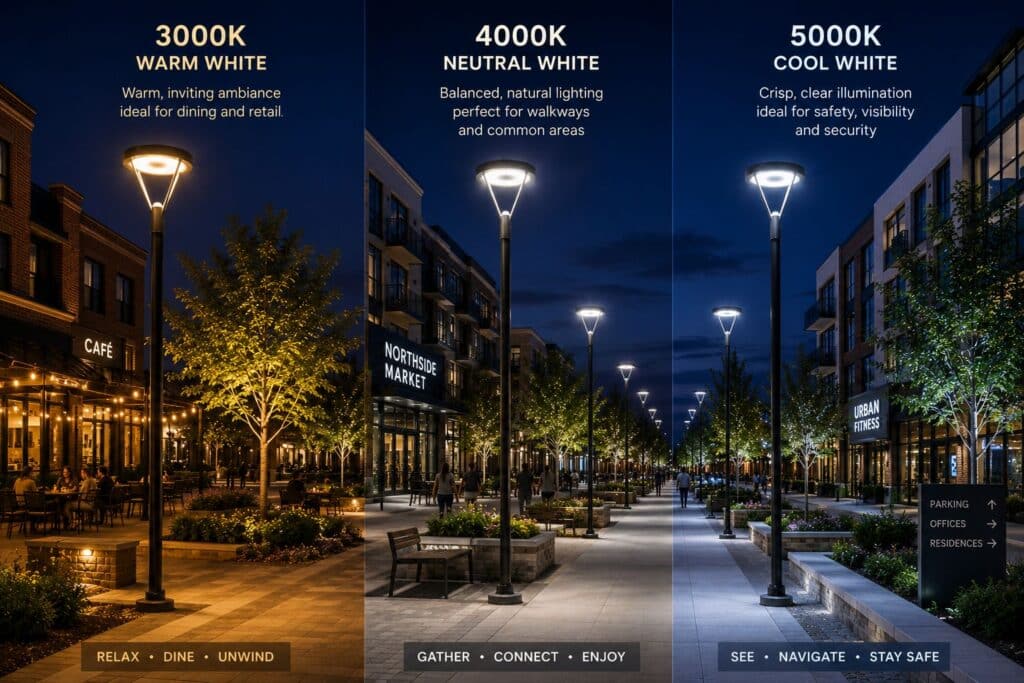
Choosing the proper color temperature helps create safer, more comfortable, and more attractive outdoor environments while supporting architectural goals and responsible lighting practices.
Selecting the right color temperature can transform your outdoor environment.
Our lighting specialists help architects, municipalities, contractors, and commercial property owners choose LED post top fixtures that provide the ideal balance of visibility, architectural appeal, occupant comfort, and long-term performance.
👉 Explore our Commercial LED Post Top Fixtures available with field-selectable color temperature options for maximum project flexibility.
Commercial Lighting Specifications at a Glance
| Specification | Typical Commercial Options |
|---|---|
| Available Color Temperatures | 3000K • 4000K • 5000K |
| CRI | 70+ or 80+ (model dependent) |
| Field-Selectable CCT | Available on many commercial fixtures |
| Field-Selectable Wattage | Available on premium models |
| Controls | Photocell • 0–10V Dimming • Motion Sensors • Wireless Controls |
| Typical Service Life | Up to 100,000 hours |
| Typical Applications | Parks • Campuses • Courtyards • Plazas • Mixed-Use Developments |
Learn why commercial properties continue to upgrade to LED in our Why Choose Commercial LED Post Top Lighting? guide, covering energy savings, maintenance reductions, and long-term value.
Understanding Color Temperature
Color temperature describes the visual appearance of white light and is measured in Kelvin (K).
Although all three common outdoor lighting options produce white light, each creates a different atmosphere and influences how outdoor spaces are perceived after dark.
| Color Temperature | Appearance | Typical Use |
|---|---|---|
| 3000K | Warm White | Hospitality, parks, residential communities |
| 4000K | Neutral White | Campuses, offices, commercial developments |
| 5000K | Cool White | Security, industrial, utility applications |
Rather than indicating brightness, Kelvin describes the color characteristics of the light itself.
Why Color Temperature Matters
The color of outdoor lighting affects more than aesthetics.
It influences:
- Pedestrian comfort
- Wayfinding
- Visual perception
- Color rendering
- Architectural appearance
- Security camera performance
- Environmental impact
- Dark Sky compliance
- Occupant experience
Selecting the appropriate color temperature helps create outdoor environments that are both functional and visually appealing.
3000K — Warm and Inviting
Warm white lighting creates a comfortable, welcoming atmosphere that complements landscaped environments and traditional architecture.
Typical applications include:
- Luxury apartment communities
- Hotels
- Resorts
- Municipal parks
- Courtyards
- Outdoor dining
- Botanical gardens
- Residential neighborhoods
- Retirement communities
- Historic districts
Advantages
- Comfortable pedestrian environment
- Reduced perceived glare
- Inviting architectural appearance
- Excellent for hospitality properties
- Supports Dark Sky initiatives
- Complements landscape lighting
Considerations
- May not provide the crisp appearance desired for some commercial or industrial applications.
4000K — The Commercial Sweet Spot
Many lighting designers consider 4000K the most versatile color temperature for commercial outdoor lighting.
It provides a clean, neutral appearance while maintaining excellent visual comfort.
Common applications include:
- University campuses
- Office developments
- Healthcare facilities
- Mixed-use developments
- Apartment communities
- Municipal facilities
- Retail centers
- Public plazas
Advantages
- Excellent balance between comfort and visibility
- Natural color rendering
- Professional appearance
- Comfortable pedestrian lighting
- Versatile for many commercial environments
This balance explains why 4000K has become one of the most widely specified color temperatures for commercial outdoor projects.
5000K — Maximum Visibility
Cool white lighting emphasizes visibility and contrast, making it appropriate for applications where task performance and security are primary considerations.
Typical applications include:
- Industrial facilities
- Utility yards
- Maintenance facilities
- Service areas
- Security perimeters
- Equipment storage yards
- Loading areas
Advantages
- Maximum visibility
- High perceived brightness
- Excellent color differentiation
- Well suited for industrial operations
Considerations
Because cooler lighting contains more short-wavelength (blue) energy, it can create a harsher visual appearance than warmer alternatives. For pedestrian-oriented environments such as parks, courtyards, hospitality properties, and residential communities, many designers prefer 3000K or 4000K to create a more comfortable nighttime atmosphere.
Comparing the Most Common Color Temperatures
| Evaluation Criteria | 3000K | 4000K | 5000K |
|---|---|---|---|
| Pedestrian Comfort | ★★★★★ | ★★★★☆ | ★★☆☆☆ |
| Architectural Appearance | ★★★★★ | ★★★★★ | ★★★☆☆ |
| Commercial Versatility | ★★★☆☆ | ★★★★★ | ★★★★☆ |
| Security Visibility | ★★★☆☆ | ★★★★★ | ★★★★★ |
| Dark Sky Compatibility | ★★★★★ | ★★★★☆ | ★★☆☆☆ |
| Residential Acceptance | ★★★★★ | ★★★★☆ | ★★☆☆☆ |
This comparison is intended as a practical design aid rather than a rigid rule. Local ordinances, project goals, lighting levels, and user expectations should always guide the final selection.
Color Temperature and Security Camera Performance
Outdoor lighting influences more than human vision—it also affects the performance of modern security cameras.
Commercial properties increasingly rely on surveillance systems for:
- Building security
- Parking lot monitoring
- Pedestrian safety
- License plate recognition
- Incident investigations
- Property management
The selected color temperature can influence image quality, color accuracy, and object recognition.
3000K
Produces warmer images that create a welcoming appearance but may reduce color contrast under certain conditions.
Excellent for:
- Hospitality
- Residential communities
- Parks
- Courtyards
4000K
Often provides an excellent balance between visual comfort and image quality.
Many designers consider 4000K ideal for:
- Universities
- Office campuses
- Hospitals
- Mixed-use developments
- Commercial properties
5000K
Produces crisp white light with excellent contrast.
Frequently selected for:
- Industrial facilities
- Utility yards
- Service areas
- Security-sensitive locations
However, the additional perceived brightness should be balanced against occupant comfort and overall lighting objectives.
Security is one of the most important objectives of outdoor lighting. Our Commercial Outdoor Security Lighting Guide explains how proper lighting layouts, optics, and color temperatures improve visibility without creating excessive glare.
Color Temperature and Dark Sky Initiatives
Communities throughout North America continue to adopt lighting practices that reduce light pollution while maintaining safe outdoor environments.
Color temperature has become an important part of responsible lighting design.
Many municipalities encourage warmer lighting in pedestrian-oriented environments because it produces less short-wavelength blue light than cooler color temperatures.
Dark Sky-friendly lighting focuses on:
- Reducing sky glow
- Minimizing glare
- Limiting light trespass
- Improving visual comfort
- Protecting nighttime environments
Color temperature works together with:
- Full-cutoff fixtures
- Proper optical distributions
- Pole height
- Pole spacing
- Appropriate lumen output
A well-designed lighting system can improve safety while minimizing unnecessary environmental impact.
Not sure which commercial post top fixture is right for your project? Read our Commercial LED Post Top Lighting Buyer’s Guide to compare fixture styles, mounting options, optics, color temperatures, smart controls, and long-term performance considerations.
Effects on Sleep and Circadian Rhythms
Outdoor lighting not only affects visibility—it may also influence how people experience the nighttime environment. Researchers continue to study the relationship between artificial light exposure and the body’s natural circadian rhythm, which helps regulate sleep-wake cycles and other biological processes.
Light with a higher proportion of short-wavelength (blue) energy, typically associated with cooler color temperatures, can suppress melatonin production when people are exposed to it during the evening. Melatonin is a hormone that helps signal the body that it is time to prepare for sleep.
Although outdoor lighting generally contributes less to personal light exposure than indoor lighting or electronic screens, designers increasingly consider color temperature when planning environments where people spend extended periods outdoors after sunset.
These projects often include:
- Apartment communities
- University campuses
- Hotels and resorts
- Healthcare campuses
- Municipal parks
- Outdoor dining districts
- Courtyards
- Senior living communities
Balancing Visibility with Human Comfort
Commercial lighting should provide adequate illumination while creating outdoor spaces that feel comfortable and welcoming.
Many designers therefore select:
| Color Temperature | Typical Objective |
|---|---|
| 3000K | Warm, relaxing pedestrian environments |
| 4000K | Balanced visibility and occupant comfort |
| 5000K | Maximum visibility where task performance is the priority |
For pedestrian-oriented commercial properties, 3000K and 4000K often provide an excellent balance between safety, aesthetics, and occupant comfort, while 5000K remains appropriate for industrial, utility, and security-focused applications.
Field-Selectable Color Temperature Provides Greater Flexibility
One of the most significant advances in commercial outdoor lighting is the availability of field-selectable color temperature (CCT).
Rather than stocking separate fixtures for every project, many modern LED post top fixtures allow installers to select the desired color temperature during installation.
Common selectable options include:
3000K
4000K
5000K
Benefits include:
Simplified inventory
Easier project changes
Greater design flexibility
Reduced replacement costs
Ability to adapt to future lighting requirements
Many premium fixtures also combine field-selectable CCT with:
Field-selectable wattage
Adjustable lumen output
Smart lighting controls
Programmable dimming
If you’re interested in the technology that makes these features possible, our How Commercial LED Post Top Lights Work guide explains modern LED drivers, controls, optics, and field-selectable performance.
Maintain Consistent Color Temperature Throughout the Property
One of the most common outdoor lighting design mistakes is mixing different color temperatures within the same development.
For example, combining 3000K fixtures along one walkway with 5000K fixtures nearby can create an inconsistent nighttime appearance that distracts from the property’s architectural design.
Professional lighting plans typically maintain consistent color temperatures throughout:
- Campus walkways
- Courtyards
- Parking connections
- Building entrances
- Public plazas
- Landscaped pathways
Consistency improves:
- Visual comfort
- Architectural continuity
- Wayfinding
- Property appearance
- Visitor experience
Modern LED Technology Improves Lighting Quality
Today’s commercial LED post top fixtures offer much more than energy efficiency.
Many premium fixtures include:
Field-selectable wattage
Field-selectable color temperature
Adjustable lumen output
Precision optics
Smart controls
Photocells
Motion sensors
0–10V dimming
Wireless lighting management
10kV–20kV surge protection
These technologies allow designers to optimize lighting quality while maintaining architectural consistency across commercial properties.
If you’re evaluating fixtures, our How to Choose the Best Commercial LED Post Top Lights guide explains how to compare warranties, component quality, optical performance, and long-term value.
Inline Buyer Q&A
Q: Is 4000K the best choice for most commercial properties?
For many campuses, office developments, municipalities, and mixed-use properties, 4000K offers an excellent balance between visibility, pedestrian comfort, architectural appearance, and long-term versatility.
Q: Should hospitality properties use 5000K lighting?
Generally, hospitality environments such as hotels, resorts, outdoor dining areas, and luxury residential communities often benefit from warmer 3000K lighting that creates a more inviting atmosphere.
Q: Can color temperature be changed after installation?
Many premium commercial fixtures feature field-selectable color temperature, allowing installers to choose 3000K, 4000K, or 5000K during installation without replacing the fixture.
Selecting the Right Color Temperature Improves More Than Appearance
Color temperature influences how people experience outdoor spaces, how effectively pedestrians navigate a property, how architectural features are perceived, and how comfortably commercial environments function after dark. By selecting the appropriate color temperature and combining it with precision optics, thoughtful lighting layouts, and modern LED technology, designers can create outdoor spaces that balance safety, aesthetics, environmental responsibility, and long-term performance.
Ready to Choose the Right Color Temperature for Your Outdoor Lighting Project?
Whether you’re illuminating a university campus, apartment community, municipal park, hospitality property, healthcare facility, or mixed-use development, our lighting specialists can help you select commercial LED post top fixtures with the ideal color temperature, optical distribution, and performance features for your application.
Explore our complete line of Commercial LED Post Top Fixtures and discover how the right lighting design can improve pedestrian comfort, architectural appeal, energy efficiency, security, and long-term lighting performance.
Frequently Asked Questions
Does color temperature affect energy consumption?
No. Color temperature describes the appearance of the light, not how much electricity the fixture consumes. Energy use is determined primarily by wattage, fixture efficiency, driver performance, and operating hours.
Can I mix different color temperatures on the same property?
While there may be specific design reasons to do so, maintaining a consistent color temperature across pedestrian areas generally creates a more cohesive and visually appealing environment.
Which color temperature is most compatible with Dark Sky initiatives?
Many projects pursuing Dark Sky-friendly lighting choose 3000K or warmer color temperatures in combination with full-cutoff optics and carefully designed lighting layouts. Always verify local requirements, as ordinances vary by jurisdiction.
Stay Connected with Our Lighting Resources
Add IndustrialLightingFixtures.org as a Preferred Source on Google to see more of our lighting guides and technical resources across Google Search experiences.
