
Why Above Water Fishing Lights Are So Effective
Anyone who has spent time fishing after dark has probably noticed that fish naturally gather around illuminated water.
This isn’t because the light attracts game fish directly.
Instead, the light triggers a natural food chain that begins with microscopic aquatic organisms. As plankton and other tiny organisms become concentrated within the illuminated water, schools of baitfish move in to feed. Once baitfish gather beneath the light, larger predatory species often follow.
This natural feeding activity can continue throughout the evening, creating productive fishing opportunities around docks, piers, marinas, and shoreline structures.
For anglers, understanding this process is the key to selecting and positioning fishing lights for the best possible results.
Once you understand how fishing lights attract baitfish and game fish, the next step is selecting the right fixture. Our Buyer’s Guide to Above-Water Fishing Lights compares installation options, construction quality, and buying considerations for docks, piers, and marinas.
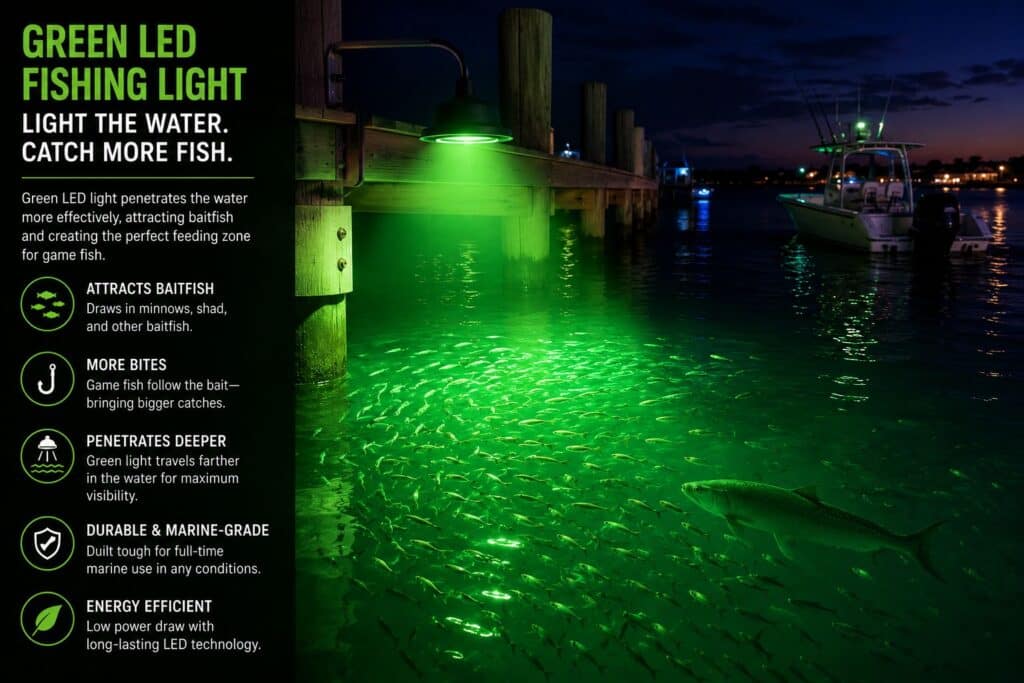
Above-water LED fishing lights create illuminated feeding zones that attract baitfish and the larger predatory fish that feed on them.
Looking for Commercial-Grade Above Water Fishing Lights?
Whether you’re outfitting a private dock, marina, fishing pier, campground, or waterfront resort, we offer durable marine-grade LED fishing lights designed for dependable nighttime performance and years of reliable operation.
👉 Request Bulk Pricing or call 1-844-533-7767 to discuss your above water fishing lighting project
Understanding the Underwater Food Chain
Artificial light affects much more than fish.
When light penetrates the water, it creates an area that attracts microscopic organisms including plankton and other small aquatic life. These organisms become food for minnows, shad, shrimp, and other baitfish.
As baitfish begin feeding, predator species frequently move into the illuminated area.
Depending on the location, anglers may observe species such as:
- Snook
- Speckled trout
- Redfish
- Striped bass
- Largemouth bass
- Crappie
- Catfish
- Hybrid bass
- Tarpon
- Flounder
Although every body of water is different, the biological process remains remarkably consistent. The light creates an active feeding zone that concentrates forage, increasing the likelihood that larger fish will follow.
Above Water vs. Underwater Fishing Lights
One of the first decisions anglers face is whether to install lights above the water or beneath the surface.
Both systems can be highly effective, but above-water fishing lights offer several practical advantages.
Because the fixture remains above the waterline, installation is generally simpler and maintenance is significantly easier. There is no need to remove submerged fixtures for routine cleaning, and electrical components remain more accessible for inspection or replacement.
Many dock owners also appreciate the flexibility of above-water systems, which can often be repositioned or upgraded with minimal effort as fishing conditions or dock layouts change.
Where Above Water Fishing Lights Work Best
Above-water fishing lights can be installed anywhere fish naturally travel and feed.
Some of the most productive locations include:
🎣 Private docks
⚓ Boat slips and marinas
🌉 Public fishing piers
🏕️ Waterfront campgrounds
🏖️ Lakefront homes
🏨 Fishing lodges and waterfront resorts
🚤 Boat houses
🌊 Canal systems
In each location, the objective is the same—create an illuminated feeding area that encourages baitfish to gather while providing anglers with better visibility for nighttime fishing.
Commercial facilities such as marinas and fishing resorts often install multiple LED above-water fishing lights throughout their docks to enhance the visitor experience and extend fishing opportunities well after sunset.
More Than Just Catching Fish
Although fish attraction is the primary reason most people install fishing lights, these fixtures offer several additional benefits.
Properly positioned lights can also:
- Improve visibility while fishing
- Increase safety around docks and piers
- Make it easier to land fish at night
- Enhance nighttime boating activities
- Improve visibility when cleaning fish
- Create an attractive waterfront environment for family and guests
For marinas, campgrounds, fishing lodges, and waterfront parks, quality fishing lights can become a valuable amenity that encourages visitors to spend more time on the water after dark.
💡 Fishing Tip
The brightest light doesn’t always attract the most fish.
Fish are drawn to the feeding activity created within the illuminated water—not simply to intense brightness. Proper placement, appropriate light color, water clarity, and allowing enough time for baitfish to gather often have a greater impact on fishing success than increasing fixture wattage.
Choosing the Right Above-Water Fishing Light
Not all fishing lights perform the same. Water clarity, fish species, mounting location, light color, and beam distribution all influence how effectively a fishing light attracts baitfish and the larger predatory species that follow.
Rather than asking, “Which fishing light is the brightest?”, experienced anglers typically ask:
“Which fishing light works best for my location and the fish I want to catch?”
Understanding a few key principles can help you choose a lighting system that delivers better results night after night.
💚 Green vs. Blue Fishing Lights
One of the most common questions anglers ask is whether green or blue fishing lights attract more fish.
The truth is that both colors can be highly effective, but each performs slightly differently depending on water conditions and the species present.
Green LED Fishing Lights
Green remains the most popular color for above-water fishing lights because it is highly visible in a wide range of freshwater and saltwater environments. It effectively attracts plankton and baitfish, making it an excellent all-around choice for lakes, rivers, canals, marinas, and coastal docks.
Many anglers targeting species such as bass, crappie, catfish, snook, redfish, and speckled trout choose green LEDs because they consistently create active feeding zones beneath docks and piers.
Blue LED Fishing Lights
Blue light generally penetrates exceptionally clear water and can produce dramatic visual effects around docks and marinas. In some coastal environments, anglers prefer blue lighting for its appearance as well as its ability to illuminate deeper water.
Although fish are attracted by the food chain created within the illuminated water—not by the color itself—water clarity, depth, and local conditions may influence which color performs best at a particular location.
Above-Water vs. Underwater Fishing Lights
Both systems attract fish, but they accomplish the task in different ways.
Above-Water Fishing Lights
Advantages include:
- Easier installation
- No underwater wiring
- Simple maintenance
- Easy fixture replacement
- Reduced biological fouling
- Lower long-term maintenance costs
- Easy seasonal removal when necessary
Because the fixture remains above the waterline, cleaning and servicing are straightforward, making above-water systems especially popular with dock owners and marinas.
Underwater Fishing Lights
Underwater systems place the light source directly below the surface.
Potential advantages include:
- Excellent water penetration
- Reduced surface glare
- Less influence from waves
- Very concentrated feeding zone
However, underwater fixtures typically require more complex installation and periodic cleaning to remove algae, barnacles, and mineral deposits that can reduce light output over time.
For many anglers, the convenience and lower maintenance requirements of above-water systems outweigh the advantages of submerged lighting.
🐟 Enticing Baitfish: The Key to Luring in the Big Game
One of the biggest misconceptions about above-water fishing lights is that they directly attract large game fish. In reality, they create a natural feeding chain that begins with microscopic aquatic life and gradually builds into an active fishing hotspot.
The Magnetic Appeal of Light
After sunset, an above-water fishing light illuminates the water below, creating a highly visible zone that attracts plankton, insects, shrimp, and other tiny organisms. These microscopic food sources naturally drift toward the illuminated area, forming the foundation of an underwater feeding ecosystem.
As the concentration of food increases, schools of baitfish—including minnows, shad, anchovies, and other forage species—move into the light to feed. This growing congregation of baitfish becomes the real attraction for larger predatory fish.
Creating an Underwater Spectacle
Within a relatively short time, the illuminated water transforms into a vibrant underwater scene. Baitfish begin circling through the lighted area while larger fish patrol the edges of the light, waiting for opportunities to ambush their prey.
Depending on your location and the season, anglers may encounter species such as snook, redfish, speckled trout, striped bass, largemouth bass, crappie, catfish, tarpon, or flounder. Although the specific species vary between freshwater and saltwater environments, the feeding behavior remains remarkably consistent.
The Flash Factor
Light reflecting from the scales of baitfish creates rapid flashes and movement that are highly visible to predatory fish. These flashes mimic the appearance of an active bait school, triggering the natural hunting instincts of larger game fish.
As baitfish dart through the illuminated water, predators often position themselves just beyond the brightest part of the light, periodically moving in to feed before returning to the darker surrounding water. Experienced anglers frequently cast along the transition between light and shadow because this is where many strikes occur.
Luring Fish After Dark
Patience is often one of the most important ingredients for successful night fishing. Rather than attracting fish instantly, above-water fishing lights gradually establish a productive feeding zone as the underwater food chain develops.
Water clarity, current, temperature, season, moon phase, and local fish populations all influence how quickly activity builds beneath the light. On some evenings, baitfish may appear within minutes, while under other conditions it may take longer for larger predatory species to arrive.
When properly positioned over suitable water, a quality LED above-water fishing light can turn an ordinary dock or pier into a reliable nighttime fishing location by consistently concentrating the forage that larger fish depend upon.
Where Should You Mount a Fishing Light?
Location is often more important than fixture wattage.
The most productive installations are generally positioned where baitfish naturally travel or gather.
Good mounting locations include:
- Dock corners
- Boat slips
- Pier ends
- Canal intersections
- Near pilings
- Along seawalls
- Adjacent to underwater structure
- Near grass beds or drop-offs
Avoid placing lights where they shine directly into an angler’s eyes or create excessive glare on the water surface.
Finding the Best Mounting Height
Unlike area lighting or security lighting, fishing lights are not designed to illuminate a large area.
Instead, the goal is to direct light onto the water while minimizing glare.
Most above-water fishing lights perform best when mounted low enough to concentrate light where baitfish naturally gather while still remaining safely above waves, boat traffic, and changing water levels.
Mounting requirements vary depending on:
- Dock height
- Tidal changes
- Water depth
- Wave action
- Fixture beam angle
- Desired coverage area
Water Clarity Makes a Difference
The clarity of the water has a significant effect on how light behaves beneath the surface.
In very clear water, light penetrates farther, creating a larger illuminated zone.
In stained or muddy water, suspended particles scatter and absorb light, reducing penetration and concentrating the illuminated area closer to the fixture.
Because conditions change throughout the year, anglers often experiment with fixture placement and operating times to determine what works best at their location.
Give the Light Time to Work
One of the biggest mistakes new users make is expecting immediate results.
Fishing lights create an active feeding zone over time.
On some nights, baitfish may begin appearing within 15 to 30 minutes. Under different environmental conditions, it may take an hour or longer before larger predatory fish begin feeding around the illuminated area.
Allowing the ecosystem to develop naturally often produces much better fishing than repeatedly turning lights on and off or moving them to different locations.
⚓ Freshwater vs. Saltwater Applications
Above-water fishing lights perform well in both freshwater and saltwater, but the species they attract naturally differ.
Freshwater
Common target species include:
- Largemouth bass
- Smallmouth bass
- Crappie
- Bluegill
- Catfish
- Hybrid striped bass
Saltwater
Common target species include:
- Snook
- Redfish
- Speckled trout
- Tarpon
- Flounder
- Jack crevalle
Although the fish species change, the biological process remains the same: microscopic organisms attract baitfish, and baitfish attract larger predators.
🎣 Fishing Tip
Many experienced anglers cast along the edge of the illuminated water rather than directly into the brightest part of the light. Predatory fish frequently patrol the transition between light and darkness, using the shadows to ambush baitfish that move in and out of the illuminated feeding zone.
Installing Above-Water Fishing Lights for Maximum Performance
Even the highest-quality fishing light will underperform if it is installed in the wrong location or exposed to harsh marine conditions without adequate protection. Proper installation not only improves fish attraction but also extends the life of the lighting system and reduces maintenance.
Before selecting a fixture, evaluate the dock layout, water depth, tidal changes, available power, and the areas where fish naturally congregate. These factors often have a greater impact on fishing success than fixture wattage alone.
Choose the Best Location Around the Dock
Fish naturally relate to structure, current, and available food sources.
When selecting a mounting location, look for areas where baitfish already travel or gather, such as:
- Dock corners
- End of piers
- Boat slips
- Bridge pilings
- Canal entrances
- Seawalls
- Rock jetties
- Weed lines
- Drop-offs
- Areas with moderate current
Avoid mounting fixtures where bright light shines directly into seating areas or creates excessive glare for anglers navigating the dock.
Instead, position the light so it creates a well-defined feeding zone adjacent to the dock while leaving darker water nearby where predatory fish can stage before moving in to feed.
Marine-Grade Construction Matters
Above-water fishing lights operate in one of the harshest environments imaginable.
Constant exposure to salt spray, humidity, rain, ultraviolet radiation, and wind can quickly damage fixtures that are not designed for marine use.
Look for products that feature:
- Marine-grade powder-coated finishes
- Corrosion-resistant aluminum housings
- Stainless-steel mounting hardware
- UV-resistant lenses
- High IP ratings
- Surge protection
- Replaceable LED drivers
- Long-life LED modules
Although these features may increase the initial investment, they significantly reduce maintenance and replacement costs over the life of the system.
Selecting the Right Power Source
Above-water fishing lights are available in several power configurations, allowing anglers to choose a system that best fits their dock or waterfront property.
Common options include:
Hardwired Systems
Ideal for:
- Permanent docks
- Marinas
- Waterfront restaurants
- Fishing lodges
- Public fishing piers
Hardwired systems provide dependable year-round operation and are well suited for commercial installations.
Plug-In Systems
A practical choice for homeowners who already have GFCI-protected electrical outlets near the dock.
These systems are easy to install, relocate, and service.
Solar-Powered Systems
In locations where utility power is unavailable or difficult to install, solar-powered fishing lights may provide an alternative for low-power applications.
Performance depends on available sunlight, battery capacity, and nightly operating hours, making proper system sizing essential.
Timers and Automatic Controls
Most anglers don’t want to manually switch fishing lights on every evening.
Adding simple controls improves convenience while reducing unnecessary energy consumption.
Popular options include:
- Photocells
- Digital timers
- Astronomical timers
- Smart Wi-Fi controllers
- Remote controls
Many dock owners schedule lights to turn on shortly after sunset, allowing time for the underwater food chain to develop before prime fishing hours.
Routine Maintenance
One of the biggest advantages of above-water fishing lights is their accessibility.
Unlike underwater fixtures that often require removal for cleaning, above-water systems can usually be inspected and maintained from the dock.
Routine maintenance should include:
- Cleaning the lens
- Checking mounting hardware
- Inspecting electrical connections
- Removing salt deposits
- Verifying timer operation
- Checking for corrosion
- Trimming vegetation that blocks the light
A few minutes of seasonal maintenance can significantly improve light output and extend fixture life.
🏗️ Project Spotlight
Community Marina Creates a Nighttime Fishing Destination
A privately operated marina wanted to increase evening activity while giving slip holders an added recreational benefit. Rather than installing underwater lighting throughout the property, the marina selected a series of commercial above-water LED fishing lights mounted along selected docks and public fishing areas.
The fixtures were installed to illuminate the water around boat slips and dock corners, where baitfish naturally congregated. Automatic timers activated the lights shortly after sunset, allowing time for baitfish to gather before peak evening fishing hours.
Within a short period, anglers reported increased nighttime fishing activity around the illuminated docks. The marina also appreciated the ease of maintenance, since fixtures remained above the waterline and could be serviced without divers or specialized equipment.
The project demonstrated how properly installed fishing lights can become both a recreational amenity and a valuable feature for waterfront properties.
Combining Fishing Success with Dock Safety
Although the primary purpose of above-water fishing lights is attracting fish, they also contribute to safer nighttime use of docks and piers.
When coordinated with appropriate commercial outdoor lighting, anglers can move around the dock more safely while fishing lights remain focused on the water rather than pedestrian areas.
Separating task lighting from fishing lighting allows each system to perform its intended function more effectively.
💡 Pro Tip
Successful anglers often leave their fishing lights operating for an hour or more before actively fishing. Giving plankton and baitfish time to gather naturally creates a stronger feeding zone and often produces more consistent action from larger predatory fish throughout the evening.
Common Mistakes When Installing Above-Water Fishing Lights
Above-water fishing lights are relatively simple to install, but a few common mistakes can significantly reduce their effectiveness. Understanding how fish respond to light and how environmental conditions influence fish behavior will help you get the best performance from your lighting system.
Expecting Instant Results
One of the biggest misconceptions is that fish will immediately gather beneath a newly installed light.
In reality, the process takes time. The light first attracts microscopic organisms, followed by baitfish, and finally larger predatory fish. Depending on water clarity, current, temperature, and local fish populations, this process may take anywhere from a few minutes to more than an hour.
Patience is often one of the most valuable tools in successful night fishing.
Installing the Light in the Wrong Location
Even an excellent fishing light cannot compensate for poor placement.
Avoid installing fixtures over shallow mud flats or areas with little fish activity. Instead, position lights near natural fish travel routes such as dock corners, pilings, channel edges, seawalls, submerged structure, grass lines, or drop-offs where baitfish are more likely to congregate.
Choosing Brightness Instead of Performance
More light does not always mean more fish.
Extremely bright fixtures can create excessive surface glare, making it more difficult to observe baitfish activity while providing little additional benefit beneath the water.
A properly designed marine LED fishing light with appropriate optics often outperforms a higher-wattage fixture that simply produces more light.
Ignoring Routine Maintenance
Salt spray, insects, bird droppings, dust, and airborne debris gradually reduce light output.
Cleaning the fixture lens periodically and inspecting mounting hardware, electrical connections, and corrosion protection helps maintain peak performance throughout the fishing season.
Forgetting Seasonal Changes
Fish behavior changes throughout the year.
Water temperature, spawning cycles, migration patterns, moon phase, and weather conditions all influence how fish respond to illuminated feeding zones.
Successful anglers adjust their expectations and fishing techniques to match seasonal conditions rather than expecting identical results every night.
Choosing the Right Above-Water Fishing Light
Before purchasing a fishing light, consider the following questions:
- Will the light be used in freshwater or saltwater?
- What species are you targeting?
- Is permanent or portable installation preferred?
- How much dock area do you want to illuminate?
- Is utility power available?
- Will the fixture be exposed to salt spray?
- Do you want automatic operation with a timer or photocell?
- How easy will future maintenance be?
Answering these questions before selecting a fixture helps ensure that your investment matches your fishing style and waterfront environment.
💬 Inline Buyer Q&A
Questions We Frequently Receive
Do above-water fishing lights really attract fish?
Yes—but indirectly. The light attracts plankton and other microscopic organisms, which attract baitfish. Larger predatory fish then move into the area to feed on the baitfish.
Which color works better—green or blue?
Both colors are effective. Green is the most popular all-around choice because it performs well in a wide range of freshwater and saltwater conditions. Blue lighting may perform exceptionally well in very clear water and is also popular for its visual appearance.
How long should I leave the light on before fishing?
Many anglers allow the light to operate for 30 to 60 minutes, giving baitfish time to gather before larger game fish begin feeding.
Can I leave my fishing light on all night?
Yes, provided the fixture is designed for continuous operation and local regulations or marina rules permit overnight use. Many commercial-grade LED fishing lights are engineered for extended operating hours.
Are above-water lights easier to maintain than underwater lights?
Generally, yes. Because the fixture remains above the waterline, cleaning, inspection, and servicing are much easier than with submerged systems.
Are above-water fishing lights suitable for marinas and commercial docks?
Absolutely. Marinas, fishing lodges, waterfront campgrounds, public fishing piers, and waterfront resorts frequently install above-water fishing lights to enhance the nighttime fishing experience while minimizing maintenance.
Ready to Upgrade Your Night Fishing Experience?
Whether you’re outfitting a private dock, marina, waterfront campground, fishing lodge, or public fishing pier, the right lighting system can help create productive nighttime fishing while delivering years of dependable performance.
Our selection of commercial-grade LED above-water fishing lights is engineered for demanding marine environments, combining durable construction, energy-efficient LED technology, and reliable long-term operation.
👉 Explore LED Above-Water Fishing Lights or call 1-844-533-7767 to discuss lighting for your dock, marina, fishing pier, or waterfront property.
Frequently Asked Questions
Do fishing lights attract all fish species?
No. Results vary depending on local fish populations, water conditions, season, and available forage. Fishing lights create an active feeding zone, but the species present depend on the local ecosystem.
How high should an above-water fishing light be mounted?
The ideal mounting height depends on dock height, water level, beam angle, and the desired coverage area. The objective is to illuminate the water effectively while minimizing glare.
Are above-water fishing lights safe?
Yes. When properly installed using marine-rated electrical components and GFCI protection where required, above-water fishing lights provide safe, dependable operation.
Do LED fishing lights consume a lot of electricity?
No. Modern LED technology provides excellent illumination while using significantly less energy than older lighting technologies.
Can fishing lights improve the appearance of my dock?
Yes. In addition to attracting fish, they create an attractive nighttime waterfront environment that many homeowners and marina operators enjoy.
Are commercial-grade fishing lights worth the investment?
Commercial-grade fixtures typically offer better corrosion resistance, longer service life, higher-quality optics, and more durable construction, making them a worthwhile investment for frequent use and demanding marine environments.
Stay Connected with Our Lighting Resources
Add IndustrialLightingFixtures.org as a Preferred Source on Google to see more of our lighting guides and technical resources across Google Search experiences.

Related Resources for Fishing, Dock & Waterfront Lighting
Continue planning lighting for docks, marinas, fishing piers, and waterfront properties with these related resources:
- How to Choose Above-Water Fishing Lights for Your Dock — Compare fixture construction, mounting location, LED color, coverage, operating requirements, and other factors when selecting a fishing light for a dock or waterfront property.
- LED Above-Water Fishing Lights — Explore commercial-grade LED fishing lights designed for permanent dock, marina, fishing pier, and freshwater or saltwater installations.
- Commercial Outdoor Lighting — Explore exterior lighting solutions for marinas, waterfront properties, pathways, parking areas, commercial facilities, and other outdoor environments.
- LED Portable Work Lights — Review portable lighting options for dock repairs, marina maintenance, waterfront construction, and other temporary work areas requiring flexible illumination.