Commercial lighting serves multiple purposes beyond simply illuminating a space. A well-designed lighting system improves visibility, supports employee productivity, enhances customer experiences, improves safety, and highlights important architectural or merchandising features.
Most commercial lighting systems are built around four primary lighting categories:
- Ambient Lighting
- Task Lighting
- Accent Lighting
- Decorative Lighting
Understanding how each lighting type functions can help facility managers, property owners, architects, and lighting designers create more effective lighting systems for commercial environments.
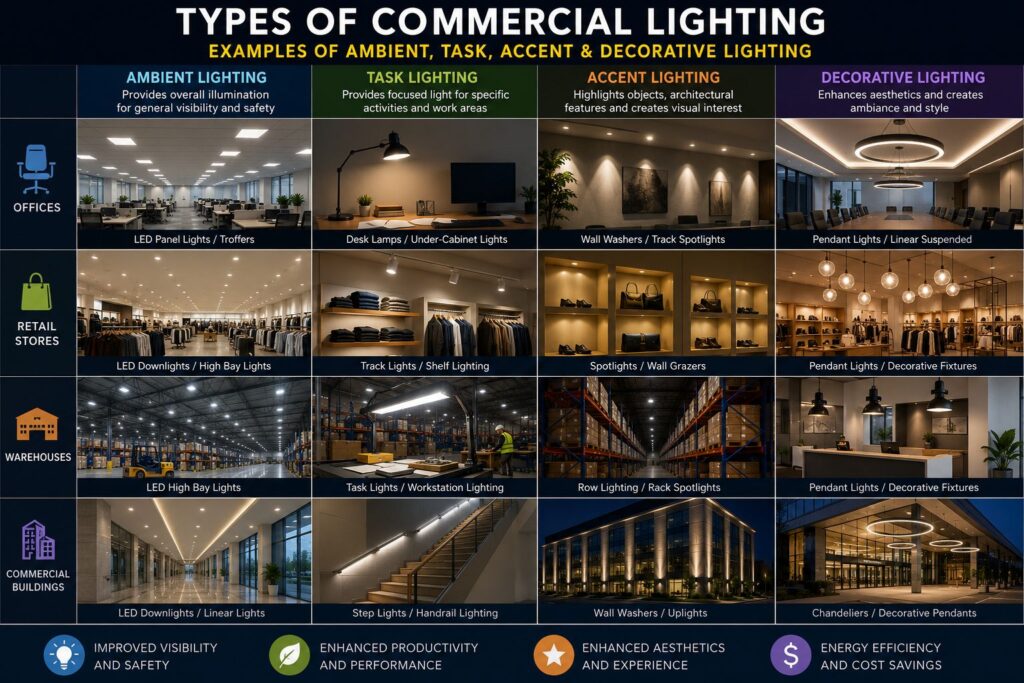
Commercial lighting systems often combine ambient, task, accent, and decorative lighting to improve visibility, functionality, and aesthetics throughout a facility.
Need Help Choosing the Right Commercial Lighting?
The right lighting solution depends on how each area of your property is used. Ceiling height, required light levels, fixture placement, operating hours, energy goals, controls, environmental conditions, and the appearance of the space should all be considered when selecting fixtures.
Explore our Commercial LED Lighting solutions or call 844-533-7767 for help matching the right fixtures to your commercial facility.
What Are the Four Types of Commercial Lighting?
Commercial lighting designs typically combine several lighting layers rather than relying on a single fixture type.
Each layer serves a different purpose and contributes to overall visibility, comfort, and aesthetics.
Four Types of Commercial Lighting
| Lighting Type | Primary Purpose | Common Commercial Applications |
|---|---|---|
| Ambient | General illumination | Offices, warehouses, retail stores |
| Task | Specific work activities | Workstations, counters, production areas |
| Accent | Highlight features | Displays, architecture, signage |
| Decorative | Enhance appearance | Lobbies, restaurants, campuses |
Ambient Lighting
Ambient lighting provides the general illumination needed throughout a space.
It serves as the foundation of most commercial lighting systems and ensures occupants can safely navigate a facility.
Common ambient lighting fixtures include:
- LED Troffers
- High Bay Fixtures
- Low Bay Fixtures
- Recessed Downlights
- Linear LED Fixtures
- Area Lights
- Parking Lot Lights
Typical Applications
- Warehouses
- Manufacturing facilities
- Offices
- Schools
- Retail stores
- Parking garages
Common Ambient Lighting Fixtures
| Facility Type | Common Fixture |
|---|---|
| Warehouse | LED High Bay |
| Office | LED Troffer |
| Retail Store | Linear LED |
| School | Recessed Troffer |
| Parking Garage | Parking Garage Fixture |
| Distribution Center | Linear High Bay |
Planning a warehouse project? Review our Warehouse Lighting guide to understand high bay lighting strategies and illumination requirements.
Task Lighting
Task lighting provides additional illumination where specific activities occur.
Unlike ambient lighting, task lighting focuses light on a smaller work area.
Common task lighting applications include:
- Workstations
- Inspection stations
- Assembly lines
- Laboratory work areas
- Cash registers
- Loading docks
- Equipment maintenance areas
Industrial facilities often combine general high bay illumination with task-specific lighting for assembly, inspection, and production areas. Explore our LED Linear High Bay Lighting fixtures for applications where their optical distribution and mounting configurations suit the facility layout.
Benefits of Task Lighting
Task lighting can:
- Improve productivity
- Reduce shadows
- Enhance visibility
- Improve safety
- Support detailed work
- Increase employee comfort
Accent Lighting
Accent lighting draws attention to specific objects, architectural elements, or visual displays.
Rather than illuminating an entire space, accent lighting highlights particular features.
Common accent lighting applications include:
- Retail displays
- Signage
- Artwork
- Architectural details
- Product showcases
- Building facades-Commercial building exteriors may also use specialized LED Façade Lighting to highlight architectural surfaces, entrances, and exterior design features.
- Monument signs
Common fixtures include:
- LED Spotlights
- Track Lighting
- Directional Flood Lights
- Sign Lights
- Landscape Lighting
Where to Use Commercial LED Outdoor Lights Every commercial property has unique lighting requirements. From parking lots and office buildings to schools, hospitals, hotels, retail centers, and industrial facilities, our Where to Use Commercial LED Outdoor Lights guide explores the best applications for exterior commercial lighting and fixture selection.
Common Accent Lighting Applications
| Application | Typical Fixture |
|---|---|
| Retail Display | Track Lighting |
| Building Facade | LED Flood Light |
| Signage | LED Sign Light |
| Artwork | Directional Spotlight |
| Architectural Features | Accent Flood Light |
| Monument Sign | Landscape Spotlight |
Need guidance on overall commercial lighting design? Visit our Commercial Lighting Solutions page for fixture recommendations and application guidance.
Decorative Lighting
Decorative lighting combines illumination with aesthetics.
The fixture itself often becomes part of the architectural design.
Decorative lighting is commonly used in:
- Hotels
- Restaurants
- Office Lobbies
- Multifamily Communities
- Campuses
- HOA Entrances
- Municipal Buildings
Examples include:
- Chandeliers
- Pendant Fixtures
- Decorative Post Tops
- Lantern Fixtures
- Architectural Wall Sconces
Why Commercial Facilities Use Multiple Lighting Types
Most successful commercial lighting designs combine multiple lighting layers.
For example:
Retail Store
- Ambient lighting for general visibility
- Task lighting at checkout counters
- Accent lighting on merchandise displays
- Decorative lighting near entrances
Warehouse
- Ambient lighting from high bays
- Task lighting at packing stations
- Accent lighting is limited
- Decorative lighting typically unnecessary
Office Building
- Ambient lighting throughout workspaces
- Task lighting at desks
- Accent lighting in reception areas
- Decorative lighting in lobbies
Designing an office environment? Explore our LED Troffer Lights resource for common ambient lighting solutions.
Typical Commercial Lighting Mix
| Facility | Ambient | Task | Accent | Decorative |
|---|---|---|---|---|
| Warehouse | High | Medium | Low | Low |
| Office | High | High | Medium | Medium |
| Retail | High | High | High | Medium |
| Hotel | Medium | Medium | High | High |
| Campus | High | Medium | Medium | High |
| Restaurant | Medium | Medium | High | High |
LED Technology and Modern Commercial Lighting
Today, nearly all commercial lighting categories utilize LED technology.
Benefits include:
- Reduced energy consumption
- Longer service life
- Lower maintenance costs
- Improved optical control
- Better color rendering
- Smart control compatibility
- Instant-on operation
LED technology can be applied to ambient, task, accent, and decorative lighting applications.
Looking for recommended illumination levels? See our Expert Lighting Level Recommendations guide for foot-candle recommendations and lighting design best practices.
Inline Buyer Q&A
Which type of commercial lighting is most important?
Ambient lighting is typically the foundation of a commercial lighting system because it provides overall illumination throughout a facility. Most projects then incorporate task, accent, or decorative lighting depending on operational and aesthetic requirements.
Do warehouses need all four lighting types?
Most warehouses primarily rely on ambient lighting and task lighting. Accent and decorative lighting are generally limited to office areas, customer-facing spaces, or facility entrances.
What lighting types are commonly used in office buildings?
Office environments often combine ambient lighting from troffers or downlights, task lighting at workstations, accent lighting in reception areas, and decorative lighting in lobbies or conference rooms.
Can LED fixtures be used for all four lighting categories?
Yes. Modern LED fixtures are available for ambient, task, accent, and decorative lighting applications, making LED technology suitable for virtually any commercial environment.
How do I determine the right lighting mix for my facility?
The ideal combination depends on the building type, tasks being performed, occupant needs, architectural goals, and recommended illumination levels. A lighting specialist or photometric plan can help identify the best solution.
Is a photometric lighting plan recommended?
Yes. Photometric layouts help determine fixture placement, light levels, uniformity, and overall lighting performance before installation.
Speak With a Commercial Lighting Specialist
Ready to Select Lighting for Your Commercial Facility?
Whether you’re planning warehouse illumination, office lighting, parking lot upgrades, architectural lighting, or a complete commercial LED retrofit, LED PROS WorldWide can help you evaluate fixture options for your project.
Request a Commercial Lighting Quote to discuss your facility requirements, mounting conditions, lighting performance, and available fixture options.
Frequently Asked Questions About Commercial Lighting
What are the four types of commercial lighting?
The four primary types are ambient lighting, task lighting, accent lighting, and decorative lighting.
Which type of lighting is most important?
Ambient lighting serves as the foundation of most commercial lighting systems because it provides overall illumination.
What is task lighting used for?
Task lighting provides focused illumination for specific activities such as reading, assembly work, inspections, and workstation tasks.
What is accent lighting?
Accent lighting highlights architectural features, products, artwork, signage, and displays.
What is decorative lighting?
Decorative lighting enhances the appearance of a space while also providing illumination.
Can one fixture serve multiple purposes?
Yes. Some fixtures provide both ambient and decorative lighting functions depending on the application.
Is LED lighting suitable for all four lighting types?
Yes. LED fixtures are available for ambient, task, accent, and decorative lighting applications.
What commercial facilities use all four lighting types?
Retail stores, hotels, office buildings, campuses, restaurants, and mixed-use facilities commonly utilize all four lighting categories.
How do I determine the right lighting mix?
The proper combination depends on the facility type, tasks performed, visual requirements, and design goals.
Are photometric plans recommended?
Yes. Photometric plans help verify illumination levels, uniformity, fixture placement, and overall lighting performance.
Related Commercial Lighting Resources
- Commercial LED Outdoor Lighting Guide — Explore fixture selection and planning considerations for commercial exterior lighting applications.
- LED High Bay Lighting — Compare commercial and industrial high bay fixtures for warehouses, manufacturing facilities, and other high-ceiling spaces.
- Warehouse Lighting — Explore LED lighting solutions for warehouse aisles, open storage areas, distribution centers, and industrial facilities.
- Commercial Site Lighting Design Guide — Learn how fixture placement, mounting height, light distribution, and site conditions influence commercial lighting design.
- Commercial LED Ceiling Lights — Compare ceiling fixtures for offices, retail spaces, commercial interiors, drop ceilings, and suspended applications.
- LED Troffer Lights — Explore recessed LED troffers for commercial offices, schools, healthcare facilities, and other grid-ceiling applications.
- Expert Lighting Level Recommendations — Review recommended illumination levels for commercial and industrial facilities when planning a lighting project.