Why Extreme Temperature Environments Require Specialized Lighting
Industrial facilities operating in elevated temperatures place extraordinary demands on lighting systems. Heat generated by furnaces, kilns, boilers, drying equipment, and manufacturing processes can accumulate near ceilings where high bay fixtures are installed, creating operating conditions well beyond those encountered in standard commercial buildings.
When lighting systems are not designed for these environments, excessive heat can shorten component life, reduce light output, increase maintenance requirements, and contribute to unexpected fixture failures.
Modern industrial LED lighting engineered for high-temperature operation helps facilities maintain dependable illumination while reducing maintenance and improving long-term operating efficiency.
Explore our complete selection of LED High Temperature High Bay Lighting to compare commercial-grade fixtures engineered for steel mills, foundries, glass plants, boiler rooms, and other high-heat industrial environments.
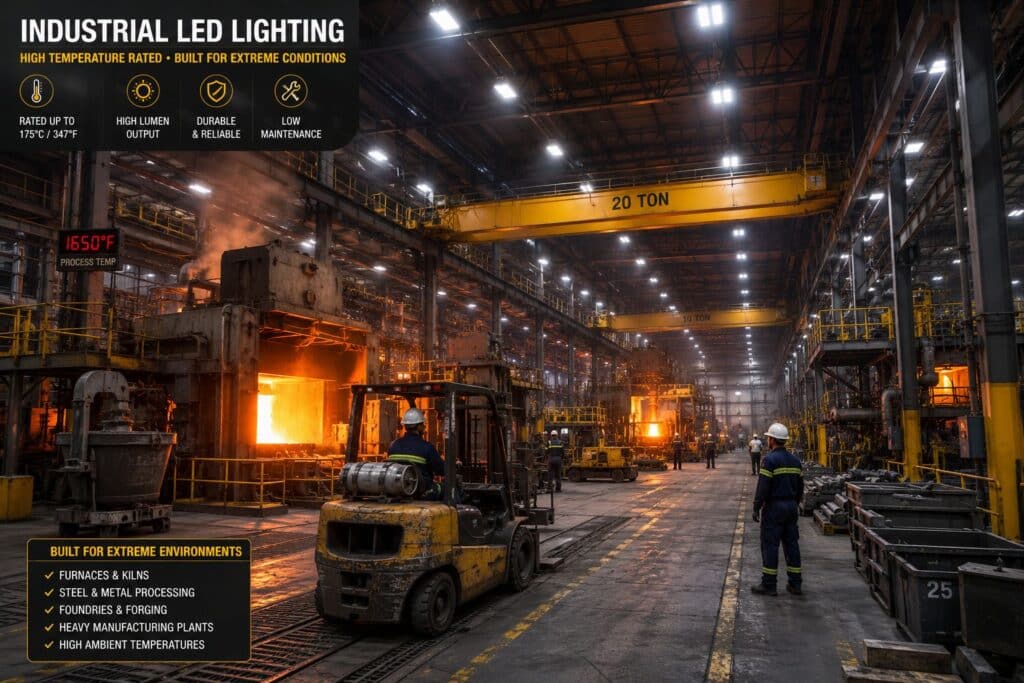
Industrial LED lighting engineered for extreme temperature environments provides dependable illumination in facilities where heat, dust, vibration, moisture, and continuous operation challenge conventional commercial lighting systems.
Designing lighting for a demanding industrial environment?
Our lighting specialists can help you specify LED lighting solutions engineered for elevated ambient temperatures, harsh operating conditions, and long-term reliability.
Request a Free Lighting Consultation – – https://industriallightingfixtures.org/
Environmental Challenges Beyond Heat
Although elevated ambient temperature is often the primary concern, many industrial facilities expose lighting fixtures to multiple environmental conditions simultaneously.
Common challenges include:
- Elevated ambient temperatures
- Radiant heat from production equipment
- Dust and airborne particulates
- Steam and humidity
- Moisture and washdowns
- Corrosive atmospheres
- Continuous vibration
- Twenty-four-hour production schedules
Selecting lighting based on the complete operating environment helps maximize fixture life and overall system reliability.
Industries Operating in Extreme Temperature Environments
High-temperature industrial lighting is commonly installed in facilities such as:
- Steel mills
- Foundries
- Glass manufacturing plants
- Cement production facilities
- Paper and pulp mills
- Boiler rooms
- Power generation facilities
- Heat treatment operations
- Industrial processing plants
- Commercial bakeries
- Food manufacturing facilities
- Industrial laundries
Each application presents unique environmental conditions that influence fixture selection, mounting methods, and maintenance planning.
n facilities where extreme heat is combined with dust, moisture, or corrosive exposure, the HB Series high-temperature LED high bay provides IP66 protection and is rated for continuous operation in ambient temperatures up to 158°F (70°C).
Choosing the Right Industrial Lighting
Successful lighting design begins with understanding the operating environment rather than simply selecting fixture wattage.
Important selection criteria include:
- Maximum ambient temperature
- Radiant heat exposure
- Mounting height
- Beam angle
- Dust levels
- Moisture exposure
- Ventilation
- Fixture materials
- Maintenance accessibility
- Required illumination levels
Evaluating these factors before installation helps improve lighting performance while reducing long-term operating costs.
Looking for a comprehensive buyer’s guide? Visit the High Temperature High Bay Lighting Guide to compare fixture ratings, thermal management, installation considerations, and lighting controls.
Understanding High Ambient Temperature Ratings
One of the most important specifications for industrial lighting is the maximum ambient operating temperature. This rating indicates the highest surrounding air temperature in which a fixture is designed to operate while maintaining its published performance and expected service life.
In many industrial facilities, temperatures near the ceiling can be significantly higher than those measured at floor level. Heat generated by furnaces, kilns, boilers, ovens, drying equipment, and manufacturing processes naturally rises, exposing ceiling-mounted lighting fixtures to elevated ambient temperatures throughout normal operation.
Selecting fixtures with the appropriate ambient temperature rating helps improve reliability, reduce maintenance, and extend fixture life.
Typical High Ambient Temperature Ratings
| Maximum Ambient Rating | Equivalent Temperature | Typical Applications |
|---|---|---|
| +40°C | 104°F | Warehouses, distribution centers, standard manufacturing facilities |
| +50°C | 122°F | Heavy industrial facilities with moderate heat exposure |
| +65°C | 149°F | Steel fabrication, paper mills, cement plants, boiler rooms, industrial processing |
| +80°C | 176°F* | Foundries, glass manufacturing, heat treatment facilities, furnace support areas, and other extreme high-temperature environments |
*Some manufacturers may publish this rating as approximately 175°F, depending on product specifications and rounding conventions.
When Should You Specify a +65°C Fixture?
Fixtures rated for +65°C (149°F) are commonly selected where standard commercial LED high bays may be exposed to sustained elevated temperatures.
- Boiler rooms
- Steel fabrication plants
- Paper mill dryer sections
- Cement production facilities
- Industrial manufacturing areas with continuous heat generation
When Is a +80°C Fixture Appropriate?
Industrial facilities operating in exceptionally hot environments may require fixtures rated to +80°C (approximately 175–176°F).
Typical applications include:
- Steel mills
- Foundries
- Glass manufacturing plants
- Heat treatment facilities
- Furnace support areas
- Industrial kilns
- High-temperature processing equipment
Specification Tip: Always compare the fixture’s published maximum ambient temperature rating with the highest expected operating temperature at the mounting location. Heat accumulation near furnaces, ovens, kilns, and process equipment can create ceiling temperatures well above general room temperature, making proper fixture selection essential for long-term reliability.
Typical Industrial Applications
| Facility | Environmental Challenge | Recommended Lighting |
| Steel Mill | Radiant heat, dust | High Temperature High Bays |
| Foundry | Extreme heat, vibration | High Temperature High Bays |
| Glass Plant | Continuous furnace heat | High Temperature LED Fixtures |
| Paper Mill | Heat and humidity | Industrial LED High Bays |
| Boiler Room | Elevated ambient temperatures | High Temperature LED Fixtures |
| Cement Plant | Heat and airborne dust | High Temperature High Bays |
| Commercial Bakery | Ovens and heat | High Temperature LED Fixtures |
| Food Processing | Heat and washdowns | Application-specific LED Fixtures |
Want to see where these fixtures are commonly installed? Read High Temperature High Bay Applications for Industrial & Commercial LED Lighting for industry-specific examples and recommended applications.
Benefits of Industrial LED Lighting in Extreme Temperature Environments
Selecting lighting specifically engineered for demanding industrial environments provides operational benefits that extend beyond simple energy savings.
Key advantages include:
- Reliable operation in elevated ambient temperatures
- Reduced maintenance interruptions
- Longer fixture service life
- Improved worker visibility
- Better illumination consistency
- Lower operating costs
- Reduced production downtime
- Compatibility with modern lighting controls
Facilities operating continuously often benefit the most because dependable lighting minimizes maintenance disruptions and supports uninterrupted production.
Maintenance Strategies for High-Temperature Facilities
Maintenance planning is especially important in environments where lighting fixtures are mounted above production equipment, furnaces, overhead cranes, or elevated process areas.
Best practices include:
- Select fixtures with appropriate ambient temperature ratings.
- Position fixtures away from direct radiant heat whenever practical.
- Keep heat sinks and optical surfaces free of excessive dust accumulation.
- Inspect mounting hardware periodically in high-vibration environments.
- Verify driver compartments remain properly sealed.
- Incorporate scheduled inspections during planned maintenance shutdowns.
A proactive maintenance program helps maximize fixture life while reducing unexpected failures.
Common Specification Mistakes
Many industrial lighting problems can be traced to improper fixture selection rather than fixture quality.
Avoid these common mistakes:
- Specifying fixtures based only on wattage.
- Ignoring maximum ambient temperature ratings.
- Measuring temperatures only at floor level instead of fixture height.
- Confusing high-temperature lighting with explosion-proof lighting.
- Overlooking radiant heat from nearby equipment.
- Failing to account for dust, humidity, vibration, or washdown requirements.
- Selecting fixtures without performing a photometric lighting layout.
- Assuming all industrial LED fixtures are suitable for elevated temperatures.
Selecting lighting based on the complete operating environment helps improve long-term reliability and return on investment.
Working in a hazardous classified location rather than simply a hot environment? Visit the Explosion Proof Lighting Guide to understand the differences between hazardous-location lighting and high-temperature industrial lighting.
Matching Lighting to Environmental Conditions
| Environmental Condition | Primary Design Consideration | Typical Lighting Solution |
|---|---|---|
| Elevated Ambient Temperature | Heat-resistant components | High Temperature High Bays |
| Radiant Furnace Heat | Thermal management | High Temperature LED Fixtures |
| Airborne Dust | Sealed fixture construction | Industrial LED High Bays |
| Steam & Humidity | Moisture protection | Vapor Tight Fixtures |
| Washdown Areas | Sealed housings and corrosion resistance | Vapor Tight or NSF Fixtures |
| Corrosive Atmospheres | Protective finishes and materials | Application-specific Industrial Fixtures |
| Continuous Operation | Long-life LED systems | Industrial High Bays with lighting controls |
Inline Buyer Q&A
What qualifies as an extreme-temperature lighting environment?
An extreme-temperature environment is one where lighting fixtures are exposed to sustained elevated ambient temperatures, radiant process heat, or combinations of heat and other demanding conditions that exceed the operating capabilities of standard commercial or industrial lighting.
Conditions such as dust, humidity, vibration, airborne contaminants, and continuous production can further affect fixture selection.
Do all hot industrial facilities require high-temperature fixtures?
Not necessarily. One of the most important factors is the temperature at the actual fixture mounting location rather than the general temperature elsewhere in the facility.
Some facilities can use standard industrial high bays, while areas near furnaces, ovens, process equipment, ceilings, or other heat sources may require fixtures specifically rated for elevated ambient temperatures.
Why are ambient-temperature ratings important?
LED fixtures, drivers, electronic components, seals, and other materials are designed to operate within specified temperature ranges.
Selecting a fixture with an ambient-temperature rating appropriate for the installation helps keep components within their intended operating conditions and can improve reliability and service life.
How do I determine the temperature at the fixture mounting location?
Use temperature information representative of the actual location where the fixture will operate, including expected conditions during normal production and the hottest operating periods.
Temperatures near ceilings, furnaces, ovens, process equipment, and other heat sources can differ significantly from measurements taken at floor level.
For demanding applications, facility operating data or measurements taken near the proposed mounting position can provide more useful information than the general room temperature.
How much temperature headroom should I allow when selecting a fixture?
Avoid specifying a fixture solely because its maximum published ambient rating exactly matches the expected operating temperature.
Consider normal temperature variation, seasonal conditions, process changes, localized heat sources, mounting position, airflow, and the manufacturer’s published operating limitations. Where conditions approach a fixture’s maximum rating, selecting equipment with additional temperature capability may provide a more appropriate operating margin.
Engineer Reliable Lighting for Extreme Industrial Conditions
Extreme industrial environments require lighting systems selected for elevated ambient temperatures, radiant process heat, dust, humidity, vibration, airborne contaminants, and demanding production schedules.
Whether you’re upgrading lighting in a steel mill, foundry, paper mill, glass manufacturing facility, power plant, cement operation, or another high-temperature industrial environment, our lighting specialists can help evaluate ambient-temperature ratings, mounting conditions, fixture output, environmental exposure, and application requirements.
👉 Explore our LED High Temperature High Bay Lighting solutions engineered for elevated ambient temperatures, or call 1-844-533-7767 to discuss your high-temperature industrial lighting project.
Frequently Asked Questions
What is the difference between ambient heat and radiant heat?
Ambient temperature refers to the temperature of the air surrounding the fixture.
Radiant heat is thermal energy transferred from hot equipment or surfaces such as furnaces, boilers, ovens, kilns, molten-material processes, and other industrial heat sources.
A fixture can therefore experience challenging thermal conditions even when the general room-air temperature does not appear exceptionally high. Both ambient conditions and nearby sources of radiant heat should be considered during fixture selection.
Can LED fixtures operate in temperatures above 149°F?
Yes. Specialized industrial LED fixtures are available for elevated ambient-temperature applications.
Some products are rated for approximately 65°C (149°F), while certain specialized fixtures can have higher published ambient ratings. Temperature capability varies significantly by product.
Always verify the manufacturer’s published ambient operating range and other environmental limitations for the specific fixture being considered rather than assuming all high-temperature LEDs have the same rating.
Are high-temperature LED fixtures more energy efficient?
High-temperature capability by itself does not make a fixture more energy efficient.
However, properly selected LED high-temperature fixtures can provide substantial energy savings compared with many older metal halide, high-pressure sodium, or other legacy lighting systems.
Actual savings depend on the existing system, replacement fixture wattage and quantity, operating hours, required illumination, and controls.
Should lighting controls be used in high-temperature facilities?
Controls can be used when the fixtures, sensors, drivers, communication devices, and other components are suitable for the operating environment.
Depending on the facility, options may include scheduling, dimming, occupancy-based controls, or networked lighting-management systems.
The environmental ratings of control components should be evaluated separately rather than assuming that a high-temperature fixture automatically makes every attached component suitable for the same conditions.
Does high-temperature lighting also need to be explosion-proof?
Not necessarily. High-temperature capability and hazardous-location suitability address different operating conditions.
A facility may require high-temperature lighting without being classified as a hazardous location. Conversely, some locations may require explosion-proof or hazardous-location equipment and also experience elevated ambient temperatures.
Where both conditions exist, the selected fixture must be suitable for the applicable hazardous classification as well as the temperature and environmental conditions of the installation.
Can standard LED high bays fail prematurely in excessive heat?
Operating an LED fixture outside its specified ambient-temperature range can negatively affect drivers, LEDs, electronic components, seals, and other materials and may reduce reliability or service life.
Fixtures installed in elevated-temperature environments should therefore be selected according to their published operating limits and the conditions expected at the actual mounting location.
Stay Connected with Our Lighting Resources
Add IndustrialLightingFixtures.org as a Preferred Source on Google to see more of our lighting guides and technical resources across Google Search experiences.

Related High Temperature & Industrial Lighting Resources
- LED High Temperature High Bay Lighting — Explore commercial high-temperature LED high bay solutions designed for elevated ambient temperatures and demanding industrial environments.
- High Temperature High Bay Lighting Guide — Learn how ambient temperature, mounting height, fixture ratings, light output, and environmental conditions influence high-temperature lighting selection.
- High Temperature High Bay Applications — Review industrial and commercial applications where specialized high-temperature LED fixtures may be required.
- Industrial Lighting Guide — Review broader industrial lighting considerations including facility conditions, fixture selection, efficiency, controls, and lighting design.
- Explosion-Proof Lighting Guide — Understand when hazardous-location requirements may apply in addition to elevated-temperature conditions and why the two specifications should be evaluated separately.