The terms flameproof and explosion proof are often used interchangeably when discussing hazardous location lighting. While both describe equipment designed for operation in potentially explosive atmospheres, they originate from different certification systems and regulatory frameworks.
Understanding the differences between flameproof and explosion proof lighting helps engineers, facility managers, contractors, and safety professionals select the proper lighting equipment for hazardous environments while maintaining compliance with applicable standards.
Although both approaches share the same safety objective—preventing hazardous atmospheres from being ignited—the terminology, certification methods, and regional requirements differ significantly.
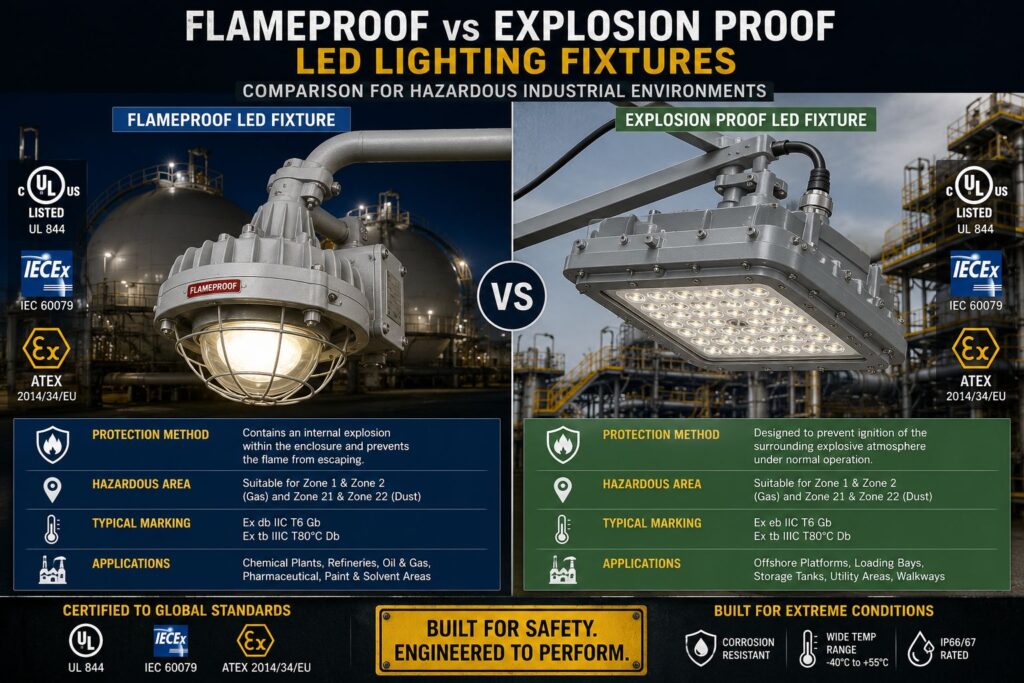
Flameproof and explosion proof lighting fixtures are designed to safely operate in hazardous locations while preventing ignition of explosive atmospheres.
Need Certified Hazardous-Location Lighting for Your Project?
Whether your project requires North American explosion-proof lighting or internationally certified flameproof equipment, LED PROS can help identify fixtures based on the required classification, certification, voltage, mounting and application.
Explore Explosion-Proof LED Lighting | Request a Quote | Call 844-533-7767
Why the Terms Cause Confusion
Many international manufacturers use the term flameproof, while North American specifications commonly use explosion proof.
As a result, facility owners often encounter both terms when evaluating hazardous location equipment.
The good news is that both technologies are designed to accomplish a similar objective:
- Contain internal ignition events
- Prevent external ignition
- Protect surrounding hazardous atmospheres
- Maintain safe operation in explosive environments
The difference primarily lies in certification systems and regional standards.
What Is Explosion Proof Lighting?
Explosion proof lighting is a term commonly used throughout the United States and Canada.
These fixtures are typically certified under standards such as:
- UL844
- CSA
- ETL hazardous location standards
Explosion proof fixtures are designed so that if an internal spark or ignition occurs, the fixture housing can contain the event and prevent ignition of the surrounding atmosphere.
Typical applications include:
- Oil and gas facilities
- Refineries
- Chemical plants
- Fuel terminals
- Paint manufacturing
- Wastewater treatment facilities
Selecting Explosion-Proof Lighting for a North American Project
For U.S. hazardous-location projects, fixture selection should begin with the required Class, Division and material group. Review Class I Division 1 LED Lighting for locations requiring Division 1 equipment, or Class I Division 2 LED Lighting for applicable Division 2 installations.
What Is Flameproof Lighting?
Flameproof lighting is commonly associated with international hazardous location standards.
The term is frequently used in:
- Europe
- Middle East
- Asia
- Africa
- Offshore energy projects
Flameproof equipment is often certified under:
- ATEX
- IECEx
Like explosion proof fixtures, flameproof equipment is designed to contain internal ignition events and prevent flame propagation into surrounding hazardous atmospheres.
High temperature LED lighting is used across numerous industries where excessive heat challenges conventional lighting systems. High Temperature High Bay Applications for Industrial & Commercial LED Lighting highlights the environments where these fixtures provide the greatest value.
Explosion Proof vs Flameproof Comparison
| Feature | Explosion Proof | Flameproof |
|---|---|---|
| Common Region | North America | Europe & International Markets |
| Typical Certification | UL844 | ATEX / IECEx |
| Classification Method | Classes & Divisions | Zones |
| Oil & Gas Applications | Yes | Yes |
| Chemical Facilities | Yes | Yes |
| Offshore Projects | Yes | Yes |
| Safety Objective | Contain Ignition | Contain Ignition |
Despite different terminology, both systems focus on preventing ignition of hazardous atmospheres.
Need a detailed comparison of North American and international certification systems? Review ATEX vs UL844 Lighting for a deeper look at hazardous location approvals.
Classes and Divisions vs Zones
One of the biggest differences between these systems involves hazardous area classification.
North American System
Explosion proof lighting commonly uses:
- Class I
- Class II
- Class III
- Division 1
- Division 2
Example:
- Class I Division 1
- Class I Division 2
International System
Flameproof equipment commonly uses:
- Zone 0
- Zone 1
- Zone 2
Dust environments may also include:
- Zone 20
- Zone 21
- Zone 22
These systems classify hazardous environments according to exposure frequency and duration.
Want to understand certification requirements in greater detail? Explore UL844, IECEx, and ATEX Certifications Explained to learn how hazardous location equipment is tested and approved.
How Flameproof and Explosion Proof Fixtures Work
Both fixture types rely on similar protective principles.
Containment
The fixture housing contains internal ignition events.
Flame Path Design
Specialized joints and threaded pathways cool escaping gases before they can ignite surrounding atmospheres.
Surface Temperature Control
Fixtures maintain safe operating temperatures below ignition thresholds.
Mechanical Integrity
Heavy-duty construction helps maintain protection under harsh industrial conditions.
Typical Industries Using Flameproof and Explosion Proof Lighting
Both technologies are widely used in:
- Oil and gas production
- Refineries
- Petrochemical facilities
- Chemical processing plants
- Mining operations
- Fuel storage terminals
- Offshore drilling platforms
- Wastewater treatment facilities
- Grain processing facilities
Hazardous location requirements vary according to project location and applicable regulations.
Certifications Associated with Each System
Common Explosion Proof Certifications
- UL844
- CSA
- ETL
Common Flameproof Certifications
- ATEX
- IECEx
Many modern fixtures carry multiple certifications, allowing deployment across multiple geographic markets.
Temperature Codes Remain Important
Regardless of certification system, hazardous location fixtures utilize temperature ratings.
| Temperature Code | Maximum Surface Temperature |
| T1 | 450°C |
| T2 | 300°C |
| T3 | 200°C |
| T4 | 135°C |
| T5 | 100°C |
| T6 | 85°C |
Temperature limitations help ensure fixture surfaces remain below ignition temperatures of hazardous materials.
Which One Is Better?
Neither system is inherently better.
The correct solution depends on:
- Project location
- Applicable regulations
- Customer specifications
- Engineering requirements
- Hazardous area classification
For North American projects, explosion proof certifications are typically required.
For many international projects, flameproof certifications may be specified.
Match the Certification to the Fixture Application
Once the required hazardous-location classification and certification framework are established, the next step is selecting the appropriate fixture type for the installation.
Explosion-Proof Linear Lighting — corridors, process lines, equipment rows and lower mounting heights.
Explosion-Proof High Bay Lighting — production areas, processing facilities and higher mounting applications.
Explosion-Proof Flood Lighting — yards, tank areas, loading areas and broad outdoor illumination.
Explosion-Proof Paint Spray Booth Lighting — coating and finishing environments requiring lighting selected around the booth’s classified location and installation method.
Explosion-Proof Vapor-Tight Lighting — compact, confined, service-area and lower-mounting applications.
Common Buyer Mistakes
Assuming the Terms Mean Different Technologies
Both systems share similar safety objectives and protective principles.
Ignoring Regional Requirements
Certification requirements often depend on project location.
Focusing Only on Appearance
Certification markings and documentation are far more important than visual appearance.
Overlooking Hazardous Area Classifications
The classification of the environment ultimately determines acceptable equipment.
Inline Buyer Q&A
Is flameproof the same as explosion proof?
Not exactly.
The terms describe related protection concepts used within different hazardous-location standards and regulatory frameworks.
“Explosion proof” is terminology commonly encountered in North American hazardous-location systems, while “flameproof” is associated with the IEC/ATEX protection concept commonly identified as Ex d.
Because the terminology, testing requirements, equipment markings, and certification frameworks differ, the terms should not automatically be treated as interchangeable.
Is ATEX considered flameproof?
ATEX is not itself a flameproof protection method.
ATEX is a European Union regulatory framework for equipment intended for use in potentially explosive atmospheres.
Equipment subject to ATEX requirements can use different recognized protection concepts depending on the application. Flameproof protection is one such concept for applicable equipment.
Can one fixture be both flameproof and explosion proof?
Potentially.
Some hazardous-location luminaires carry certifications or markings addressing multiple regulatory or conformity frameworks.
However, approval under one system should not automatically be assumed to establish compliance with another.
Verify the certifications and markings for the exact fixture and configuration being specified.
Which hazardous-location lighting requirements are commonly used in the United States?
U.S. hazardous-location projects commonly involve National Electrical Code requirements together with appropriately listed or certified equipment evaluated to applicable product standards.
UL 844 is an important product standard covering luminaires for hazardous classified locations.
The required listing, certification, classification, and equipment markings depend on the project and jurisdiction.
Can I substitute a flameproof fixture for an explosion-proof fixture?
Not automatically.
The fixture must satisfy the hazardous-location classification, certification, equipment-marking, electrical, and regulatory requirements applicable to the installation.
A product described as flameproof under one certification framework should not automatically be substituted for equipment required to carry North American hazardous-location certification.
What should I provide when requesting flameproof or explosion-proof lighting?
Useful information includes:
- Country and installation location
- Required certification framework
- Class/Division or Zone classification
- Gas, vapor, or dust group
- Temperature classification
- Ambient-temperature range
- Fixture type
- Mounting requirements
- Voltage
- Environmental exposure
- Project specifications
- Required listing or certification
For international projects, providing the actual hazardous-area specification is especially useful.
Match the Protection Method and Certification to the Project
Flameproof and explosion-proof lighting requirements depend on the installation country, hazardous-location classification, certification framework and application. Send us your project specifications—including any known Class/Division or Zone, gas or dust group, voltage, mounting and fixture requirements—and we’ll help identify appropriate lighting options.
Request a Quote or call 844-533-7767
Frequently Asked Questions About Flameproof vs Explosion-Proof Lighting
What does flameproof mean?
Flameproof is a defined hazardous-area protection concept commonly associated with IEC-based systems and the Ex d protection method.
The enclosure is designed according to applicable requirements to withstand an internal explosion of a specified explosive atmosphere and prevent transmission capable of igniting the surrounding specified atmosphere.
The complete equipment marking and certification determine where the equipment can be used.
What does explosion proof mean?
In the North American hazardous-location context, explosion-proof equipment uses construction intended to contain an internal explosion of specified gases or vapors and prevent ignition of the surrounding specified hazardous atmosphere through the enclosure.
The term does not mean that equipment is universally resistant to external explosions or suitable for every hazardous location.
Are flameproof and explosion-proof fixtures interchangeable?
Not automatically.
Although the protection concepts have similarities, they operate within different standards, certification systems, equipment markings, and regulatory frameworks.
The required equipment should be selected according to the classification and certification requirements of the actual project.
Is ATEX the same as flameproof?
No.
ATEX is a European Union regulatory framework addressing equipment and protective systems intended for use in potentially explosive atmospheres.
Flameproof is a particular protection concept that may be used by applicable equipment.
An ATEX-compliant product is not necessarily flameproof; the actual equipment marking identifies the protection method.
Is IECEx the same as flameproof?
No.
IECEx is an international conformity assessment system for equipment used in explosive atmospheres.
Flameproof protection is one protection concept that can be evaluated within IEC-based hazardous-area standards.
IECEx certification can apply to equipment using other recognized protection concepts as well.
Is UL 844 the same as explosion proof?
No.
UL 844 is a product standard covering luminaires for use in hazardous classified locations.
“Explosion proof” describes a type of hazardous-location equipment construction or protection recognized for applicable North American classified locations.
UL 844 itself should be described as a standard rather than as another term for explosion-proof construction.
Is ATEX the same as UL 844?
No.
ATEX is a European Union regulatory framework, while UL 844 is a North American product standard for hazardous-location luminaires.
They should not be described as equivalent certification systems.
The appropriate requirements depend on the installation country, classification, project specification, and applicable regulations.
What does Ex d mean on a flameproof fixture?
Ex d identifies flameproof enclosure protection within applicable IEC-based hazardous-area marking systems.
It is only one part of the equipment marking.
Other information can identify the equipment group, gas group, temperature class, equipment protection level, certification, and conditions affecting where the fixture can be installed.
Does an Ex d marking mean the fixture can be installed anywhere in a hazardous area?
No.
The complete equipment marking must match the hazardous-area classification and installation requirements.
Gas group, temperature classification, equipment protection level, ambient conditions, certification, and other characteristics can affect suitability.
Can an ATEX flameproof fixture automatically be installed in the United States?
No.
ATEX compliance alone does not automatically establish acceptance for a U.S. installation.
Applicable electrical-code requirements, product certification, equipment markings, project specifications, and requirements of the authority having jurisdiction must be considered.
Can a North American explosion-proof fixture automatically be installed in Europe?
No.
North American hazardous-location certification should not automatically be treated as satisfying European ATEX requirements.
Equipment intended for an installation subject to ATEX requirements must meet the applicable European regulatory and conformity requirements.
Can a fixture carry both North American and ATEX or IECEx certifications?
Yes.
Some hazardous-location luminaires are available with certifications or markings for multiple markets.
Verify the exact model and configuration because certifications can vary within a product family.
What is the difference between Class/Division and Zone classifications?
Class/Division and Zone are different hazardous-area classification approaches.
The traditional North American system uses Classes, Divisions, and material groups.
Zone systems use Zones and associated hazardous-area concepts and equipment markings.
Zone classification is widely used internationally, but Zone-based approaches are also recognized within North American electrical frameworks for applicable installations.
Is flameproof equipment always used in Zone 1?
No universal assumption should be made from the Zone designation alone.
Equipment protection methods and certification requirements depend on the hazardous-area classification, type of hazard, equipment, applicable standards, and project requirements.
The complete equipment marking should be evaluated.
Are flameproof and explosion-proof fixtures waterproof?
Not necessarily.
Hazardous-location protection and protection against water ingress are separate equipment characteristics.
Ingress protection should be verified from the fixture’s applicable IP, enclosure, or environmental ratings.
Does an IP66 or IP67 rating mean a fixture is flameproof or explosion proof?
No.
IP ratings describe specified protection against ingress of solids and water.
They do not establish hazardous-location suitability or a flameproof/explosion-proof protection method.
Why are hazardous-location certifications important?
Third-party certification and conformity assessment provide evidence that equipment has been evaluated according to applicable requirements for the classifications and conditions identified by its markings.
Certification does not make a fixture universally suitable for every hazardous location.
The complete markings still need to match the installation.
Which is better: flameproof or explosion proof?
Neither is universally better.
The correct choice is the equipment and protection method that satisfy the hazardous-area classification, certification framework, regulatory requirements, environmental conditions, and project specifications for the installation.
Stay Connected with Our Lighting Resources
Add IndustrialLightingFixtures.org as a Preferred Source on Google to see more of our lighting guides and technical resources across Google Search experiences.

Related Flameproof and Explosion-Proof Lighting Resources
- LED Explosion-Proof Lighting — Explore hazardous-location LED fixture options after determining the applicable classification and certification requirements.
- Class I Division 1 LED Lighting — Review LED fixtures for hazardous locations requiring Class I, Division 1 equipment.
- Class I Division 2 LED Lighting — Explore LED lighting options for applicable Class I, Division 2 hazardous locations.
- Explosion-Proof Linear Lighting — Compare linear LED fixtures for process lines, equipment areas, corridors, and other hazardous-location applications.
- UL 844, IECEx & ATEX Certifications — Review the major certification systems used for hazardous-location lighting projects.