One of the most common questions facility managers, contractors, and maintenance professionals ask is, “Are LED lights explosion proof?” The short answer is no—not all LED lights are explosion proof.
While LED technology offers significant advantages over traditional lighting, an LED light fixture is only considered explosion proof if it has been specifically designed, tested, and certified for installation in hazardous locations.
Understanding the difference between a standard LED fixture and a certified explosion proof LED fixture is essential for maintaining worker safety, meeting regulatory requirements, and protecting industrial facilities operating in hazardous environments.
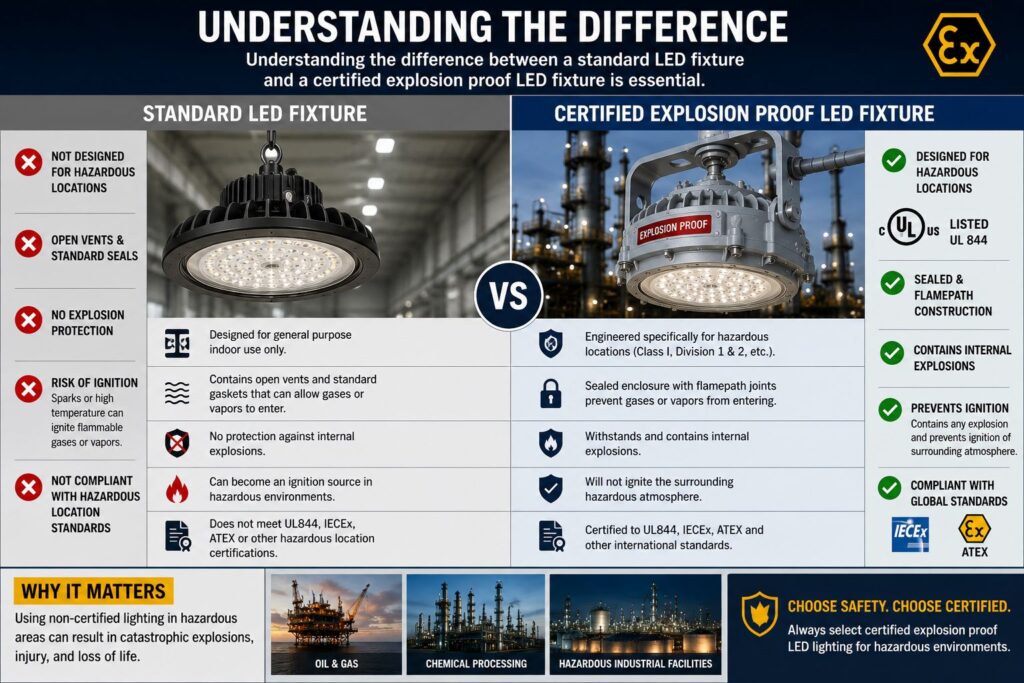
Only LED fixtures specifically tested and certified for hazardous locations should be installed where explosive gases, vapors, or combustible dust may be present.
Need certified explosion proof LED lighting?
Browse our complete selection of hazardous location lighting fixtures:
https://industriallightingfixtures.org/led-explosion-proof-lighting/
Why the Answer Is "Not Always"
Many people assume that because LED fixtures produce less heat than traditional HID or fluorescent lighting, they are automatically safer in hazardous locations.
While LEDs offer several performance advantages, the light source itself does not determine whether a fixture is explosion proof.
Instead, certification depends on the complete fixture, including:
- Housing construction
- Internal electrical components
- Flame path design
- Sealed electrical compartments
- Temperature performance
- Third-party certification
Without these features, a standard LED fixture cannot be installed in classified hazardous locations.
What Makes an LED Fixture Explosion Proof?
A certified explosion proof LED fixture is engineered to safely contain an internal ignition event and prevent that ignition from reaching the surrounding hazardous atmosphere.
Certified fixtures typically include:
- Heavy-duty cast aluminum housing
- Threaded flame paths
- Reinforced impact-resistant lens
- Sealed conduit entries
- Corrosion-resistant finishes
- Certified hazardous location markings
Most importantly, the fixture must be independently tested and approved for hazardous location use.
Need help identifying certified hazardous location fixtures? Visit How Do You Know If a Light Is Explosion Proof? to learn how to verify hazardous location markings and certification labels.
How to Verify an Explosion Proof LED Fixture
Never rely solely on product descriptions or marketing terms.
Look for:
- UL844 certification
- Class I Division 1 or Division 2 markings
- Class II or Class III ratings (where applicable)
- ATEX certification
- IECEx certification
- Temperature code (T-Code)
- Manufacturer identification
Certification markings should be permanently attached to the fixture.
Looking for a complete overview of hazardous area classifications? Explore our Hazardous Location Lighting Guide covering Classes, Divisions, Groups, Zones, and temperature codes.
Standard LED vs Explosion Proof LED
| Feature | Standard LED Fixture | Explosion Proof LED Fixture |
|---|---|---|
| Hazardous Location Certified | No | Yes |
| UL844 Certification | No | Yes (when specified) |
| Heavy-Duty Housing | Varies | Yes |
| Threaded Flame Paths | No | Yes |
| Temperature Code | Usually No | Yes |
| Suitable for Hazardous Locations | No | Yes |
Although both fixtures use LED technology, only one is certified for hazardous environments.
Before specifying explosion proof lighting for a project, review Are LED Lights Explosion Proof? to understand the certifications, construction features, and safety requirements that distinguish compliant fixtures.
Why LED Technology Is Preferred in Hazardous Locations
Modern explosion proof fixtures almost exclusively utilize LED technology because of several operational advantages.
Lower Energy Consumption
LED fixtures significantly reduce electrical consumption compared to older HID technologies.
Longer Service Life
Long operating life reduces maintenance frequency and minimizes worker exposure in hazardous environments.
Improved Visibility
High-quality LED illumination improves visibility for inspections, maintenance, and facility operations.
Instant Startup
LED fixtures reach full brightness immediately after energization.
Reduced Maintenance Costs
Longer service intervals help reduce labor and maintenance expenses over the life of the installation.
Common Industries Using Explosion Proof LED Lighting
Certified explosion proof LED fixtures are widely used in:
- Oil and gas production
- Refineries
- Chemical manufacturing
- Fuel storage terminals
- Wastewater treatment plants
- Grain processing facilities
- Mining operations
- Paint spray booths
- Pharmaceutical manufacturing
Each application requires proper hazardous location classification before selecting lighting equipment.
Ready to compare available hazardous location fixtures? Browse our complete selection of LED Explosion Proof Lighting for industrial and commercial applications.
Common Misconceptions
“LED Means Explosion Proof”
False.
The LED light source alone does not make a fixture explosion proof.
“Heavy-Duty Fixtures Are Automatically Certified”
False.
Industrial construction does not replace hazardous location certification.
“Outdoor Fixtures Can Be Used Anywhere”
False.
Weather resistance and hazardous location certification are entirely different requirements.
“All Explosion Proof Fixtures Look the Same”
False.
Certification markings—not appearance—determine whether a fixture is approved for hazardous locations.
Typical Certifications to Look For
| Certification | Primary Market |
| UL844 | United States & Canada |
| CSA | Canada |
| ETL | North America |
| ATEX | European Union |
| IECEx | International Markets |
Project location and governing regulations determine which certification is required.
Can Explosion Proof LED Fixtures Be Used Outdoors?
Yes.
Many explosion proof LED fixtures are specifically designed for outdoor installations including:
- Tank farms
- Wellheads
- Offshore platforms
- Refineries
- Loading racks
- Fuel terminals
- Chemical processing facilities
Outdoor ratings often include additional corrosion resistance and environmental protection.
Inline Buyer Q&A
Are all LED lights explosion proof?
No. Only fixtures specifically certified for hazardous locations are considered explosion proof.
Can I install a standard LED high bay in a hazardous location?
No. Standard industrial fixtures should not be installed in classified hazardous environments.
Why do explosion proof LED fixtures cost more?
They require specialized construction, third-party testing, and hazardous location certification.
How do I verify an explosion proof LED fixture?
Review the fixture nameplate for hazardous location classifications, certification markings, and temperature codes.
Modern LED technology has transformed hazardous location lighting, but not every LED fixture is explosion proof. Selecting properly certified equipment is essential for protecting workers, maintaining compliance, and ensuring long-term reliability in hazardous industrial environments.
Browse our complete line of certified hazardous location lighting solutions:
https://industriallightingfixtures.org/led-explosion-proof-lighting/
Or visit our homepage to explore all industrial and commercial lighting products:
FAQ
Are LED bulbs themselves explosion proof?
No. The complete lighting fixture—not the LED bulb—must be certified for hazardous location use.
Are explosion proof LED fixtures safer?
When properly selected and installed, certified fixtures help reduce ignition risks in hazardous environments.
Do all hazardous locations require explosion proof lighting?
Requirements depend on the hazardous area classification and applicable regulations.
Can LED fixtures carry multiple certifications?
Yes. Many manufacturers offer fixtures certified under UL844, ATEX, IECEx, or multiple hazardous location standards.
Is LED the preferred technology today?
Yes. LED technology has become the preferred lighting source for most new hazardous location installations because of its efficiency, reliability, and long service life.