Hazardous location lighting is designed for industrial environments where flammable gases, vapors, combustible dust, or ignitable fibers may be present. Selecting properly rated hazardous location fixtures is essential for maintaining worker safety, regulatory compliance, and reliable industrial illumination in demanding environments such as oil refineries, chemical plants, manufacturing facilities, and fuel storage terminals.
Facilities replacing aging hazardous location lighting should review Explosion Proof Lighting Prices to compare long-term operating value rather than focusing only on initial purchase cost.
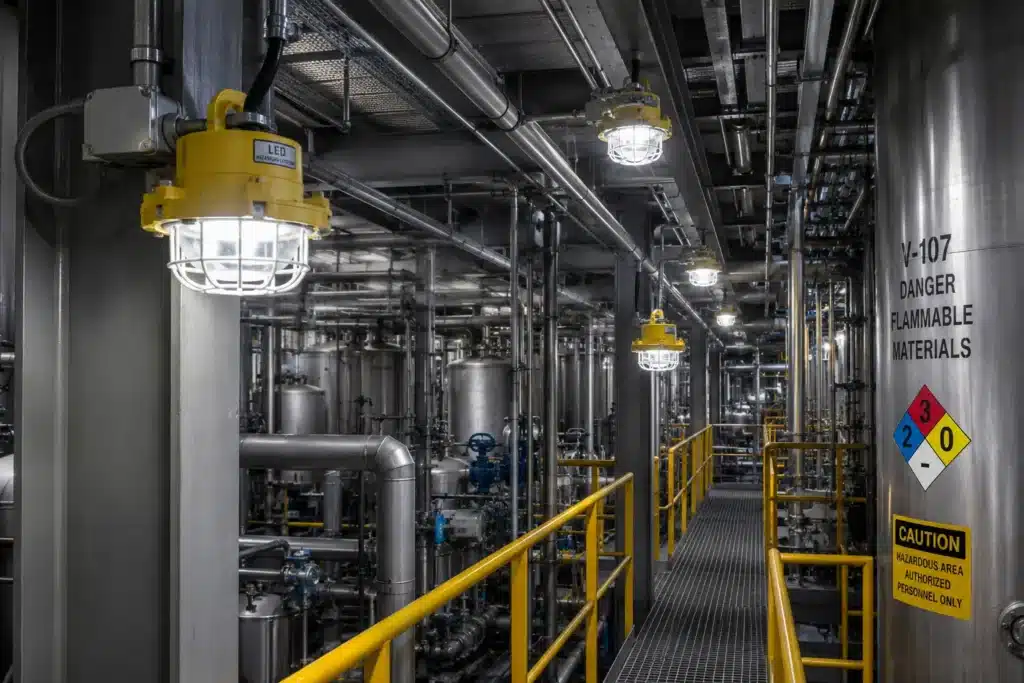
Hazardous location LED lighting provides properly rated illumination for industrial environments where flammable gases, vapors, combustible dust, or ignitable fibers may be present.
Need Help Selecting Hazardous Location Lighting?
Choosing the correct fixture starts with the classified environment—not simply the wattage or fixture type. Our lighting specialists can help you evaluate Class, Division or Zone requirements, gas or dust groups, temperature codes, mounting conditions, certifications, and lighting performance for your industrial application.
👉 Explore Explosion-Proof Lighting Solutions, request a quote, or call 1-844-533-7767 for help matching hazardous-location fixtures to your project requirements.
What Is Hazardous Location Lighting?
Hazardous location lighting refers to specialized industrial lighting systems engineered for environments where explosive or combustible materials may create ignition risks.
Unlike standard commercial fixtures, hazardous location lighting is designed to:
- reduce ignition risks,
- contain sparks or arcs,
- withstand harsh industrial conditions,
- comply with hazardous area regulations,
- operate safely in explosive atmospheres.
These fixtures are commonly used in:
- oil & gas facilities,
- chemical plants,
- ethanol processing,
- grain operations,
- wastewater treatment plants,
- industrial manufacturing facilities,
- aviation fueling environments.
Petroleum environments frequently require Explosion Proof Lighting for Oil & Gas facilities where combustible vapors may be present.
Why Hazardous Location Lighting Is Important
Industrial facilities often contain:
- flammable gases,
- combustible vapors,
- ignitable dust,
- volatile chemicals,
- aerosol particles,
- industrial solvents.
Improper lighting in these environments may create serious:
- fire hazards,
- explosion risks,
- equipment damage,
- operational shutdowns,
- safety violations.
Proper hazardous location lighting helps facilities:
- maintain NEC compliance,
- improve worker safety,
- support operational reliability,
- reduce maintenance risks,
- improve visibility in hazardous areas.
Many industrial hazardous environments rely on LED Explosion Proof Lighting fixtures engineered for combustible gas and vapor applications.
Understanding Hazardous Location Classifications
Hazardous locations are classified based on:
- the type of hazardous material present,
- the probability of exposure,
- environmental operating conditions.
NEC Classifications
The National Electrical Code (NEC) uses:
- Class,
- Division,
- Group,
- Temperature Code classifications.
Class I Hazardous Locations
Class I environments contain:
- flammable gases,
- combustible vapors.
Common examples include:
- petroleum vapors,
- propane,
- methane,
- hydrogen,
- gasoline vapors.
Class II Hazardous Locations
Class II locations contain combustible dust.
Examples include:
- grain dust,
- metal dust,
- powdered chemicals,
- industrial powders.
Class III Hazardous Locations
Class III locations involve ignitable fibers or flyings.
Common applications include:
- textile facilities,
- woodworking operations,
- paper manufacturing plants.
When selecting fixtures for hazardous environments, it is important to verify that products are properly certified. Learn How Do You Know If a Light Is Explosion Proof? to identify hazardous location markings, certification labels, and compliance requirements before installation.
Division Classifications
Division 1
Hazardous materials are present during normal operations.
Examples include:
- refinery processing zones,
- chemical blending operations,
- fuel transfer areas.
Division 2
Hazardous materials are only present under abnormal operating conditions such as equipment failure or accidental leaks.
Examples include:
- adjacent processing rooms,
- maintenance corridors,
- enclosed utility spaces.
Zone Classification System
International hazardous location standards commonly use the Zone system.
Gas Zones
- Zone 0
- Zone 1
- Zone 2
Dust Zones
- Zone 20
- Zone 21
- Zone 22
These classifications are commonly associated with:
- ATEX,
- IECEx,
- international hazardous area standards.
Selecting Lighting for Class I Division 1 and Division 2 Locations
For Class I gas and vapor environments, the required Division directly affects equipment selection. Review Class I Division 1 LED Lighting for locations requiring Division 1 equipment, or Class I Division 2 LED Lighting for applicable Division 2 installations.
Explosion Proof vs Non-Incendive Lighting
Explosion Proof Lighting
Explosion proof fixtures are engineered to contain internal explosions and prevent ignition of surrounding hazardous atmospheres.
These fixtures commonly feature:
- reinforced housings,
- sealed compartments,
- heavy-duty construction,
- hazardous location certifications.
Non-Incendive Lighting
Non-incendive fixtures are commonly used in Division 2 environments where hazardous conditions are less likely during normal operations.
These fixtures are designed to:
- minimize arcs,
- reduce spark risks,
- control surface temperatures.
Common Hazardous Location Fixture Types
Explosion Proof High Bay Lighting
Used in:
- refineries,
- manufacturing plants,
- industrial warehouses,
- processing facilities.
These fixtures provide high-output illumination for elevated mounting applications.
Hazardous Location Flood Lighting
Flood lights are commonly installed in:
- tank farms,
- loading docks,
- perimeter zones,
- drilling operations,
- outdoor industrial environments.
Explosion-Proof Vapor Tight Fixtures
Vapor tight fixtures provide sealed protection against:
- moisture,
- dust,
- humidity,
- contaminants.
These fixtures are commonly used in industrial washdown areas and utility spaces.
Explosion-Proof Linear Lighting
Linear hazardous location fixtures are often installed in:
- tunnels,
- walkways,
- enclosed industrial corridors,
- maintenance areas.
Industries Using Hazardous Location Lighting
Oil & Gas Facilities
Petroleum environments commonly contain combustible vapors requiring explosion proof fixtures.
Chemical Processing Plants
Chemical facilities may contain volatile solvents and hazardous gases during production.
Wastewater Treatment Facilities
Methane and hydrogen sulfide exposure often require hazardous location lighting systems.
Grain Processing Operations
Combustible grain dust creates hazardous conditions requiring properly rated fixtures.
Aviation Fueling Facilities
Aircraft fueling and maintenance operations may require explosion proof lighting systems.
Paint and coating operations may require specialized explosion-proof paint spray booth lighting selected according to the classified location, booth design and installation method.
LED Technology in Hazardous Location Lighting
Modern industrial facilities increasingly use LED hazardous location fixtures due to their performance advantages.
Energy Efficiency
LED fixtures reduce electrical consumption while maintaining high lumen output.
Reduced Maintenance
Long operating life helps minimize maintenance in hazardous and difficult-to-access environments.
Instant-On Operation
LED fixtures provide immediate full brightness without warm-up delays.
Improved Durability
Hazardous location LED fixtures resist:
- vibration,
- corrosion,
- moisture,
- thermal cycling,
- harsh industrial exposure.
Important Hazardous Location Certifications
Hazardous location fixtures may require:
- UL844 certification,
- ATEX certification,
- IECEx approval,
- CSA certification,
- NEC compliance,
- NEMA ratings,
- IP ratings.
Facilities operating internationally may require multiple certifications depending on project specifications.
International industrial facilities may require fixtures certified under multiple hazardous area standards. Learn more about ATEX vs UL844 lighting certifications.
Key Factors When Selecting Hazardous Location Lighting
Important considerations include:
- hazardous classification,
- gas group,
- T-Code,
- environmental exposure,
- mounting height,
- corrosion resistance,
- ambient temperature,
- lumen requirements,
- voltage compatibility,
- maintenance accessibility.
Fixture selection should always follow guidance from:
- engineers,
- hazardous area specialists,
- safety personnel,
- local code authorities.
Common Hazardous Location Applications
Hazardous location lighting is commonly used in:
- oil refineries,
- drilling platforms,
- petrochemical facilities,
- manufacturing plants,
- industrial warehouses,
- grain facilities,
- wastewater treatment plants,
- fuel terminals,
- aircraft hangars,
- chemical storage environments.
Inline Buyer Q&A
What information do I need before selecting hazardous location lighting?
Start with the hazardous-location classification established for the area where the fixture will be installed.
Important information can include:
- Class and Division or Zone classification
- Gas, vapor, dust, or fiber hazard
- Applicable material group
- Temperature code requirements
- Ambient temperature
- Fixture type and mounting
- Required illumination
- Voltage
- Environmental exposure
- Required certifications or listings
- Applicable jurisdiction and project specifications
The lighting equipment should be selected to match the classified location rather than choosing a fixture first and determining suitability afterward.
How do I know whether I need Class 1, Class 2, or Class 3 lighting?
The Class identifies the general type of hazardous material associated with the classified location.
Class 1 addresses flammable gases or vapors. Class 2 addresses combustible dust. Class 3 addresses easily ignitable fibers or flyings.
The classification should be established from the actual process and conditions within the facility according to the applicable electrical requirements.
How do I determine whether a location is Division 1 or Division 2?
Division classification depends on the conditions under which the hazardous material may be present and the applicable hazardous-location definitions.
Division 1 generally addresses locations where ignitable concentrations may exist under normal operating conditions or under other conditions included within the Division 1 classification.
Division 2 generally addresses locations where ignitable concentrations are normally contained or not likely to occur during normal operation but could occur under specified abnormal conditions.
Do not classify an area solely from the industry or facility type.
Can I use the same hazardous location fixture throughout an entire facility?
Not automatically.
Different parts of a facility can have different classifications, material groups, temperature requirements, ambient conditions, and environmental exposures.
A fixture suitable for one classified area may be unnecessarily restrictive—or unsuitable—for another area.
What should I provide when requesting a hazardous location lighting quote?
Provide the hazardous-location classification and available project documentation first.
Also include fixture type, quantity, mounting height, voltage, required illumination, existing fixture information for retrofits, ambient temperature, environmental conditions, and required certifications.
For larger facilities, drawings or photometric information can help evaluate fixture quantity, placement, and light distribution.
Do I need a photometric layout for hazardous location lighting?
Hazardous-location certification determines whether a fixture is suitable for the classified environment; it does not determine whether the fixture will adequately illuminate the facility.
For larger or more complex projects, a photometric layout can help evaluate fixture placement, output, distribution, illumination, and uniformity.
Hazardous-location suitability and lighting performance should be evaluated separately.
Match the Fixture to the Hazardous Location
Hazardous-location lighting selection begins with the classified environment. Class, Division or Zone, material group, temperature code, ambient temperature, environmental exposure, fixture configuration, and applicable certifications should all be evaluated before equipment is specified.
Send us your available project requirements—including classification, fixture type, quantity, voltage, mounting, environmental conditions, required certifications, and lighting requirements—and we’ll help identify appropriate hazardous-location LED fixture options.
Request a Quote or call 1-844-533-7767 for application and product-selection assistance.
Frequently Asked Questions About Hazardous Location Lighting
What is hazardous location lighting?
Hazardous location lighting refers to luminaires designed, tested, and marked for use in classified environments where flammable gases or vapors, combustible dusts, or easily ignitable fibers or flyings can create a fire or explosion hazard.
The required fixture characteristics depend on the classification of the specific installation.
What is the difference between hazardous location and explosion-proof lighting?
Hazardous-location lighting is the broader category.
“Explosion-proof” describes a particular type of equipment construction or protection approach associated with certain classified locations. Hazardous-location equipment can also be identified through other protection methods and certification systems depending on the classification and jurisdiction.
The fixture’s actual markings and certifications should be matched to the project requirements.
What are Class 1 Division 1 and Division 2 locations?
Class 1 locations involve flammable gases or vapors.
Division 1 generally applies where ignitable concentrations may exist under normal operating conditions or under other conditions defined within the applicable classification requirements.
Division 2 generally applies where ignitable concentrations are not normally present during normal operation but may occur under specified abnormal conditions, or where other conditions defined by the classification apply.
The actual area classification should be established for the facility rather than inferred from the application alone.
What is Class 2 hazardous location lighting?
Class 2 locations involve combustible dust.
The required lighting equipment depends on the classified area, dust group, temperature considerations, environmental conditions, and applicable requirements.
A fixture approved for a Class 1 gas or vapor environment should not automatically be assumed suitable for a Class 2 combustible-dust location.
What is Class 3 hazardous location lighting?
Class 3 locations involve easily ignitable fibers or flyings.
These environments have different hazard characteristics from Class 1 gas/vapor and Class 2 dust locations, so equipment should be selected according to the actual classification and applicable requirements.
What certifications and standards are important for hazardous location lighting?
Requirements depend on the jurisdiction and project.
In North America, applicable equipment may be listed or certified under standards such as UL 844 or corresponding recognized standards for the particular hazardous-location application.
IECEx and ATEX are commonly encountered in international hazardous-area projects.
The NEC provides electrical installation and classification requirements in the United States; it is not itself a product certification.
NEMA enclosure types and IP ratings describe environmental or ingress-protection characteristics and should not be treated as substitutes for hazardous-location certification.
Are LED fixtures suitable for hazardous locations?
Yes, when the complete luminaire is specifically designed, tested, and certified for the applicable hazardous location.
LED technology can offer advantages including energy efficiency, directional optical control, instant-on operation, and potentially reduced maintenance compared with some older lighting systems.
Using LEDs alone does not make a fixture suitable for a hazardous location.
What industries use hazardous location lighting?
Applications can include:
- Oil and gas
- Petrochemical facilities
- Chemical processing
- Refineries
- Grain handling and processing
- Wastewater treatment
- Paint and coating operations
- Manufacturing
- Aviation fueling and maintenance
- Marine and offshore facilities
- Other operations containing classified hazardous areas
The presence of one of these industries does not mean the entire facility has the same hazardous-location classification.
What are hazardous location gas groups?
Gas groups categorize flammable gases and vapors according to characteristics relevant to hazardous-location equipment selection.
Under the North American Class/Division system, Class 1 materials can be divided into Groups A, B, C, and D.
Representative materials are associated with these groups, but fixture selection should be based on the group specified for the classified location rather than simply choosing equipment from the name of a gas.
What are hazardous location dust groups?
Class 2 combustible-dust locations use material group classifications appropriate to different types of dust hazards.
The required equipment should match the group and other characteristics established for the classified location.
Gas/vapor group markings and combustible-dust group markings are not interchangeable.
What is a T-Code in hazardous location lighting?
A temperature code, or T-Code, identifies the maximum surface temperature associated with equipment under specified conditions.
The equipment temperature classification must be appropriate for the ignition characteristics of the hazardous material and the conditions of the installation.
Ambient-temperature ratings should also be considered because they can affect equipment suitability.
Is an IP66 or IP67 fixture automatically suitable for a hazardous location?
No.
IP ratings describe specified levels of protection against ingress of solids and water.
They do not establish hazardous-location suitability.
A fixture intended for a classified location must carry the appropriate hazardous-location certification and markings in addition to any environmental ratings required for the application.
Is a NEMA-rated enclosure automatically explosion proof?
No.
NEMA enclosure ratings describe particular environmental protection characteristics.
Some enclosure types may be associated with equipment used in hazardous environments, but a NEMA rating alone should not be used as a substitute for verifying the complete hazardous-location certification and markings of the luminaire.
Can hazardous location LED fixtures replace existing HID or fluorescent fixtures?
Often, but a one-for-one replacement should not automatically be assumed.
The proposed LED fixture must match the hazardous-location requirements and should also be evaluated for output, distribution, mounting, voltage, ambient temperature, environmental exposure, and required illumination.
Can one hazardous location fixture be used for both gas and dust environments?
Only when the fixture is specifically marked and certified for the classifications involved.
Approval for a Class 1 gas or vapor environment does not automatically establish suitability for a Class 2 combustible-dust environment.
Always verify the complete fixture markings.
Are hazardous location fixtures the same as vapor-tight fixtures?
No.
Vapor-tight fixtures are designed to resist moisture, dust, and other environmental exposure according to their construction and ratings.
Hazardous-location fixtures are designed and certified for specified classified environments involving ignition hazards.
A vapor-tight or high-IP fixture should not be assumed to be explosion proof or hazardous-location rated.
Does hazardous location certification guarantee adequate lighting levels?
No.
Certification addresses equipment suitability for the classified environment.
Lighting performance—including illumination, uniformity, glare, distribution, and fixture quantity—must be evaluated separately for the application.
Stay Connected with Our Lighting Resources
Add IndustrialLightingFixtures.org as a Preferred Source on Google to see more of our lighting guides and technical resources across Google Search experiences.
Related Hazardous Location Lighting Resources
Continue narrowing your hazardous-location lighting requirements by classification, fixture type, and application:
-
LED Explosion-Proof Lighting — Explore the complete hazardous-location LED lighting range for classified industrial environments.
-
Explosion-Proof Linear Lighting — Review linear fixtures for process lines, equipment areas, corridors, walkways, and other hazardous-location applications.
-
Explosion-Proof High Bay Lighting — Explore high-output fixtures for processing facilities, production areas, warehouses, and elevated mounting applications.
-
Class I Division 1 LED Lighting — Review lighting equipment for locations requiring Class I, Division 1 protection.
-
Class I Division 2 LED Lighting — Explore LED fixture options for applicable Class I, Division 2 environments.