Hazardous industrial environments require lighting systems specifically engineered to operate safely in areas where flammable gases, vapors, combustible dust, or ignitable fibers may be present. In these environments, selecting properly certified hazardous location fixtures is critical for maintaining safety, regulatory compliance, and operational reliability.
Two of the most recognized hazardous location standards are ATEX and UL844. While both standards focus on explosion protection and hazardous area safety, they apply to different regulatory systems, certification processes, and geographic regions.
Understanding the differences between ATEX vs UL844 lighting helps facility operators, engineers, contractors, and industrial buyers choose the correct hazardous location fixtures for their specific applications.
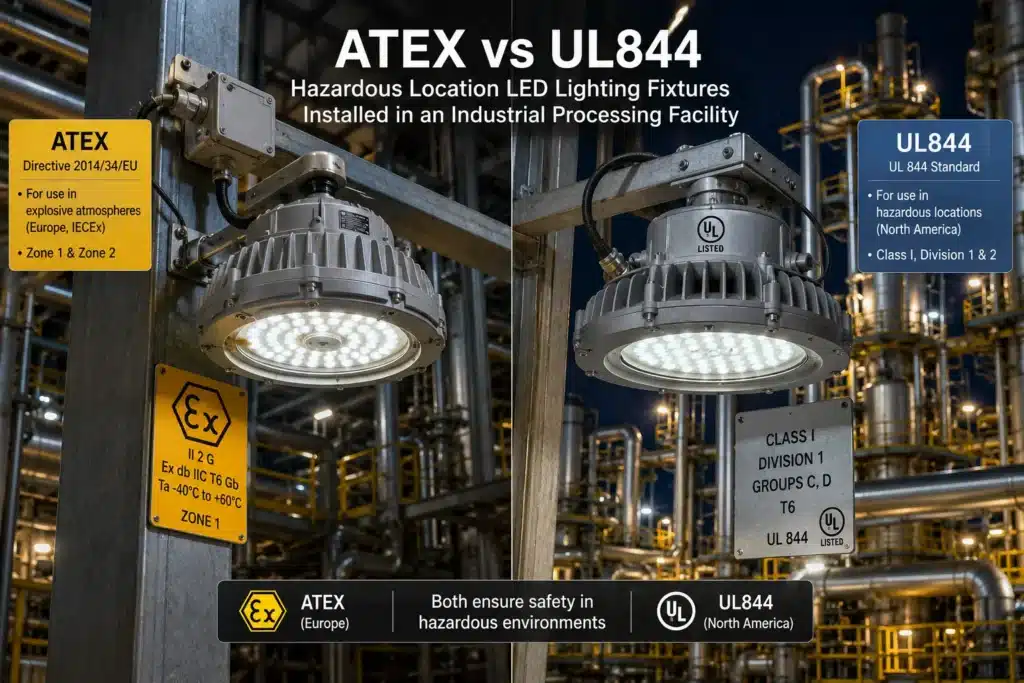
ATEX and UL844 explosion-proof lighting requirements help engineers and facility operators select properly certified LED fixtures for hazardous locations in international and North American projects.
Need Help Selecting ATEX or UL844 Hazardous-Location Lighting?
Certification requirements depend on the project location, hazardous-area classification, governing standards, and application. LED PROS can help evaluate ATEX, UL844, IECEx, Class/Division, Zone, and fixture requirements for your hazardous-location project.
👉 Explore Certified Explosion-Proof Lighting, request a quote, or call 1-844-533-7767 to discuss your certification and lighting requirements.
What Is ATEX Lighting?
ATEX lighting refers to hazardous location fixtures certified under the European Union’s ATEX directives for explosive atmospheres.
The term “ATEX” originates from the French phrase:
“ATmosphères EXplosibles”
ATEX-certified lighting is designed for environments where explosive gases, vapors, dust, or combustible particles may be present.
ATEX regulations apply throughout the European Union and many international industrial markets.
ATEX-certified fixtures are commonly used in:
- offshore oil platforms,
- petrochemical plants,
- marine facilities,
- chemical processing operations,
- grain handling facilities,
- pharmaceutical manufacturing,
- mining operations,
- industrial manufacturing plants.
What Is UL844 Lighting?
UL844 lighting refers to hazardous location fixtures certified under the UL844 standard in North America.
UL844 is widely used throughout:
- the United States,
- Canada,
- North American industrial facilities,
- oil & gas operations,
- manufacturing plants,
- fuel storage terminals,
- wastewater treatment facilities,
- chemical processing environments.
UL844 certification verifies that a lighting fixture is suitable for use in NEC-classified hazardous locations.
These fixtures are commonly rated for:
- Class I Division 1,
- Class I Division 2,
- Class II hazardous dust locations,
- Class III hazardous fiber environments.
The Primary Difference Between ATEX and UL844 Lighting
The main difference between ATEX vs UL844 lighting involves:
- geographic regulatory systems,
- classification methodology,
- certification standards,
- hazardous area terminology.
ATEX Uses the Zone Classification System
ATEX hazardous locations are classified using:
- Zone 0,
- Zone 1,
- Zone 2 for gases,
and: - Zone 20,
- Zone 21,
- Zone 22 for combustible dust.
These classifications are based on how frequently explosive atmospheres are present.
Example:
- Zone 0 = continuous hazardous exposure
- Zone 1 = likely hazardous exposure during normal operation
- Zone 2 = hazardous exposure only under abnormal conditions
UL844 Uses the NEC Class/Division System
UL844 lighting follows the NEC hazardous location classification system using:
- Class,
- Division,
- Group,
- Temperature Code.
Examples include:
- Class I Division 1,
- Class I Division 2,
- Class II Division 1,
- Class II Division 2.
These classifications are based on the type of hazardous material and the likelihood of exposure.
Match the Certification System to the Lighting Equipment
For projects requiring European or Zone-based hazardous-area approvals, review ATEX-Certified Explosion-Proof Lighting for applicable fixture options.
For North American Class I installations, review Class I Division 1 LED Lighting for locations requiring Division 1 equipment, or Class I Division 2 LED Lighting for applicable Division 2 environments.
ATEX vs UL844 Hazardous Area Comparison
ATEX Zone 0
Roughly comparable to:
-
continuous hazardous atmosphere exposure.
UL844 Class I Division 1
Hazardous gases or vapors present during normal operation.
ATEX Zone 1
Hazard likely during standard operating conditions.
UL844 Class I Division 1
Also addresses regular hazardous exposure.
ATEX Zone 2
Hazardous atmosphere only under abnormal conditions.
UL844 Class I Division 2
Similar lower-probability hazardous classification.
Facilities operating globally should review Flameproof vs Explosion Proof Lighting to understand how certification systems differ between ATEX, IECEx, and UL844 environments.
Fixture Markings and Certifications
ATEX Fixture Markings
ATEX-certified fixtures include detailed labeling such as:
-
Ex ratings,
-
equipment category,
-
gas group,
-
temperature class,
-
protection method,
-
zone approval.
Example markings may include:
-
Ex d
-
Ex e
-
Ex nR
-
Ex tb
These identify the type of explosion protection used within the fixture.
Facilities evaluating compliance requirements should read Understanding Explosion Proof Lighting Standards to understand how NEC, UL844, ATEX, and IECEx standards work together.
UL844 Fixture Markings
UL844 fixtures typically display:
-
Class,
-
Division,
-
Group,
-
T-Code,
-
UL listing information.
Examples:
-
Class I Division 1 Groups C & D
-
Class I Division 2
-
T4 temperature rating
These markings identify where the fixture may safely operate under NEC standards.
Before purchasing explosion proof fixtures, learn how certification systems differ by reading UL844, IECEx, and ATEX Certifications Explained to ensure the selected product meets project requirements.
Common Hazardous Location Protection Methods
Both ATEX and UL844 fixtures use specialized protection techniques to reduce ignition risks.
Common methods include:
- explosion proof enclosures,
- flameproof housings,
- increased safety designs,
- non-incendive protection,
- dust ignition protection,
- sealed electronics,
- thermal management systems.
Typical ATEX Lighting Applications
ATEX-certified lighting is frequently used in:
- European industrial facilities,
- offshore marine environments,
- international petrochemical operations,
- pharmaceutical manufacturing plants,
- LNG facilities,
- global mining operations.
Many multinational companies require ATEX-certified fixtures for international projects.
Typical UL844 Lighting Applications
UL844-certified fixtures are commonly installed in:
- North American refineries,
- ethanol plants,
- chemical facilities,
- wastewater treatment plants,
- aircraft fueling stations,
- industrial processing plants,
- grain facilities,
- fuel storage terminals.
LED Technology in Hazardous Location Lighting
Modern ATEX and UL844 fixtures increasingly use LED technology due to its performance advantages in industrial environments.
Energy Efficiency
LED fixtures reduce power consumption while maintaining high lumen output.
Reduced Maintenance
Long operating life minimizes maintenance requirements in difficult hazardous areas.
Improved Durability
LED fixtures resist:
- vibration,
- corrosion,
- thermal cycling,
- moisture,
- harsh industrial conditions.
Instant-On Performance
LED hazardous location fixtures provide immediate full brightness without warm-up delays.
Industrial hazardous facilities frequently use Explosion Proof High Bay Lighting fixtures for elevated mounting applications requiring reliable hazardous location illumination.
For perimeter lighting and outdoor industrial applications, Hazardous Location Flood Lighting fixtures provide durable illumination in demanding hazardous environments.
International Certification Considerations
Some industrial projects require fixtures carrying:
- both ATEX and UL844 certifications,
- IECEx certification,
- marine ratings,
- regional hazardous approvals.
This is common in:
- multinational oil & gas operations,
- marine applications,
- export projects,
- offshore facilities,
- international manufacturing plants.
Dual-certified fixtures help simplify procurement for globally operated facilities.
Global oil and gas operations frequently require hazardous location fixtures carrying ATEX, IECEx, or UL844 certifications. Explore Explosion Proof Lighting for Oil & Gas environments used in refineries, offshore platforms, and fuel terminals.
Choosing Between ATEX and UL844 Lighting
The correct certification depends primarily on:
- project location,
- governing electrical code,
- facility requirements,
- customer specifications,
- engineering standards,
- insurance requirements,
- environmental conditions.
ATEX Is Typically Required For:
- European Union projects,
- international hazardous environments,
- offshore global operations.
UL844 Is Commonly Required For:
- United States industrial projects,
- Canadian hazardous locations,
- NEC-regulated facilities.
Important Hazardous Location Standards
Additional hazardous location standards often associated with ATEX and UL844 lighting include:
- NEC Article 500,
- NEC Article 505,
- IECEx,
- CSA,
- NEMA ratings,
- IP ratings,
- UL1598,
- UL1598A.
Facilities may require multiple certifications depending on operational risks and geographic location.
Common Fixture Types Available in ATEX and UL844 Ratings
Hazardous location fixture categories include:
- Explosion-Proof High Bay Lighting,
- Explosion-Proof Flood Lighting,
- Explosion-Proof Vapor-Tight Lighting,
- Explosion-Proof Linear Lighting,
- wall packs,
- Explosion-Proof Emergency Lighting,
- portable hazardous work lights,
- Explosion-Proof Area Lighting.
Many manufacturers offer equivalent fixture families with both ATEX and UL844 certification options.
Inline Buyer Q&A
What is the most important difference between ATEX and UL 844 when specifying hazardous-location lighting?
They belong to different regulatory and conformity frameworks.
ATEX applies to equipment intended for potentially explosive atmospheres within the European Union and uses Zone-based hazardous-area concepts.
UL 844 is a North American product standard covering luminaires for use in hazardous classified locations.
The appropriate requirement depends on where the equipment will be installed, the area’s classification, applicable regulations, project specifications, and the authority having jurisdiction.
Can I specify an ATEX fixture for a North American project?
Not automatically.
ATEX marking does not by itself establish that a fixture satisfies the product-certification and installation requirements applicable to a U.S. or Canadian project.
Verify the required listing or certification, hazardous-location markings, electrical code requirements, and acceptance by the authority having jurisdiction before specifying the equipment.
Can a UL 844-listed or certified fixture automatically be used on a European project?
Not automatically.
European projects subject to ATEX requirements must use equipment meeting the applicable regulatory and conformity requirements for the installation.
Compliance with a North American product standard should not be assumed to satisfy ATEX requirements.
Can one fixture carry approvals for multiple hazardous-location systems?
Yes.
Some luminaires are available with certifications or markings addressing multiple hazardous-location frameworks.
However, do not assume that every configuration of a fixture family carries every approval. Verify the markings and certification documentation for the exact product being specified.
What information should I provide when requesting ATEX or North American hazardous-location lighting?
Useful information includes:
- Country and installation location
- Applicable regulatory or certification framework
- Class/Division or Zone classification
- Gas, vapor, or dust group
- Temperature classification
- Equipment protection requirements, where applicable
- Ambient-temperature range
- Fixture type
- Mounting
- Voltage and electrical requirements
- Environmental exposure
- Project specifications
- Required certification or listing
Providing the actual hazardous-area documentation is preferable to selecting equipment solely by the terms “ATEX” or “UL 844.”
Specify the Correct Certification for Your Hazardous-Location Project
ATEX, UL844, and IECEx requirements should be established before hazardous-location lighting equipment is specified. Project location, classification system, gas or dust group, temperature requirements, fixture type, environmental conditions, and required certifications can all affect product selection.
Send us your available project requirements and we’ll help identify hazardous-location LED fixture options that match the applicable certification framework and lighting application.
Request a Quote or call 1-844-533-7767 for certification and product-selection assistance.
Frequently Asked Questions About ATEX vs UL844 Lighting
What is the difference between ATEX and UL 844 lighting?
ATEX and UL 844 address hazardous-area equipment within different systems.
ATEX refers to European Union requirements governing equipment intended for use in potentially explosive atmospheres.
UL 844 is a North American product standard covering luminaires for use in hazardous classified locations.
They should not be described as two directly equivalent certifications.
What does ATEX stand for?
ATEX derives from the French term atmosphères explosibles.
The term is commonly used for European Union requirements addressing equipment and protective systems intended for use in potentially explosive atmospheres.
ATEX equipment markings communicate important information about the environments and conditions for which equipment is intended.
What is UL 844?
UL 844 is a product standard covering luminaires for use in hazardous classified locations.
A luminaire can be evaluated by an appropriate certification organization to applicable UL 844 requirements and carry markings identifying the hazardous locations for which it has been evaluated.
UL 844 itself is a standard rather than a certification body or regulatory code.
Is UL 844 the same as the NEC?
No.
UL 844 is a product standard addressing hazardous-location luminaires.
The National Electrical Code addresses electrical installations in the United States, including hazardous classified locations.
Product evaluation and installation requirements are related but distinct parts of specifying a hazardous-location lighting system.
What is the difference between Zone and Division classifications?
The systems classify hazardous areas using different structures and terminology.
The traditional North American Class/Division system uses Classes, Divisions, and material groups.
Zone systems classify areas according to the type of hazardous atmosphere and the conditions or frequency under which that atmosphere can occur.
Zone concepts are widely used internationally, but Zone classification is not exclusive to ATEX; Zone-based hazardous-location provisions are also recognized within North American electrical frameworks.
Does North America only use Class I Division 1 and Division 2?
No.
Class/Division remains an important North American hazardous-location classification system, but North American electrical requirements also recognize Zone-based classification approaches for applicable installations.
The system used for a particular project should be determined from the project documentation and applicable electrical requirements.
Can Class I Division 1 be directly converted to ATEX Zone 1?
Do not assume a simple one-to-one conversion.
The classification systems use different terminology, equipment markings, protection concepts, and regulatory frameworks.
Equipment should be selected according to the actual classification and certification requirements of the project rather than by substituting one designation for another.
Can a fixture have both ATEX and North American hazardous-location certifications?
Yes.
Some hazardous-location luminaires carry multiple certifications or approvals intended to support projects in different markets.
The exact fixture model and configuration should be checked because certification can vary within a product family.
Where is ATEX lighting commonly required?
ATEX requirements are principally associated with installations within the European Union where equipment is intended for potentially explosive atmospheres.
ATEX-marked equipment may also appear in international specifications outside the EU, depending on the project.
Do not determine the required certification solely from the industry, such as oil and gas, mining, pharmaceutical, or petrochemical processing.
Where is UL 844 commonly encountered?
UL 844 is commonly encountered in North American hazardous-location lighting specifications for applications such as oil and gas, chemical processing, manufacturing, wastewater treatment, fuel handling, paint and coating operations, and other classified industrial environments.
The applicable product certification and markings should be verified for the specific project.
Are ATEX and IECEx the same?
No.
ATEX and IECEx are separate frameworks.
ATEX is associated with European Union regulatory requirements, while IECEx is an international conformity assessment system based on IEC standards for equipment used in explosive atmospheres.
Although there can be technical similarities, one should not automatically be substituted for the other.
Are ATEX and UL 844 fixtures always explosion proof?
No.
Hazardous-area equipment can use different protection concepts depending on the classification system, equipment type, certification, and application.
For example, the term “flameproof” has a specific meaning within IEC/ATEX protection concepts, while “explosion-proof” has specific usage within North American hazardous-location systems.
Always evaluate the actual equipment markings rather than relying on a generic description.
What does flameproof mean in ATEX or IEC hazardous-area equipment?
Flameproof protection is a defined protection concept for equipment intended for explosive gas atmospheres.
It should not simply be treated as another spelling of the North American term “explosion proof.”
The equipment’s complete marking identifies the protection concept and conditions for which it has been evaluated.
Do ATEX and UL 844 address combustible dust as well as gases and vapors?
Hazardous-area requirements can address both gas/vapor and combustible-dust environments, but the classification systems and equipment markings differ.
A fixture suitable for a particular gas or vapor environment should not automatically be assumed suitable for a combustible-dust environment.
Verify the exact markings and certification for the hazard involved.
Are IP ratings part of ATEX or UL 844 hazardous-location certification?
Ingress protection can be an important equipment characteristic, but an IP rating should not be treated as a substitute for hazardous-location certification.
The environmental protection and hazardous-area suitability of the fixture should each be verified.
Why are temperature classifications important in both systems?
Electrical equipment installed in a hazardous environment must not present an unacceptable ignition risk from surface temperature.
Temperature classifications communicate equipment temperature characteristics used when matching equipment to the hazardous material and installation conditions.
The exact markings and ambient limitations of the fixture should be reviewed.
Which is better: ATEX or UL 844?
Neither is universally “better.”
The relevant question is which regulatory framework, product certification, classification system, and equipment markings are required for the installation.
A European industrial project and a North American industrial project can require different documentation even when the lighting applications appear similar.
Stay Connected with Our Lighting Resources
Add IndustrialLightingFixtures.org as a Preferred Source on Google to see more of our lighting guides and technical resources across Google Search experiences.
Related ATEX & UL844 Lighting Solutions
-
ATEX-Certified Explosion-Proof Lighting — Explore hazardous-location LED fixtures for projects requiring ATEX approvals and Zone-based classifications.
-
LED Explosion-Proof Lighting — Review hazardous-location LED fixture options for industrial applications and classified environments.
-
Class I Division 1 LED Lighting — Explore lighting equipment for North American locations requiring Class I, Division 1 protection.
-
Class I Division 2 LED Lighting — Review LED fixture options for applicable Class I, Division 2 environments.
-
Explosion-Proof Linear Lighting — Explore linear hazardous-location fixtures for process lines, equipment areas, corridors, marine environments, and other industrial applications.