Selecting lighting for hazardous locations requires more than simply choosing an explosion proof fixture. Facility owners, engineers, contractors, and safety managers must also understand the certification systems that verify a fixture has been tested and approved for use in potentially explosive atmospheres.
Three of the most common certification systems used worldwide are UL844, IECEx, and ATEX. While all three focus on hazardous location safety, they serve different geographic markets and regulatory frameworks.
Understanding these certifications helps ensure proper fixture selection, regulatory compliance, and long-term operational safety.
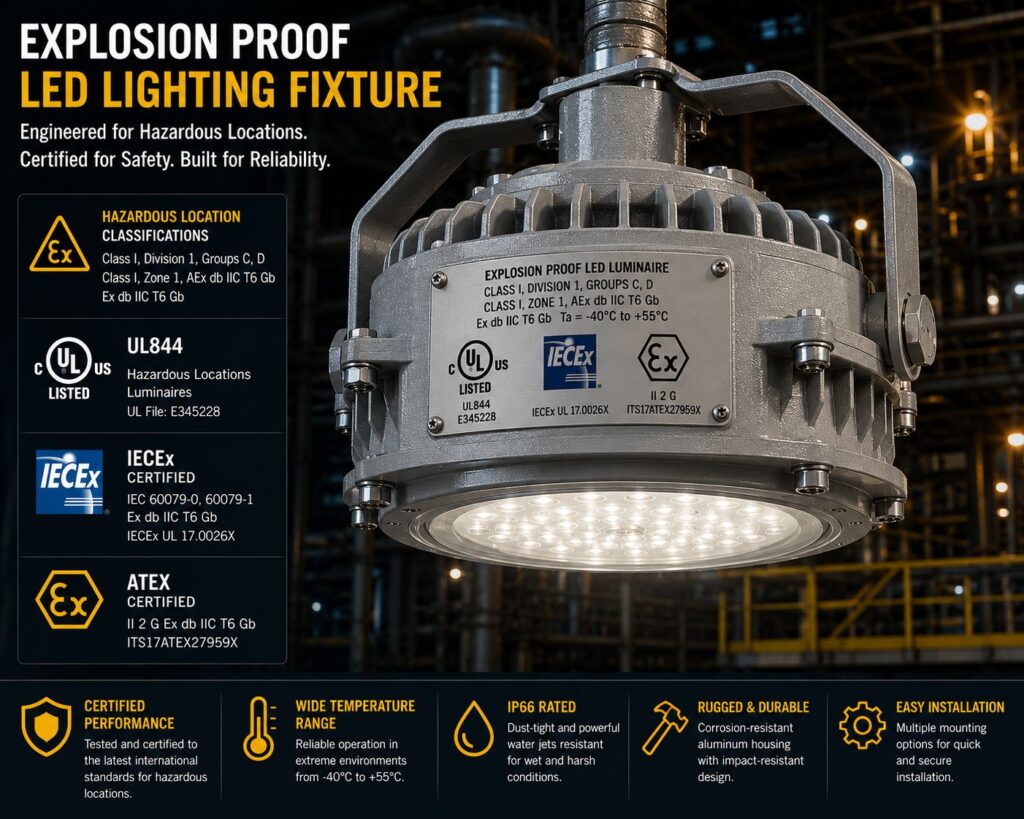
Hazardous location lighting fixtures often carry UL844, IECEx, or ATEX certifications depending on installation requirements and geographic location.
Need Help Selecting Certified Explosion-Proof Lighting?
Certification requirements vary by project location, hazardous-area classification, and governing standards. LED PROS can help you evaluate UL844, IECEx, ATEX, Class, Division, Zone, gas or dust group, temperature-code, and fixture requirements for your application.
👉 Explore Certified Explosion-Proof Lighting, request a quote, or call 1-844-533-7767 to discuss your hazardous-location lighting requirements.
Why Hazardous Location Certifications Matter
Hazardous location certifications provide independent verification that a fixture has been tested and approved for operation in potentially explosive environments.
Certification programs evaluate factors such as:
- Electrical safety
- Temperature limitations
- Flame containment
- Environmental protection
- Mechanical durability
- Hazardous atmosphere compatibility
Without proper certification, a fixture may not comply with local regulations or project specifications.
Want to verify whether a fixture is properly certified? Read How Do You Know If a Light Is Explosion Proof? to learn how to identify hazardous location markings and certification labels.
What Is UL844?
UL844 is one of the most recognized hazardous location lighting standards in North America.
The standard applies primarily to:
- United States installations
- Canada installations
- Industrial facilities
- Oil and gas operations
- Refineries
- Chemical plants
- Fuel terminals
UL844-certified fixtures are evaluated for use in Class I, Class II, and Class III hazardous locations.
When reviewing hazardous location classifications, understanding applicable certification requirements is critical. Visit UL844, IECEx, and ATEX Certifications Explained to learn how hazardous location approvals affect fixture selection.
Typical UL844 Markings
Certified fixtures often include:
- Class designation
- Division rating
- Group classification
- Temperature code
- Electrical ratings
- Certification information
These markings allow inspectors and facility personnel to verify compliance quickly.
What Is ATEX?
ATEX is the hazardous location certification framework commonly used throughout the European Union.
ATEX regulations govern equipment used in explosive atmospheres and establish safety requirements for both manufacturers and facility operators.
ATEX-certified fixtures are typically classified according to:
- Zones
- Equipment categories
- Gas groups
- Dust groups
- Temperature classes
ATEX approval is often required for facilities operating within European markets.
For a broader overview of hazardous area classifications, review our Hazardous Location Lighting Guide covering Classes, Divisions, Groups, Zones, and temperature codes.
What Is IECEx?
IECEx is an international certification system designed to simplify hazardous location compliance across multiple countries.
Many global engineering firms and multinational corporations utilize IECEx-certified products to standardize hazardous location equipment across international operations.
IECEx is commonly recognized in:
- Australia
- Asia-Pacific markets
- Middle East projects
- International energy projects
- Offshore facilities
IECEx certification promotes consistency and international acceptance.
Comparing UL844, IECEx, and ATEX
| Feature | UL844 | IECEx | ATEX |
|---|---|---|---|
| Primary Market | North America | International | European Union |
| Classification Method | Classes & Divisions | Zones | Zones |
| Oil & Gas Applications | Yes | Yes | Yes |
| Chemical Facilities | Yes | Yes | Yes |
| Offshore Installations | Common | Common | Common |
| Third-Party Certification | Yes | Yes | Yes |
All three systems focus on hazardous location safety, but project requirements often determine which certification is required.
Classes, Divisions, and Zones
One of the biggest differences between certification systems involves hazardous area classification methods.
North America
UL844 commonly uses:
- Class I
- Class II
- Class III
- Division 1
- Division 2
Examples include:
- Class I Division 1
- Class I Division 2
International Systems
ATEX and IECEx commonly use:
- Zone 0
- Zone 1
- Zone 2
- Zone 20
- Zone 21
- Zone 22
These systems classify hazards according to the frequency and duration of exposure.
Match the Classification to Certified Lighting Equipment
For North American Class I installations, the required Division directly affects fixture selection. Review Class I Division 1 LED Lighting for locations requiring Division 1 equipment, or Class I Division 2 LED Lighting for applicable Division 2 installations.
For projects using Zone classifications or requiring European approvals, review ATEX-Certified Explosion-Proof Lighting for applicable hazardous-area fixture options.
Temperature Codes and Certifications
Regardless of certification system, hazardous location fixtures are assigned temperature ratings.
Common temperature classes include:
| Temperature Code | Maximum Surface Temperature |
| T1 | 450°C |
| T2 | 300°C |
| T3 | 200°C |
| T4 | 135°C |
| T5 | 100°C |
| T6 | 85°C |
The selected fixture must maintain surface temperatures below the ignition temperature of hazardous materials present within the environment.
Common Industries Requiring Certified Fixtures
Certified explosion proof lighting is commonly used in:
- Oil and gas production
- Refineries
- Petrochemical facilities
- Chemical manufacturing
- Grain processing
- Mining operations
- Fuel storage terminals
- Wastewater treatment facilities
- Offshore platforms
Each facility must evaluate site-specific hazardous location requirements.
How to Verify Certification
Before purchasing or installing hazardous location lighting:
Review Product Labels
Verify certification markings are permanently attached.
Review Documentation
Confirm certification documents match the project requirements.
Verify Classification
Ensure the fixture matches required classes, divisions, groups, or zones.
Confirm Temperature Ratings
Verify the temperature code is appropriate for the environment.
Inline Buyer Q&A
Is UL844 accepted internationally?
UL844 is widely recognized but many international projects may require IECEx or ATEX certification.
Can one fixture carry multiple certifications?
Yes. Many manufacturers offer fixtures certified under multiple hazardous location standards.
Which certification is best?
The correct certification depends on project location, governing regulations, and customer requirements.
Do all oil and gas facilities require the same certification?
No. Requirements vary depending on geographic location and project specifications.
Certification Selection Guide
| Project Location | Common Certification |
| United States | UL844 |
| Canada | UL844 / CSA |
| European Union | ATEX |
| International Projects | IECEx |
| Offshore Facilities | IECEx and/or ATEX |
| Global Energy Companies | IECEx |
Understanding local requirements simplifies project planning and equipment selection.
Select the Right Certified Explosion-Proof Lighting for Your Project
Hazardous-location lighting must match both the electrical classification of the installation and the certification requirements governing the project. A fixture specified for a U.S. Class I Division 1 installation may require different approvals than equipment intended for a Zone 1 facility in Europe or an international IECEx project.
Send us your available project requirements—including installation country, Class/Division or Zone, gas or dust group, temperature code, fixture type, voltage, mounting, quantity, and required certifications—and we’ll help identify appropriate certified lighting options.
Request a Quote or call 1-844-533-7767 for certification and product-selection assistance.
FAQ for UL844, IECEx, and ATEX Certifications
What does UL844 certify?
UL844 certifies lighting equipment for hazardous locations in North America.
Is ATEX required in Europe?
Many European hazardous location installations require ATEX-certified equipment.
What is the purpose of IECEx?
IECEx provides an internationally recognized hazardous location certification system.
Can a fixture have both ATEX and IECEx approvals?
Yes. Many hazardous location fixtures carry multiple certifications.
Why are certifications important?
Certifications verify that fixtures have been tested and approved for safe operation in hazardous environments.
Stay Connected with Our Lighting Resources
Add IndustrialLightingFixtures.org as a Preferred Source on Google to see more of our lighting guides and technical resources across Google Search experiences.

Related Certified Explosion-Proof Lighting Solutions
Continue narrowing your hazardous-location lighting requirements by certification, classification, and fixture type:
-
LED Explosion-Proof Lighting — Explore certified hazardous-location LED fixture options for industrial applications.
-
Class I Division 1 LED Lighting — Review lighting equipment for North American installations requiring Class I, Division 1 protection.
-
Class I Division 2 LED Lighting — Explore LED fixture options for applicable Class I, Division 2 environments.
-
ATEX-Certified Explosion-Proof Lighting — Review hazardous-location LED lighting for projects requiring ATEX approvals and Zone-based classifications.
-
Explosion-Proof Linear Lighting — Explore linear hazardous-location fixtures for process lines, equipment areas, corridors, marine environments, and other industrial applications.