Why This Difference Matters
The terms fire-rated, fire-resistant, high-temperature, flameproof, and explosion-proof are often used interchangeably—even though they describe very different concepts.
Selecting the wrong lighting product can result in reduced performance, unnecessary costs, or the use of fixtures that are not appropriate for the intended application.
Understanding these distinctions helps building owners, architects, electrical engineers, contractors, and facility managers make informed lighting decisions.
Planning a broader facility lighting upgrade? Explore the Industrial Lighting Guide for recommendations on industrial LED fixtures, lighting layouts, energy efficiency, and application-specific lighting solutions.
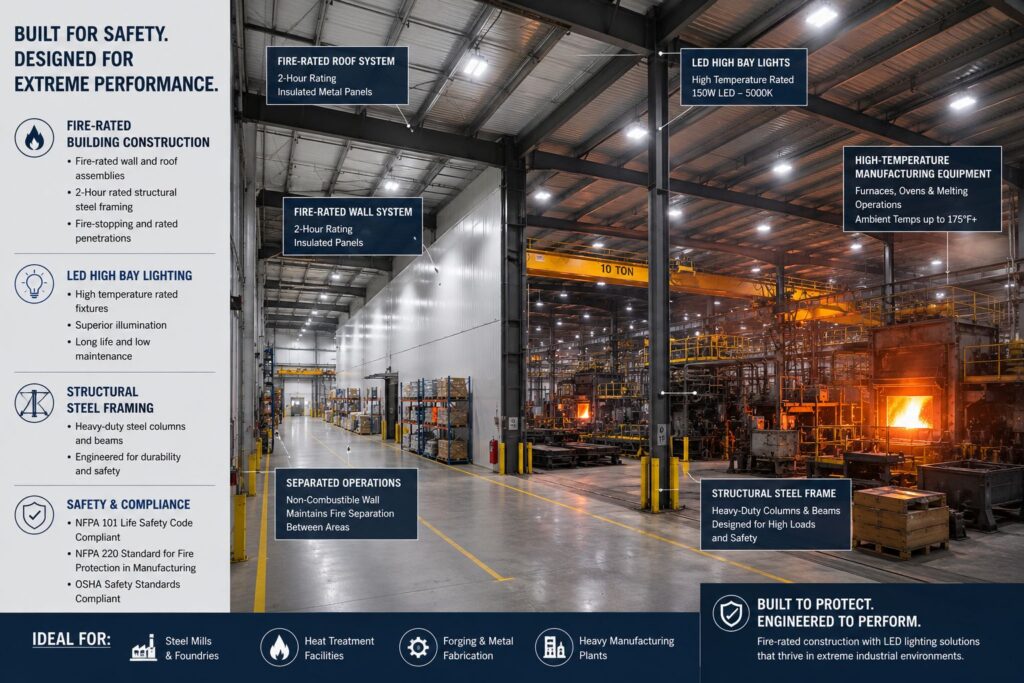
Fire-rated lighting and high-temperature lighting serve different purposes. Understanding the distinction helps architects, engineers, contractors, and facility managers select lighting solutions appropriate for their building design and operating environment.
Not sure whether your project requires fire-rated lighting, high-temperature fixtures, or another specialized lighting solution?
Our lighting specialists can help you select commercial and industrial LED lighting based on your facility, operating environment, and application requirements.
Request a Free Lighting Consultation – – https://industriallightingfixtures.org/
What Is Fire-Rated Lighting?
Fire-rated lighting generally refers to lighting installed within or penetrating fire-resistance-rated walls or ceiling assemblies. The objective is to help preserve the fire-resistance performance of the building assembly rather than simply allowing the fixture to withstand high temperatures.
Fire-rated lighting considerations commonly apply to:
- Fire-rated ceilings
- Fire-rated walls
- Stairwells
- Exit corridors
- Hospitals
- Schools
- Hotels
- Multifamily buildings
- Commercial office buildings
Depending on the project, fire-rated assemblies may require specific fixture types, housings, covers, or installation methods designed to maintain the integrity of the rated construction.
Comparing hazardous location terminology? Visit What Is the Difference Between Flameproof and Explosion Proof? to understand how international flameproof equipment differs from explosion-proof lighting used in North America.
What Is High-Temperature Lighting?
High-temperature lighting is designed for industrial environments where elevated ambient temperatures can shorten the operating life of conventional lighting fixtures.
Rather than focusing on building fire resistance, these fixtures are engineered to withstand continuous exposure to higher operating temperatures commonly found above industrial processes.
Typical applications include:
- Steel manufacturing
- Foundries
- Glass production
- Cement plants
- Paper mills
- Boiler rooms
- Heat treatment facilities
- Power generation
- Industrial processing plants
These fixtures often incorporate enhanced thermal management, heat-resistant electronic components, and industrial-grade construction.
Explore our complete selection of LED High Temperature High Bay Lighting to compare commercial-grade fixtures engineered for demanding industrial applications.
Fire-Rated vs. High-Temperature Lighting
Although the names sound similar, these lighting systems solve completely different problems.
| Fire-Rated Lighting | High-Temperature Lighting |
|---|---|
| Protects the integrity of fire-rated building assemblies | Operates reliably in elevated ambient temperatures |
| Commonly used in commercial buildings | Commonly used in industrial facilities |
| Focuses on building compartmentation | Focuses on thermal performance |
| Supports fire-resistance design | Supports reliable operation in hot environments |
| Often associated with rated ceilings and walls | Often installed above furnaces, boilers, and industrial equipment |
Industrial facilities often expose lighting systems to elevated temperatures, dust, vibration, moisture, and continuous operation. Industrial Lighting for Extreme Temperature Environments explains how these environmental conditions influence fixture selection and long-term performance.
Common Misconceptions
Several misconceptions frequently cause confusion during lighting specification.
Fire-Rated Does Not Mean High-Temperature
A fixture installed in a fire-rated ceiling is not automatically designed for continuous operation in elevated industrial temperatures.
High-Temperature Does Not Mean Explosion-Proof
High-temperature fixtures are engineered to tolerate heat, while explosion-proof fixtures are designed for hazardous locations where combustible gases, vapors, or dust may be present.
Explosion-Proof Does Not Mean Fire-Rated
Explosion-proof lighting protects against ignition hazards within classified industrial environments. It does not indicate that a fixture maintains the fire resistance of a building assembly.
Flameproof Is Not the Same as Fire-Rated
Flameproof is an international hazardous-location classification describing equipment that contains an internal explosion. It should not be confused with fire-rated building construction.
Where Fire-Rated Lighting Is Used
Fire-rated lighting is commonly found in buildings where maintaining the fire resistance of structural assemblies is important.
Typical applications include:
- Hospitals
- Healthcare facilities
- Schools
- Universities
- Hotels
- Apartment buildings
- Office buildings
- Stairwells
- Exit corridors
- Fire-rated ceiling assemblies
Where High-Temperature Lighting Is Used
High-temperature lighting is selected for industrial facilities where excessive heat is generated during manufacturing or processing operations.
Examples include:
- Steel mills
- Glass manufacturing
- Foundries
- Paper mills
- Boiler rooms
- Cement production
- Industrial ovens
- Heat treatment facilities
- Power plants
Choosing the Right Lighting
The correct lighting solution depends on the operating environment rather than the terminology.
| Facility or Environment | Recommended Lighting |
| Fire-rated corridor | Fire-rated lighting system or approved assembly |
| Steel mill | High-temperature LED lighting |
| Foundry | High-temperature high bays |
| Boiler room | High-temperature industrial lighting |
| Hazardous chemical plant | Explosion-proof lighting |
| Pharmaceutical manufacturing | Application-specific industrial lighting |
| Commercial warehouse | Standard LED high bays unless elevated temperatures require specialized fixtures |
Looking for fixtures designed for elevated ambient temperatures? Visit the High Temperature High Bay Lighting Guide to learn how to select LED lighting for steel mills, foundries, boiler rooms, and other high-heat industrial environments.
Questions to Ask Before Specifying Lighting
Before selecting lighting, consider:
- Is the building constructed with fire-rated ceiling or wall assemblies?
- Will the fixture operate in elevated ambient temperatures?
- Is the environment classified as hazardous?
- What is the expected operating temperature?
- What maintenance access is available?
- Are specialized fixture ratings required?
- Does the application require sanitary, moisture-resistant, or hazardous-location lighting?
Answering these questions helps narrow the appropriate lighting solution before selecting specific products.
Inline Buyer Q&A
Is fire-rated lighting the same as high-temperature lighting?
No. Fire-rated lighting is associated with maintaining the integrity of fire-resistance-rated building assemblies, while high-temperature lighting is engineered to operate reliably in industrial environments with elevated ambient temperatures.
Do steel mills require fire-rated lighting?
Most steel mills are primarily concerned with lighting fixtures designed for elevated ambient temperatures. Specific areas within a facility may have fire-resistance requirements depending on the building design, but the two concepts should not be confused.
Is explosion-proof lighting considered fire-rated?
No. Explosion-proof lighting is intended for hazardous locations where combustible gases, vapors, or dust may be present. It serves a different purpose than lighting associated with fire-rated building assemblies.
Choose the Right Lighting for Your Industrial or Commercial Application
Understanding the differences between fire-rated lighting, high-temperature lighting, explosion-proof lighting, and flameproof equipment helps ensure the correct solution is selected for each project. While these terms are sometimes used interchangeably, each serves a distinct purpose based on building construction, environmental conditions, and operational requirements.
Whether you’re specifying lighting for a commercial building, steel mill, manufacturing facility, power plant, or hazardous industrial location, selecting the appropriate lighting system improves safety, reliability, code compliance, and long-term performance.
👉 Explore our complete selection of LED High Temperature High Bay Lighting for elevated ambient temperature environments, or browse our industrial lighting solutions to find fixtures designed for specialized commercial and industrial applications. Our lighting specialists are available to help you choose the right solution for your project.
Frequently Asked Questions
When should high-temperature lighting be specified?
High-temperature lighting is recommended when fixture operating temperatures exceed the ratings of standard commercial LED lighting, such as above furnaces, boilers, kilns, ovens, foundries, or other industrial heat sources.
Can high-temperature fixtures be installed in commercial buildings?
Yes. If the operating environment requires them, high-temperature fixtures can be used in commercial or industrial facilities. Their selection depends on ambient operating conditions rather than building occupancy.
Does every fire-rated ceiling require specialized lighting?
Lighting installed in fire-resistance-rated assemblies should be evaluated as part of the overall building design. The appropriate solution depends on the ceiling assembly, applicable codes, and the lighting installation method.
How do I know which lighting solution my project requires?
Evaluate the building construction, operating environment, ambient temperature, maintenance requirements, and whether the location is classified as hazardous. A lighting specialist can help identify the most appropriate fixture for the application.
Stay Connected with Our Lighting Resources
Add IndustrialLightingFixtures.org as a Preferred Source on Google to see more of our lighting guides and technical resources across Google Search experiences.
