
Proper illumination is one of the most important factors affecting the effectiveness of an outdoor advertising display. A billboard that is too dim may be difficult to read at night, while excessive brightness can create glare, light trespass, and potential compliance issues. Billboard lighting foot candle requirements help establish illumination targets that provide clear visibility while maintaining safe and responsible lighting practices.
Modern LED billboard lighting systems allow designers to achieve consistent illumination levels across the sign face while reducing energy consumption and improving optical control. Understanding foot candles, illumination uniformity, and fixture placement helps billboard owners, sign companies, advertisers, and municipalities develop effective lighting solutions for a wide range of billboard applications.
What Is a Foot Candle?
A foot candle (fc) is a unit of illuminance that measures the amount of light reaching a surface.
One foot candle equals:
- One lumen distributed over one square foot
- Approximately 10.76 lux
Foot candles are commonly used in North America to evaluate lighting performance in commercial, industrial, and outdoor environments.
For billboard lighting, foot candles measure how much light reaches the advertising face rather than how much light is produced by the fixture.
Why Foot Candle Levels Matter for Billboards
Proper illumination levels help ensure that billboard graphics, text, and advertising messages remain visible and readable after dark.
Benefits of appropriate foot candle levels include:
- Improved visibility
- Better advertising effectiveness
- Enhanced readability
- Reduced glare
- Improved lighting uniformity
- Regulatory compliance
- Reduced light pollution
The goal is to provide sufficient illumination without over-lighting the billboard.
Billboard Lighting vs Fixture Lumens
A common mistake is assuming higher lumen output automatically results in better billboard illumination.
Several factors influence actual foot candle levels on the sign face:
- Fixture mounting height
- Extension arm distance
- Beam angle
- Billboard dimensions
- Fixture spacing
- Aiming angle
- Environmental conditions
Two fixtures with identical lumen output may produce significantly different foot candle readings depending on placement and optical design.
Before selecting illumination levels, review our Billboard Lighting Requirements guide for overall billboard lighting design considerations.
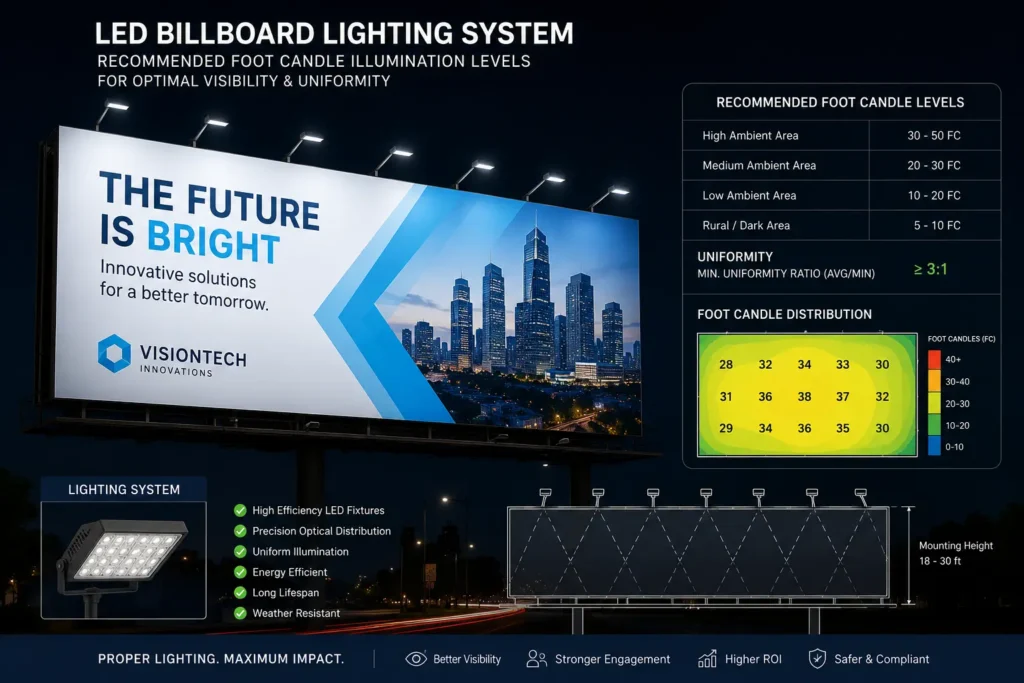
Typical Billboard Illumination Recommendations
Specific requirements vary by municipality, property owner, and advertising company.
However, many billboard lighting systems are designed to achieve average illumination levels within ranges similar to the following:
| Billboard Type | Typical Average Foot Candles |
|---|---|
| Small Commercial Signs | 10-20 fc |
| Urban Advertising Billboards | 15-30 fc |
| Highway Billboards | 20-40 fc |
| Premium Advertising Displays | 30-50 fc |
| Specialty Advertising Installations | Project Specific |
Actual design criteria should always comply with local requirements and project objectives.
Uniformity Is Often More Important Than Brightness
Many lighting professionals consider illumination uniformity more important than achieving extremely high foot candle values.
A billboard with:
- Consistent 20 fc illumination
is generally more effective than a billboard with:
- 50 fc hot spots
- 5 fc dark areas
Uneven lighting can reduce readability and create an unprofessional appearance.
Comparing LED vs metal halide billboard lighting helps explain why modern LED fixtures often achieve better illumination uniformity and foot candle performance.
Understanding Uniformity Ratios
Uniformity ratio compares the brightest and darkest areas of the billboard face.
Lower ratios generally indicate more consistent illumination.
Benefits include:
- Improved visual appearance
- Better readability
- Reduced shadows
- Enhanced advertising presentation
Proper fixture spacing and beam selection are essential for achieving acceptable uniformity.
Fixture placement has a major impact on illumination performance. Learn more in our Billboard Lighting Mounting Heights guide.
Factors Affecting Billboard Foot Candle Levels
Billboard Size
Larger signs require more total illumination.
For example:
Standard Bulletin Billboard
Typical dimensions:
- 14 feet high
- 48 feet wide
- 672 square feet
This size often requires multiple fixtures positioned strategically across the top of the sign.
Mounting Height
Fixture mounting height influences:
- Beam spread
- Light distribution
- Uniformity
- Average foot candle levels
Improper mounting height can create excessive brightness near the top of the billboard while reducing illumination lower on the sign face.
Extension Arm Distance
Extension arms position fixtures away from the billboard face.
Benefits include:
- Improved beam overlap
- Reduced hot spots
- Better vertical coverage
- Enhanced illumination uniformity
Most billboard lighting systems achieve better results when fixtures are mounted several feet away from the sign face rather than directly against it.
Beam Angle Selection
The optical distribution of the fixture significantly affects foot candle performance.
Narrow Beam
Best for:
- Long throw distances
- Tall billboard structures
Medium Beam
Suitable for:
- Most standard billboard applications
Wide Beam
Often used for:
- Smaller signs
- Shorter setbacks
- Broad coverage requirements
Foot Candle Considerations for Highway Billboards
Highway billboards often require greater visibility due to:
- Higher vehicle speeds
- Longer viewing distances
- Reduced viewing time
Lighting systems commonly focus on:
- Uniform coverage
- Reduced glare
- Effective contrast
- Long-range readability
The objective is to make the advertising message visible without creating distractions for motorists.
For remote locations, explore our Solar Billboard Lighting solutions for off-grid operation.
Foot Candle Considerations for Urban Billboards
Urban environments typically contain higher levels of ambient lighting.
Design considerations may include:
- Building lighting
- Street lighting
- Parking lot lighting
- Architectural lighting
- Local brightness restrictions
In many urban settings, balancing visibility with light pollution concerns becomes a primary design objective.
LED Billboard Lighting and Photometric Design
Modern LED fixtures offer significant advantages when designing for specific foot candle targets.
Benefits include:
Improved Optical Control
LED optics direct light precisely onto the billboard face.
Better Uniformity
Advanced beam distributions improve coverage consistency.
Reduced Light Spill
Less wasted light improves efficiency and compliance.
Flexible Fixture Selection
Designers can choose from multiple wattages and optical configurations to achieve project-specific illumination goals.
If you are upgrading an existing billboard, our LED Billboard Retrofit Guide explains how modern LED systems can improve illumination quality.
Avoiding Over-Lighting
Excessive illumination can create several problems.
Potential issues include:
- Increased energy consumption
- Driver discomfort
- Regulatory concerns
- Light trespass complaints
- Reduced visual comfort
The best billboard lighting systems provide the appropriate amount of light—not simply the highest possible brightness.
Advanced LED optics help achieve billboard foot candle requirements while minimizing energy consumption.
Common Billboard Lighting Design Targets
Successful billboard lighting projects typically focus on:
- Average foot candle levels
- Uniform illumination
- Minimal glare
- Efficient fixture placement
- Long-term reliability
- Regulatory compliance
A photometric analysis is often recommended for larger billboard projects to verify lighting performance before installation.
Many billboard lighting systems utilize commercial-grade LED flood lighting fixtures designed for precise optical control and uniform coverage.
Inline Buyer Q&A
What foot candle level should a billboard have?
Many billboard installations are designed within a range of approximately 10 to 40 average foot candles, depending on location, visibility requirements, and local regulations.
Are higher foot candle levels always better?
No. Excessive illumination can create glare, increase energy consumption, and potentially violate local lighting ordinances.
What affects billboard foot candle readings?
Fixture wattage, beam angle, mounting height, extension arm distance, spacing, and billboard dimensions all influence illumination levels.
Why is uniformity important?
Uniform illumination improves readability and creates a more professional appearance across the entire billboard face.
Can LED fixtures improve billboard illumination?
Yes. Modern LED optics provide improved light control, better uniformity, and reduced energy consumption compared to many legacy lighting systems.
Turn Billboard Illumination Requirements into the Right Fixture Layout
Determining a target illumination level is only the beginning. The billboard lighting system still needs to deliver that light across the advertising face with appropriate uniformity while controlling glare and unnecessary spill light.
Billboard dimensions, fixture output, optical distribution, mounting position, extension-arm setback, spacing, and aiming all affect the illumination that actually reaches the sign.
Our lighting specialists can help evaluate:
- Billboard dimensions and sign-face geometry
- Target illumination requirements
- Fixture output and optical distribution
- Fixture quantity and spacing
- Top- or bottom-mounted configurations
- Mounting-arm setback
- Fixture aiming
- Illumination uniformity
- Glare and spill-light control
- Existing HID-to-LED conversions
- New and retrofit billboard lighting projects
Explore our LED Billboard Lights for commercial outdoor advertising and large-format sign applications.
For project assistance, have your billboard dimensions, photographs, mounting configuration, fixture setback, voltage, existing fixture information, and any project-specific illumination requirements available when possible.
Call 1-844-533-7767 to discuss your billboard lighting layout and fixture requirements.
Frequently Asked Questions About Billboard Foot Candle Levels
What is a foot candle?
A foot candle measures the amount of light reaching a surface and is commonly used to evaluate billboard illumination levels.
How many foot candles does a billboard need?
Requirements vary, but many billboard installations target average illumination levels between 10 and 40 foot candles.
Does billboard size affect foot candle requirements?
Yes. Larger signs generally require additional lighting to maintain consistent illumination across the entire sign face.
Can LED fixtures reduce glare?
Yes. Properly designed LED optics can improve illumination control and reduce unwanted glare.
Should billboard lighting be photometrically analyzed?
For larger projects and premium advertising installations, photometric analysis is often recommended to verify performance before installation.
Stay Connected with Our Lighting Resources
Add IndustrialLightingFixtures.org as a Preferred Source on Google to see more of our lighting guides and technical resources across Google Search experiences.
Related Billboard Lighting Resources
- LED Billboard Lights — Explore commercial LED billboard fixtures and the output, optics, mounting, and layout considerations that determine how effectively light reaches the advertising face.
- Billboard Lighting Requirements — Review the broader requirements affecting billboard illumination, including uniformity, glare, light spill, controls, fixture placement, and local regulations.
- Billboard Lighting Mounting Heights & Fixture Placement — Learn how fixture location, mounting position, extension-arm setback, spacing, beam distribution, and aiming influence illumination across the sign face.
- LED Billboard Retrofit Guide — Review the considerations involved in replacing existing metal halide and other legacy billboard lighting with LED fixtures while maintaining appropriate coverage.
- LED vs. Metal Halide Billboard Lighting — Compare LED and metal halide billboard systems in terms of wattage, optical control, operating characteristics, maintenance, and retrofit considerations.
- Billboard Lighting Energy Savings — Learn how existing wattage, replacement wattage, fixture quantity, operating hours, controls, and lighting requirements influence potential energy savings from an LED upgrade.