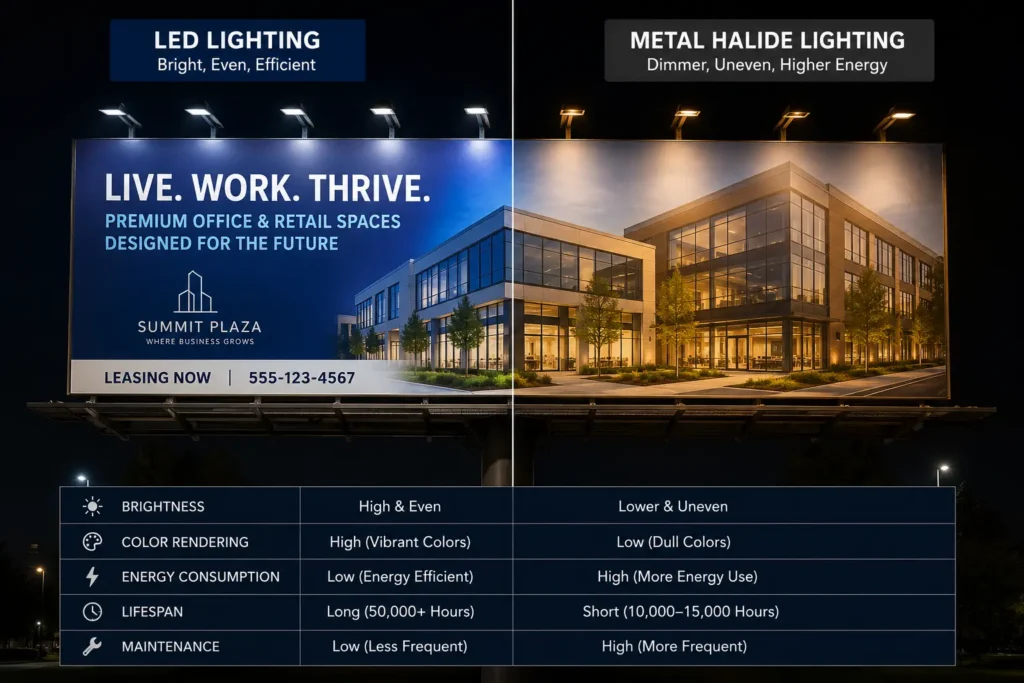
For decades, metal halide lighting served as the primary technology for illuminating outdoor billboards. The high light output of metal halide fixtures made them a popular choice for highway advertising signs, commercial displays, and large-format outdoor signage. However, advances in LED technology have transformed the billboard lighting industry, offering significant improvements in efficiency, reliability, and lighting performance.
Today, many billboard owners are evaluating whether to continue maintaining aging metal halide systems or upgrade to modern LED billboard lighting. Understanding the differences between these technologies can help determine which solution delivers the best long-term value.
This guide compares LED and metal halide billboard lighting across key performance categories including illumination quality, operating costs, maintenance requirements, lifespan, and return on investment.
Understanding Metal Halide Billboard Lighting
Metal halide fixtures are a type of high-intensity discharge (HID) lighting technology.
A typical metal halide billboard lighting system includes:
- HID lamp
- Ballast
- Reflector assembly
- Fixture housing
- Mounting hardware
For many years, metal halide fixtures were commonly installed on:
- Highway billboards
- Outdoor advertising signs
- Commercial signage
- Sports facilities
- Large outdoor displays
Although capable of producing substantial light output, these systems have several limitations compared to modern LED technology.
Proper illumination design remains critical regardless of fixture type. Visit our Billboard Lighting Foot Candle Requirements guide to learn more.
Understanding LED Billboard Lighting
LED billboard lighting uses light-emitting diodes as the primary light source.
Unlike metal halide fixtures, LED systems typically include:
- LED light engine
- Optical lens system
- Driver electronics
- Thermal management components
- Precision optics
Modern LED fixtures are specifically engineered to provide controlled illumination across billboard faces while minimizing wasted light and glare.
Energy Consumption Comparison
One of the most significant differences between LED and metal halide technology is energy efficiency.
Metal Halide Systems
Metal halide fixtures often require:
- Higher wattage lamps
- Ballast power consumption
- Additional energy losses
Actual power usage is frequently greater than the lamp’s rated wattage due to ballast inefficiencies.
One of the primary advantages discussed in LED vs metal halide billboard lighting comparisons is the substantial energy savings achieved through modern LED technology.
LED Systems
LED fixtures convert a greater percentage of electrical energy into usable light.
Benefits include:
- Lower operating wattage
- Reduced electrical demand
- Improved optical efficiency
- Lower utility costs
Many billboard retrofit projects reduce total energy consumption substantially after converting from metal halide to LED lighting.
Illumination Quality Comparison
Brightness alone does not determine billboard lighting performance.
The quality and distribution of light are equally important.
Metal Halide Light Distribution
Traditional metal halide fixtures often rely on reflectors to direct light.
Common challenges include:
- Uneven coverage
- Reduced optical control
- Light spill
- Hot spots
- Shadowing
Over time, reflector performance may decline due to aging and contamination.
LED Optical Performance
LED fixtures utilize advanced optics designed specifically for billboard illumination.
Advantages include:
- Improved beam control
- Better uniformity
- Reduced glare
- More consistent coverage
- Improved visual appearance
This often results in better readability and advertising effectiveness.
Fixture Lifespan Comparison
Fixture longevity has a direct impact on maintenance costs and operational reliability.
Metal Halide Lifespan
Metal halide lamps typically require periodic replacement.
Common issues include:
- Lamp degradation
- Reduced light output
- Color shift
- Ballast failures
Even before complete failure occurs, light levels often decline significantly.
LED Lifespan
Commercial-grade LED billboard fixtures commonly provide:
- Long operating life
- Stable light output
- Reduced maintenance frequency
- Improved reliability
Many LED systems are rated for 50,000 to 100,000 operating hours.
Maintenance Requirements
Maintenance costs are often overlooked when evaluating lighting systems.
Metal Halide Maintenance
Typical maintenance activities include:
- Lamp replacement
- Ballast replacement
- Fixture servicing
- Troubleshooting electrical failures
- Bucket truck service visits
For elevated highway billboards, these activities can become expensive.
LED Maintenance
LED systems generally require:
- Periodic inspection
- Lens cleaning
- Electrical connection checks
The reduction in service frequency can significantly lower long-term operating expenses.
Startup and Restart Performance
Another important difference involves operating behavior.
Metal Halide Warm-Up Time
Metal halide fixtures typically require several minutes to reach full brightness.
Following a power interruption:
- Lamps may extinguish
- Cooling periods may be required
- Restart delays can occur
LED Instant-On Operation
LED fixtures provide:
- Immediate illumination
- Full brightness instantly
- No restrike delay
- Improved operational reliability
This is especially beneficial in locations subject to electrical disturbances
Color Rendering and Advertisement Visibility
Billboards are designed to communicate messages visually.
Color quality directly impacts advertising effectiveness.
Metal Halide Color Performance
Metal halide lamps generally provide acceptable color rendering when new.
However:
- Performance degrades over time
- Color shift occurs
- Visual consistency declines
LED Color Performance
LED fixtures maintain:
- Stable color quality
- Improved color rendering
- Consistent visual appearance
This helps preserve advertising graphics and branding.
Glare and Light Pollution
Lighting control is becoming increasingly important due to evolving regulations.
Metal Halide Systems
Older fixtures often generate:
- Excessive spill light
- Poor beam control
- Increased glare potential
LED Systems
Modern optics help:
- Direct light onto the billboard face
- Reduce wasted illumination
- Improve dark-sky compatibility
- Minimize neighboring property impacts
For off-grid advertising applications, explore our Solar Billboard Lighting solutions.
Operating Cost Comparison
When evaluating total ownership costs, energy consumption and maintenance expenses must both be considered.
| Category | Metal Halide | LED |
|---|---|---|
| Energy Usage | Higher | Lower |
| Lamp Replacements | Frequent | Rare |
| Ballast Maintenance | Required | Not Required |
| Warm-Up Time | Yes | No |
| Optical Control | Limited | Excellent |
| Light Uniformity | Moderate | High |
| Operating Costs | Higher | Lower |
| Lifespan | Shorter | Longer |
For many billboard owners, operating cost reductions become one of the primary drivers behind LED conversions.
Retrofit Opportunities
Many existing billboard structures can be upgraded without replacing the sign itself.
Typical retrofit projects include:
- Fixture replacement
- Mounting upgrades
- Extension arm improvements
- Control upgrades
- Photocell integration
- LED conversion
These projects often improve both lighting performance and operating efficiency.
If you are planning an upgrade project, review our LED Billboard Retrofit Guide for fixture replacement and modernization strategies
When Metal Halide May Still Be Operating
Although LED technology dominates new installations, some existing billboards continue to utilize metal halide systems because:
- Fixtures remain operational
- Capital budgets are limited
- Replacement projects have been delayed
However, aging equipment often results in increasing maintenance costs and declining lighting quality.
Why Most New Billboard Projects Use LED
Today’s billboard lighting projects overwhelmingly specify LED technology because of:
- Lower energy consumption
- Better illumination quality
- Longer service life
- Reduced maintenance
- Improved optical control
- Better compliance with modern lighting requirements
For most new installations, LED has become the preferred solution.
For a complete overview of billboard illumination solutions, visit our LED Billboard Lighting page.
Inline Buyer Q&A
Is LED billboard lighting brighter than metal halide?
LED fixtures can provide equal or greater effective illumination while often consuming less power and delivering better light distribution.
How much maintenance does metal halide require?
Metal halide systems require periodic lamp and ballast replacement, particularly in older installations.
Can existing metal halide billboards be converted to LED?
Yes. Many billboard structures can be retrofitted with LED lighting fixtures and updated controls.
Why are billboard owners switching to LED?
Common reasons include energy savings, reduced maintenance, improved visibility, and longer fixture lifespan.
Does LED lighting reduce glare?
Modern LED optics generally provide better beam control and can significantly reduce unwanted glare.
Replace Aging Metal Halide Billboard Lighting with the Right LED System
Converting a billboard from metal halide to LED is an opportunity to reduce lighting wattage while improving how effectively the available light is directed across the advertising face.
But a successful conversion requires more than matching the old fixture wattage. Billboard dimensions, existing fixture locations, mounting-arm setback, beam distribution, aiming, voltage, operating hours, and desired illumination should all be considered before selecting replacement fixtures.
Our lighting specialists can help evaluate:
- Metal halide-to-LED billboard conversions
- Existing and proposed fixture wattage
- Billboard dimensions
- Fixture quantity and spacing
- Mounting-arm setback
- Beam distribution and aiming
- Illumination uniformity
- Existing mounting hardware
- Controls and operating hours
- New and retrofit billboard lighting projects
Explore our LED Billboard Lights for commercial outdoor advertising and large-format sign applications.
For retrofit projects, have your billboard dimensions, photographs, existing fixture wattage and quantity, mounting-arm dimensions, voltage, and operating hours available when possible.
Call 1-844-533-7767 to discuss replacing your metal halide billboard lighting with LED.
Frequently Asked Questions About LED vs Metal Halide Billboard Lighting
Is LED billboard lighting more efficient than metal halide?
Yes. LED fixtures typically consume less energy while providing comparable or superior illumination performance.
How long do LED billboard fixtures last?
Many commercial LED fixtures are rated for 50,000 to 100,000 hours of operation.
Can I retrofit a metal halide billboard to LED?
In most cases, yes. Many billboard structures can accommodate LED retrofit systems.
Do LED fixtures require ballast replacement?
No. LED systems do not use traditional metal halide ballasts.
Is LED lighting the industry standard for new billboard projects?
Yes. LED technology has become the preferred solution for most modern billboard lighting installations.
Stay Connected with Our Lighting Resources
Add IndustrialLightingFixtures.org as a Preferred Source on Google to see more of our lighting guides and technical resources across Google Search experiences.

Related Billboard Lighting Resources
- LED Billboard Lights — Explore commercial LED billboard fixtures and selection considerations for outdoor advertising and large-format illuminated signs.
- Billboard Lighting Requirements — Review illumination, uniformity, glare, controls, fixture placement, and project-specific requirements that influence billboard lighting design.
- Billboard Lighting Mounting Heights & Fixture Placement — Learn how mounting position, extension-arm setback, beam distribution, spacing, and aiming affect illumination across the billboard face.
- Billboard Lighting Foot-Candle Requirements — Understand how illuminance, uniformity, fixture placement, and billboard dimensions influence lighting performance.
- LED Billboard Retrofit Guide — Review the practical considerations involved in replacing existing metal halide and other legacy billboard lighting with LED equipment.