
What Is Airport High Mast Lighting?
Airport high mast lighting consists of powerful LED luminaires mounted on tall poles that provide wide-area illumination for large outdoor airport environments. Unlike runway edge lights, taxiway centerline lights, or approach lighting systems used for aircraft navigation, high mast lighting is primarily used to illuminate airport operational and support areas where ground personnel, vehicles, aircraft servicing equipment, and maintenance activities take place.
These systems allow airports to illuminate expansive paved areas using fewer poles while providing excellent lighting uniformity and reducing long-term maintenance requirements.
Typical airport applications include:
- Aircraft parking aprons
- Cargo handling facilities
- General aviation ramps
- Fixed Base Operator (FBO) facilities
- Maintenance yards
- Airport service roads
- Ground support equipment staging areas
- Employee parking
- Snow removal equipment storage
- Utility compounds
Browse our complete selection of LED High Mast Lighting to compare commercial-grade fixtures engineered for airport aprons, cargo ramps, maintenance facilities, service roads, and large outdoor aviation environments.
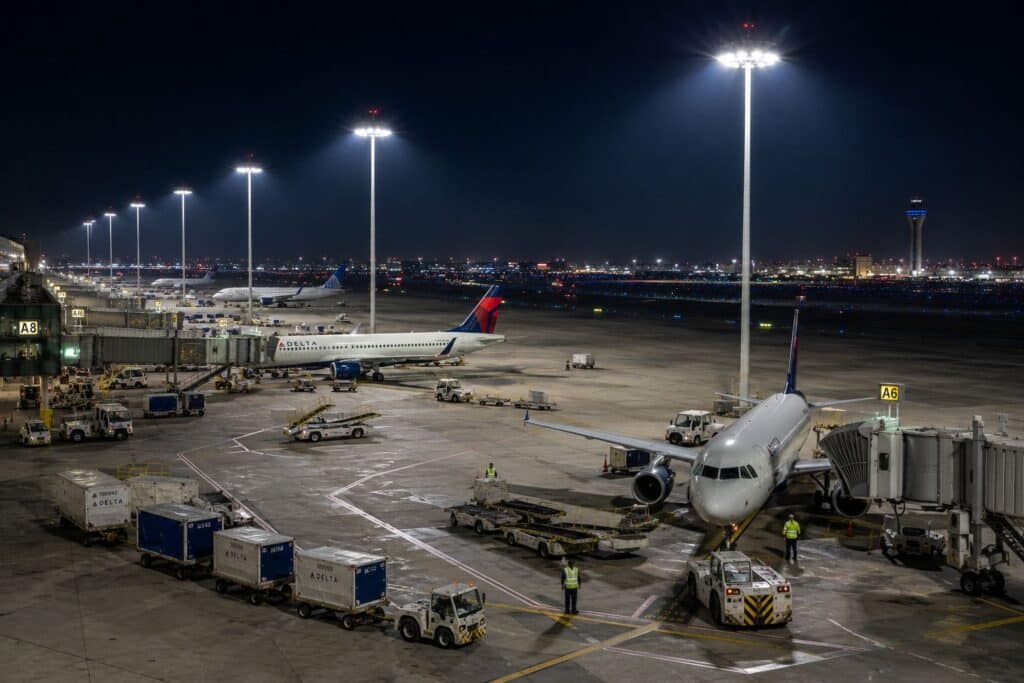
LED high mast lighting provides dependable wide-area illumination for airport aprons, cargo ramps, maintenance facilities, aircraft parking areas, and other airside support operations requiring exceptional visibility and long-term reliability.
Planning lighting for an airport, FBO, cargo terminal, or aviation support facility?
Our lighting specialists can help design an LED high mast lighting system that improves visibility, reduces maintenance, and delivers efficient illumination across large airport properties.
Request a Free Lighting Consultation – – https://industriallightingfixtures.org/
Why Airports Choose High Mast Lighting
Airports operate around the clock under demanding conditions where visibility directly affects operational efficiency and personnel safety.
LED high mast lighting offers several important advantages:
- Wide-area illumination from fewer poles
- Improved visibility for ground crews
- Better color rendering for inspections
- Lower maintenance requirements
- Reduced energy consumption
- Long LED service life
- Instant-on operation
- Compatibility with modern lighting controls
These benefits help airport operators improve operational efficiency while lowering lifecycle costs.
Looking for a broader overview of high mast lighting applications? Visit the LED High Mast Lighting Applications Guide to learn how these systems are used at airports, rail yards, ports, correctional facilities, sports complexes, and other large commercial properties.
Common Airport Applications
Aircraft Parking Aprons
Aircraft aprons require consistent illumination to support aircraft parking, passenger boarding, fueling, baggage handling, catering services, and routine inspections.
High mast lighting minimizes dark areas while providing broad illumination across large paved surfaces.
Cargo Ramp Operations
Airport cargo facilities operate continuously, often requiring dependable lighting for:
- Freight loading
- Cargo unloading
- Container handling
- Forklift operations
- Aircraft servicing
- Ground equipment staging
LED high mast lighting improves visibility while reducing maintenance interruptions that could disrupt cargo operations.
Airport Maintenance Facilities
Maintenance departments rely on outdoor lighting for:
- Equipment servicing
- Fleet maintenance
- Material storage
- Utility operations
- Snow removal equipment
- Emergency response vehicles
Reliable illumination improves worker safety during nighttime maintenance activities.
General Aviation Facilities
General aviation airports and Fixed Base Operators (FBOs) often use high mast lighting to illuminate:
- Aircraft tie-down areas
- Hangar access roads
- Ramp operations
- Fueling stations
- Customer parking
- Maintenance areas
LED systems improve visibility for both aircraft operators and ground personnel.
For lighting installed on tall airport structures or towers, also review our FAA obstruction lighting resources.
Airport Service Roads
Airport service vehicles operate throughout the airfield transporting personnel, equipment, fuel, baggage, and maintenance supplies.
High mast lighting improves visibility along:
- Service roads
- Equipment staging areas
- Vehicle inspection points
- Utility corridors
- Operations support areas
Typical Pole Heights
Pole height varies depending on the operational area, required illumination levels, and overall airport layout.
| Airport Area | Typical Pole Height |
|---|---|
| Employee Parking | 60–80 ft |
| General Aviation Ramp | 60–80 ft |
| Maintenance Yard | 80–100 ft |
| Cargo Ramp | 80–120 ft |
| Aircraft Aprons | 80–120 ft |
| Large Airside Support Areas | 100–150+ ft |
Professional photometric lighting studies help determine optimum pole heights, fixture output, and optical distribution before installation.
Lighting Design Considerations
Airport lighting projects require careful planning to balance visibility, operational efficiency, maintenance, and long-term operating costs.
Key design considerations include:
- Pole placement
- Fixture optics
- Mounting height
- Lighting uniformity
- Glare control
- Wind loading
- Electrical infrastructure
- Maintenance access
- Future airport expansion
Proper lighting design improves safety while reducing unnecessary fixture quantities.
LED Advantages for Airport Facilities
Modern LED high mast lighting provides several operational improvements compared to legacy HID lighting systems.
Key benefits include:
- Lower electrical consumption
- Reduced maintenance
- Longer fixture life
- Improved visibility
- Better color rendering
- Instant restart after power interruptions
- Compatibility with dimming and lighting controls
- Reduced operating costs
These advantages are particularly valuable at airports where lighting systems often operate every night throughout the year.
Operating a freight rail or logistics terminal? Explore the Rail Yard & Intermodal High Mast Lighting Guide to learn how high mast lighting improves visibility throughout rail classification yards, intermodal terminals, and container handling facilities.
Airport Applications
| Airport Facility | Recommended Lighting |
| Aircraft Apron | LED High Mast Lighting |
| Cargo Ramp | LED High Mast Lighting |
| FBO Ramp | LED High Mast Lighting |
| Airport Maintenance Yard | LED High Mast Lighting |
| Service Roads | LED High Mast Lighting |
| Employee Parking | LED High Mast Lighting |
| Ground Support Equipment Storage | LED High Mast Lighting |
| Snow Removal Equipment Yard | LED High Mast Lighting |
Maintenance and Lowering Headframe Systems
Many airport high mast lighting installations utilize lowering headframe systems, allowing luminaires to be safely lowered to ground level for routine inspection, cleaning, and maintenance.
This approach provides several operational advantages:
- Eliminates routine bucket truck maintenance
- Improves technician safety
- Reduces maintenance labor
- Minimizes disruption to airport operations
- Simplifies fixture replacement
- Reduces maintenance equipment costs
For airports operating around the clock, lowering systems help reduce service time while maintaining lighting performance across critical operational areas.
Planning lighting for airport maintenance buildings or industrial support facilities? Read the Industrial Lighting Guide for recommendations on industrial LED fixtures, facility lighting, and application-specific solutions.
Energy Savings and Lifecycle Costs
Airport lighting systems often operate every night, making energy efficiency an important consideration.
Replacing legacy metal halide or high-pressure sodium fixtures with modern LED high mast lighting can provide numerous operational benefits.
Typical advantages include:
- Lower electrical consumption
- Reduced maintenance
- Longer fixture service life
- Improved lighting uniformity
- Better color rendering
- Reduced relamping
- Lower lift equipment costs
- Improved lighting reliability
These improvements contribute to lower total cost of ownership over the life of the lighting system.
Common Specification Mistakes
Avoid these common design and specification errors:
- Selecting pole heights without a photometric analysis
- Choosing fixture wattage instead of evaluating optical performance
- Ignoring glare control near aircraft operations
- Underestimating maintenance access requirements
- Overlooking wind loading calculations
- Installing excessive pole quantities
- Failing to consider future airport expansion
- Selecting fixtures without evaluating long-term operating costs
Professional lighting design helps optimize illumination while reducing unnecessary installation and maintenance expenses.
Airport High Mast Lighting Design Checklist
| Design Consideration | Recommendation |
|---|
| Pole Height | Determine through photometric analysis |
| Optical Distribution | Match apron, cargo, or roadway application |
| Glare Control | Minimize glare affecting pilots and ground crews |
| Pole Placement | Coordinate with airport operations and future expansion |
| Maintenance | Consider lowering headframe systems |
| Lighting Controls | Evaluate dimming and scheduling where appropriate |
| Wind Loading | Verify pole and foundation design |
| Energy Efficiency | Specify high-performance LED luminaires |
Inline Buyer Q&A
Why do airports use high mast lighting instead of standard parking lot lighting?
High mast lighting provides broader illumination from taller poles, reducing the number of poles required while improving lighting uniformity across large operational areas such as aircraft aprons, cargo ramps, and maintenance facilities.
What airport areas typically use high mast lighting?
High mast lighting is commonly installed around aircraft aprons, cargo facilities, maintenance yards, FBO operations, airport service roads, equipment storage areas, employee parking, and other large outdoor support areas.
Are lowering headframe systems recommended?
Many airports choose lowering systems because they allow luminaires to be serviced from ground level, improving worker safety while reducing maintenance costs and minimizing operational disruptions.
Design Reliable Airport High Mast Lighting Systems
Airport lighting systems must deliver dependable illumination across expansive operational areas while supporting aircraft servicing, cargo handling, maintenance operations, security, and personnel safety. Modern LED high mast lighting provides exceptional wide-area coverage, reduced maintenance requirements, improved energy efficiency, and long-term reliability for airports of every size.
Whether you’re lighting a commercial airport, general aviation facility, cargo terminal, or airport maintenance complex, our lighting specialists can help you determine the ideal pole heights, fixture optics, and lighting layouts for your project. 👉 Explore our complete selection of LED High Mast Lighting solutions engineered for airport aprons, cargo ramps, maintenance facilities, service roads, aircraft parking areas, and other aviation support environments. Contact us today for a free photometric lighting layout and fixture recommendation.
Frequently Asked Questions
What pole heights are commonly used for airport high mast lighting?
Depending on the application, airport high mast poles commonly range from approximately 60 feet to more than 150 feet, with larger cargo ramps and apron areas often requiring the tallest installations.
Can LED high mast lighting reduce airport operating costs?
Yes. Modern LED systems typically reduce electrical consumption, maintenance, and relamping requirements compared to many legacy HID lighting systems.
Is high mast lighting used on runways?
Generally, no. Runway, taxiway, and approach lighting systems serve aircraft navigation functions and are separate from high mast lighting, which is primarily used for airport operational support areas such as aprons, maintenance yards, cargo facilities, and service roads.
Can airport high mast lighting be integrated with lighting controls?
Yes. Many LED high mast systems are compatible with dimming, scheduling, wireless controls, and other lighting management technologies where appropriate for the airport’s operational requirements.
Stay Connected with Our Lighting Resources
Add IndustrialLightingFixtures.org as a Preferred Source on Google to see more of our lighting guides and technical resources across Google Search experiences.
