
A commercial outdoor light can produce plenty of useful illumination while also sending unwanted light behind the fixture, above the horizontal plane, or toward neighboring properties and people.
BUG ratings provide a standardized way to describe some of that optical behavior.
BUG stands for Backlight, Uplight, and Glare.
The Illuminating Engineering Society’s Luminaire Classification System evaluates the amount of light emitted into defined angular zones around an outdoor luminaire. The resulting BUG rating can help lighting professionals compare fixtures for their potential contribution to light trespass, skyglow, and high-angle brightness.
A specification such as:
B3-U0-G3
is therefore not a model number or efficiency rating. It describes characteristics of the fixture’s light distribution.
Understanding those three numbers can help contractors, facility managers, municipalities, property owners, architects, and lighting specifiers make better outdoor lighting decisions.
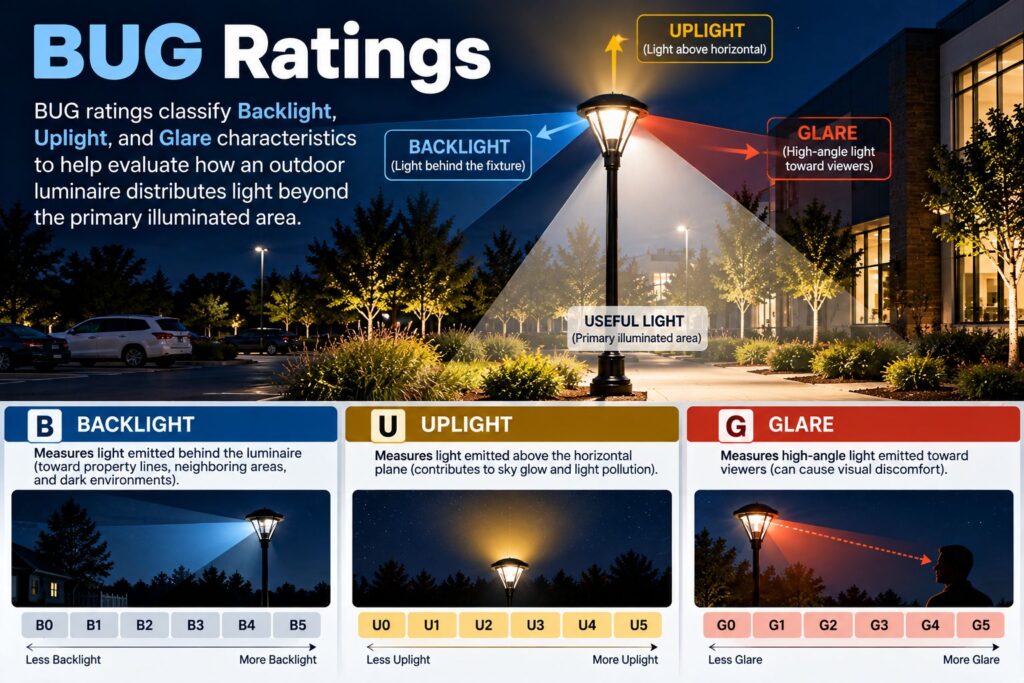
BUG ratings classify Backlight, Uplight, and Glare characteristics to help evaluate how an outdoor luminaire distributes light beyond the primary illuminated area.
Control Outdoor Light Before Simply Adding More Lumens
Choosing commercial outdoor lighting involves more than wattage and lumen output. Where the fixture sends its light can be just as important as how much light it produces.
LED PROS WorldWide can help evaluate commercial outdoor LED lighting based on application, mounting height, optical distribution, photometric performance, and the amount of Backlight, Uplight, and Glare appropriate for the project.
Request a Quote/ Call 1-844-533-7767 for commercial outdoor lighting assistance.
What Is a BUG Rating in Outdoor Lighting?
BUG is an acronym for:
B — Backlight
U — Uplight
G — Glare
BUG ratings are part of the IES Luminaire Classification System for outdoor luminaires. The current ANSI/IES TM-15-20 standard defines the classification system and includes BUG ratings.
Rather than simply classifying a fixture as “cutoff” or “full cutoff,” the system evaluates lumens emitted into defined solid-angle regions around the luminaire.
That gives lighting designers more information about where the fixture is distributing its light.
What Does B3-U0-G3 Mean?
Consider an outdoor fixture listed as:
B3-U0-G3
Each part should be read independently.
| Rating | Represents | General Concern |
|---|---|---|
| B3 | Backlight rating of 3 | Light emitted behind the fixture |
| U0 | Uplight rating of 0 | Light emitted above horizontal |
| G3 | Glare rating of 3 | High-angle light with glare potential |
The numbers represent classifications based on defined zonal lumen thresholds—not percentages of total fixture output. The IES rating tables use values from 0 through 5, with the classification determined by light emitted into specified angular zones.
This distinction matters.
A BUG rating should not be interpreted as:
“B3 means 3% backlight.”
It does not.
B — What Does Backlight Mean?
Backlight describes light emitted behind the luminaire relative to its designated forward direction.
Imagine an area light mounted near the edge of a parking lot.
The useful forward light may illuminate:
Parking lot →
while the backlight travels:
← Property line / neighboring property
Excessive backlight can contribute to:
- Light trespass
- Illumination beyond property boundaries
- Light entering residential areas
- Unwanted illumination behind poles
- Difficulty meeting site-lighting requirements
The IES system subdivides the backlight region into angular zones and assigns the overall B rating according to defined lumen thresholds.
Why Backlight Matters Near Property Lines
Backlight becomes particularly important when poles or wall-mounted fixtures are located close to a property boundary.
Consider:
Neighboring Property | Property Line | Pole → Parking Lot
The objective may be to illuminate the parking lot while minimizing illumination behind the pole.
A fixture with good backlight control can help accomplish this more effectively than simply lowering the fixture’s wattage.
This is an important distinction:
Reducing lumens reduces light everywhere.
Controlling optics reduces light where it is unwanted.
That is one reason optical selection is so important in commercial outdoor lighting.
U — What Does Uplight Mean?
Uplight describes light emitted above the horizontal plane of the luminaire.
The IES divides uplight into defined angular regions above horizontal. Uplight contributes to skyglow, although reflected light from surfaces and other factors also contribute to the overall nighttime sky brightness.
For many modern commercial outdoor fixtures, minimizing direct uplight is an important design objective.
This is particularly relevant for:
- Parking lots
- Roadways
- Campuses
- Municipal properties
- Dark Sky-sensitive areas
- Parks
- Residential-adjacent commercial sites
What Does U0 Mean?
U0 indicates zero lumens in the defined uplight zones used for the BUG classification.
The IES BUG tables specify zero zonal lumens for U0.
This makes U0 a useful specification when direct uplight must be eliminated.
However, there is an important limitation.
U0 Does Not Mean Zero Skyglow
A U0 fixture emits no direct light into the BUG uplight zones, but downward light can still strike:
- Pavement
- Concrete
- Buildings
- Vehicles
- Landscaping
- Snow
- Other surfaces
Some of that light can be reflected upward.
IES specifically notes that the uplight classification does not account for light reflected from the ground and adjacent structures.
Therefore:
U0 = no direct uplight under the BUG classification
It does not mean the entire installation produces zero contribution to skyglow.
Does U0 Automatically Make a Fixture Dark Sky Compliant?
No.
This is one of the most important distinctions for commercial buyers.
Responsible nighttime lighting involves more than eliminating direct uplight.
Other considerations can include:
- Fixture output
- Glare
- Backlight
- Light trespass
- Color temperature
- Spectral characteristics
- Controls
- Operating hours
- Mounting height
- Application
- Local regulations
DarkSky International and IES principles for responsible outdoor lighting emphasize using light only where and when needed, directing it properly, avoiding excessive brightness, and considering warmer light where appropriate.
For a broader discussion, see our Dark Sky Friendly Lighting Guide.
G — What Does Glare Mean in a BUG Rating?
The G component addresses high-angle light emitted by the luminaire that has the potential to contribute to glare.
Glare is especially important because outdoor lighting is not useful simply because a light meter records adequate illumination.
An excessively bright source within a person’s field of view can make an outdoor environment visually uncomfortable and may interfere with seeing surrounding objects.
The Department of Energy notes that glare is affected by the viewing environment and a person’s adaptation level; bright sources in otherwise dark environments can be particularly problematic.
Lower BUG Numbers Are Not Automatically “Better”
This deserves its own section because it prevents buyers from misusing the rating system.
It is tempting to assume:
B0 is always better than B3.
G0 is always better than G3.
But outdoor lighting design isn’t that simple.
The objective is not to achieve the smallest possible BUG numbers regardless of application.
The objective is to put appropriate light where it is needed while controlling light where it is not needed.
For example, reducing high-angle output may help control glare, but it can also affect fixture spacing and distribution.
IES itself says that the Luminaire Classification System should not be the sole method used to evaluate lighting quality. Illuminance, uniformity, luminance, glare, aesthetics, color, energy efficiency, cost, safety, security, and appropriate distribution also need consideration.
BUG Ratings and Lighting Zones
BUG ratings are often encountered alongside outdoor lighting zones.
The Model Lighting Ordinance developed by IES and the former International Dark-Sky Association uses lighting zones from LZ0 through LZ4 so outdoor lighting restrictions can correspond to the surrounding nighttime environment. It also incorporates BUG ratings as a means of controlling unwanted light.
Conceptually:
LZ0 represents extremely sensitive nighttime environments.
At the other end:
LZ4 represents areas with high ambient nighttime lighting.
The important buyer takeaway is not that every fixture requires one universal BUG rating.
Instead, acceptable optical performance can depend on the environment and application in which the fixture will be installed.
Local codes and project specifications should always be checked.
BUG Ratings vs Light Distribution Types
BUG ratings and distribution types answer different questions.
A fixture might be described as:
Type III, B3-U0-G3
Those specifications are complementary.
| Specification | Primary Question |
|---|---|
| Type II / III / IV / V | Where does the fixture distribute useful light? |
| B rating | How much classified light goes behind it? |
| U rating | How much classified light goes upward? |
| G rating | What is its high-angle light classification? |
A Type III fixture is not automatically low-backlight.
A Type V fixture is not automatically high-glare.
And U0 does not tell you whether the fixture provides the correct illumination pattern for the site.
BUG Ratings vs Lumens
Lumens tell you the quantity of light produced.
BUG ratings help describe aspects of where that light goes.
Two fixtures with similar lumen output can therefore have different BUG ratings.
For example:
Fixture A — 20,000 lumens — B2-U0-G2
Fixture B — 20,000 lumens — B4-U0-G4
Those specifications suggest different optical behavior, but they still do not tell you which fixture is appropriate without considering the application.
A parking-lot interior pole has different requirements from a fixture installed directly beside a residential property line.
BUG Ratings vs Foot-Candles
BUG ratings also do not replace foot-candle calculations.
A fixture could have excellent control of uplight and backlight but still fail to provide adequate illumination on the ground.
Conversely, a fixture could produce high foot-candle levels while creating unwanted spill light or high-angle brightness.
A complete commercial lighting design should consider both:
Light delivered to the intended surface
and
Light distributed outside the intended area.
BUG Ratings vs Photometric Plans
A BUG rating describes the luminaire.
A photometric plan describes how the luminaire performs within a particular site design.
That distinction is critical.
A photometric plan can evaluate:
- Pole locations
- Mounting heights
- Fixture orientation
- Optical distribution
- Foot-candle levels
- Uniformity
- Property boundaries
- Buildings
- Walkways
- Parking areas
BUG ratings provide useful fixture-level information, while photometric analysis evaluates the complete installation.
BUG Ratings for Parking Lot and Area Lights
BUG ratings are particularly useful for commercial area lighting because parking-lot fixtures frequently operate near:
- Property boundaries
- Public roads
- Residential areas
- Building windows
- Pedestrian areas
A perimeter fixture may require substantially different backlight control than a fixture located near the center of a large parking area.
This is why the same outdoor project may use several optical configurations of the same luminaire family.
Instead of reducing every fixture’s output, designers can use optics appropriate for each pole location.
BUG Ratings for Wall Packs
Wall-mounted outdoor lighting creates a different geometry.
Backlight may be less relevant when the building itself blocks light behind the fixture, while uplight and high-angle brightness can remain significant concerns.
Modern full-cutoff or controlled-distribution wall packs can help direct illumination downward and outward rather than toward the sky.
BUG ratings, photometric data, mounting height, and property-line conditions should be evaluated together.
BUG Ratings for Post Top Lighting
Post top fixtures present an interesting challenge because some traditional decorative luminaires intentionally produce visible light in many directions.
Acorn fixtures, lantern-style post tops, and other decorative luminaires may emphasize architectural appearance as well as illumination.
Modern LED optical systems can provide better control, but the design must still balance:
- Architectural appearance
- Pedestrian scale
- Glare
- Uplight
- Fixture spacing
- Mounting height
- Required illumination
Our Post Top Lighting Spacing Guide and Post Top Lighting Pole Height Guide address the other two major parts of this design relationship.
BUG Ratings for Roadway and Municipal Lighting
Roadway and municipal lighting frequently requires careful control of high-angle light, backlight, and spill illumination.
But BUG ratings are only one design input.
Roadway and parking design also requires consideration of appropriate illumination, uniformity, pavement characteristics, visibility, mounting height, spacing, and application-specific requirements.
The IES Recommended Practice for roadway and parking facilities explicitly describes BUG as an initial means of evaluating and comparing luminaires, while emphasizing that additional lighting-quality considerations remain necessary.
BUG Ratings and Mounting Height
A fixture’s published BUG rating does not mean that mounting height can be ignored.
The physical relationship among:
Fixture → observer → property line → illuminated surface
changes when mounting height changes.
A fixture mounted at 12 feet creates a different real-world viewing condition from the same fixture mounted at 25 feet.
Mounting height can also affect:
- Pole spacing
- Illuminance
- Uniformity
- Perceived brightness
- Light trespass
- Viewing angles
BUG data should therefore be considered alongside the intended mounting configuration.
BUG Ratings and Fixture Orientation
Fixture orientation also matters.
A luminaire tested and classified in its intended orientation should be installed according to its designed mounting configuration.
Tilting or aiming an outdoor fixture can change where its light travels.
A fixture designed to produce U0 when mounted level should not automatically be assumed to maintain the same real-world uplight performance if it is tilted upward.
This is particularly relevant for adjustable floodlights and improperly installed area lights.
Can BUG Ratings Help Reduce Light Trespass?
Yes—but particularly the B component should be considered in context.
For perimeter poles, reducing backlight can help limit illumination behind the fixture and toward adjacent properties.
However, light trespass is ultimately a site-level issue.
Other factors include:
- Distance to the property line
- Mounting height
- Fixture orientation
- Pole location
- Lumen output
- Adjacent land use
- Shields
- Building geometry
- Multiple fixtures
A low backlight rating does not eliminate the need for a photometric property-line calculation.
For a parking-lot-specific application of these principles, see our Parking Lot Lighting Glare & Light Trespass Guide, which connects backlight, uplight and glare with pole location, optical distribution, shielding and property-line photometric analysis.
BUG Ratings and Dark Sky Design
BUG ratings can be an important component of responsible outdoor lighting design.
The U rating is especially relevant to direct uplight, while B and G provide information useful for evaluating spill light and high-angle output.
But responsible outdoor lighting should address the entire system:
Need → Location → Output → Distribution → Spectrum → Controls → Operating time.
DarkSky International’s current guidance similarly treats BUG ratings as one part of broader responsible-lighting practices rather than the complete answer.
Why BUG Ratings Should Not Be Used Alone
BUG ratings are useful because they convert complex photometric information into relatively understandable classifications.
But that simplification has limits.
Even IES has publicly discussed the limitations of BUG ratings, particularly around glare and the need for context-specific evaluation of outdoor nighttime environments.
Therefore, don’t select a commercial outdoor fixture solely because it has a lower BUG rating than another fixture.
Evaluate:
- Required illumination
- Uniformity
- Optical distribution
- Mounting height
- Fixture spacing
- Property-line conditions
- Glare
- Color temperature
- Controls
- Energy use
- Architecture
- Local requirements
BUG is a selection and comparison tool, not a complete lighting design.
Inline Buyer Q&A
What does BUG stand for in outdoor lighting?
BUG stands for Backlight, Uplight, and Glare. The rating system provides information about how an outdoor luminaire distributes light into defined regions around the fixture.
Is B0-U0-G0 always the best BUG rating?
No. Lower ratings indicate tighter control within the defined BUG zones, but fixture selection should match the actual application. Required illumination, uniformity, distribution, mounting height, spacing, and site geometry also matter.
What does U0 mean?
U0 means the fixture emits zero lumens into the defined BUG uplight zones. It does not mean the complete lighting installation produces zero skyglow because reflected light can still travel upward.
Does a U0 fixture qualify as Dark Sky compliant?
Not automatically. Dark Sky-oriented lighting also considers appropriate light levels, glare, light trespass, color characteristics, controls, operating time, and the overall application.
Can two fixtures with the same wattage have different BUG ratings?
Yes. Optical systems can distribute light differently even when fixtures have similar wattage or lumen output.
Select Commercial Outdoor Lighting Based on Where the Light Goes
Outdoor lighting performance cannot be evaluated by wattage or lumens alone.
Understanding Backlight, Uplight, and Glare helps determine whether a fixture directs useful illumination toward the intended area while controlling unwanted light around property boundaries, toward the sky, and at high viewing angles.
LED PROS WorldWide can help evaluate commercial outdoor LED fixtures based on lumen output, optical distribution, BUG ratings, mounting height, photometric performance, and project requirements.
Call 844-533-7767 to discuss parking lots, commercial properties, campuses, municipalities, HOA and multifamily developments, pathways, courtyards, and other outdoor lighting projects.
Frequently Asked Questions About Outdoor Lighting BUG Ratings
What is a good BUG rating for outdoor lighting?
There is no universal BUG rating that is correct for every project. Appropriate Backlight, Uplight, and Glare classifications depend on fixture location, lighting zone, application, property boundaries, mounting height, and applicable codes or project requirements.
Is a lower BUG rating always better?
Not necessarily. Lower classifications indicate tighter control in the respective BUG regions, but excessive restriction can conflict with the illumination and distribution required by an application. The complete photometric design should be evaluated.
Where can I find the BUG rating for an LED fixture?
BUG ratings may appear on a manufacturer’s specification sheet, photometric report, or other technical documentation. IES-format photometric data can also be used by appropriate lighting software to evaluate fixture distribution.
What is the difference between BUG rating and cutoff?
BUG is part of the newer IES Luminaire Classification System and provides separate information about Backlight, Uplight, and Glare. ANSI/IES TM-15-20 describes the LCS as replacing the older cutoff classification system.
Does BUG rating determine fixture spacing?
No. BUG ratings describe aspects of the luminaire’s optical distribution. Fixture spacing also depends on mounting height, delivered lumens, distribution pattern, required illumination, uniformity, and site geometry.
Do post top lights have BUG ratings?
They can. Outdoor post top luminaires with appropriate photometric data can be evaluated using the Luminaire Classification System. Decorative fixture construction and distribution may result in different BUG characteristics than conventional flat-lens area lights.
Can BUG ratings help with light trespass?
Yes. Backlight information can be particularly useful when selecting fixtures near property boundaries, but a photometric site plan should be used to evaluate actual illumination at and beyond the property line.
Stay Connected with Our Lighting Resources
Add IndustrialLightingFixtures.org as a Preferred Source on Google to see more of our lighting guides and technical resources across Google Search experiences.
