Commercial LED lighting has transformed the way businesses illuminate warehouses, manufacturing facilities, parking lots, campuses, retail centers, sports venues, and municipal properties. Beyond reducing energy consumption, one of the greatest advantages of modern LED technology is its exceptional service life. While traditional lighting systems often require frequent lamp replacements and ongoing maintenance, commercial LED fixtures are engineered to provide dependable illumination for many years with minimal upkeep.
However, not all LED fixtures are created equal. The advertised lifespan printed on a specification sheet is only one part of the equation. Real-world longevity depends on the quality of the LED chips, driver electronics, thermal management, operating environment, surge protection, and overall fixture construction. Understanding these factors helps facility managers, engineers, contractors, and property owners make informed purchasing decisions that maximize long-term value.
This guide explains how commercial LED lifespan is measured, what affects long-term performance, and how selecting premium fixtures can reduce maintenance expenses while delivering reliable illumination for years to come.
While fixture lifespan is an important consideration, it is only one part of designing an efficient lighting system. Our Commercial Lighting Guide explores fixture selection, lighting layouts, controls, and application-specific recommendations for offices, warehouses, manufacturing facilities, campuses, and commercial properties.
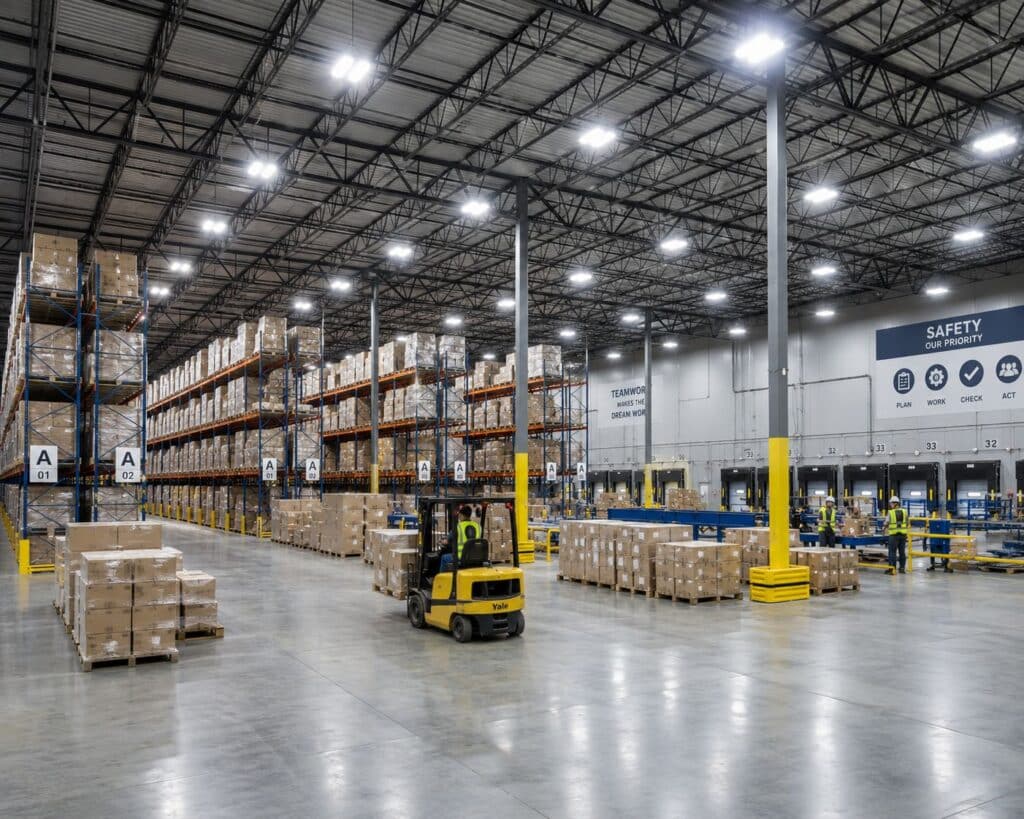
Premium commercial LED lighting delivers years of reliable illumination while significantly reducing maintenance costs and energy consumption.
Invest in Commercial LED Lighting Built to Last
Whether you’re upgrading a warehouse, illuminating a parking lot, replacing aging HID fixtures, or designing lighting for a new commercial facility, selecting high-quality LED fixtures can dramatically reduce maintenance costs while providing dependable illumination for years to come.
Explore our complete selection of Commercial & Industrial LED Lighting Solutions and let our lighting specialists help you choose fixtures designed for long-term performance.
Why LED Lifespan Matters
For commercial and industrial facilities, lighting represents far more than an electrical expense. Every fixture replacement involves labor, equipment, scheduling, and, in many cases, operational disruptions. In warehouses with 35-foot ceilings, manufacturing plants operating around the clock, or municipal parking lots requiring lift equipment, replacing even a single failed fixture can cost significantly more than the fixture itself.
Choosing lighting with a longer operational lifespan helps organizations reduce these hidden ownership costs while improving reliability throughout the facility.
Long-lasting commercial LED lighting offers several important advantages:
- Lower maintenance expenses
- Reduced labor requirements
- Fewer service interruptions
- Improved workplace safety
- Less equipment rental for elevated installations
- Consistent light levels over many years
- Lower total cost of ownership
- Better return on investment
For facilities operating continuously—such as distribution centers, airports, hospitals, food processing plants, correctional facilities, and manufacturing operations—minimizing maintenance can translate into substantial long-term savings.
Long service life and energy efficiency often go hand in hand. Learn how lumens per watt helps measure commercial lighting performance when comparing modern LED fixtures.
How Long Do Commercial LED Fixtures Really Last?
One of the most common questions buyers ask is simple:
“How long will these LED fixtures actually last?”
The answer depends on the fixture’s design, component quality, and operating environment, but commercial-grade LED fixtures typically provide rated service lives between 50,000 and more than 100,000 operating hours.
To better understand what those numbers mean, consider how operating schedules affect expected service life.
| Commercial Application | Typical Rated Life | Approximate Years at 12 Hours/Day | Approximate Years at 24/7 Operation |
|---|---|---|---|
| Commercial Ceiling Lights | 50,000–75,000 Hours | 11–17 Years | 5.7–8.5 Years |
| LED High Bay Lighting | Up to 100,000 Hours | Nearly 23 Years | Approximately 11 Years |
| Parking Lot Lighting | Up to 100,000 Hours | Nearly 23 Years | Approximately 11 Years |
| Sports Lighting | Up to 100,000+ Hours | More than 23 Years | More than 11 Years |
| High Mast Lighting | Up to 100,000 Hours | Nearly 23 Years | Approximately 11 Years |
| Post Top Fixtures | 75,000–100,000 Hours | 17–23 Years | 8.5–11 Years |
| Explosion Proof Fixtures | Up to 100,000 Hours | Nearly 23 Years | Approximately 11 Years |
These estimates assume normal operating conditions and proper installation. Facilities exposed to excessive heat, voltage fluctuations, corrosive environments, or inadequate maintenance may experience shorter service lives, while premium fixtures operating in favorable conditions often continue performing well beyond their published ratings.
The key takeaway is that commercial LED lighting is designed to be a long-term infrastructure investment rather than a consumable product requiring frequent replacement. When combined with quality drivers, efficient thermal management, and proper surge protection, today’s commercial LED fixtures can deliver dependable performance for well over a decade in many applications.
Although LED chips are engineered for exceptional longevity, the driver often determines how long the complete lighting system performs reliably. To better understand how drivers regulate power, support dimming, and protect sensitive electronics, read our Commercial LED Drivers Explained: Types, Functions & Buying Guide.
Why LEDs Don't Burn Out Like Traditional Light Sources
One of the biggest misconceptions about LED lighting is that it eventually “burns out” like an incandescent bulb. In reality, commercial LED fixtures age very differently than traditional lighting technologies, which is one of the primary reasons they have become the preferred choice for commercial, industrial, municipal, and institutional facilities.
Traditional lamps typically experience catastrophic failure. When the filament breaks in an incandescent bulb or the arc tube fails in a metal halide lamp, the fixture suddenly goes dark and requires immediate replacement. Fluorescent lamps often show warning signs such as flickering, delayed starts, buzzing ballasts, or uneven illumination before ultimately failing.
LED technology follows a different path. Instead of an abrupt failure, quality LED fixtures gradually produce less light over time while continuing to operate. This predictable reduction in light output allows facility managers to plan maintenance schedules rather than responding to unexpected outages.
For businesses where continuous illumination is critical—such as manufacturing plants, warehouses, hospitals, airports, correctional facilities, and sports complexes—this predictable performance significantly improves operational reliability.
Comparing Common Lighting Technologies
| Lighting Technology | Typical End of Life |
|---|---|
| Incandescent | Sudden filament failure |
| Halogen | Sudden lamp failure |
| Fluorescent | Flickering, ballast failure, lamp degradation |
| Metal Halide | Reduced brightness, color shift, sudden lamp failure |
| High Pressure Sodium | Significant lumen depreciation and lamp failure |
| Commercial LED | Gradual lumen depreciation with continued operation |
Understanding L70, LM-80, and TM-21
When reviewing commercial LED specifications, you’ll frequently encounter technical terms such as L70, LM-80, and TM-21. These industry-recognized standards provide a much more accurate picture of long-term LED performance than simply stating a fixture lasts “100,000 hours.”
Understanding these measurements helps buyers compare products based on verified performance rather than marketing claims.
What Is L70?
Unlike incandescent lamps that simply stop working, LEDs slowly lose light output over many years.
L70 represents the point at which an LED light source has declined to 70% of its original lumen output. At this point, the fixture continues operating but no longer delivers its initial illumination level.
For most commercial applications, reaching L70 is considered the practical end of useful service life because lighting levels may no longer satisfy design requirements or recommended foot-candle levels.
A fixture rated for 100,000 hours at L70 does not stop working at 100,000 hours—it simply means the LEDs are expected to still produce approximately 70% of their original light output.
What Is LM-80?
LM-80 is an industry testing standard used to measure how LED packages, arrays, and modules perform over time under controlled operating conditions.
Rather than estimating lifespan, LM-80 testing records:
- Lumen maintenance
- Color stability
- Operating temperatures
- Long-term performance data
Manufacturers use these results to verify how LED components behave after thousands of hours of continuous operation.
LM-80 testing provides confidence that the LEDs themselves are capable of delivering dependable long-term performance when incorporated into a properly engineered fixture.
What Is TM-21?
While LM-80 measures actual performance over a defined testing period, TM-21 provides a standardized method for projecting future lumen maintenance beyond the duration of laboratory testing.
Engineers use TM-21 calculations to estimate expected L70 performance based on verified LM-80 data.
Together, these standards provide buyers with a more reliable understanding of expected LED longevity than unsupported lifespan claims.
Why These Standards Matter
When comparing commercial LED fixtures, it’s important to evaluate more than wattage and lumen output.
Fixtures supported by recognized testing standards provide greater confidence that published performance expectations are based on measurable engineering data rather than theoretical estimates.
Quality manufacturers invest in premium LED components that have undergone rigorous testing, helping ensure long-term reliability across demanding commercial and industrial environments.
The Biggest Cause of LED Fixture Failure Isn't Usually the LEDs
One of the most surprising facts about commercial LED lighting is that the LED chips themselves are often the most reliable component inside the fixture.
In many cases, if an LED fixture stops operating unexpectedly, the problem is more likely to originate from another component rather than the LEDs.
The component most commonly responsible for premature fixture failure is the LED driver.
Because the driver plays such a critical role in fixture reliability, understanding how drivers regulate power, dissipate heat, and influence overall system performance can help buyers make better purchasing decisions. Learn more in our What Are LED Drivers? A Comprehensive Guide for Commercial Applications, where we explain driver types, common failure causes, dimming technologies, and what to look for when comparing commercial LED fixtures.
An LED driver functions as the fixture’s power supply, converting incoming electrical power into the precise voltage and current required by the LEDs. Because the driver operates continuously whenever the fixture is energized, it experiences ongoing electrical and thermal stress throughout its service life.
The longevity of the driver depends on several factors, including:
- Internal component quality
- Operating temperature
- Surge protection
- Voltage stability
- Ambient environment
- Fixture ventilation
Premium commercial fixtures typically incorporate higher-quality drivers designed for demanding applications, while economy-grade products often reduce costs by using lower-grade electronic components that may not withstand years of continuous operation.
This is one reason two fixtures with identical lumen output and wattage can perform very differently over the long term.
A well-designed commercial LED fixture combines premium LEDs, quality drivers, efficient heat dissipation, durable housing materials, and effective surge protection into a complete lighting system engineered for dependable service over many years.
Project Spotlight
Warehouse Lighting Upgrade Delivers Long-Term Savings
A regional distribution center replaced aging 400-watt metal halide high bay fixtures with premium commercial LED high bays throughout its warehouse.
The previous lighting system required frequent lamp replacements, ballast failures, and scheduled maintenance using personnel lifts that interrupted warehouse operations.
Following the LED retrofit, the facility experienced:
- Dramatically lower maintenance requirements
- Improved lighting uniformity throughout storage aisles
- Reduced downtime for fixture servicing
- Lower operating costs through improved energy efficiency
- Long-term confidence backed by commercial-grade fixture warranties
For facilities operating long hours or around the clock, investing in premium LED lighting often produces savings that extend well beyond reduced electrical consumption by significantly lowering lifetime maintenance expenses.
What Factors Shorten Commercial LED Lifespan?
Although commercial LED fixtures are designed for exceptional longevity, their actual service life depends on far more than the quality of the LED chips. Every fixture operates as a complete lighting system, and the reliability of that system is influenced by its environment, electrical conditions, installation practices, and component quality.
Well-engineered commercial fixtures can provide dependable illumination for decades, while lower-quality products exposed to harsh operating conditions may experience premature driver failures, accelerated lumen depreciation, or reduced overall performance.
Understanding these factors allows facility managers and building owners to make smarter purchasing decisions while maximizing the return on their lighting investment.
Excessive Heat
Heat is widely recognized as the single greatest factor affecting long-term LED performance.
Although LEDs generate significantly less heat than traditional HID lighting, they still produce heat at the semiconductor junction. If this heat cannot be effectively transferred away from the LEDs and electronic components, operating temperatures increase, accelerating the aging process.
Excessive heat may contribute to:
- Faster lumen depreciation
- Reduced driver life
- Premature electronic component aging
- Color shift over time
- Shorter overall fixture lifespan
Applications particularly susceptible to elevated operating temperatures include:
- Steel mills
- Foundries
- Manufacturing facilities
- Warehouses with high roof temperatures
- Commercial kitchens
- Mechanical equipment rooms
- Outdoor installations in hot climates
Premium commercial fixtures incorporate larger heat sinks, improved airflow, advanced thermal materials, and carefully engineered housings that help maintain lower operating temperatures throughout the fixture’s life.
Elevated ambient temperatures can dramatically accelerate component aging. Facilities such as foundries, steel mills, and manufacturing plants often require specialized fixtures engineered for demanding environments. Learn more in our LED High Temperature High Bay Lighting Guide.
Electrical Surges and Voltage Fluctuations
Power quality has a significant influence on electronic equipment, including commercial LED lighting.
Utility switching events, nearby lightning strikes, industrial equipment, and unstable electrical systems can all generate voltage spikes capable of damaging sensitive electronic components.
Without adequate surge protection, repeated electrical disturbances may gradually weaken driver components or cause immediate failure.
Commercial-grade fixtures often include integrated surge protection to improve long-term reliability in demanding environments such as:
- Parking lots
- Roadways
- Airports
- Manufacturing facilities
- Distribution centers
- Municipal campuses
For locations with frequent electrical disturbances, additional external surge protection can further enhance system reliability.
Outdoor lighting systems experience greater exposure to lightning, utility switching events, and voltage fluctuations. Our Commercial Parking Lot Lighting Guide explains how proper fixture selection and surge protection improve long-term reliability.
Moisture, Dust, and Corrosive Environments
Environmental conditions also influence fixture longevity.
Facilities exposed to excessive moisture, airborne contaminants, chemicals, salt spray, or corrosive atmospheres require lighting specifically designed for those environments.
Examples include:
- Wastewater treatment plants
- Food processing facilities
- Coastal properties
- Marine terminals
- Agricultural buildings
- Car washes
- Natatoriums
- Industrial processing plants
High-quality commercial fixtures designed for these applications typically feature sealed optical compartments, corrosion-resistant finishes, durable gaskets, stainless steel hardware, and appropriate IP ratings to help prevent contaminants from reaching sensitive internal components.
Selecting the correct fixture for the environment often has a greater impact on lifespan than choosing a fixture solely based on lumen output or purchase price.
High humidity and chloramine-rich environments present unique challenges for lighting systems. Our Natatorium Lighting Guide explains why corrosion-resistant construction is essential for long service life.
Continuous Operation
Many commercial facilities operate around the clock.
Distribution centers, hospitals, correctional facilities, airports, manufacturing plants, and transportation hubs often require lighting that remains energized twenty-four hours a day.
Although commercial LED fixtures are designed for continuous operation, a fixture operating 24 hours per day naturally reaches its rated operating hours sooner than one operating only during normal business hours.
This is why expected service life is often expressed in operating hours rather than calendar years.
Facilities with continuous operation benefit most from premium commercial fixtures engineered for extended duty cycles and long-term reliability.
Poor Installation Practices
Even the highest-quality LED fixture can experience reduced performance if improperly installed.
Common installation issues include:
- Incorrect supply voltage
- Loose electrical connections
- Improper grounding
- Restricted airflow around fixtures
- Installing fixtures outside their intended temperature range
- Using incompatible dimming controls
- Inadequate surge protection
Following manufacturer recommendations during installation helps ensure the lighting system performs as designed throughout its service life.
Why Premium Components Make a Difference
At first glance, many commercial LED fixtures appear nearly identical.
They may advertise similar wattages, lumen outputs, beam patterns, and color temperatures.
The difference often lies inside the fixture.
Premium commercial lighting manufacturers invest in higher-quality internal components specifically selected to deliver dependable long-term performance under demanding operating conditions.
These may include:
- Premium LED packages
- Commercial-grade drivers
- Larger aluminum heat sinks
- High-performance thermal interface materials
- UV-resistant optical lenses
- Marine-grade powder-coated finishes
- Corrosion-resistant stainless steel hardware
- Silicone gaskets designed for extended service life
- Higher surge protection ratings
These engineering improvements help explain why premium fixtures frequently provide years of additional dependable operation while reducing maintenance costs over the life of the installation.
When evaluating commercial lighting, the lowest purchase price does not always represent the lowest lifetime cost.
Choosing the Right Fixture for the Environment
One of the best ways to maximize LED lifespan is to select lighting specifically designed for its intended application.
| Application | Recommended Fixture Characteristics |
|---|---|
| Warehouses | Efficient thermal management and high-lumen output |
| Parking Lots | Weather-resistant housing with integrated surge protection |
| Manufacturing Plants | Heavy-duty construction and high operating temperature ratings |
| Cold Storage | Drivers rated for low-temperature operation |
| Coastal Locations | Marine-grade finishes and corrosion-resistant hardware |
| Natatoriums | Corrosion-resistant construction with sealed optical chambers |
| Hazardous Locations | Certified explosion-proof fixtures designed for classified environments |
Matching fixture design to environmental conditions helps maximize reliability while minimizing maintenance requirements throughout the fixture’s service life.
Facilities with high ceilings particularly benefit from long-lasting lighting because fixture replacement often requires personnel lifts and scheduled downtime. Learn how premium fixtures reduce maintenance in our Commercial LED High Bay Lighting Guide.
Project Spotlight
Municipal Parking Lot Retrofit Reduces Maintenance Costs
A municipality replaced aging high-pressure sodium parking lot fixtures throughout several public parking areas with premium LED area lights designed for long service life.
Previously, maintenance crews routinely scheduled lamp replacements, ballast repairs, and nighttime service calls requiring bucket trucks and traffic control.
Following the LED upgrade, maintenance requirements were dramatically reduced while improving nighttime visibility, public safety, and overall operating efficiency.
By selecting commercial-grade fixtures with quality drivers, integrated surge protection, and corrosion-resistant construction, the municipality expects dependable performance for many years while significantly lowering long-term maintenance expenses.
Municipalities frequently invest in premium Commercial LED Area Lights because their extended service life significantly reduces maintenance costs, bucket truck usage, and nighttime service calls.
Understanding Commercial LED Warranties
One of the most overlooked aspects of purchasing commercial lighting is the relationship between a fixture’s rated lifespan and its manufacturer’s warranty.
While these terms are often mentioned together, they represent two very different measurements.
A fixture may be engineered to provide 100,000 hours of dependable illumination, yet carry a 5-year or 10-year warranty. The warranty defines the period during which the manufacturer stands behind the product under normal operating conditions, while the rated lifespan estimates how long the fixture is expected to continue providing useful illumination.
For commercial buyers, both numbers matter.
A longer warranty often reflects the manufacturer’s confidence in the quality of its components, engineering, and manufacturing processes.
Typical Commercial LED Warranty Periods
| Fixture Type | Typical Warranty |
|---|---|
| Economy Commercial Fixtures | 3–5 Years |
| Premium Commercial Fixtures | 5 Years |
| Industrial-Grade Fixtures | 5–10 Years |
| Premium Sports & High Mast Lighting | Up to 10 Years |
| Specialized Hazardous Location Fixtures | Typically 5 Years |
Although warranty length should never be the only purchasing factor, it often serves as an indicator of overall product quality.
What Makes a Longer Warranty Possible?
Manufacturers offering extended warranties generally invest in higher-quality components throughout the fixture.
These often include:
- Premium LED packages
- Commercial-grade drivers
- Larger thermal management systems
- Higher-quality capacitors and electronics
- Improved surge protection
- Corrosion-resistant hardware
- UV-resistant optics
- Better sealing against moisture and contaminants
Because every component contributes to overall reliability, a fixture is only as dependable as its weakest part.
How to Maximize Commercial LED Lifespan
Even the highest-quality commercial LED fixture benefits from proper installation and routine maintenance.
Following several best practices can help maximize performance while extending service life.
Choose Fixtures Designed for the Application
Warehouse lighting differs significantly from parking lot lighting, sports lighting, or food processing facilities.
Selecting fixtures specifically engineered for the installation environment improves long-term reliability.
Protect Against Power Surges
Outdoor lighting systems are routinely exposed to electrical disturbances.
Installing fixtures with integrated surge protection—and adding external surge protection where appropriate—helps protect valuable electronic components.
Keep Fixtures Clean
Dust, dirt, grease, and airborne contaminants reduce optical performance while increasing operating temperatures.
Periodic cleaning helps maintain:
- Maximum light output
- Better heat dissipation
- Improved appearance
- Longer component life
Cleaning schedules should always follow manufacturer recommendations.
Maintain Proper Airflow
Commercial fixtures rely on heat dissipation to maintain safe operating temperatures.
Avoid installing fixtures where airflow is restricted or where excessive heat becomes trapped around the housing.
Inspect During Routine Maintenance
Although LED fixtures require significantly less maintenance than traditional lighting, periodic inspections remain valuable.
Look for:
- Loose mounting hardware
- Damaged wiring
- Lens damage
- Water intrusion
- Corrosion
- Signs of electrical overheating
Early detection often prevents more costly repairs later.
Why Long-Term Value Matters More Than Initial Cost
When comparing commercial lighting products, it is easy to focus on purchase price alone.
However, the true cost of ownership includes much more than the fixture itself.
Consider:
- Energy consumption
- Maintenance labor
- Replacement parts
- Lift equipment
- Downtime
- Safety considerations
- Fixture replacement frequency
A premium fixture may cost more initially while producing substantially lower lifetime operating costs.
For warehouses, municipalities, hospitals, campuses, airports, and industrial facilities, investing in durable commercial lighting often provides one of the highest long-term returns available in facility infrastructure.
Inline Buyer Q&A
Do commercial LED lights really last 100,000 hours?
Some commercial LED fixtures carry published lifetime ratings approaching or exceeding 100,000 hours, but the meaning of that rating depends on the manufacturer’s testing methodology and stated performance criteria. LED lifetime specifications often describe projected lumen maintenance rather than guaranteeing that every component in the fixture will operate without failure for the full rated period.
Actual service life depends on driver reliability, thermal management, electrical conditions, operating temperature, installation quality, operating hours, and environmental exposure.
What usually fails first in an LED fixture?
The driver and other electronic components can sometimes fail before the LED light source reaches its projected lumen-maintenance life. Driver quality, operating temperature, electrical surges, thermal management, and overall fixture design can therefore have a significant effect on real-world service life.
Can an LED driver be replaced?
Many commercial fixtures are designed with replaceable drivers, allowing maintenance personnel to repair the luminaire without replacing the complete fixture. Serviceability depends on fixture design, driver availability, manufacturer support, and whether compatible replacement components remain available when service is required.
Does leaving LED lights on all the time shorten their life?
Continuous operation accumulates operating hours more quickly, so a fixture reaches a given number of operating hours sooner in calendar time. Continuous operation can also affect component temperatures and driver life depending on fixture design and operating environment.
Commercial fixtures intended for extended or 24/7 operation should be selected with appropriate thermal performance, driver quality, and environmental ratings.
Are more expensive commercial LED fixtures worth it?
They can be. Higher-quality commercial fixtures may incorporate better drivers, thermal management, surge protection, optical systems, construction materials, corrosion protection, and warranty support.
Rather than evaluating fixtures on purchase price alone, compare expected operating conditions, component quality, rated performance, warranty terms, energy consumption, serviceability, and anticipated maintenance requirements.
Invest in Commercial LED Lighting Designed for Long-Term Performance
The service life of a commercial LED fixture depends on far more than its published hour rating. Driver quality, thermal management, fixture construction, surge protection, operating environment, and application-specific engineering all contribute to long-term lighting performance.
Whether you’re upgrading a warehouse, manufacturing facility, office, parking lot, sports complex, campus, or municipal property, selecting fixtures suited to the actual operating environment can reduce maintenance requirements and improve the long-term value of the lighting system.
👉 Explore our Commercial & Industrial LED Lighting Solutions or call 1-844-533-7767 for help selecting fixtures for your commercial lighting application.
Frequently Asked Questions
How many years should commercial LED lighting last?
Depending on operating hours and application, quality commercial LED fixtures often provide reliable service for 10 to more than 20 years.
Do LEDs suddenly stop working?
Unlike incandescent or HID lamps, LEDs gradually lose light output over time rather than experiencing sudden catastrophic failure.
What affects LED lifespan the most?
Heat, driver quality, electrical surges, operating environment, fixture design, and proper installation all influence long-term performance.
Is a 10-year warranty better than a 5-year warranty?
A longer warranty often reflects greater manufacturer confidence in component quality and engineering, although overall fixture design should also be considered.
Can commercial LEDs be used in extreme temperatures?
Yes. Many commercial fixtures are specifically engineered for cold storage facilities, high-temperature manufacturing environments, coastal installations, and other demanding applications. Always verify the fixture’s rated operating temperature range before installation.
Stay Connected with Our Lighting Resources
Add IndustrialLightingFixtures.org as a Preferred Source on Google to see more of our lighting guides and technical resources across Google Search experiences.
Related Commercial LED Performance Resources
-
Continue researching the components and operating conditions that influence commercial LED performance and service life:
- What Are LED Drivers? A Comprehensive Guide for Commercial Applications — Learn how driver quality, electrical regulation, thermal conditions, surge protection, and serviceability can influence LED fixture reliability.
- LED High Temperature High Bay Lighting Guide — Explore how elevated ambient temperatures affect LED fixtures and why thermal management and appropriately rated components matter in demanding industrial environments.
- Commercial Lighting Guide — Review fixture selection, efficiency, controls, maintenance, operating conditions, and other considerations when planning commercial LED lighting systems.
- Commercial LED High Bay Lighting Guide — Review commercial and industrial high bay selection for applications where extended operating hours, mounting height, environmental conditions, and maintenance access influence long-term fixture performance.
- Explosion-Proof Lighting Guide — Explore lighting for hazardous industrial environments where fixture construction, operating temperature, electrical protection, certifications, and environmental conditions are critical selection factors.