
Modern commercial LED lighting systems are remarkably efficient, dependable, and long-lasting, but the LED chips themselves are only one part of the equation. Hidden inside virtually every commercial fixture is an electronic component that quietly controls the flow of electricity, protects sensitive electronics, and ensures consistent illumination throughout the life of the fixture.
That component is the LED driver.
Often described as the “heart” of an LED lighting system, the driver converts incoming electrical power into the precise voltage and current required by the LEDs. Without it, even the highest-quality LED chips would operate inefficiently, produce inconsistent light, or fail prematurely.
Whether you’re specifying lighting for a warehouse, manufacturing facility, office building, parking lot, sports complex, school, hospital, or municipal project, understanding how LED drivers work can help you evaluate fixture quality, improve long-term reliability, and make more informed purchasing decisions.
In this guide, we’ll explain what LED drivers do, how they work, the different driver technologies available, and why selecting quality drivers is just as important as choosing quality LED fixtures.
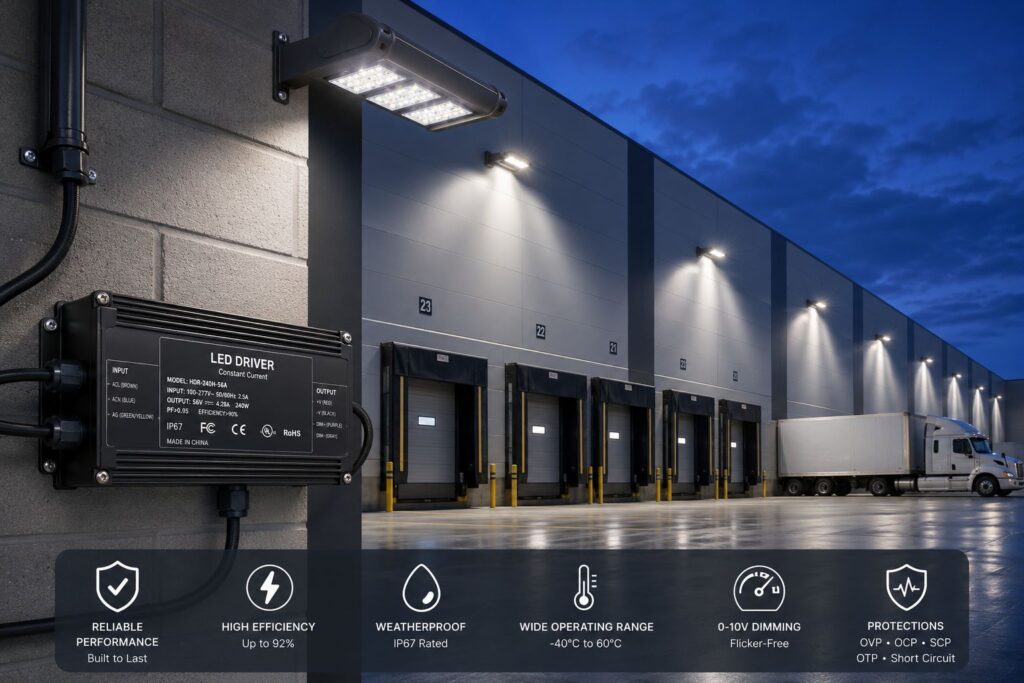
High-quality LED drivers regulate power, protect electronic components, and play a critical role in the long-term performance of commercial lighting systems.
Choose Commercial LED Lighting Engineered for Long-Term Reliability
Premium commercial LED fixtures depend on more than efficient LEDs—they also rely on high-quality drivers designed to deliver stable performance, superior energy efficiency, and years of dependable operation.
Browse our complete selection of commercial and industrial LED lighting solutions, or contact our lighting specialists for assistance selecting fixtures built with premium driver technology for your application.
What Is an LED Driver?
An LED driver is an electronic power supply specifically designed to operate light-emitting diodes (LEDs). Its primary purpose is to convert incoming electrical power into the precise voltage and current required for safe, efficient, and reliable LED operation.
Unlike incandescent lamps that can often operate directly from line voltage, LEDs require carefully controlled electrical input. Too much current can generate excessive heat and permanently damage the LEDs, while too little current reduces brightness and overall performance.
The LED driver continuously regulates this electrical output, ensuring the LEDs receive the correct amount of power regardless of normal fluctuations in the building’s electrical system.
Think of the LED driver as the fixture’s intelligent power management system. It constantly monitors and adjusts electrical conditions to help maintain consistent illumination while protecting both the LEDs and other electronic components.
What Does an LED Driver Do?
Although compact in size, an LED driver performs several critical functions simultaneously.
Its responsibilities include:
- Converting alternating current (AC) into direct current (DC)
- Regulating electrical current delivered to the LEDs
- Protecting LEDs from voltage fluctuations
- Maintaining consistent light output
- Improving overall energy efficiency
- Supporting dimming and lighting controls
- Helping reduce heat-related stress on electronic components
- Extending the operational life of the lighting system
Without an appropriately designed driver, even premium LED chips cannot achieve their intended performance or lifespan.
As discussed in our Complete Commercial LED Lifespan Guide, the driver is often one of the most influential components affecting the long-term reliability of an LED fixture.
Why LED Drivers Matter
When evaluating commercial lighting, buyers often compare lumen output, wattage, color temperature, beam distribution, and fixture appearance.
However, one of the most important differences between premium commercial fixtures and lower-cost alternatives is something most buyers never see—the quality of the driver.
A properly engineered LED driver helps deliver:
- Stable illumination throughout the fixture’s life
- Improved electrical efficiency
- Better protection against voltage fluctuations
- Reduced flicker
- Greater compatibility with lighting controls
- Lower operating temperatures
- Longer overall fixture life
Because the driver continuously manages power flowing to the LEDs, its reliability directly affects the performance of the entire lighting system.
For facility managers responsible for maintaining hundreds—or even thousands—of fixtures, selecting lighting equipped with commercial-grade drivers can significantly reduce maintenance requirements and improve long-term operating costs.
Where Are LED Drivers Used?
Nearly every commercial LED fixture relies on an integrated or remote-mounted driver.
Common applications include:
- Warehouse high bay lighting
- Commercial ceiling lights
- Parking lot lighting
- Area lighting
- Sports lighting
- Flood lighting
- Wall pack fixtures
- Vapor-tight lighting
- High mast lighting
- Post top fixtures
- Explosion-proof lighting
- Architectural lighting
Whether illuminating an office, distribution center, manufacturing plant, or municipal streetscape, the driver performs the same essential function—delivering stable, reliable electrical power to the LEDs.
For a broader overview of selecting commercial lighting systems, including fixture types and application recommendations, visit our Commercial Lighting Guide.
Project Spotlight
Premium Drivers Help Distribution Center Reduce Maintenance
A regional distribution center replaced aging HID high bay fixtures with commercial LED high bays equipped with premium programmable drivers.
In addition to reducing energy consumption, the new drivers provided more stable illumination, improved compatibility with occupancy sensors, and reduced maintenance by minimizing unexpected electronic failures.
Because replacing fixtures mounted more than 30 feet above the warehouse floor requires specialized lift equipment, investing in high-quality driver technology helped lower maintenance costs while improving overall operational reliability.
Learn how premium fixtures designed for demanding industrial environments improve long-term performance in our Commercial LED High Bay Lighting Guide.
Constant Current vs. Constant Voltage LED Drivers
Not all LED drivers operate the same way.
Commercial lighting systems generally rely on one of two driver technologies: constant current or constant voltage. While both regulate electrical power, they serve different applications and are designed to work with different types of LED products.
Understanding the distinction helps engineers, contractors, and facility managers specify lighting systems that deliver reliable performance while protecting the LEDs from electrical damage.
Constant Current LED Drivers
Constant current drivers are the most common choice for commercial and industrial LED fixtures.
Rather than supplying a fixed voltage, these drivers automatically adjust the output voltage while maintaining a consistent electrical current. This allows the LEDs to operate within their designed electrical parameters even as operating conditions change.
Because LEDs are highly sensitive to current fluctuations, maintaining a stable current helps improve:
- Long-term reliability
- Consistent brightness
- Thermal performance
- Energy efficiency
- Overall fixture lifespan
Most commercial fixtures—including high bays, parking lot lights, sports lighting, wall packs, and area lights—utilize constant current drivers because they provide superior protection for high-output LED arrays.
Constant Voltage LED Drivers
Constant voltage drivers maintain a fixed output voltage while allowing the connected lighting load to determine how much current is required.
These drivers are commonly used for products specifically designed to operate at standardized voltages, including:
- LED strip lighting
- Linear accent lighting
- Sign lighting
- Display lighting
- Decorative architectural lighting
Because the LEDs themselves incorporate current-limiting circuitry, the driver supplies a stable voltage while the connected devices regulate their own current requirements.
Although highly effective for these specialized applications, constant voltage drivers are generally less common in heavy-duty commercial lighting fixtures.
Whether a driver is required also depends on how the lighting system is powered. Our guide to line voltage vs. low voltage lighting explains the differences, typical commercial applications, and key design considerations.
Comparing Driver Types
| Feature | Constant Current | Constant Voltage |
|---|---|---|
| Primary Application | Commercial & Industrial Fixtures | LED Strips & Architectural Lighting |
| Output | Fixed Current / Variable Voltage | Fixed Voltage / Variable Current |
| Common Uses | High Bays, Area Lights, Parking Lots, Sports Lighting | Strip Lights, Cove Lighting, Signage |
| LED Protection | Excellent | Depends on Fixture Design |
| Typical Commercial Choice | Yes | Limited |
For most commercial lighting applications, constant current drivers remain the preferred solution because they provide the precise power regulation required for high-performance LED fixtures.
Premium Commercial LED High Bay Lighting systems almost exclusively utilize constant current drivers to deliver stable illumination and maximize service life in demanding warehouse and manufacturing environments.
How LED Drivers Regulate Power
One of the primary responsibilities of an LED driver is maintaining a stable electrical supply despite fluctuations in the building’s incoming power.
Commercial electrical systems rarely deliver perfectly consistent voltage. Normal variations occur throughout the day as electrical demand changes, equipment cycles on and off, and utility conditions fluctuate.
Without regulation, these variations could result in:
- Inconsistent brightness
- Excessive heat generation
- Reduced LED lifespan
- Driver instability
- Premature component failure
Modern commercial drivers continuously monitor incoming power and make rapid adjustments to deliver the correct electrical output required by the LEDs.
This intelligent regulation helps maintain consistent illumination while protecting the lighting system from normal electrical variations.
Inside an LED Driver
Although enclosed within a compact housing, commercial LED drivers contain sophisticated electronic components working together to provide stable, efficient power.
Typical components include:
Rectifier
Converts incoming alternating current (AC) into direct current (DC) required by LEDs.
Filtering Components
Smooth electrical fluctuations and help reduce unwanted electrical noise.
Capacitors
Store and stabilize electrical energy to maintain consistent output.
High-quality capacitors are among the most important contributors to long-term driver reliability.
Switching Electronics
Rapidly regulate output voltage and current to maximize efficiency while minimizing heat generation.
Protection Circuits
Help safeguard the driver and LEDs from:
- Voltage spikes
- Current overload
- Short circuits
- Thermal overload
- Abnormal operating conditions
Control Electronics
Many commercial drivers incorporate intelligent control circuitry supporting:
- Dimming
- Occupancy sensors
- Daylight harvesting
- Smart building controls
- Wireless communication
These advanced capabilities allow modern commercial lighting systems to reduce energy consumption while improving occupant comfort and operational efficiency.
Common Driver Features
Today’s commercial LED drivers do much more than simply power LEDs.
Many include advanced features that improve flexibility, energy savings, and system integration.
Popular features include:
0–10V Dimming
Allows smooth brightness adjustment using one of the most widely adopted commercial lighting control standards.
Widely used in:
- Offices
- Schools
- Warehouses
- Healthcare facilities
Programmable Output
Some drivers can be configured during installation to deliver different output currents, allowing a single fixture platform to support multiple lumen packages.
This simplifies inventory while providing greater flexibility for lighting designers.
Occupancy Sensor Compatibility
Commercial drivers frequently integrate with occupancy and motion sensors, automatically reducing light levels when spaces become unoccupied.
This feature is commonly used in:
- Warehouses
- Parking garages
- Storage rooms
- Manufacturing facilities
Daylight Harvesting
Drivers compatible with photocells and daylight sensors automatically adjust fixture output based on available natural light.
Benefits include:
- Lower energy consumption
- Improved occupant comfort
- Reduced operating costs
Emergency Lighting Compatibility
Many commercial fixtures utilize emergency drivers capable of operating selected fixtures during power outages.
These systems help maintain safe egress lighting in commercial buildings while meeting emergency lighting requirements.
Smart Lighting Integration
Modern drivers increasingly support intelligent lighting systems capable of:
- Remote monitoring
- Scheduling
- Wireless controls
- Energy reporting
- Predictive maintenance
As commercial buildings become smarter, the LED driver continues evolving from a simple power supply into an intelligent component of the overall building management system.
Learn how lighting controls fit into a complete facility lighting strategy in our Commercial Lighting Guide.
Project Spotlight
Smart Driver Technology Improves Campus Lighting Efficiency
A university upgraded multiple academic buildings with commercial LED ceiling fixtures equipped with programmable drivers and 0–10V dimming controls.
By integrating occupancy sensors and daylight harvesting controls, the campus reduced unnecessary lighting operation in classrooms, offices, and common areas while maintaining comfortable illumination for students and faculty.
The upgrade not only lowered electrical consumption but also improved long-term maintenance planning through more reliable commercial-grade driver technology.
Facility managers evaluating indoor lighting upgrades can learn more in our Commercial LED Ceiling Lights, which explains fixture selection for offices, schools, healthcare facilities, and commercial buildings.
Why Do LED Drivers Fail?
Commercial LED drivers are engineered for years of dependable operation, but like any electronic component, they have a finite service life. While premium drivers often perform reliably for decades, environmental conditions, electrical stress, and component quality all influence long-term performance.
Understanding the most common causes of driver failure helps facility managers reduce maintenance costs while selecting lighting systems designed for maximum reliability.
Commercial LED drivers can also be vulnerable to transient overvoltages, making surge protection an important consideration in demanding electrical environments.
Excessive Heat
Heat is one of the leading factors affecting the lifespan of electronic components.
Although LED fixtures generate less heat than many traditional lighting technologies, drivers still operate continuously whenever the fixture is energized. Elevated temperatures gradually accelerate the aging of internal electronic components, particularly capacitors.
Applications that place additional thermal demands on drivers include:
- Warehouses with high roof temperatures
- Manufacturing plants
- Steel mills
- Foundries
- Commercial kitchens
- Outdoor installations in hot climates
Premium fixtures utilize larger heat sinks, improved airflow, and carefully engineered housings to help maintain lower operating temperatures.
Facilities operating in elevated ambient temperatures should consider fixtures specifically engineered for demanding environments. Learn more in our LED High Temperature High Bay Lighting Guide.
Electrical Surges
Voltage spikes caused by lightning, utility switching, or heavy industrial equipment can damage sensitive electronic components inside LED drivers.
Even small electrical disturbances occurring repeatedly over time may gradually weaken internal circuitry.
Commercial-grade drivers often incorporate integrated surge protection, while facilities in areas with frequent electrical disturbances may benefit from additional external surge protection devices.
Outdoor applications—including parking lots, roadways, sports complexes, and municipal lighting—typically experience greater exposure to surge events than indoor installations.
Moisture and Corrosive Environments
Water intrusion, excessive humidity, airborne chemicals, and corrosive atmospheres can significantly reduce driver life if fixtures are not properly protected.
Examples include:
- Natatoriums
- Coastal properties
- Wastewater treatment plants
- Food processing facilities
- Agricultural buildings
- Marine terminals
- Chemical processing facilities
Selecting fixtures with appropriate IP ratings, corrosion-resistant finishes, and sealed electronic compartments helps maximize long-term reliability.
Inferior Components
Not every LED driver is built to the same standard.
Although two fixtures may advertise identical lumen output and wattage, the quality of their internal electronics can vary considerably.
Premium commercial drivers typically utilize:
- Higher-grade capacitors
- Better power management circuitry
- Improved thermal protection
- Enhanced surge suppression
- Commercial-grade electronic components
These differences often determine whether a fixture provides dependable operation for many years or experiences premature electronic failure.
How to Select a Quality Commercial LED Driverere
Choosing the right driver involves more than comparing wattage.
When evaluating commercial lighting, buyers should consider several key performance characteristics.
Driver Efficiency
Higher-efficiency drivers convert more incoming electrical power into usable energy while generating less waste heat.
Benefits include:
- Lower operating temperatures
- Improved energy efficiency
- Reduced electrical losses
- Longer component life
Because driver efficiency directly affects overall fixture performance, it’s important to understand how it contributes to lumens per watt and lighting efficiency.
Power Factor
Power factor measures how efficiently electrical power is utilized.
Commercial applications generally benefit from higher power factor drivers because they reduce unnecessary electrical demand while improving overall system efficiency.
Total Harmonic Distortion (THD)
Lower THD helps improve overall power quality and reduces unwanted electrical distortion within commercial electrical systems.
Facilities operating large numbers of fixtures often benefit from drivers designed with low THD characteristics.
Surge Protection Rating
Commercial outdoor fixtures should incorporate adequate surge protection appropriate for their installation environment.
Higher surge ratings improve resistance to electrical disturbances while helping protect valuable electronic components.
Operating Temperature Range
Always verify that the driver is rated for the expected ambient operating temperature.
Facilities with elevated temperatures or extremely cold environments should select fixtures specifically designed for those conditions.
Dimming Compatibility
If lighting controls will be installed, verify driver compatibility with:
- 0–10V dimming
- Occupancy sensors
- Daylight harvesting
- Building automation systems
- Smart lighting controls
Selecting compatible drivers during initial design simplifies future system expansion.
Replace the Driver or Replace the Fixture?
When an LED fixture stops operating, many facility managers ask whether replacing the driver is more economical than replacing the entire fixture.
The answer depends on several factors.
Driver replacement may be appropriate when:
- The fixture housing remains in excellent condition.
- Replacement drivers are readily available.
- The fixture is relatively new.
- Labor costs are reasonable.
Complete fixture replacement may provide greater long-term value when:
- The fixture is approaching the end of its service life.
- Multiple components show signs of aging.
- More efficient fixture technology is available.
- Maintenance access is expensive.
- Replacement parts are difficult to obtain.
For facilities with high mounting heights or difficult access, replacing the entire fixture during scheduled maintenance may reduce long-term labor costs.
The Future of Commercial LED Drivers
LED drivers continue evolving alongside advances in intelligent building technologies.
Modern commercial drivers increasingly support features such as:
- Wireless commissioning
- Bluetooth® Mesh networking
- Remote diagnostics
- Energy monitoring
- Predictive maintenance
- Occupancy analytics
- Cloud-based lighting management
- Programmable light output
- Tunable white lighting
- Scheduled lighting control
As commercial buildings become more connected, the LED driver is transforming from a simple power supply into an intelligent communication device capable of improving both energy efficiency and facility management.
Project Spotlight
Modern Driver Technology Simplifies Municipal Lighting Management
A municipal facilities department upgraded several public buildings with commercial LED lighting equipped with programmable drivers and intelligent lighting controls.
The new system allowed maintenance personnel to schedule lighting levels, monitor energy usage, and simplify future maintenance planning while improving occupant comfort throughout administrative offices and community spaces.
By selecting fixtures with commercial-grade drivers designed for long-term reliability, the municipality reduced maintenance requirements while creating a lighting system capable of adapting to future smart building technologies.
Inline Buyer Q&A
What is the primary purpose of an LED driver?
An LED driver converts incoming electrical power into the precise voltage and current required for safe, efficient LED operation while protecting the lighting system from electrical fluctuations.
Do premium LED drivers last longer?
Generally, yes. Premium drivers often incorporate higher-quality electronic components, better thermal protection, improved surge suppression, and more robust engineering designed for demanding commercial environments.
Can a failed LED driver be replaced?
Many commercial fixtures are designed with replaceable drivers, although the decision to replace the driver or the entire fixture depends on fixture age, labor costs, and overall condition.
Why do LED lights sometimes flicker?
Flickering may result from incompatible dimming controls, unstable electrical supply, driver issues, or aging electronic components. Properly matched commercial drivers help minimize these issues.
Are smart LED drivers worth the investment?
For many commercial facilities, smart drivers provide additional energy savings, improved maintenance planning, and greater flexibility through advanced lighting controls and building automation integration.
Specify Commercial LED Lighting Built for Long-Term Performance
The LED driver is one of the most important components inside a commercial LED fixture. From regulating electrical power and supporting lighting controls to protecting sensitive electronics and maintaining consistent fixture operation, driver quality can directly influence lighting-system performance and reliability.
Whether you’re illuminating a warehouse, manufacturing facility, office, sports complex, parking lot, or municipal property, fixture selection should consider not only lumen output and wattage but also driver quality, surge protection, thermal management, control compatibility, and warranty support.
👉 Explore our Commercial & Industrial LED Lighting Solutions or call 1-844-533-7767 to discuss your commercial lighting project.
Frequently Asked Questions
How long should a commercial LED driver last?
Quality commercial drivers are typically engineered to provide many years of dependable service, often matching the expected lifespan of the fixture under normal operating conditions.
Is the driver more important than the LED chips?
Both are essential, but even premium LED chips cannot perform properly without a well-designed driver that supplies stable electrical power.
What is the difference between an LED driver and a transformer?
A transformer primarily changes AC voltage, while an LED driver regulates the electrical output required by LEDs. Depending on the system, a driver may provide constant-current or constant-voltage output and may also support dimming, thermal protection, control interfaces, and other electronic functions.
Can lightning damage LED drivers?
Yes. Electrical surges associated with lightning, utility switching, and other power disturbances can damage LED drivers and other fixture electronics. Appropriate surge-protection strategies become particularly important for outdoor lighting and facilities exposed to unstable electrical conditions.
Are commercial LED drivers serviceable?
Many commercial fixtures use replaceable drivers, making it possible to repair the luminaire without replacing the entire fixture. Serviceability depends on fixture design, component availability, manufacturer support, and whether replacement parts remain available when service is required.
Stay Connected with Our Lighting Resources
Add IndustrialLightingFixtures.org as a Preferred Source on Google to see more of our lighting guides and technical resources across Google Search experiences.

Related Commercial LED Technology Resources
Continue learning about the components, operating conditions, and fixture applications that influence commercial LED lighting performance:
- Commercial LED Lifespan Guide — Learn how driver quality, LED components, thermal management, operating temperature, and electrical conditions influence commercial LED fixture service life.
- Commercial Lighting Guide — Review fixture selection, energy efficiency, controls, lighting performance, and other considerations when planning commercial LED lighting systems.
- LED High Temperature High Bay Lighting — Explore lighting designed for elevated ambient temperatures where thermal stress on drivers and other electronic components becomes a critical fixture-selection consideration.
- Commercial LED High Bay Lighting — Review high bay lighting for warehouses, manufacturing plants, distribution facilities, and other applications where driver reliability and long operating hours are important.
- Commercial Parking Lot Lighting — Explore outdoor LED lighting applications where drivers must withstand temperature changes, electrical surges, extended operating hours, and demanding environmental conditions.