Electrical surges can damage far more than traditional electrical equipment. Modern commercial and industrial LED lighting systems contain electronic drivers, controls, photocells, sensors, dimming components, and other electronics that can be vulnerable to transient overvoltages.
Surge protection helps reduce the risk that these short-duration electrical events will damage connected equipment or disrupt operation. For commercial facilities, the appropriate protection strategy may include surge protective devices at the electrical distribution system, protection closer to individual loads, or a coordinated combination of both.
For LED lighting, surge protection is particularly important in outdoor and pole-mounted applications, industrial facilities, sports lighting systems, warehouses, campuses, and other installations where electrical exposure or the cost of accessing and replacing failed fixtures can be significant.
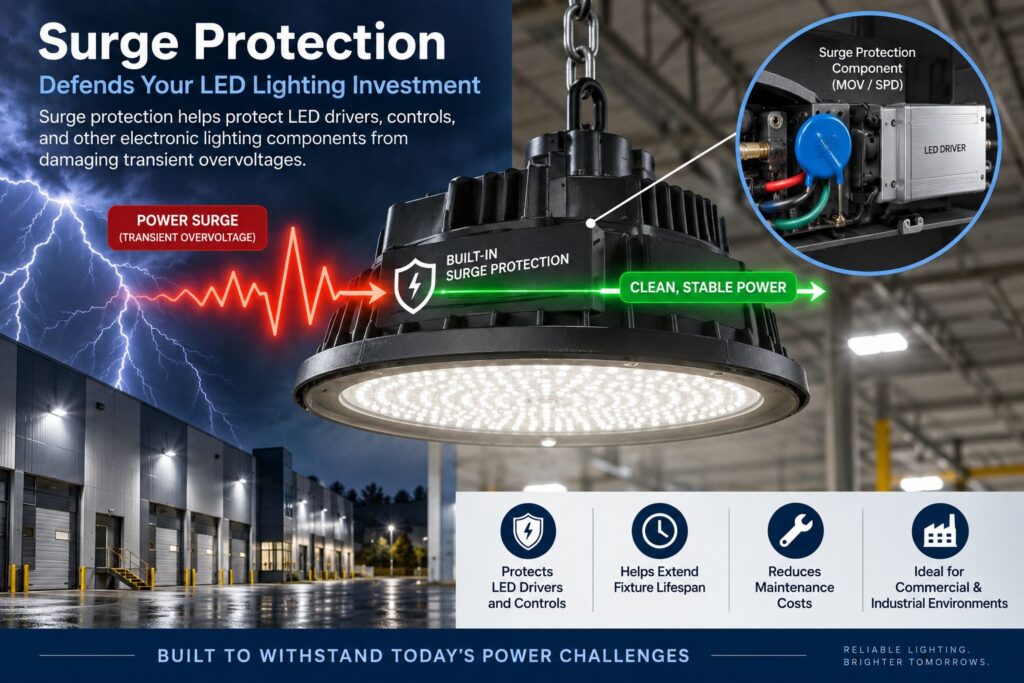
Surge protection helps protect LED drivers, controls, and other electronic lighting components from damaging transient overvoltages.
Protect Your LED Lighting Investment
Surge protection should be evaluated as part of the overall electrical and lighting design, particularly for outdoor, pole-mounted, industrial, and electrically demanding commercial applications.
Explore our commercial and industrial LED lighting products when planning a new lighting system or upgrading an existing installation.
What Is Surge Protection?
Surge protection is the use of electrical devices and system-design practices to limit potentially damaging transient overvoltages before they reach connected equipment.
A surge protective device, commonly abbreviated SPD, is designed to respond to transient electrical events by limiting voltage and diverting surge current. These events can originate from lightning activity, switching operations, electrical equipment, or disturbances elsewhere in the power system.
Surges are generally short-duration events. IEEE C62.41.2-2025 characterizes surges on low-voltage AC power circuits as events that do not exceed one-half cycle of the normal mains waveform and that can occur between combinations of line, neutral, and grounding conductors.
Surge protection should not be confused with protection against every type of power-quality problem. Voltage sags, prolonged overvoltage, electrical noise, outages, and other disturbances can require different solutions.
Why Do LED Lighting Systems Need Surge Protection?
LED fixtures differ from older incandescent and many conventional lighting systems because the LED light source operates through an electronic driver. The driver converts incoming electrical power into the controlled current and voltage required by the LEDs.
Commercial luminaires may also incorporate:
- photocells and daylight controls;
- occupancy or motion sensors;
- 0–10V dimming;
- programmable drivers;
- wireless lighting controls;
- networked lighting systems;
- monitoring and communication electronics.
These components increase lighting functionality but also mean that a modern luminaire contains electronic equipment that can be affected by transient electrical events.
A sufficiently severe surge can cause immediate component failure. Repeated electrical stress can also contribute to premature deterioration of susceptible electronic components.
This becomes particularly important when fixtures are mounted high above the ground, distributed across a large property, or located where replacement requires lifts, traffic control, production shutdowns, or other costly access.
What Causes Electrical Surges?
Lightning is an important source of electrical surges, but it is not the only one.
Lightning-Related Surges
A direct lightning event can produce extremely high electrical energy, but a direct strike to a luminaire is not required for lighting equipment to experience a transient.
Nearby lightning activity can induce transient voltages in electrical conductors and interconnected systems.
Outdoor lighting installations deserve particular attention because poles, long conductor runs, and distributed electrical circuits can increase exposure.
Switching and Equipment-Generated Transients
Industrial and commercial electrical systems contain equipment that repeatedly switches electrical loads.
Motors, transformers, contactors, HVAC systems, pumps, and other equipment can contribute to electrical disturbances when operating or switching.
This means an industrial facility can experience transient activity even when there is no lightning nearby.
Utility and Distribution Events
Electrical disturbances can also originate elsewhere in a building’s electrical distribution system or upstream from the facility.
The practical lesson is simple:
Surge risk should not be evaluated solely by asking whether a property is likely to experience a direct lightning strike.
Industrial Surge Protection for Commercial Facilities
Industrial surge protection should consider the complete electrical environment rather than one individual piece of equipment.
Manufacturing plants, warehouses, processing facilities, distribution centers, transportation facilities, and other commercial properties can contain combinations of motors, HVAC systems, transformers, machinery, lighting controls, and sensitive electronic equipment.
Modern LED lighting becomes another electronic load within that environment.
For these facilities, a surge-protection assessment may consider:
- incoming electrical service;
- distribution panels;
- branch circuits;
- system voltage and configuration;
- sensitive equipment;
- lighting circuits;
- LED drivers and controls;
- outdoor equipment;
- long conductor runs;
- exposure to lightning;
- switching equipment;
- consequences of equipment failure.
The objective is not necessarily to specify the largest SPD available. The objective is to select protection appropriate for the electrical system, equipment, exposure, and installation location.
Where Is LED Lighting Surge Protection Most Important?
Although transient protection can be considered for virtually any commercial lighting system, certain applications deserve particular attention.
| Application | Why Surge Protection Matters |
|---|---|
| Parking lot lighting | Elevated poles, outdoor exposure, long circuits, and expensive fixture access |
| Street and roadway lighting | Distributed outdoor electrical systems and environmental exposure |
| Sports lighting | Tall mounting heights, high-output luminaires, and costly service access |
| Industrial facilities | Motors, machinery, transformers, and electrical switching activity |
| Warehouses | Large fixture populations and potential widespread maintenance costs |
| High-bay lighting | Elevated mounting and difficult fixture replacement |
| Campus lighting | Distributed circuits serving multiple outdoor lighting applications |
| Building exterior lighting | Outdoor exposure and connection to facility electrical systems |
| Networked lighting systems | Additional electronic drivers, sensors, controllers, and communications equipment |
Fixture-Level vs. Panel-Level Surge Protection
Surge protection can be installed at different locations within an electrical system. These approaches should not automatically be viewed as alternatives to one another.
Service and Distribution-Level Protection
An SPD installed at service or distribution equipment can limit transient energy before it propagates farther into the facility’s electrical system.
This approach can provide broader protection for multiple downstream loads.
Fixture-Level Protection
Commercial LED luminaires may incorporate surge protection internally or use a separate SPD located near the luminaire or driver.
Placing protection close to the equipment being protected can provide another level of defense against transients reaching sensitive fixture electronics.
Layered Surge Protection
For some commercial and industrial systems, protection at multiple locations can provide a more comprehensive approach.
For example, facility-level protection may be combined with protection farther downstream or at particularly sensitive or exposed equipment.
IEEE guidance specifically recognizes interactions between multiple SPDs installed on the same electrical circuit, reinforcing the importance of considering protection as a coordinated system rather than simply adding unrelated devices.
The appropriate configuration should be determined according to the electrical system and project requirements by qualified electrical professionals.
Built-In Surge Protection in Commercial LED Fixtures
Many commercial and industrial LED luminaires include surge protection as part of the fixture’s electrical design. This protection may be incorporated into the LED driver, provided by a separate surge protective component inside the fixture, or designed as a replaceable module ahead of sensitive electronics.
Built-in surge protection is particularly valuable for parking lot lights, street and roadway fixtures, sports lights, floodlights, wall packs, high bays, and other commercial luminaires installed in locations where electrical transients can damage LED drivers and controls.
Fixture specifications may describe surge protection using ratings such as 6 kV, 10 kV, or 20 kV. These values should not be interpreted simply as a scale where the highest number automatically identifies the best fixture. The test method, electrical configuration, protection mode, driver design, application, and expected surge environment also matter.
Built-In vs. External Surge Protection
Built-in fixture protection and electrical-system surge protection serve related but different purposes.
| Protection | Location | Primary Role |
|---|---|---|
| Driver-integrated protection | Within LED driver | Helps protect driver electronics from specified transient conditions |
| Fixture-integrated SPD | Inside luminaire | Provides localized protection close to the driver and controls |
| Replaceable fixture SPD | Inside/adjacent to luminaire | Local protection with potential serviceability after SPD failure |
| Panel/service SPD | Electrical distribution system | Limits surge energy entering or propagating through downstream circuits |
A fixture advertised with built-in surge protection should therefore not automatically be considered a substitute for properly selected service or distribution-level protection. In higher-exposure commercial applications, these protective measures can be used together as part of a layered strategy.
What Should Buyers Look for in a Fixture's Surge Protection?
When comparing commercial LED fixtures, review the manufacturer’s specifications for:
- stated surge protection or withstand level;
- applicable test standard or test method;
- whether protection is integral to the driver or provided by a separate SPD;
- protection modes;
- whether the protective component is replaceable;
- failure or end-of-life behavior;
- fixture voltage and electrical configuration;
- warranty provisions related to surge damage.
For projects involving elevated poles, exposed outdoor locations, expensive luminaires, difficult service access, or areas with significant lightning or electrical-transient exposure, surge protection should be considered during fixture selection, not only after the lighting system has been installed.
Power Factor, THD, and Surge Protection
Surge protection is only one electrical characteristic to consider when specifying commercial LED lighting. Power factor (PF) and total harmonic distortion (THD) provide different information about how an LED driver interacts with the electrical system.
Power factor describes how effectively an AC electrical load converts supplied electrical power into useful real power. Commercial LED drivers are commonly designed for high power factor, particularly at their rated operating load.
Total harmonic distortion (THD) describes distortion of the electrical current waveform caused by nonlinear loads such as electronic power supplies and LED drivers. Lower current THD generally indicates less harmonic distortion introduced by the equipment.
Neither specification tells a buyer how well a fixture withstands a transient surge:
| Specification | What it addresses |
|---|---|
| kV surge rating | Transient voltage withstand/protection performance under specified testing |
| kA surge rating | Surge-current capability under specified conditions |
| Power Factor (PF) | Relationship between real and apparent power |
| THD | Harmonic distortion associated with the electrical load |
A commercial LED fixture can therefore have high power factor and low THD yet still require appropriate surge protection. Conversely, a fixture with substantial built-in surge protection does not automatically have superior power-factor or harmonic performance.
Surge Protection and Power Factor Correction Are Different Functions
The original version of this page featured equipment that combined surge protection with power factor correction. These functions should not be confused.
Surge protection addresses transient overvoltages that can damage electrical and electronic equipment.
Power factor correction addresses the relationship between real and reactive power in AC electrical systems and may be used to improve power factor under appropriate circumstances.
A product may incorporate both functions, but one does not replace the other.
For modern commercial lighting projects, each should be evaluated according to the electrical characteristics and requirements of the facility.
Legacy BTU Research Surge Protection Products
LED Pros WorldWide originally published this page in 2013 to provide information about BTU Research SURGE-PRO and ARC-TECH PRO surge protective devices.
Those products were presented for applications that included electrical-panel and load-level protection, single- and three-phase systems, and equipment incorporating surge protection with power factor correction.
This page has since been expanded into a broader educational resource addressing modern surge protection for commercial and industrial electrical systems and LED lighting applications.
Type 1 vs. Type 2 Surge Protective Devices
Understanding SPD classifications is important when evaluating commercial surge protection.
Type 1 SPD
Type 1 devices are intended for installation where their listing and electrical characteristics permit their use on the line or load side of the service disconnect overcurrent protective device.
Type 2 SPD
Type 2 devices are installed on the load side of the service disconnect overcurrent protective device.
UL documentation also notes that SPDs investigated for Type 1 applications can be suitable for Type 2 applications, while devices marked only as Type 2 are not suitable for Type 1 applications.
This is why SPD type is an installation classification—not simply a measure of whether one device provides “better” protection than another.
Understanding Surge Protection Device Specifications
SPD specifications can be confusing because no single number tells the entire story.
| Specification | Why It Matters |
|---|---|
| System voltage | SPD must be appropriate for the electrical system it protects |
| SPD type | Identifies the intended installation location |
| Surge current rating | Indicates specified surge-current capability |
| Nominal discharge current (In) | Standardized current value used in SPD evaluation |
| Voltage Protection Rating (VPR) | Indicates voltage-limiting performance under specified testing |
| Maximum Continuous Operating Voltage (MCOV) | Maximum continuous voltage that can be applied to the SPD under specified conditions |
| Short-Circuit Current Rating (SCCR) | Identifies fault-current conditions for which the device has been evaluated |
| Modes of protection | Identifies conductor combinations across which protection is provided |
| Environmental rating | Determines suitability for indoor, outdoor, or other environmental conditions |
| Status indication | Allows maintenance personnel to determine whether protection remains operational |
Is a Higher kA Rating Always Better?
Not necessarily.
A higher surge-current rating by itself does not establish that an SPD is the correct device for an installation.
System voltage, SPD type, voltage protection rating, MCOV, SCCR, modes of protection, environmental suitability, installation location, and equipment requirements all need consideration.
UL 1449 and Surge Protective Devices
UL 1449 is the principal U.S. product safety standard associated with surge protective devices.
UL’s current certification information identifies SPD characteristics such as Type, voltage, phase, protection mode, VPR, MCOV, nominal discharge current, and SCCR. UL documentation also distinguishes Type 1 and Type 2 installation requirements.
For commercial and industrial projects, specifying an SPD therefore involves more than asking for a generic “surge protector.” The device needs to be appropriate for the system voltage, configuration, intended installation point, environmental conditions, and other applicable electrical requirements.
UL certification records currently reference evaluation to UL 1449, 5th Edition, including subsequent revisions for listed products. UL Solutions surge protection information
IEEE C62.41.2 and Low-Voltage Surge Environments
Another important current reference is IEEE C62.41.2-2025, Recommended Practice on Characterization of Surges in Low-Voltage (1000 V and Less) AC Power Circuits.
The 2025 revision characterizes surge environments using standardized waveforms and other stress parameters. It recognizes that surges can occur between line, neutral, and grounding conductors and can have sufficient amplitude, duration, or rate of change to damage equipment or disrupt operation.
This is particularly relevant when engineers and manufacturers evaluate the surge environment and equipment withstand requirements rather than treating every electrical installation as having identical exposure.
IEEE C62.41.2-2025
Surge Protection Does Not Replace Proper Grounding and Bonding
An SPD should not be treated as a substitute for proper electrical-system design.
Grounding, bonding, wiring practices, conductor routing, overcurrent protection, and compliance with applicable electrical requirements remain fundamental parts of the installation.
Likewise, surge protection does not guarantee that equipment will survive every possible electrical event. Extreme lightning events and other abnormal conditions can exceed the capabilities of protective equipment.
A properly selected SPD is therefore one component of a broader electrical-protection strategy.
Surge Protection for Outdoor and Pole-Mounted LED Lighting
Outdoor LED lighting is one of the applications where surge protection deserves especially careful consideration.
Parking lots, roadways, campuses, industrial yards, sports facilities, and commercial properties frequently use luminaires mounted on poles and connected through long electrical runs.
These systems combine sensitive LED electronics with environmental exposure and potentially expensive maintenance access.
When planning an outdoor lighting system, consider:
- service or distribution-level surge protection;
- fixture-level protection;
- grounding and bonding;
- pole configuration;
- branch-circuit length;
- lightning exposure;
- system voltage;
- LED driver specifications;
- photocells and lighting controls;
- accessibility of fixtures;
- cost of future replacement.
For facilities with dozens or hundreds of exterior luminaires, avoiding even a portion of premature electronic failures can have meaningful maintenance implications.
See our commercial outdoor LED lighting resources for additional information about exterior lighting applications.
Surge Protection for Parking Lot Lighting
Parking lot lighting illustrates why surge protection should be considered during system design rather than after failures begin occurring.
LED parking lot fixtures are commonly installed high on poles and distributed over large areas. Servicing a failed driver or luminaire can require a bucket truck or lift in addition to replacement components and labor.
Electrical protection therefore affects more than fixture reliability—it can influence long-term maintenance costs and property operations.
Explore LED parking lot lighting when planning commercial area-lighting upgrades.
LED Drivers, Sensors, and Lighting Controls
A surge does not have to destroy the LED array itself to cause a lighting-system failure.
A luminaire can become inoperative because of damage to its:
- LED driver;
- photocell;
- occupancy sensor;
- dimming interface;
- wireless controller;
- network interface;
- other electronic control components.
As commercial lighting becomes more intelligent and interconnected, protecting these electronics becomes increasingly relevant.
Our LED Drivers Guide explains how drivers regulate power to commercial LED fixtures and why driver quality is important to lighting-system performance.
Buyer Questions About Commercial LED Surge Protection
How much surge protection does an LED fixture need?
There is no single surge rating appropriate for every LED installation. The electrical system, fixture specifications, installation location, exposure, controls, and project requirements should all be considered.
Is fixture-level surge protection enough?
Not necessarily. Fixture-level protection places an SPD close to the luminaire, while service or distribution-level devices address transients elsewhere in the electrical system. Some installations benefit from coordinated protection at multiple locations.
Should outdoor LED fixtures have surge protection?
Outdoor and pole-mounted fixtures are particularly worth evaluating because of environmental exposure, long electrical runs, mounting height, and the expense associated with accessing failed fixtures.
Does a higher kA rating automatically provide better protection?
No. Surge-current capability is only one specification. VPR, MCOV, SCCR, system voltage, modes of protection, SPD type, and installation requirements also matter.
Can surge protection protect LED lighting from a direct lightning strike?
SPDs are designed to limit transient electrical energy reaching protected equipment, but they should not be represented as guaranteeing protection against every direct lightning event or extreme electrical condition.
Do commercial LED fixtures have built-in surge protection?
Many commercial LED fixtures provide some level of built-in transient protection through the LED driver or a separate internal surge protective component. The level and type of protection vary by fixture, so buyers should review the manufacturer’s electrical specifications rather than assuming all LED luminaires provide equivalent surge protection. Built-in protection also does not necessarily eliminate the need for panel-level or other system-level SPDs.
Protect Commercial LED Lighting from Electrical Surges
Reliable LED fixtures are only one part of a durable commercial lighting system. Electrical distribution, surge exposure, drivers, controls, installation conditions, and maintenance requirements should also be considered when specifying equipment.
Contact LED PROS WorldWide to discuss commercial or industrial LED lighting requirements, or call 844-533-7767.
Frequently Asked Questions About Surge Protection
What is a surge protective device?
A surge protective device, or SPD, is electrical equipment designed to limit transient overvoltages and divert surge current so that less damaging electrical energy reaches protected equipment.
What causes power surges in commercial buildings?
Potential sources include lightning activity, electrical switching, motors, transformers, HVAC equipment, machinery, and disturbances within or upstream of the electrical distribution system.
What is the difference between a power surge and an overvoltage?
A surge is a short-duration transient event. Longer-duration abnormal voltage conditions are different power-quality events and may require different protective measures.
What does kA mean on a surge protector?
kA means kiloamperes and is commonly used when specifying surge-current capability. It should be evaluated together with other SPD ratings rather than used as the sole selection criterion.
What is the difference between Type 1 and Type 2 surge protection?
Type 1 and Type 2 refer primarily to where an SPD is permitted to be installed within the electrical distribution system. Type 1 devices can be suitable for line- or load-side service applications when properly listed, while Type 2 devices are installed on the load side of the service overcurrent device.
Does surge protection prevent every LED lighting failure?
No. Surge protection addresses transient electrical events. LED fixtures can also fail because of heat, moisture, component aging, improper installation, driver problems, sustained electrical abnormalities, or other causes.
Stay Connected with Our Lighting Resources
Add IndustrialLightingFixtures.org as a Preferred Source on Google to see more of our lighting guides and technical resources across Google Search experiences.

Related Surge Protection & LED Electrical Resources
What Are LED Drivers? — Learn how drivers regulate electrical power for commercial LED fixtures and why driver performance affects system reliability.
Commercial & Industrial LED Lighting Products — Explore indoor, outdoor, industrial, hazardous-location, aviation, solar, architectural, and specialty LED lighting solutions.
Commercial Outdoor LED Lighting — Review outdoor lighting systems where pole mounting, long electrical runs, environmental exposure, and maintenance access can make surge protection particularly important.
LED Parking Lot Lights — Explore commercial pole-mounted area lighting applications where electrical protection should be considered as part of overall system design.