
Commercial LED area lights are among the most widely used outdoor lighting fixtures for illuminating large outdoor spaces where safe vehicle movement, pedestrian visibility, and nighttime operations are essential. From retail shopping centers and office campuses to industrial facilities, healthcare complexes, distribution centers, schools, and municipal properties, these fixtures deliver broad, uniform illumination that enhances both safety and operational efficiency.
Many lighting professionals still refer to these fixtures as shoebox lights, a nickname that originated from their rectangular housing design. While the name remains common within the industry, today’s commercial LED area lights have evolved well beyond their original appearance. Modern luminaires incorporate precision optical systems, multiple light distribution patterns, advanced surge protection, intelligent lighting controls, and energy-efficient LED technology that significantly outperform the metal halide and high-pressure sodium fixtures they often replace.
Selecting the right area light involves much more than choosing a wattage. Proper fixture performance depends on several interrelated factors, including mounting height, optical distribution, pole spacing, lighting controls, color temperature, and site-specific design objectives. Understanding how these elements work together helps property owners, engineers, and contractors create lighting systems that improve visibility while minimizing energy consumption and long-term maintenance costs.
Selecting the right fixture is only the beginning. Our Commercial Outdoor Area Lighting Design Guide explains how pole spacing, layered lighting, optical distributions, lighting controls, and site planning work together to create successful commercial lighting systems.
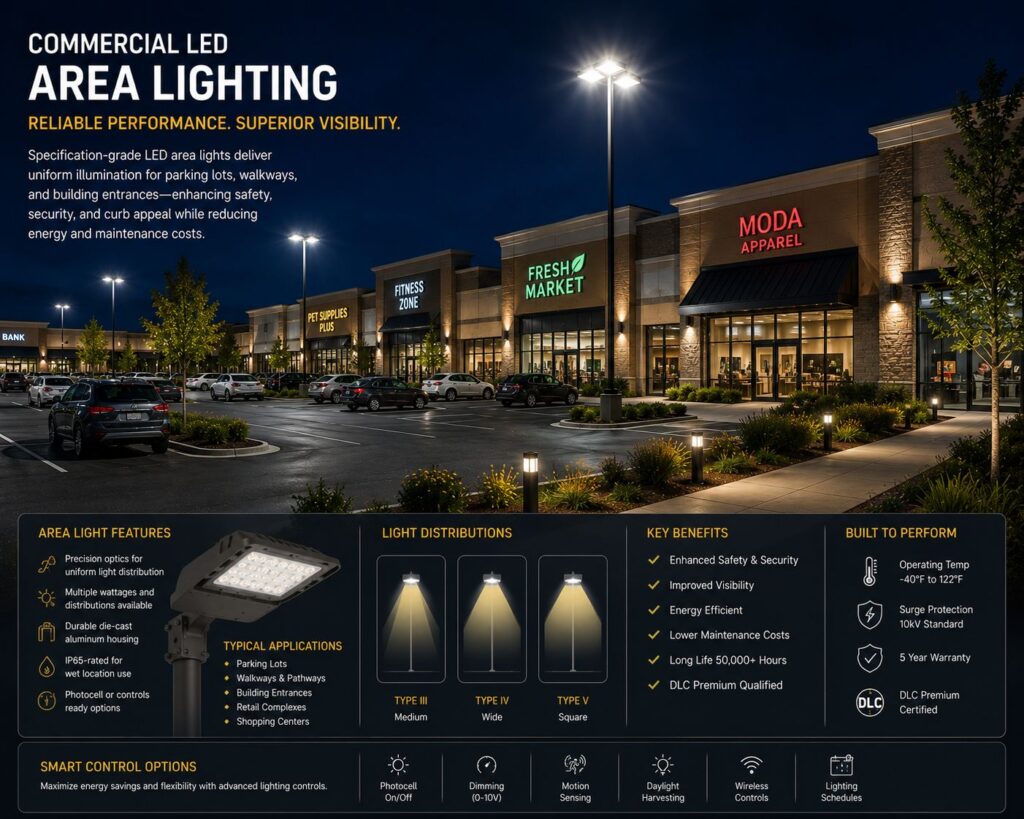
Commercial LED area lights provide uniform illumination for parking lots, campuses, industrial facilities, and commercial properties while improving visibility, safety, and energy efficiency.
Looking for Commercial LED Area Lights for Your Project?
Whether you’re illuminating a parking lot, distribution center, office campus, healthcare facility, retail center, or municipal property, selecting the right LED area light involves more than simply choosing a wattage. Our lighting specialists can help you identify the proper fixture, optical distribution, mounting option, lighting controls, and pole height to maximize performance while reducing long-term operating costs.
👉 Browse our complete selection of Commercial LED Area Lights or contact us for expert assistance with your next outdoor lighting project.
Commercial LED Area Lights at a Glance
| Feature | Benefit |
|---|---|
| Precision LED Optics | Uniform illumination with reduced glare |
| Multiple Optical Distributions | Optimized light placement for different site layouts |
| Pole-Mounted Installation | Wide-area coverage for commercial properties |
| Smart Control Compatibility | Supports photocells, motion sensors, and networked controls |
| Long Service Life | Reduced maintenance and lower operating costs |
| High Energy Efficiency | Significant energy savings compared to legacy HID lighting |
What Are Commercial LED Area Lights?
Commercial LED area lights are high-output outdoor luminaires specifically designed to illuminate large open spaces from elevated mounting positions. Unlike wall-mounted fixtures or flood lights that concentrate light in a specific direction, area lights distribute illumination across broad horizontal surfaces, creating uniform lighting for vehicle traffic, pedestrians, and facility operations.
These fixtures are typically mounted on steel, aluminum, or concrete poles ranging from 15 to 40 feet in height. Depending on the application, they may be installed individually along roadways, in parking lots, around industrial facilities, or throughout large commercial campuses.
Although often called shoebox lights because of their rectangular shape, today’s commercial LED area lights incorporate advanced engineering features such as precision optics, integrated heat management, surge protection, dimming capability, and compatibility with smart lighting controls. Their combination of performance, durability, and energy efficiency has made them the preferred replacement for traditional HID parking lot and site lighting systems.
Once you’ve selected the appropriate fixture, continue to our Commercial Area Lighting Design Guide to learn about pole spacing, lighting layouts, foot-candle recommendations, uniformity ratios, and best practices for designing commercial outdoor lighting systems.
🛠️ Field Experience
One of the most common mistakes encountered during lighting upgrades is selecting replacement fixtures based solely on wattage. Two fixtures with identical wattages can produce dramatically different lighting performance depending on their optical distribution, mounting height, and pole spacing.
For example, replacing a 400-watt metal halide fixture with a similarly rated LED fixture may not deliver the desired results if the optical pattern is incorrect. Successful projects begin by evaluating the lighting layout, fixture spacing, and illumination requirements rather than attempting a simple watt-for-watt replacement.
Common Commercial Applications
Commercial LED area lights are designed to provide reliable illumination across a wide variety of outdoor environments. Selecting the appropriate fixture depends on how each property is used, expected traffic patterns, mounting heights, and required lighting levels.
Parking Lots
Parking lots remain one of the most common applications for commercial LED area lights. Uniform illumination improves driver visibility, helps pedestrians navigate safely between vehicles and building entrances, and supports surveillance camera performance. Properly designed parking lot lighting minimizes dark areas while reducing glare that can distract drivers or neighboring properties.
Parking lots are one of the most common applications for Commercial LED Parking Lot Lights, where proper optics, mounting heights, and lighting controls help create safe, efficient outdoor environments.
Distribution Centers & Logistics Facilities
Distribution centers require dependable lighting that supports truck traffic, trailer storage, loading docks, and employee parking throughout the day and night. LED area lights provide broad coverage across expansive paved areas while maintaining excellent visibility for vehicle operators, shipping personnel, and security staff. Intelligent controls can further reduce operating costs by dimming fixtures during periods of low activity.
Industrial Facilities
Manufacturing plants, fabrication shops, equipment yards, and processing facilities often operate around the clock. Commercial LED area lights help illuminate employee entrances, outdoor work areas, storage yards, and access roads, allowing personnel to work safely while improving security around valuable equipment and inventory.
Office Campuses
Office parks and corporate campuses use area lighting to create safe, welcoming environments for employees and visitors. Proper illumination enhances parking areas, sidewalks, landscaped gathering spaces, and building entrances while complementing the property’s architectural appearance.
Healthcare Facilities
Hospitals, medical centers, and outpatient clinics rely on outdoor lighting to support patient safety, emergency vehicle access, visitor parking, and pedestrian circulation. Uniform lighting around entrances, drop-off zones, and parking lots helps visitors navigate unfamiliar environments while improving nighttime visibility for staff and first responders.
Municipal & Public Properties
Cities, counties, and public agencies use commercial LED area lights to illuminate libraries, fire stations, public works facilities, community centers, recreation complexes, and government buildings. Long fixture life and reduced maintenance requirements make LED technology particularly attractive for municipalities seeking to lower operating costs while improving public safety.
📋 Specification Tip
Professional lighting designers typically begin with the required illumination levels for the site rather than fixture wattage alone. Mounting height, pole spacing, optical distribution, and desired uniformity all influence fixture selection. Choosing the correct optic often delivers better lighting performance than simply increasing fixture output, resulting in improved visibility, lower glare, and more efficient energy use.
Typical Pole Heights
Pole height is one of the most important factors affecting the performance of a commercial area lighting system. Taller poles allow each fixture to illuminate a larger area, potentially reducing the total number of poles required. Shorter poles provide more localized lighting and may improve visual comfort in pedestrian-oriented environments.
Typical commercial installations include:
| Pole Height | Typical Applications |
|---|---|
| 15–20 ft | Pedestrian walkways, small parking lots, parks, HOA communities |
| 20–25 ft | Office campuses, retail centers, schools |
| 25–30 ft | Commercial parking lots, healthcare facilities, municipal properties |
| 30–40 ft | Industrial facilities, distribution centers, large commercial sites |
Pole height should always be coordinated with fixture optics and spacing to achieve consistent illumination while minimizing dark spots and excessive glare.
The performance of any area lighting system depends on selecting compatible Commercial Light Poles that provide the proper mounting height, structural capacity, and installation flexibility for your project.
Mounting Options
Commercial LED area lights are available with several mounting configurations to accommodate new construction, retrofit projects, and specialized installation requirements.
Straight Arm Mounts are the most common option for square and round poles, providing a clean, rigid installation suitable for parking lots and commercial properties.
Slip Fitter Mounts install over tenons and allow installers to adjust the fixture angle, making them ideal for roadway lighting, campuses, and projects requiring precise aiming.
Adjustable Arm Mounts offer additional flexibility where existing pole configurations or site conditions require customized fixture orientation.
Trunnion (Yoke) Mounts are commonly used when fixtures are mounted to flat surfaces, rooftops, equipment platforms, or structural supports instead of poles.
Wall Mount Adapters allow certain area lights to be installed directly on building exteriors where pole installations are impractical while still providing broad outdoor illumination.
Selecting the appropriate mounting option helps simplify installation, maintain structural integrity, and ensure the fixture delivers its intended light distribution.
NEMA Receptacles & Lighting Controls
Many specification-grade commercial LED area lights are available with ANSI C136-compliant NEMA receptacles, allowing lighting controls to be added or upgraded without replacing the fixture.
The most common configurations include:
- 3-Pin NEMA — Standard dusk-to-dawn photocells for automatic operation.
- 5-Pin NEMA — Supports photocells along with 0–10V dimming for bi-level lighting and motion sensor integration.
- 7-Pin NEMA — Designed for smart city nodes, remote monitoring, adaptive lighting, and networked lighting management systems.
Selecting a smart-ready NEMA receptacle during the initial installation provides flexibility for future lighting upgrades as operational needs and control technologies evolve.
Optical Distributions: Putting Light Where It's Needed
One of the most important decisions when specifying commercial LED area lights is selecting the correct optical distribution. While fixture wattage determines how much light is produced, the optic determines where that light is delivered.
A properly selected optical distribution improves uniformity, minimizes wasted light, reduces glare, and often allows fewer fixtures to illuminate the same area.
The Illuminating Engineering Society (IES) classifies outdoor lighting optics into several distribution types commonly used for commercial applications.
Type II Distribution
Type II optics create a narrow, elongated light pattern that projects farther forward than to the sides. They are frequently used along sidewalks, narrow roadways, bicycle paths, and perimeter roadways where lighting follows a linear route.
Type III Distribution
Type III optics are among the most versatile options for commercial properties. Their wider forward throw makes them well suited for parking lots, office campuses, retail developments, schools, and municipal facilities where balanced illumination is desired.
Type IV Distribution
Type IV optics project light predominantly in one direction. These distributions are often installed along property lines, building perimeters, loading docks, and large open areas where illumination is needed away from the pole while minimizing light behind the fixture.
Type V Distribution
Type V optics produce a nearly symmetrical distribution around the pole, making them ideal for open parking lots, intersections, public plazas, and large gathering areas requiring broad, even coverage.
🛠️ Field Experience
One of the most common causes of poor parking lot lighting is selecting the wrong optic rather than the wrong fixture. Installing a Type V optic where a Type III distribution is needed can create excessive overlap near the pole while leaving darker areas farther away. Proper optic selection often improves lighting performance without increasing fixture wattage.
BUG Ratings & Responsible Outdoor Lighting
As outdoor lighting design has evolved, minimizing unwanted light has become just as important as producing sufficient illumination.
BUG ratings evaluate three aspects of fixture performance:
- Backlight — Light projected behind the fixture that may spill onto neighboring properties.
- Uplight — Light directed upward into the night sky.
- Glare — High-angle light that can reduce visibility or create discomfort for drivers and pedestrians.
Choosing fixtures with appropriate BUG ratings helps reduce light trespass, improve visual comfort, and support responsible outdoor lighting practices.
Many municipalities and commercial developments now consider BUG ratings during the design and permitting process, particularly where properties border residential neighborhoods or environmentally sensitive areas.
📋 Specification Tip
When comparing fixtures with similar lumen output, review their BUG ratings in addition to efficacy and wattage. A fixture with well-controlled optics often produces better nighttime visibility while reducing glare and minimizing unnecessary light outside the intended coverage area.
Surge Protection Matters
Outdoor lighting systems are continually exposed to electrical disturbances caused by lightning activity, utility switching, and power fluctuations.
To improve long-term reliability, many specification-grade LED area lights include integrated surge protection.
Typical commercial options include:
| Surge Rating | Recommended Applications |
|---|---|
| 10kV | Retail centers, office campuses, schools |
| 20kV | Industrial facilities, distribution centers, airports, utility infrastructure, regions with frequent lightning activity |
Higher surge protection ratings help safeguard LED drivers and electronic components, reducing maintenance costs and extending fixture life.
Choosing the Right Color Temperature
Color temperature affects how an outdoor space appears at night and influences visibility, occupant comfort, and the overall character of a property.
3000K
Produces a warm white appearance that complements pedestrian-oriented environments, hospitality properties, parks, and residential-style developments where visual comfort is a priority.
4000K
Provides a neutral white light that balances visibility and comfort. It is widely specified for office campuses, educational facilities, healthcare campuses, municipal properties, and commercial parking lots.
5000K
Creates a crisp daylight-white appearance that enhances visibility in industrial facilities, logistics centers, equipment yards, ports, and manufacturing operations where recognizing detail is important.
Color temperature selection should support the intended use of the property while considering local ordinances, community preferences, and project objectives.
Retrofitting Existing Parking Lot Poles
Many commercial lighting upgrades involve replacing aging HID fixtures while retaining existing poles and electrical infrastructure.
A successful retrofit begins by evaluating more than fixture wattage.
Important considerations include:
- Pole structural condition
- Existing mounting configuration
- Wiring condition
- Wind load compatibility
- Effective Projected Area (EPA)
- Pole height
- Fixture spacing
- Existing illumination levels
In many cases, existing poles can remain in service while new LED fixtures dramatically improve light quality and reduce energy consumption.
🏗️ Project Spotlight – Shopping Center Parking Lot Upgrade
A neighborhood shopping center replaced aging 400-watt metal halide fixtures with specification-grade commercial LED area lights.
The project included:
- Type III optical distributions
- 4000K color temperature
- 5-pin NEMA receptacles
- Integrated photocells
- 10kV surge protection
- Existing 25-foot steel poles reused
The result was a brighter, more uniform parking lot with improved pedestrian visibility, lower maintenance requirements, and substantially reduced energy consumption, all while avoiding the expense of replacing the pole infrastructure.
Common Specification Mistakes
Many outdoor lighting projects underperform because of specification decisions rather than fixture quality.
Common mistakes include:
- Selecting fixtures based only on wattage
- Ignoring optical distribution
- Mounting poles too high or too low
- Overlooking surge protection requirements
- Using the wrong color temperature for the application
- Failing to consider future lighting controls
- Choosing optics that create excessive glare
- Not evaluating existing pole conditions during retrofit projects
Careful planning during the design phase helps improve long-term lighting performance while reducing maintenance and operating costs.
Commercial Area Light Application Matrix
| Application | Typical Pole Height | Recommended Optic | Typical Color Temperature |
|---|---|---|---|
| Retail Parking Lots | 20–25 ft | Type III | 4000K |
| Office Campuses | 20–25 ft | Type III | 4000K |
| Distribution Centers | 30–40 ft | Type IV or V | 5000K |
| Manufacturing Facilities | 25–35 ft | Type IV | 5000K |
| Municipal Properties | 20–30 ft | Type III | 4000K |
| Parks & Public Spaces | 15–20 ft | Type II or III | 3000K |
| Healthcare Facilities | 20–30 ft | Type III | 4000K |
Inline Buyer Q&A
What is the difference between an LED area light and a shoebox light?
There is essentially no difference. “Shoebox light” is an industry nickname based on the fixture’s rectangular housing, while “commercial LED area light” is the broader term used to describe its application.
How do I choose the correct optic?
The appropriate optic depends on pole height, fixture spacing, property layout, and the direction light needs to travel. Selecting the right optical distribution is often more important than increasing fixture wattage.
Should I replace my existing poles during an LED retrofit?
Not necessarily. Many commercial projects successfully reuse existing poles after confirming they are structurally sound, compatible with the new fixtures, and appropriate for the desired lighting layout.
Why Commercial LED Area Lights Continue to Be the Preferred Choice
Commercial LED area lights have become the standard for illuminating parking lots, campuses, industrial facilities, healthcare properties, retail developments, and municipal sites because they combine energy efficiency, long service life, advanced optics, and intelligent control capabilities. By selecting the proper optical distribution, mounting configuration, color temperature, and control strategy, property owners can create outdoor lighting systems that improve safety, enhance visibility, and reduce long-term operating costs.
Ready to Upgrade Your Outdoor Lighting?
Whether you’re planning a new installation or retrofitting an existing parking lot, our lighting specialists can help you select the right commercial LED area lights for your application.
Explore our complete collection of Commercial LED Area Lights and let us help you design a lighting solution that delivers lasting performance and value.
Frequently Asked Questions
How long do commercial LED area lights last?
Specification-grade commercial LED area lights are designed for long service life and, under normal operating conditions, can provide many years of reliable performance while significantly reducing maintenance compared to legacy HID systems.
Can LED area lights be equipped with motion sensors?
Yes. Many commercial fixtures are compatible with motion sensors, photocells, bi-level dimming, and smart lighting controls through 5-pin or 7-pin NEMA receptacles.
What mounting height is best?
The appropriate mounting height depends on the size of the area being illuminated, desired lighting uniformity, and fixture optics. Commercial installations commonly range from 15 to 40 feet.
Are commercial LED area lights suitable for Dark Sky projects?
Many specification-grade fixtures are available with controlled optics and low uplight characteristics that support responsible outdoor lighting practices and help reduce light trespass.