Choosing the right LED troffer is about more than selecting the brightest fixture. The physical size of the troffer plays an important role in how light is distributed, how well the fixture integrates into a suspended ceiling system, and how effectively it supports the activities taking place below.
Commercial buildings use a variety of ceiling grid configurations, and selecting the appropriate troffer size helps achieve a clean appearance, consistent illumination, and efficient installation. While 2×4 LED troffers remain the most common choice for offices and educational facilities, 2×2 and 1×4 fixtures each offer distinct advantages depending on room dimensions, architectural design, and lighting objectives.
In this guide, we’ll compare the three standard LED troffer sizes, explain where each performs best, and provide practical planning tips to help you select the right fixture for your next commercial project.
If you’re new to troffer lighting, begin with our comprehensive LED Troffers guide to learn how these fixtures have become the preferred solution for modern suspended ceiling installations.
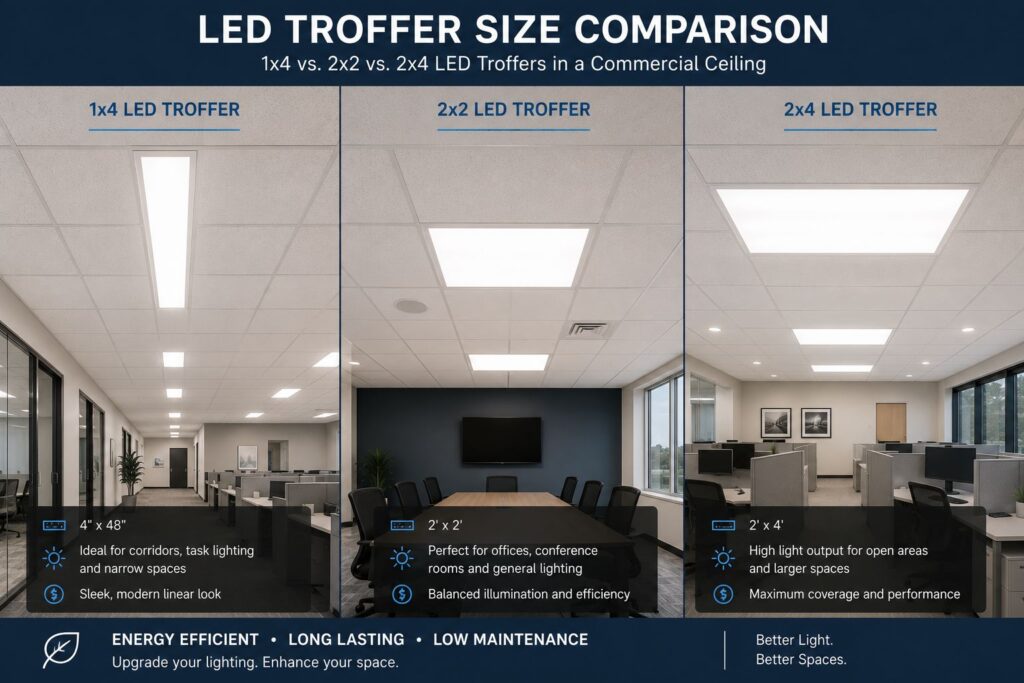
Choosing the appropriate LED troffer size helps optimize lighting performance, installation efficiency, and the appearance of commercial interiors.
Selecting the Right Troffer Starts with the Right Guidance
Whether you’re upgrading fluorescent fixtures or designing a new commercial space, selecting the appropriate troffer size improves lighting quality, simplifies installation, and reduces long-term operating costs.
Our lighting specialists can help you compare fixture sizes, lumen packages, color temperatures, and control options for your specific project.
📞 Call 1-844-533-7767 or explore our complete selection of Commercial LED Troffers.
Understanding Standard Commercial Troffer Sizes
Commercial LED troffers are designed to fit directly into standard suspended ceiling grids, often called lay-in or T-bar ceilings. Because these ceiling systems are built around modular dimensions, selecting the correct fixture size is usually straightforward—but choosing the best size for lighting performance requires a closer look.
The three most common troffer sizes are:
- 2×4 LED Troffers
- 2×2 LED Troffers
- 1×4 LED Troffers
Each is engineered to fit a corresponding ceiling opening while delivering efficient, uniform illumination. Although all three use similar LED technology, their size influences light distribution, fixture spacing, visual appearance, and the types of spaces where they perform best.
Before selecting a fixture, it’s important to verify the existing ceiling grid dimensions, understand the function of the space, and determine the desired lighting level. Matching the fixture to both the ceiling and the application helps ensure a successful installation.
🛠️ Design Insight
The best troffer size isn’t necessarily the largest one—it’s the fixture that fits the ceiling grid, provides the required illumination, and complements how the space will be used. A properly matched troffer creates a cleaner installation and often reduces the need for unnecessary fixtures.
2x4 LED Troffers: The Commercial Standard
The 2×4 LED troffer remains the most widely specified size for commercial buildings throughout North America. Its larger footprint delivers broad, even illumination that makes it especially effective for expansive spaces with rows of suspended ceiling tiles.
Typical applications include:
- Open office workstations
- Corporate headquarters
- Classrooms
- Government facilities
- Healthcare administrative areas
- Libraries
- Financial institutions
- Municipal buildings
Modern 2×4 troffers are available with center basket diffusers, volumetric optics, and selectable wattage and color temperature options, allowing building owners to tailor lighting performance without changing fixture size.
They are also one of the most popular retrofit choices for replacing older fluorescent troffers because they fit directly into existing 2×4 ceiling grids, minimizing disruption during renovation projects.
Once you’ve selected the right fixture type, learn how to maximize your investment with our Commercial LED Ceiling Light Lifespan Guide, covering driver quality, warranties, and maintenance best practices.
For organizations planning energy-efficient upgrades, 2×4 LED troffers offer an excellent balance of coverage, efficiency, visual comfort, and ease of installation.
📐 Specification Tip
Many commercial retrofits can reuse the existing 2×4 ceiling grid while replacing outdated fluorescent fixtures with modern LED troffers. This approach reduces labor, minimizes ceiling modifications, and shortens project timelines.
2x2 LED Troffers: A Versatile Choice for Smaller Spaces
While 2×4 troffers dominate large open office environments, 2×2 LED troffers have become increasingly popular as commercial interiors evolve toward smaller workspaces, collaborative areas, and modern office designs.
Their compact footprint makes them an excellent choice for suspended ceiling systems with 2×2 grid modules, while also providing greater flexibility when designing lighting layouts in rooms with irregular dimensions.
Common applications include:
- Conference rooms
- Executive offices
- Medical offices
- Classrooms
- Retail spaces
- Financial institutions
- Reception areas
- Professional offices
Because they occupy less ceiling space, 2×2 fixtures often allow designers to create balanced layouts that complement room proportions while maintaining excellent illumination.
Many commercial projects also appreciate the clean, contemporary appearance of 2×2 troffers, particularly when paired with modern architectural finishes and open interior designs.
Like larger troffers, today’s 2×2 models are commonly available with:
- Field-selectable wattage
- Adjustable color temperature (CCT)
- 0–10V dimming
- Emergency battery backup options
- Occupancy sensor compatibility
This flexibility allows facility managers to standardize on one fixture family while adapting performance to different rooms throughout the building.
🛠️Design Insight
Smaller rooms don’t necessarily require smaller light levels—they require lighting that is properly proportioned to the space. A 2×2 troffer often delivers a cleaner appearance and better layout flexibility than forcing larger fixtures into compact rooms.
1x4 LED Troffers: Ideal for Linear Spaces
The 1×4 LED troffer is designed for spaces where a narrow fixture better matches the shape of the room.
Although less common than 2×2 or 2×4 models, 1×4 troffers provide an excellent solution for corridors, hallways, narrow offices, and circulation areas where long, continuous lines of light enhance both functionality and aesthetics.
Typical applications include:
- Hospital corridors
- Medical facilities
- Hallways
- Educational buildings
- Government offices
- Retail aisles
- Administrative corridors
- Support spaces
Their elongated profile creates a visually continuous lighting pattern that naturally guides occupants through the building while maintaining uniform illumination.
Many designers also specify 1×4 troffers when renovating facilities that already utilize narrow ceiling modules, simplifying installation while preserving the existing ceiling system.
As with other commercial LED troffers, modern 1×4 fixtures are available with high-efficiency LED technology, dimming capability, selectable wattages, and adjustable color temperatures, providing the same energy-saving benefits found in larger models.
Comparing Standard LED Troffer Sizes
Although all three standard sizes serve the same general purpose, each offers unique advantages depending on the application.
| Feature | 1×4 | 2×2 | 2×4 |
|---|---|---|---|
| Best for corridors | ★★★★★ | ★★☆☆☆ | ★☆☆☆☆ |
| Conference rooms | ★★☆☆☆ | ★★★★★ | ★★★☆☆ |
| Open offices | ★★☆☆☆ | ★★★★☆ | ★★★★★ |
| Schools | ★★☆☆☆ | ★★★★☆ | ★★★★★ |
| Healthcare | ★★★★☆ | ★★★★★ | ★★★★☆ |
| Retail | ★★★☆☆ | ★★★★☆ | ★★★★☆ |
| Existing 2×4 retrofits | ★☆☆☆☆ | ★★☆☆☆ | ★★★★★ |
| Modern appearance | ★★★★☆ | ★★★★★ | ★★★★☆ |
While this comparison provides a useful starting point, the best choice ultimately depends on ceiling configuration, lighting objectives, and the activities taking place within the space.
Once you’ve selected the right troffer dimensions, review our Commercial LED Ceiling Light Installation Guide for planning and installation best practices
Which Troffer Size Is Right for Your Project?
Rather than asking which troffer size is “best,” it is more useful to ask which size is best for a particular application.
Consider these general recommendations:
Choose 2×4 LED Troffers when:
- Renovating existing commercial offices
- Replacing fluorescent troffers
- Lighting large open workspaces
- Maximizing fixture coverage
- Seeking the most common commercial specification
Choose 2×2 LED Troffers when:
- Designing modern office interiors
- Lighting conference rooms
- Working with 2×2 suspended ceiling grids
- Renovating executive offices
- Creating balanced layouts in smaller rooms
Choose 1×4 LED Troffers when:
- Illuminating corridors
- Lighting healthcare hallways
- Upgrading narrow commercial spaces
- Creating continuous linear lighting
- Matching existing 1×4 ceiling openings
Many commercial facilities actually combine multiple troffer sizes throughout the building, selecting each fixture based on the function of individual spaces rather than relying on one size everywhere.
📐 Specification Tip
Standardizing on one troffer family with multiple size options can simplify maintenance while allowing each area of the building to receive the fixture that best fits its layout and lighting requirements.
Size Is Only Part of the Lighting Design
Selecting the correct troffer dimensions is an important step, but successful lighting projects also depend on proper fixture spacing, lumen output, optics, and lighting controls.
Even the ideal fixture size can produce disappointing results if fixtures are spaced too far apart, installed without considering ceiling height, or selected with the wrong optical distribution.
For this reason, fixture size should always be evaluated alongside the overall lighting layout during the design phase.
If you’re planning a renovation or new construction project, our Commercial Drop Ceiling Lighting Layout Guide explains how fixture spacing, photometric layouts, and lighting controls work together to create comfortable, energy-efficient commercial interiors.
🏢 Project Spotlight
During the renovation of a multi-story medical office building, the lighting design team selected 2×4 LED troffers for administrative offices, 2×2 troffers for examination and consultation rooms, and 1×4 fixtures for patient corridors. Matching fixture size to each area’s function produced a cohesive appearance, simplified maintenance, and delivered consistent illumination throughout the facility while improving overall energy efficiency.
Selecting the Right Lumen Package
Choosing the correct troffer size is only the first step. The next decision is selecting a lumen package that provides the appropriate amount of illumination for the space.
While larger fixtures often accommodate higher lumen outputs, today’s high-efficiency LED technology allows all three standard troffer sizes to deliver impressive performance. Rather than focusing solely on fixture wattage, evaluate delivered lumens, optical performance, and the lighting requirements of the application.
General guidelines include:
| Application | Typical Lighting Goal |
|---|---|
| Conference rooms | Comfortable, glare-controlled illumination |
| Open offices | Uniform lighting for computer work |
| Classrooms | Consistent visibility for reading and instruction |
| Healthcare facilities | Balanced illumination with accurate color rendering |
| Corridors | Safe, continuous illumination with reduced energy use |
The final lumen package should always be verified through a professional photometric lighting layout rather than relying on generalized assumptions.
📐 Specification Tip
Modern LED fixtures deliver significantly more light than earlier generations. Many commercial installations now achieve the desired illumination using lower wattages than were required just a few years ago, helping reduce both energy consumption and operating costs.
Center Basket vs. Flat Lens Troffers
Another important specification decision involves the optical design of the fixture.
Although both styles provide efficient LED illumination, they create noticeably different visual experiences.
Center Basket Troffers
Center basket troffers feature a recessed diffuser positioned within the fixture housing.
Advantages include:
Softer light distribution
Improved glare control
Better visual comfort
Reduced brightness when viewed directly
Traditional commercial appearance
These fixtures remain a popular choice for:
Offices
Schools
Government buildings
Administrative areas
Healthcare facilities
Many organizations continue selecting center basket designs because employees spend long hours beneath the lighting system, making visual comfort a priority.
Flat Lens Troffers
Flat lens troffers feature a smooth illuminated surface that extends across the entire face of the fixture.
Benefits include:
Contemporary appearance
Uniform illuminated surface
Clean architectural styling
Excellent light distribution
Minimal fixture depth
These fixtures are frequently specified for:
Executive offices
Conference rooms
Reception areas
Corporate headquarters
Modern commercial interiors
Rather than replacing center basket fixtures, flat lens troffers simply offer another design option depending on the project’s aesthetic goals.
🛠️ Design Insight
Center basket and flat lens troffers are both excellent commercial lighting solutions. The choice is often driven by visual comfort, architectural style, and owner preference—not by which technology is “better.”
Choosing the Right Color Temperature
Color temperature has a significant impact on how commercial interiors feel to employees, customers, and visitors.
General recommendations include:
| Color Temperature | Recommended Applications |
|---|---|
| 3000K | Hospitality, lounges, upscale reception areas |
| 3500K | Executive offices, conference rooms |
| 4000K | Offices, schools, healthcare facilities |
| 5000K | Warehouses, maintenance areas, utility spaces |
For most commercial office environments, 4000K remains the preferred choice because it provides a neutral white appearance that supports productivity while maintaining a comfortable visual environment.
Many commercial troffers now feature field-selectable color temperatures, allowing installers to adjust the fixture during installation instead of stocking multiple SKUs.
Smart Features Worth Considering
Commercial LED troffers have evolved well beyond simple on-and-off lighting.
Today’s premium fixtures often include advanced features that improve building performance while reducing operating costs.
Popular options include:
- Field-selectable wattage
- Adjustable color temperature (CCT)
- 0–10V dimming
- Occupancy sensors
- Daylight harvesting compatibility
- Emergency battery backup
- Sensor-ready drivers
- Networked lighting controls
- Building Management System (BMS) integration
These features provide greater flexibility during installation and make it easier to adapt lighting systems as buildings change over time.
Planning for Future Renovations
One of the biggest advantages of modern LED troffers is their ability to support future building modifications.
Commercial spaces rarely remain unchanged. Departments grow, office layouts evolve, tenants move, and conference rooms become collaborative workspaces.
Selecting fixtures with adjustable features allows facility managers to respond to these changes without replacing the entire lighting system.
When evaluating new troffers, consider models that offer:
- Multiple lumen packages
- Selectable wattage
- Adjustable color temperatures
- Long-life LED drivers
- Easily serviceable components
- Standard dimming compatibility
- Extended warranties, including premium 10-year options available on higher-quality fixtures
These capabilities help protect your investment while reducing future maintenance and upgrade costs.
🏢 Project Spotlight
A regional insurance company replaced aging fluorescent troffers during a phased office renovation. By selecting field-adjustable LED troffers with center basket optics, the facility team standardized fixtures across multiple office locations while using different wattage and color temperature settings to match individual workspaces. The approach simplified inventory, reduced maintenance, and provided the flexibility to support future office reconfigurations without purchasing additional fixture types.
Why Efficiency Continues to Improve
Lorem ipsum dolor sit amet, consectetur adipiscing elit. Ut elit tellus, luctus nec ullamcorper mattis, pulvinar dapibus leo.
LED lighting technology has advanced dramatically over the past decade. Early commercial LED troffers commonly delivered around 100 lumens per watt, representing a major improvement over fluorescent lighting at the time.
Today, many premium commercial troffers achieve 180–200 lumens per watt, depending on the model and operating conditions. This increase in efficacy allows building owners to illuminate the same spaces with less energy, lower heat output, and reduced operating costs.
Higher efficacy also supports sustainability initiatives by lowering electrical demand while maintaining the illumination levels required for productive commercial environments.
💡 Energy Savings Snapshot
Upgrading from older fluorescent fixtures—or even first-generation LED troffers—to today’s high-efficacy models can significantly reduce energy use while improving light quality, reducing maintenance, and extending service life.
Commercial LED Troffer Selection Checklist
Lorem ipsum dolor sit amet, consectetur adipiscing elit. Ut elit tellus, luctus nec ullamcorper mattis, pulvinar dapibus leo.
Before specifying LED troffers for your next commercial project, review these key considerations to ensure the fixtures meet your lighting, operational, and long-term maintenance goals.
✓ Verify the Ceiling Grid
- Confirm whether the ceiling uses 1×4, 2×2, or 2×4 modules.
- Inspect the condition of the existing T-bar grid if performing a retrofit.
- Identify any obstructions such as HVAC diffusers, sprinkler heads, or access panels that may influence fixture placement.
✓ Match the Fixture to the Space
Select the troffer size that best supports the room’s function:
- 2×4 LED Troffers for open offices, classrooms, and large workspaces.
- 2×2 LED Troffers for conference rooms, executive offices, and medical suites.
- 1×4 LED Troffers for corridors, hallways, and other linear spaces.
Remember that many successful commercial projects use multiple troffer sizes throughout the building to optimize both performance and appearance.
✓ Review Fixture Performance
Compare more than just fixture dimensions.
Evaluate:
- Delivered lumen output
- Lumens per watt (efficacy)
- Center basket or flat lens optics
- Color Rendering Index (CRI)
- Field-selectable wattage
- Adjustable color temperature (CCT)
- Driver quality
- Dimming compatibility
✓ Consider Long-Term Ownership Costs
The purchase price is only one part of the investment.
Also evaluate:
- Energy savings
- Expected service life
- Driver reliability
- Ease of maintenance
- Warranty coverage
- Future upgrade flexibility
Higher-quality fixtures often reduce operating costs over many years through improved efficiency and fewer maintenance interruptions.
✓ Request Professional Lighting Design
Before ordering fixtures, ask for:
- Photometric lighting layout
- Fixture spacing recommendations
- Illumination calculations
- Product comparisons
- Lighting control recommendations
- Energy savings estimates
Professional planning helps ensure the selected troffers deliver the expected performance once installed.
💡 Pro Tip
Selecting the correct troffer size is important, but pairing that fixture with a professionally designed lighting layout often has an even greater impact on occupant comfort, energy efficiency, and long-term satisfaction.
Inline Buyer Q&A
Which LED troffer size is most commonly used in commercial buildings?
The 2×4 LED troffer remains the most widely used size for offices, schools, government facilities, and many healthcare environments because it fits standard suspended ceiling grids and provides broad, uniform illumination.
When should I choose a 2×2 troffer instead of a 2×4?
A 2×2 troffer is often the better choice for conference rooms, executive offices, medical suites, and other smaller spaces where room proportions or ceiling layouts favor a more compact fixture.
Where are 1×4 LED troffers typically installed?
1×4 troffers are commonly specified for corridors, hallways, healthcare circulation areas, retail aisles, and other long, narrow spaces where their linear profile provides efficient, consistent lighting.
Does a larger troffer always produce more light?
Not necessarily. Modern LED technology allows all standard troffer sizes to achieve excellent performance. Delivered lumens, fixture optics, and photometric design are more important than physical dimensions alone.
Can different troffer sizes be used in the same building?
Absolutely. Many commercial projects combine 2×4, 2×2, and 1×4 troffers to provide the most appropriate lighting solution for each area while maintaining a consistent fixture family throughout the facility.
Choose the Right Troffer for Better Lighting Performance
The right LED troffer does more than fit a ceiling opening—it supports better lighting quality, improved occupant comfort, lower operating costs, and a professional appearance throughout your facility.
Whether you’re replacing fluorescent fixtures, renovating an office, upgrading a healthcare facility, or designing a new commercial building, selecting the appropriate 1×4, 2×2, or 2×4 LED troffer is an important step toward creating an efficient, high-performing lighting system.
At LED Pros WorldWide, we help architects, engineers, electrical contractors, facility managers, and building owners choose commercial lighting solutions that deliver lasting value. Our team can recommend the right troffer size, lumen package, optics, controls, and layout to meet your project’s specific requirements.
Browse our complete selection of Commercial LED Troffers, or contact us today for expert guidance and a free lighting consultation.📞 Call 1-844-533-7767 to speak with a commercial lighting specialist.
Frequently Asked Questions
What are the standard sizes for LED troffers?
The three standard commercial sizes are 1×4, 2×2, and 2×4, each designed to fit corresponding suspended ceiling grid openings.
Which troffer size is best for offices?
For large open office areas, 2×4 LED troffers are the most common choice. Conference rooms and executive offices often benefit from 2×2 troffers, while corridors typically use 1×4 fixtures.
Are LED troffers compatible with existing fluorescent ceiling grids?
Yes. Most modern LED troffers are designed as direct replacements for fluorescent lay-in fixtures and fit standard T-bar suspended ceiling systems.
Should I choose center basket or flat lens troffers?
Both are excellent options. Center basket troffers emphasize visual comfort and glare control, while flat lens troffers provide a sleek architectural appearance with smooth, even illumination.
How efficient are today’s LED troffers?
Premium commercial LED troffers can achieve 180–200 lumens per watt, nearly doubling the efficacy of many first-generation LED fixtures while significantly outperforming older fluorescent technology.
How do I know which troffer size is right for my project?
The best choice depends on your ceiling grid, room dimensions, lighting objectives, and overall layout. A professional photometric lighting design helps ensure the selected fixtures deliver uniform illumination and long-term efficiency.
Stay Connected with Our Lighting Resources
Add IndustrialLightingFixtures.org as a Preferred Source on Google to see more of our lighting guides and technical resources across Google Search experiences.
Related Commercial Ceiling Lighting Resources
Continue evaluating LED troffers and suspended-ceiling lighting systems for offices, schools, healthcare facilities, retail spaces, and other commercial interiors with these related planning and fixture-selection resources:
- LED Troffers — Explore commercial center basket, volumetric, and architectural LED troffers designed for standard suspended ceiling grids.
- Commercial LED Ceiling Lights — Compare additional commercial ceiling lighting solutions for offices, schools, healthcare facilities, retail environments, and other indoor applications.
- Commercial Drop Ceiling Lighting Layout Guide — Review how fixture spacing, room dimensions, photometric layouts, and lighting controls influence illumination and overall system performance.
- LED Troffers vs. LED Flat Panels — Compare LED troffers and flat panels to determine which fixture type is better suited to the ceiling, visual, and lighting requirements of your project.