
Government parking lot and outdoor-area lighting projects may include procurement requirements that go beyond lumen output, wattage, distribution, and mounting.
One of those requirements can be Trade Agreements Act (TAA) compliance.
For contractors, municipalities, government agencies, facility managers, and project teams, identifying TAA-compliant LED parking lot lights early in the specification process can help prevent an otherwise suitable fixture from being rejected because it does not meet the project’s procurement requirements.
TAA-compliant LED area-lighting options are available for parking lots, roadways, government facilities, public sites, and other commercial outdoor applications.
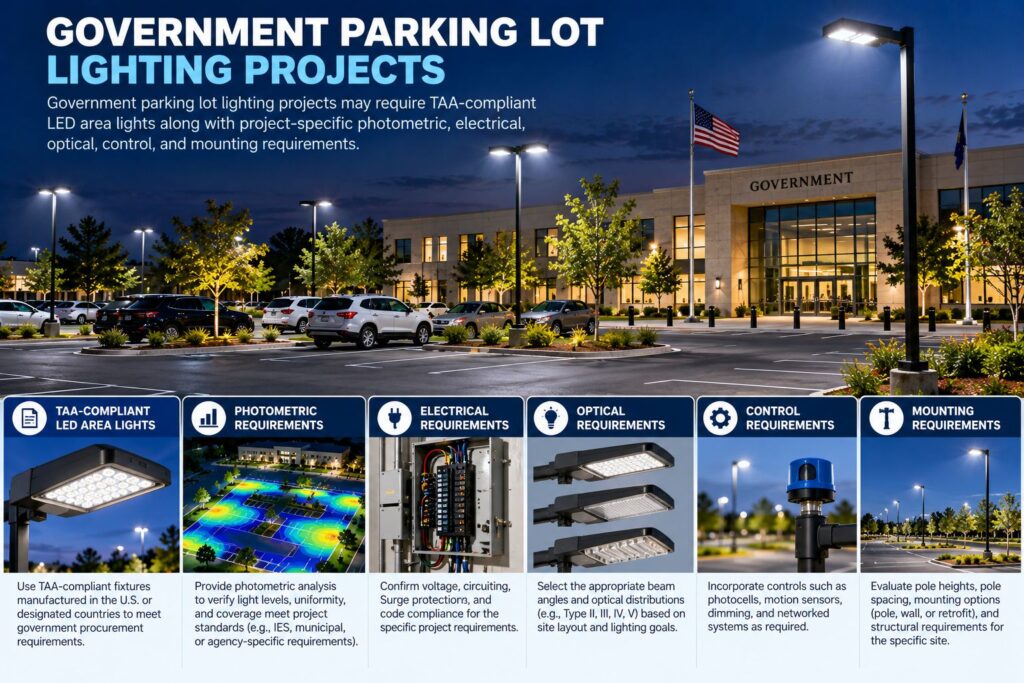
Government parking lot lighting projects may require TAA-compliant LED area lights along with project-specific photometric, electrical, optical, control, and mounting requirements.
Need TAA-Compliant LED Parking Lot Lights?
Government lighting specifications can include procurement requirements in addition to normal fixture-performance requirements.
LED PROS WorldWide can help contractors and project teams identify TAA-compliant LED parking lot and area-lighting options based on the project’s fixture schedule, wattage, lumen output, voltage, distribution, mounting, controls, and photometric requirements.
Explore our LED Parking Lot Lights or call 844-533-7767 with your project specifications.
What Does TAA Compliant Mean?
TAA refers to the Trade Agreements Act of 1979.
For federal acquisitions where applicable trade agreements govern the procurement, qualifying products generally must be U.S.-made or originate from a designated country under the applicable federal procurement rules.
Country of origin under the trade-agreement rules can also involve whether a product has been substantially transformed in the United States or a designated country into a new and different article of commerce.
TAA compliance therefore should not be determined simply from the location of a manufacturer’s headquarters or from a general statement that a product is sold by an American company.
The specific product and applicable procurement requirements matter.
Why TAA Compliance Matters in Government Lighting Projects
A commercial LED fixture can have excellent lighting performance and still be inappropriate for a particular government procurement if it does not satisfy the project’s sourcing requirements.
That makes compliance part of fixture selection.
A government parking lot specification may need to coordinate requirements involving:
-
TAA compliance
-
Fixture performance
-
UL listing
-
Wet-location suitability
-
IP rating
-
DLC qualification when required
-
Wattage and lumen output
-
Color temperature
-
Optical distribution
-
Voltage
-
Surge protection
-
Controls
-
Mounting
-
Photometric performance
The correct fixture therefore needs to satisfy both the lighting design and the procurement specification.
TAA Compliance Is Not the Same as Made in USA
TAA compliance should not automatically be interpreted as meaning that a product is labeled Made in USA.
Federal trade-agreement rules recognize products originating in the United States as well as products from designated countries when the applicable requirements are satisfied.
The country-of-origin determination under the trade agreements can also involve substantial transformation.
For that reason, specifications should use the terminology actually required by the procurement rather than treating “TAA compliant,” “Made in USA,” and other domestic-sourcing descriptions as interchangeable.
TAA and the Buy American Act Are Not the Same Requirement
Government project specifications may also reference the Buy American Act (BAA).
TAA and BAA requirements should not be treated as synonyms.
The federal acquisition rules use different tests for determining country of origin under the Buy American statute and under applicable trade agreements.
A project may specify one requirement, the other, or procurement provisions that require additional review.
When a specification calls for TAA compliance, the safest approach is to verify the exact fixture configuration against the procurement requirements rather than assuming that another domestic-sourcing designation automatically satisfies it.
TAA-Compliant LED Area Lights for Parking Lots
TAA-compliant LED area-lighting options are available for commercial and government parking-lot applications.
Depending on the fixture family and configuration, available characteristics can include:
-
Multiple wattages
-
Multiple lumen packages
-
Type II, Type III, Type IV, or Type V distributions
-
120–277V operation
-
Higher-voltage options
-
Photocells
-
Motion sensing
-
0–10V dimming
-
Pole mounting
-
Adjustable mounting
-
Slip-fitter mounting
-
Surge protection
-
Dark Sky-oriented configurations
-
DLC-listed configurations
Not every option or certification necessarily applies to every configuration. Product requirements should be verified for the specific fixture being quoted.
Selecting Wattage for a Government Parking Lot
Wattage alone should not determine the parking lot fixture.
Two LED area lights with similar wattage can produce substantially different results because of differences in:
-
Lumen output
-
Optical distribution
-
Mounting height
-
Pole spacing
-
Fixture orientation
-
Site geometry
The objective is not simply to replace an existing wattage.
The objective is to deliver the required illumination and uniformity across the property while meeting the project’s procurement requirements.
Type II, III, IV and V Light Distributions
Parking lots rarely require every fixture to distribute light in the same way.
Different IES distributions can be selected according to pole location and the area that must be illuminated.
Type II distributions can be useful for narrower areas and some roadway or perimeter applications.
Type III distributions are commonly useful where fixtures need to project illumination forward and laterally from perimeter or edge locations.
Type IV distributions can provide forward-oriented coverage where light needs to be directed away from a boundary or mounting location.
Type V distributions provide broader distribution around the fixture and can be useful for some interior parking-lot locations.
The appropriate distribution should be selected from the site layout and photometric requirements rather than from the distribution name alone.
Government Parking Lot Lighting and Photometrics
Photometric analysis can be particularly valuable for government and public-sector projects because the design may need to demonstrate compliance with specified illumination criteria.
A parking-lot photometric plan can evaluate:
-
Average illumination
-
Minimum illumination
-
Maximum illumination
-
Uniformity
-
Pole locations
-
Mounting heights
-
Fixture quantities
-
Optical distributions
-
Property boundaries
-
Building entrances
-
Pedestrian areas
-
Drive lanes
This allows fixture selection to be based on predicted site performance rather than fixture wattage alone.
Our Parking Lot Foot-Candle Requirements for Commercial Properties guide explains why both illumination levels and uniformity should be considered when planning a parking lot.
Existing Poles Can Affect Fixture Selection
Government parking-lot projects are not always new construction.
Many are retrofits of existing facilities.
When existing poles will remain, document their:
-
Height
-
Location
-
Spacing
-
Tenon or mounting configuration
-
Existing fixture quantity
-
Existing voltage
-
Physical condition
The proposed TAA-compliant fixture must work with the site’s actual mounting geometry as well as its procurement requirements.
Existing pole locations can also determine which optical distributions are appropriate.
LED Retrofits for Government Parking Lots
Older government facilities may still use metal-halide, high-pressure sodium, or earlier-generation LED area lighting.
A retrofit creates an opportunity to improve energy performance and optical control while updating the system to current project requirements.
However, an LED retrofit should not be treated as a simple wattage substitution.
Existing light levels, poles, spacing, electrical service, fixture mounting, controls, uniformity, glare, and photometric performance should be evaluated before replacement fixtures are selected.
Controls for Government Parking Lot Lighting
LED controls can reduce energy consumption during periods when full parking-lot illumination is unnecessary.
Depending on the project and fixture configuration, control strategies can include:
-
Photocells
-
Scheduling
-
0–10V dimming
-
Bi-level operation
-
Occupancy or motion sensing
-
Networked controls
The appropriate strategy depends on how the property operates and the requirements of the project.
Security, pedestrian activity, facility operating hours, and local requirements should be considered before reducing nighttime illumination.
Surge Protection and Outdoor Government Facilities
Parking lot fixtures are exposed to outdoor electrical conditions and are frequently installed on tall poles distributed across large sites.
Surge protection should therefore be considered during fixture selection.
Available protection can vary by fixture family and voltage.
For government projects, the specified surge-protection requirement should be confirmed before the fixture is quoted.
Dark Sky and Government Parking Lots
Government and municipal projects may also include requirements intended to control uplight, glare, or light trespass.
Fixture distribution, mounting orientation, color temperature, shielding, and controls can all affect outdoor-lighting performance.
A TAA-compliant fixture is not automatically a Dark Sky solution, just as a Dark Sky-oriented fixture is not automatically TAA compliant.
Each project requirement should be evaluated independently.
DLC Qualification
Some government parking-lot projects may specify DLC-listed or DLC Premium products, particularly where energy-efficiency programs or utility incentives are involved.
DLC qualification can vary by fixture model and configuration.
When DLC is required, the exact product configuration should be verified rather than assuming that every version within a fixture family carries the same qualification.
Government and Public-Sector Parking Lot Applications
TAA-compliant LED parking lot and area lighting may be relevant for projects involving:
-
Federal facilities
-
Government office buildings
-
Municipal facilities
-
Public works properties
-
Courthouses
-
Public safety facilities
-
Transportation facilities
-
Government-operated parking areas
-
Military and defense-related facilities where applicable project requirements are satisfied
-
Other public-sector properties
Each project may have its own procurement and technical specifications.
What Information Should Be Included With an RFQ?
Providing the project documentation early makes it easier to identify suitable fixture options.
| Project Information | Why It Matters |
|---|---|
| TAA requirement | Establishes procurement requirement |
| BAA requirement, if applicable | Identifies additional sourcing requirement |
| Fixture schedule | Defines specified equipment |
| Existing fixture information | Important for retrofits |
| Required wattage/lumens | Establishes performance range |
| Pole height | Influences distribution and coverage |
| Pole spacing/layout | Influences fixture quantity and optics |
| Required distribution | Helps identify appropriate optics |
| Voltage | Required for electrical configuration |
| CCT | Establishes color-temperature requirement |
| Controls | Identifies photocell, dimming or sensor requirements |
| Surge protection | Identifies electrical protection requirement |
| Photometric criteria | Establishes site-performance target |
| DLC requirement | Identifies applicable qualification requirement |
| Project specifications | Helps identify other required provisions |
Inline Buyer Q&A
Do you offer TAA-compliant LED parking lot lights?
Yes. LED PROS WorldWide can quote TAA-compliant LED area-lighting options for qualifying parking lot and outdoor-lighting projects. Availability and compliance should be confirmed for the specific fixture configuration and project requirements.
Are TAA-compliant parking lot lights only for federal projects?
No. TAA-compliant products may also be specified by contractors, municipalities, institutions, and other project owners depending on their procurement requirements.
Are TAA-compliant LED lights made in the USA?
Not necessarily. TAA rules can permit qualifying U.S.-made products as well as products from designated countries when applicable requirements are met.
Is TAA compliance the same as BAA compliance?
No. TAA and Buy American requirements use different procurement rules and country-of-origin tests. The project’s actual specification should determine which requirement must be satisfied.
Can I get TAA-compliant parking lot lights with different beam distributions?
Yes. TAA-compliant area-lighting options are available with multiple optical distributions. The correct distribution depends on pole placement, mounting height, site geometry, and photometric requirements.
Can you quote from a government fixture schedule?
Yes. Sending the fixture schedule or project specification is often the most efficient way to identify appropriate lighting options and required configurations.
Need a Quote for TAA-Compliant Government Parking Lot Lighting?
LED PROS WorldWide works with contractors, municipalities, facility operators, and project teams sourcing commercial LED lighting for government and public-sector projects.
Send us your fixture schedule, project specifications, pole heights, voltage, required distributions, controls, photometric requirements, and applicable TAA or BAA requirements.
We can help identify and quote LED parking lot and area-lighting options that match the project’s technical and procurement requirements.
Call 844-533-7767 to discuss your government parking lot lighting project or request a quote.
Frequently Asked Questions About TAA-Compliant LED Parking Lot Lights
What is a TAA-compliant LED light?
A TAA-compliant product is one that satisfies applicable Trade Agreements Act country-of-origin requirements for the procurement in which TAA applies.
What countries qualify under TAA?
Federal procurement rules maintain lists of designated countries associated with applicable trade agreements. Because those requirements can change, project teams should use current federal procurement guidance rather than relying on an old country list.
Does TAA compliance affect lighting performance?
No. TAA compliance concerns procurement and country-of-origin requirements. Lighting performance still depends on lumen output, optics, mounting, fixture design, controls, and the overall lighting layout.
Do TAA-compliant parking lot lights have to be DLC listed?
Not because of TAA itself. DLC qualification is a separate requirement. A project may require both.
Are TAA and Buy American requirements interchangeable?
No. They are separate federal procurement frameworks with different country-of-origin tests.
Can TAA-compliant LED parking lot lights be used for retrofits?
Yes. A TAA-compliant area light can be used in a retrofit when its photometric, mounting, electrical, control, procurement, and other project requirements are appropriate.
Should TAA compliance be verified before ordering?
Yes. Verify the exact fixture and configuration against the current project requirements and manufacturer documentation before ordering.
Stay Connected with Our Lighting Resources
Add IndustrialLightingFixtures.org as a Preferred Source on Google to see more of our lighting guides and technical resources across Google Search experiences.

Government & Commercial Parking Lot Lighting Resources
-
LED Parking Lot Lights — commercial LED area-lighting fixtures for parking lots and outdoor properties.
-
Parking Lot Foot-Candle Requirements for Commercial Properties — illumination levels, uniformity, layouts, and photometric planning.
-
Parking Lot Security Lighting Guide — visibility, pedestrian areas, entrances, glare, and security-oriented lighting design.
-
Commercial Parking Lot Lighting Guide — broader parking-lot fixture, pole, layout, and design considerations.
-
Area Lighting Pole Height Guide — how mounting height affects coverage, spacing, optics, and glare.
-
LED Area Lighting Layout Guide — fixture placement, distribution, spacing, uniformity, and photometric planning.