
Why Commercial Parking Lot Lighting Matters
Commercial parking lot lighting serves a much greater purpose than simply illuminating vehicles after dark. A properly engineered lighting system creates a safer environment for drivers and pedestrians, improves surveillance camera performance, enhances the appearance of the property, and reduces long-term maintenance costs.
Whether lighting a retail shopping center, office complex, healthcare campus, industrial facility, or municipal parking area, today’s LED parking lot lighting systems provide higher illumination quality while significantly reducing electrical consumption compared to older HID technologies.
A successful parking lot lighting design balances safety, efficiency, visibility, and operating costs while providing consistent illumination across the entire property.
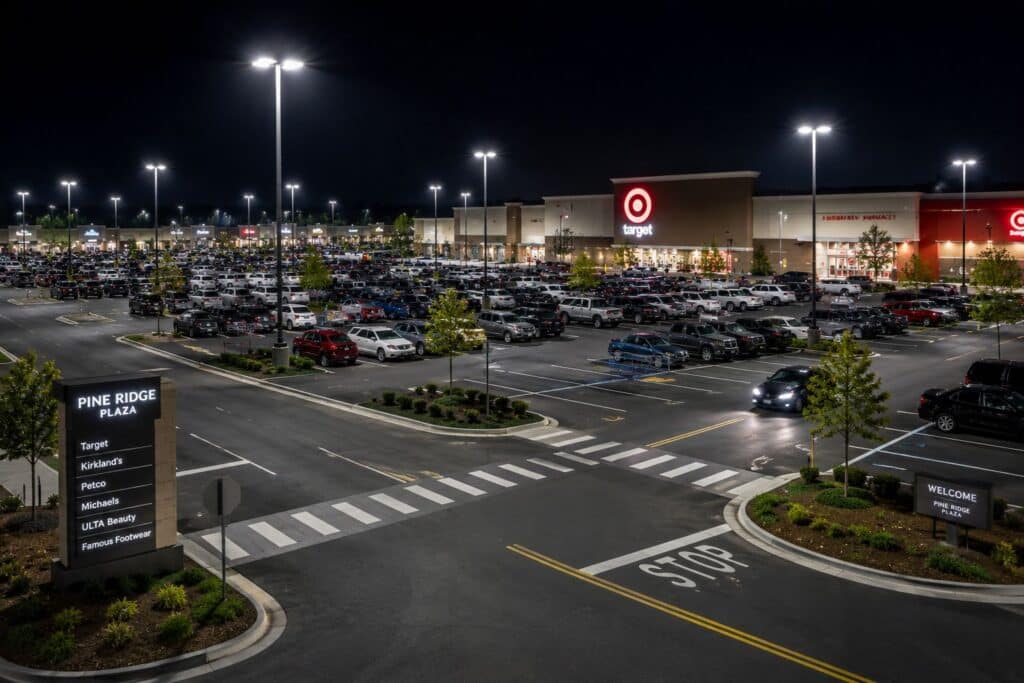
A properly designed LED parking lot lighting system improves visibility, enhances security, lowers operating costs, and creates a safer environment for customers, employees, and visitors.
Planning a new parking lot lighting project or upgrading existing fixtures?
Our lighting specialists can help you select the proper fixture wattage, optics, pole heights, and photometric layout for your property.
Request a Commercial Lighting Quote → https://industriallightingfixtures.org/commercial-lighting-fixtures/
Typical Commercial Parking Lot Applications
| Property Type | Primary Lighting Objective |
|---|---|
| Shopping Centers | Customer safety and attractive appearance |
| Retail Stores | Vehicle and pedestrian visibility |
| Office Buildings | Employee security after business hours |
| Hospitals | 24-hour safe access |
| Warehouses | Truck maneuvering and loading operations |
| Hotels | Guest safety and property aesthetics |
| Schools & Universities | Evening event visibility |
| Municipal Parking Areas | Public safety and reduced maintenance |
Choosing the Right LED Parking Lot Fixtures
Selecting the proper fixture begins with understanding how the property will be used. Factors such as traffic volume, parking lot size, pedestrian activity, and surrounding buildings all influence fixture selection.
Modern LED Parking Lot Lights are available in numerous lumen packages, mounting configurations, and optical distributions to match virtually any commercial application.
Important considerations include:
Fixture wattage
Total lumen output
Optical distribution (Type III, Type IV, or Type V)
Color temperature
Surge protection
IP weather resistance
Expected operating hours
Future maintenance requirements
Choosing fixtures based on an engineered lighting plan instead of simply replacing existing wattages often produces better illumination while reducing energy consumption.
Government facilities can add another consideration to parking lot fixture selection: procurement compliance. When TAA requirements are included in the specification, our guide to TAA-compliant LED parking lot lights explains what contractors and project teams should verify before requesting a quote.
Understanding Optical Distributions
Proper optics determine where the light is directed.
| Distribution | Best Application |
|---|---|
| Type III | Parking rows and roadways |
| Type IV | Perimeter lighting |
| Type V | Open parking lots |
| Forward Throw | Large driving lanes |
| Symmetrical | Central pole locations |
Pole Height Considerations
Pole height directly affects fixture spacing, uniformity, and overall lighting quality.
| Pole Height | Typical Applications |
|---|---|
| 15–20 ft | Small businesses |
| 20–25 ft | Retail parking lots |
| 25–30 ft | Shopping centers |
| 30–35 ft | Large commercial facilities |
| 35–40 ft | Distribution centers and large parking areas |
Higher mounting heights generally improve fixture spacing and reduce the total number of poles required for larger properties.
The Importance of Photometric Lighting Design
One of the biggest mistakes made during parking lot upgrades is selecting fixtures without first completing a photometric lighting layout.
A professional lighting layout helps determine:
- Fixture quantity
- Pole locations
- Light distribution
- Average illumination levels
- Uniformity ratios
- Dark areas
- Potential glare
Rather than simply maximizing brightness, a photometric study helps create consistent illumination throughout the parking lot while avoiding over-lighting.
For recommended illumination levels, see our guide: Parking Lot Foot Candle Requirements for Commercial Properties
Designing for Safety and Security
Lighting plays a significant role in improving the perceived and actual security of commercial properties.
Well-designed parking lot lighting can help:
- Improve pedestrian visibility
- Reduce dark hiding areas
- Improve surveillance camera image quality
- Enhance vehicle navigation
- Increase customer confidence
- Support after-hours operations
Security lighting should focus on creating uniform illumination rather than excessive brightness.
Learn more in our dedicated guide: Parking Lot Security Lighting Guide
Energy Savings with LED Parking Lot Lighting
Replacing metal halide or high-pressure sodium fixtures with modern LED parking lot lights typically produces significant operating savings.
Potential benefits include:
- Reduced electrical consumption
- Lower maintenance costs
- Longer fixture life
- Improved lumen maintenance
- Instant-on operation
- Better light quality
- Reduced service interruptions
Facilities operating lights from dusk until dawn often realize the fastest return on investment.
An efficient lighting design should consider more than illumination levels. Our Parking Lot Lighting Energy Savings Guide explains how modern LED technology helps reduce utility bills and maintenance expenses while improving long-term performance.
Estimated Benefits of LED Conversion
| Existing System | Modern LED System |
|---|---|
| Metal Halide | LED Parking Lot Fixtures |
| Frequent lamp replacement | Minimal maintenance |
| Higher energy costs | Lower operating costs |
| Slow warm-up | Instant illumination |
| Color shift over time | Consistent white light |
Existing parking lots require additional planning when the poles and electrical infrastructure will remain in place. Our LED Parking Lot Lighting Retrofit Guide covers metal halide replacement, existing pole conditions, fixture mounting, optics, photometrics, controls, and electrical considerations.
Common Parking Lot Lighting Design Mistakes
Many lighting projects fail to achieve optimal performance because of avoidable design errors.
Common mistakes include:
- Selecting fixtures based solely on wattage
- Ignoring optical distribution
- Improper pole spacing
- Uneven illumination
- Excessive glare
- Installing fixtures without a photometric plan
- Choosing the wrong mounting height
- Over-lighting certain areas while leaving others too dark
Working with an experienced commercial lighting specialist helps avoid these issues before installation.
Commercial Buyer Checklist
Before requesting a quotation, gather the following information:
- Property dimensions
- Pole heights
- Pole spacing
- Existing fixture type
- Desired illumination level
- Utility voltage
- Existing mounting hardware
- Photometric requirements
- Local lighting ordinances
- Security objectives
Providing these details allows for more accurate fixture recommendations and lighting layouts.
Inline Buyer Q&A
How many LED fixtures will my parking lot require?
Fixture quantity depends on property size and geometry, pole locations, mounting heights, fixture output, optical distribution, required illumination, uniformity objectives, and surrounding conditions.
A photometric lighting plan provides the most reliable way to determine fixture quantities and placement before installation.
Can I retrofit existing poles?
In many cases, yes. Existing poles and mounting arms can often be reused when they remain structurally suitable and are compatible with the proposed LED fixtures.
Pole condition, mounting configuration, fixture weight and projected area, electrical system, and existing pole locations should be evaluated as part of the retrofit.
Which optical distribution is best?
There is no single distribution that is best for every parking lot.
Type II, Type III, Type IV, Type V, and manufacturer-specific distributions may be appropriate depending on pole placement and site geometry. Perimeter poles, interior poles, drive lanes, property boundaries, and irregular areas may require different optics within the same project.
Photometric analysis can help determine the appropriate distribution for each fixture location.
Should every area have the same brightness?
Not necessarily. Drive aisles, parking spaces, pedestrian routes, entrances, loading areas, property boundaries, and other portions of the site can have different lighting requirements.
The goal is not simply equal brightness everywhere, but an appropriate lighting design that provides useful illumination and uniformity while controlling excessive contrast, glare, and spill light.
How long do LED parking lot fixtures last?
Commercial LED parking lot fixtures can provide long operating life, commonly measured in tens of thousands of hours. Published lifetime ratings vary by fixture and manufacturer.
Actual service life depends on driver and component quality, thermal management, operating hours, ambient temperature, electrical conditions, surge events, environmental exposure, and maintenance.
Ready to Plan Your Commercial Parking Lot Lighting?
Whether you’re lighting a retail center, office complex, industrial facility, healthcare campus, dealership, multifamily property, or municipal parking area, selecting the right LED parking lot lighting system begins with a thoughtful design.
Fixture selection, pole height and placement, optical distribution, required light levels, uniformity, controls, surrounding properties, and photometric performance all contribute to the finished system.
Our lighting specialists can help evaluate LED parking lot fixtures, retrofit options, optics, controls, and photometric layouts for your project.
👉 Explore our LED Parking Lot Lights solutions or call 1-844-533-7767 to discuss your parking lot lighting project.
Frequently Asked Questions
What color temperature is recommended for commercial parking lots?
4000K and 5000K are commonly available for commercial parking lot lighting, but there is no single color temperature appropriate for every property.
The selection can depend on owner preference, surrounding properties, local requirements, visual objectives, environmental considerations, and the desired nighttime appearance of the site.
Are LED parking lot lights compatible with lighting controls?
Many commercial LED parking lot fixtures can support photocells, scheduling, dimming, occupancy-based strategies, and networked lighting-control systems.
Compatibility depends on the fixture, driver, sensor, and control architecture, so required control capabilities should be identified during fixture selection.
Can LED fixtures reduce maintenance costs?
They can. LED parking lot fixtures eliminate the routine lamp replacement associated with traditional HID systems and can provide substantially longer service intervals.
Actual maintenance requirements depend on fixture quality, drivers, electrical conditions, environmental exposure, operating hours, controls, and other system components.
Are parking lot photometric layouts required?
Requirements vary by project and jurisdiction, but photometric layouts are strongly recommended for larger or more complex commercial parking lots.
Photometric analysis can evaluate predicted illumination, uniformity, fixture placement, mounting heights, optical distributions, and potential spill light before installation. It can also help demonstrate compliance where project or local requirements establish lighting criteria.
Can existing metal halide fixtures be replaced with LEDs?
Yes. Many commercial parking lots are upgraded by replacing older metal halide or other HID fixtures with LED area lights while retaining suitable existing poles.
Replacement fixtures should be selected according to mounting height, existing pole locations, required illumination, optical distribution, electrical conditions, and site geometry rather than simply matching the wattage of the existing fixtures.
Stay Connected with Our Lighting Resources
Add IndustrialLightingFixtures.org as a Preferred Source on Google to see more of our lighting guides and technical resources across Google Search experiences.

Related Commercial Parking Lot Lighting Resources
- LED Parking Lot Lights — Explore commercial LED parking lot fixtures and solutions for new construction, retrofit, municipal, industrial, retail, and other outdoor parking applications.
- Parking Lot Foot-Candle Requirements for Commercial Properties — Review how illumination levels, uniformity, site conditions, and project requirements influence commercial parking lot lighting design.
- Parking Lot Security Lighting Guide — Learn how fixture placement, uniformity, glare control, dark areas, pedestrian visibility, and surrounding conditions affect parking-area lighting.
- LED Area Lighting Layout Guide — Understand how pole locations, mounting heights, fixture output, optical distribution, and photometric modeling work together when planning outdoor area lighting.
- Area Lighting Pole Height Guide — Explore how mounting height influences fixture selection, spacing, coverage, and overall outdoor lighting performance.