
Retrofitting an existing parking lot with LED lighting involves more than replacing a metal halide or high-pressure sodium fixture with an LED fixture of lower wattage.
Existing pole locations, mounting heights, fixture orientation, electrical conditions, light distribution, required illumination, uniformity, glare, controls, and surrounding properties all influence which LED parking lot lights will perform properly.
A well-planned retrofit can improve lighting quality while reducing energy consumption and maintenance, but the replacement fixtures should be selected around the existing site and required lighting performance, not wattage alone.
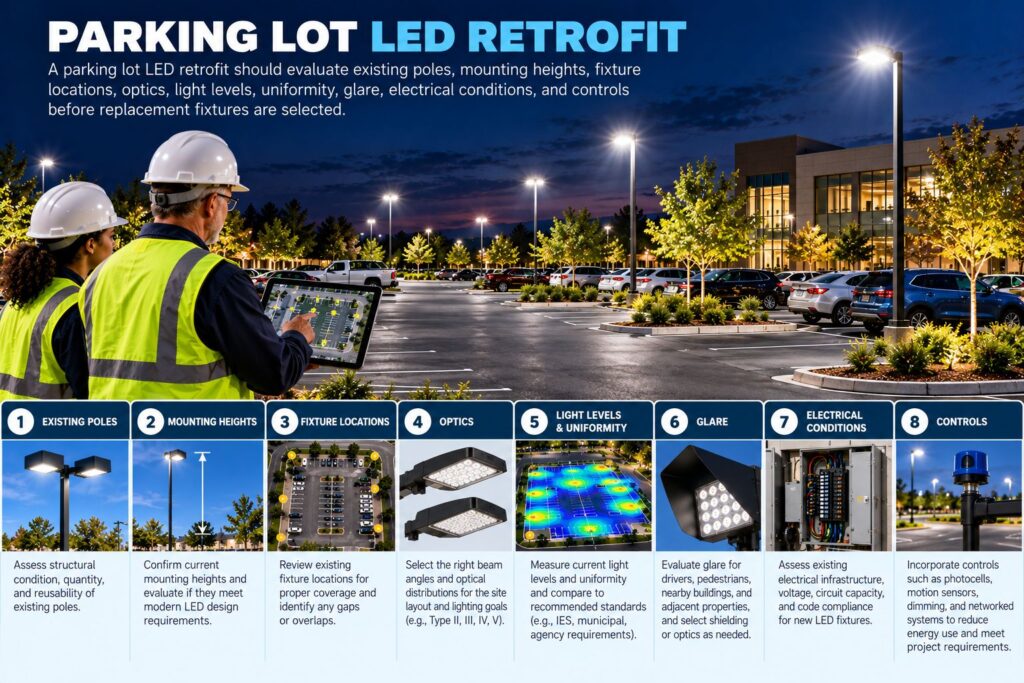
A parking lot LED retrofit should evaluate existing poles, mounting heights, fixture locations, optics, light levels, uniformity, glare, electrical conditions, and controls before replacement fixtures are selected.
Planning a Parking Lot LED Retrofit?
Replacing aging HID parking lot lights provides an opportunity to improve efficiency, visibility, optical control, and maintenance while continuing to use existing site infrastructure when appropriate.
LED PROS WorldWide can help evaluate LED parking lot light replacements based on existing fixture wattage, pole height, mounting, voltage, site layout, required distribution, controls, and photometric requirements.
Explore our LED Parking Lot Lights, Request a Quote, or call 844-533-7767 with your existing fixture information and project requirements.
Start With the Existing Parking Lot Lighting System
Before selecting replacement LED fixtures, document what is already installed.
Important information includes existing fixture type and wattage, number of fixtures per pole, pole height, pole spacing and location, mounting method, voltage, controls, and the condition of the poles and electrical system.
Existing drawings, fixture schedules and previous photometric plans can be useful when available.
For older properties where documentation is unavailable, a site survey can establish the conditions the retrofit must accommodate.
Why Parking Lots Are Strong Candidates for LED Retrofits
Parking lot lighting typically operates for long periods, often every night of the year. Older installations may still use metal halide or high-pressure sodium luminaires.
LED area lights can provide high efficacy, directional optical control, dimming capability and instant-on operation.
DOE has documented numerous parking-facility lighting upgrades involving LED technology and controls. Actual savings vary considerably by the original system, replacement equipment, operating schedule and control strategy, so energy savings should be calculated for the individual project rather than assumed from a generic percentage.
Do Not Select LED Parking Lot Lights by Wattage Alone
A common starting point for a retrofit is:
“What LED wattage replaces my 400-watt metal halide parking lot light?”
That information is useful, but it should not make the final fixture decision.
A lower-wattage LED can often replace an older HID fixture because LED technology can deliver more useful light from less input power and direct it more effectively.
However, two LED fixtures with the same wattage can produce very different installed results.
Fixture selection should also consider delivered lumens, optical distribution, mounting height, pole spacing, fixture orientation, site geometry and required illumination levels.
Metal Halide to LED Parking Lot Light Replacement
Metal halide has historically been common in commercial parking lots.
As metal halide lamps age, lumen output declines, and lamp and ballast maintenance becomes part of the operating cost.
An LED conversion eliminates the HID lamp-and-ballast system and can provide improved control over where the fixture distributes its light.
But a retrofit should not simply match the initial lumen rating of the old metal halide lamp.
The important question is:
How much useful light does the proposed LED system deliver to the parking surface, and how evenly does it deliver it?
That is where photometric analysis becomes valuable.
Is a One-for-One LED Replacement Possible?
Many parking lot projects can retain the same number of poles and install one new LED fixture for each existing fixture.
But one-for-one replacement should be verified, not assumed.
Existing parking lots may have:
-
Excessive light levels
-
Poor uniformity
-
Dark areas between poles
-
Excessive glare
-
Poor fixture aiming
-
Inappropriate distributions
-
Multiple fixtures where fewer may now be sufficient
-
Pole locations that make ideal coverage difficult
A retrofit is an opportunity to correct some of those conditions rather than reproduce them with newer fixtures.
Can Existing Parking Lot Poles Be Reused?
Often, yes.
Reusing existing poles can significantly simplify a parking lot retrofit, but the poles and mounting system need to be appropriate for the replacement fixtures.
Evaluate pole condition, mounting height, fixture quantity, arm or tenon configuration, existing bolt-on mounting hardware, fixture weight and effective projected area where applicable.
Structural suitability should be determined for the actual pole, mounting arrangement and local conditions.
Corroded, damaged or structurally questionable poles should not automatically be reused simply because they are already present.
Pole Height Matters During an LED Retrofit
Existing pole height influences how the replacement fixture’s output and optical distribution interact with the parking surface and surrounding property.
A fixture that performs well at one mounting height may produce different illumination, coverage, uniformity, and glare characteristics at another.
Mounting height should therefore be evaluated together with fixture output, optical distribution, pole spacing, orientation, and site geometry rather than used independently to select a replacement fixture.
Our Area Lighting Pole Height Guide explains the relationship between mounting height, coverage, spacing, optics and site design.
Identify the Existing Mounting Method
Parking lot fixtures can be attached to poles in several ways.
Common configurations include direct pole mounting, horizontal arms, slip fitters, adjustable pole mounts, tenons and trunnion-style mounting arrangements.
Before ordering replacement fixtures, verify the existing pole or arm dimensions and mounting method.
A fixture with suitable electrical and photometric performance is not a practical replacement if it cannot be correctly mounted to the existing infrastructure.
Measure Existing Parking Lot Light Levels
Existing conditions provide an important baseline.
A retrofit survey can document illumination at representative locations across the parking surface, including:
-
Areas directly beneath fixtures
-
Midpoints between poles
-
Drive lanes
-
Parking stalls
-
Pedestrian routes
-
Building entrances
-
Property edges
This can reveal whether the current system is under-lighted, over-lighted or poorly balanced.
DOE retrofit guidance has recommended evaluating existing exterior lighting by measuring representative light levels and identifying conditions such as glare, shadows, under-lighting and over-lighting before deciding on retrofit measures.
Establish the Required Lighting Performance
The objective of the retrofit should be defined before fixtures are selected.
Important criteria can include average illumination, minimum illumination, maximum illumination, uniformity, pedestrian visibility, glare, property-line conditions and applicable owner or project requirements.
Different parking facilities can have different operating conditions.
A retail center, warehouse, office complex, multifamily property and continuously operating logistics facility should not automatically receive the same lighting design.
Our Parking Lot Foot-Candle Requirements for Commercial Properties guide explains how illumination levels and uniformity fit into parking lot design.
Use Photometric Analysis for Fixture Selection
Photometric analysis models how proposed fixtures are expected to perform across the actual site.
For a retrofit, the model can use existing pole locations and mounting heights while testing different:
-
Fixture lumen packages
-
Wattages
-
Optical distributions
-
Fixture quantities
-
Aiming arrangements
-
Mounting configurations
This makes it possible to compare proposed LED systems before equipment is ordered.
A photometric plan can also identify dark areas, excessive illumination and poor uniformity that might not be apparent from fixture specifications alone.
When existing pole locations remain fixed, uniformity should be checked before replacement fixtures are ordered. See our Parking Lot Lighting Uniformity Guide for how minimum, maximum and average illumination reveal dark areas, hot spots and coverage problems in a retrofit design.
Select the Correct LED Light Distribution
Parking lot LED area lights are available with different optical distributions.
Depending on the fixture family, these may include Type II, Type III, Type IV and Type V.
Type III and Type IV distributions can be useful for many perimeter and edge locations where light needs to project into the parking area.
Type V can be useful in some interior locations where broader coverage around the pole is appropriate.
Type II may suit narrower areas or particular perimeter and roadway-oriented layouts.
The correct distribution depends on the pole’s position relative to the area being illuminated.
Do not assume that every existing fixture on a site should use the same distribution.
For a closer comparison of the available optical patterns, see our Parking Lot Light Distribution Guide covering Type II, Type III, Type IV and Type V distributions and their relationship to perimeter, interior and roadway-oriented pole locations.
A Retrofit Can Use Multiple Optical Distributions
A large parking lot may benefit from several distributions within the same project.
For example, perimeter poles may require optics that project light primarily forward into the property, while interior poles may need broader coverage.
Using the appropriate optic at each location can improve uniformity and reduce wasted light beyond the intended area.
This is one reason a modern LED retrofit can be more than a simple fixture substitution.
Evaluate Glare Before Finalizing the Retrofit
Higher lumen output does not automatically mean better parking lot lighting.
Poor fixture selection, mounting or aiming can create excessive brightness within drivers’ and pedestrians’ fields of view.
Consider glare from:
-
Fixtures near entrances and exits
-
Low mounting heights
-
Fixtures aimed toward drivers
-
Perimeter poles facing neighboring properties
-
High-output fixtures used where lower output would be sufficient
The goal is useful illumination on the site, not maximum apparent brightness from the luminaire.
Control Spill Light and Property-Line Illumination
Parking lots are often adjacent to roadways, residences and neighboring commercial properties.
A retrofit should evaluate where the light goes outside the intended parking area.
Fixture optics, mounting height, pole setback, shielding and output all affect spill light.
Where Dark Sky requirements, zoning restrictions or project-specific limits apply, those requirements should be incorporated into the fixture selection and photometric design.
Check the Existing Electrical System
Before ordering replacement fixtures, verify the site’s electrical characteristics.
Important information includes supply voltage, circuit condition, wiring, existing controls, photocells, contactors and available electrical capacity.
LED drivers must be ordered for the appropriate voltage.
Older installations may also reveal electrical components that should be repaired or replaced during the lighting project.
Electrical work should be performed in accordance with applicable codes and by qualified personnel.
Consider Surge Protection
Outdoor pole-mounted luminaires can be exposed to electrical disturbances.
Available surge-protection options vary among LED area-light families.
For commercial and industrial parking lots, surge protection should be considered as part of fixture specification, particularly where the owner or project documents establish a required protection level.
Add Controls During the LED Retrofit
A retrofit is also an opportunity to reconsider how the parking lot operates after normal business hours.
LED fixtures can support control strategies such as:
-
Photocells
-
Scheduling
-
0–10V dimming
-
Bi-level operation
-
Occupancy sensing
-
Networked lighting controls
Controls can reduce energy use by lowering output when full illumination is unnecessary.
They do not compensate for poor fixture placement, inappropriate optics or bad aiming. The lighting system should first be designed to perform correctly at full output.
Photocells Help Prevent Daytime Operation
For open parking lots, photocells or other daylight-responsive controls can prevent luminaires from operating unnecessarily during daylight hours.
DOE exterior-lighting guidance specifically identifies photocell or similar control as a means of eliminating daytime parking-lot lighting operation.
Existing photocells should therefore be evaluated rather than automatically reused.
LED Eliminates HID Restrike Delays
Metal halide systems can require warm-up and restrike time.
LED fixtures provide essentially immediate light output, which makes them much better suited to dimming and occupancy-based control strategies.
This can allow a parking lot to operate at reduced output during low-activity periods and increase illumination when required by the selected control strategy.
Estimate Energy Savings From the Actual Project
Energy savings should be calculated using the existing and proposed system rather than a generic claim.
A basic comparison should consider:
Existing connected load × annual operating hours
versus
Proposed connected load × annual operating hours
Controls can then be incorporated into the proposed operating profile.
For example, a system that dims for several hours each night requires a different calculation from a system operating continuously at full output.
Electricity rates can then be applied to estimate annual energy cost.
Include Maintenance in the Retrofit Analysis
Parking lot lighting maintenance can involve more than the cost of replacement lamps.
Pole-mounted fixtures may require lifts, service vehicles, electricians, traffic control and scheduled maintenance visits.
LED conversion can reduce routine lamp-and-ballast replacement associated with HID systems.
When evaluating the economics of a retrofit, consider both energy and maintenance costs.
DOE maintains a financial-analysis tool specifically for evaluating street and parking-facility lighting retrofits, including energy, maintenance and payback considerations.
Retrofit the Fixture or Replace the Entire Luminaire?
Some projects use retrofit kits inside existing housings, while others replace the complete parking lot luminaire.
The appropriate approach depends on the existing equipment, condition of the housing, available retrofit products, certification requirements, optical performance, thermal management and project objectives.
For older shoebox fixtures, complete luminaire replacement can provide an opportunity to update the LED source, driver, optics, housing, mounting and controls as one system.
The choice should be made project by project.
Parking Lot Retrofit Information Checklist
| Information | Why It Matters |
|---|---|
| Existing fixture type | Establishes retrofit baseline |
| Existing lamp/fixture wattage | Helps estimate current connected load |
| Number of fixtures | Determines system size |
| Fixtures per pole | Affects replacement configuration |
| Pole height | Influences optics and output |
| Pole locations and spacing | Determines coverage geometry |
| Mounting method | Determines fixture compatibility |
| Voltage | Determines driver configuration |
| Existing controls | Identifies control opportunities |
| Existing light levels | Establishes performance baseline |
| Required light levels | Establishes design target |
| Uniformity requirements | Helps evaluate overall coverage |
| Property boundaries | Important for spill-light control |
| Project specifications | Identifies additional requirements |
| Photometric plan | Allows proposed performance to be evaluated |
Inline Buyer Q&A
What LED wattage replaces a 400W metal halide parking lot light?
There is no single LED wattage that should automatically replace every 400W metal halide fixture. Existing mounting height, pole spacing, fixture condition, required light levels, LED lumen output and optical distribution should be considered before selecting the replacement.
Can I reuse my existing parking lot poles?
Often, but their condition, mounting arrangement and suitability for the proposed fixtures should be evaluated. Existing pole locations and heights should also be incorporated into the photometric design.
Do LED parking lot lights need new wiring?
Not necessarily. Some retrofits can use existing circuits, but voltage, wiring condition, controls and other electrical components should be verified before installation.
Should every fixture use the same distribution?
Not necessarily. Perimeter, corner and interior poles can require different distributions to place light where it is needed.
Do I need a photometric plan for a parking lot retrofit?
Not every project formally requires one, but photometric analysis is particularly valuable when pole locations are fixed, uniformity matters, existing lighting is poor, or the project has defined illumination requirements.
Can controls be added during an LED retrofit?
Yes. Depending on the fixture and project, LED parking lot systems can incorporate photocells, scheduling, dimming, occupancy sensing, bi-level operation or networked controls.
Planning a Commercial Parking Lot LED Retrofit?
LED PROS WorldWide supplies commercial LED parking lot lighting for HID-to-LED conversions, property upgrades, and existing-site retrofit projects.
Send us your existing fixture types and wattages, pole heights, fixture quantities, mounting information, voltage, site plan or property dimensions, existing controls, required illumination criteria, and project specifications.
Photographs of the existing fixtures, poles, mounting arrangements, and surrounding parking area can also help identify appropriate replacement options.
Explore our LED Parking Lot Lights, Request a Quote, or call 844-533-7767 for pricing, fixture selection, and parking lot retrofit assistance.
Frequently Asked Questions About LED Parking Lot Retrofits
Is LED better than metal halide for parking lot retrofits?
LED technology can provide lower power consumption, directional optical control, dimming, instant-on operation and reduced lamp-replacement maintenance. Actual performance depends on the fixtures and site design.
Can a parking lot LED retrofit improve uniformity?
Yes, when the replacement fixtures and distributions are selected appropriately. LED optics can provide more controlled distribution, but uniformity should be evaluated from the complete layout rather than assumed from the technology.
Can LED parking lot lights use the existing photocells?
Sometimes, but compatibility and condition should be verified. A retrofit is also an opportunity to evaluate newer control strategies.
Should old shoebox lights be retrofitted or completely replaced?
Either can be possible. The condition and design of the existing housing, available retrofit equipment, certification requirements, optics, thermal management and project goals should determine the approach.
Does changing to LED automatically solve glare?
No. Glare depends on fixture design, lumen output, optics, mounting height, placement and aiming. An improperly selected LED fixture can still create excessive glare.
How are parking lot retrofit savings calculated?
Compare the existing system’s connected load and operating schedule with the proposed LED system, then account for electricity rates, controls and maintenance. Project-specific calculations provide a more meaningful estimate than generic savings percentages.
Can TAA-compliant LED fixtures be used for a parking lot retrofit?
Yes, when government or public-sector procurement requirements call for them and the selected fixture configuration meets the project’s requirements. See our TAA-Compliant LED Parking Lot Lights for Government Projects guide.
Stay Connected with Our Lighting Resources
Add IndustrialLightingFixtures.org as a Preferred Source on Google to see more of our lighting guides and technical resources across Google Search experiences.
Parking Lot LED Retrofit & Design Resources
-
LED Parking Lot Lights — commercial LED area-lighting fixtures for parking lots and outdoor properties.
-
Parking Lot Foot-Candle Requirements for Commercial Properties — illumination, uniformity and photometric planning.
-
Parking Lot Security Lighting Guide — visibility, pedestrian areas, entrances and security-oriented design.
-
Commercial Parking Lot Lighting Guide — broader fixture, pole and parking-lot design considerations.
-
Area Lighting Pole Height Guide — mounting height, spacing, optics and coverage.
-
LED Area Lighting Layout Guide — fixture placement, distribution, uniformity and photometric planning.
-
TAA-Compliant LED Parking Lot Lights for Government Projects — procurement and fixture-selection considerations for government projects.